My builder uses Houzz Pro to plan the timeline and give detailed estimates and daily updates with photos of progress, and provide invoices at pre-agreed key points in the build. This made the whole experience much more efficient and stress-free.
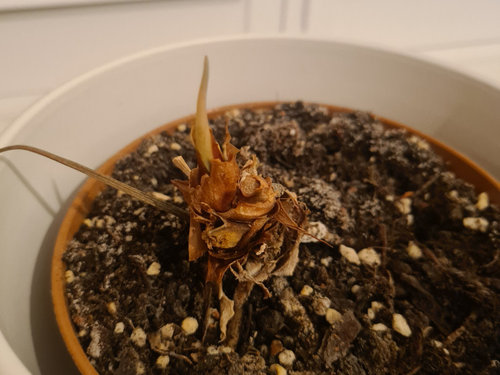
If that pointed appendage is a new sprout, it should recover IF you don't ask it to deal with cultural conditions it's not genetically programmed to tolerate, which is what caused its current state of malaise. There is only one degree of 'dead', from which it cannot be resurrected. If it is not dead, there is a chance it will be able to call on any reserve energy it has to start pushing new leaves and to sustain the new leaves until the new leaves are roughly 75% mature and become net providers of energy as opposed to net users. Bright light, warm temps, and carefully monitored soil moisture levels are the keys to success if it still has a spark of life left. If you haven't fertilized in a long time, it is appropriate to flush the soil thoroughly, remove the excess water from the pot, fertilize immediately, and again remove excess water from the pot. If you intend to follow these instructions, I recommend you use Foliage-Pro 9-3-6 as your 'go to' source of supplemental nutrition. It has all your plants need in a single package. Also, if you intend to follow instructions and want to know how to flush the soil and remove excess water from the medium, just ask. You might also consider monitoring moisture levels deep in the pot by using a wooden "tell".
Using a 'tell'
Over-watering saps vitality and is one of the most common plant assassins, so learning to avoid it is worth the small effort. Plants make and store their own energy source – photosynthate - (sugar/glucose). Functioning roots need energy to drive their metabolic processes, and in order to get it, they use oxygen to burn (oxidize) their food. From this, we can see that terrestrial plants need plenty of air (oxygen) in the soil to drive root function. Many off-the-shelf soils hold too much water and not enough air to support the kind of root health most growers would like to see; and, a healthy root system is a prerequisite to a healthy plant.
Watering in small sips leads to avoid over-watering leads to a residual build-up of dissolved solids (salts) in the soil from tapwater and fertilizer solutions, which limits a plant's ability to absorb water – so watering in sips simply moves us to the other horn of a dilemma. It creates another problem that requires resolution. Better, would be to simply adopt a soil that drains well enough to allow watering to beyond the saturation point, so we're flushing the soil of accumulating dissolved solids whenever we water; this, w/o the plant being forced to pay a tax in the form of reduced vitality, due to prolong periods of soil saturation. Sometimes, though, that's not a course we can immediately steer, which makes controlling how often we water a very important factor.
In many cases, we can judge whether or not a planting needs watering by hefting the pot. This is especially true if the pot is made from light material, like plastic, but doesn't work (as) well when the pot is made from heavier material, like clay, or when the size/weight of the pot precludes grabbing it with one hand to judge its weight and gauge the need for water.
Fingers stuck an inch or two into the soil work ok for shallow pots, but not for deep pots. Deep pots might have 3 or more inches of soil that feels totally dry, while the lower several inches of the soil is 100% saturated. Obviously, the lack of oxygen in the root zone situation can wreak havoc with root health and cause the loss of a very notable measure of your plant's potential. Inexpensive watering meters don't even measure moisture levels, they measure electrical conductivity. Clean the tip and insert it into a cup of distilled water and witness the fact it reads 'DRY'.
One of the most reliable methods of checking a planting's need for water is using a 'tell'. You can use a bamboo skewer in a pinch, but a wooden dowel rod of about 5/16” (75-85mm) would work better. They usually come 48” (120cm) long and can usually be cut in half and serve as a pair. Sharpen all 4 ends in a pencil sharpener and slightly blunt the tip so it's about the diameter of the head on a straight pin. Push the wooden tell deep into the soil. Don't worry, it won't harm the root system. If the plant is quite root-bound, you might need to try several places until you find one where you can push it all the way to the pot's bottom. Leave it a few seconds, then withdraw it and inspect the tip for moisture. For most plantings, withhold water until the tell comes out dry or nearly so. If you see signs of wilting, adjust the interval between waterings so drought stress isn't a recurring issue.
It ain't over til it's over. I recently had a pretty expensive philodendron lose all its leaves. I put the remaining stump in leca and put it in a 7-11 cup on my window sill. I retained about an inch of water at the bottom of the leca. This provided warmth, gentle light, and extra humidity.
After about a month or so, it started pushing out new baby leaves.
I know a lot of other people have success with putting stumps / chonks in sphagnum moss. You can find a lot of good information on youtube if you search for "rehab import plant" or "rehab anthurium"
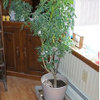
Here's a pic of what it looked like before it decided to drop all its leaves.



tapla (mid-Michigan, USDA z5b-6a)
popmama (Colorado, USDA z5)
Related Professionals
Tulsa Landscape Architects & Landscape Designers · Georgetown Landscape Architects & Landscape Designers · Hagerstown Landscape Contractors · Athens Landscape Contractors · Beckley Landscape Contractors · Akron Landscape Contractors · Springfield Interior Designers & Decorators · Hopkinsville Interior Designers & Decorators · Hannibal Interior Designers & Decorators · Aiken Interior Designers & Decorators · Coldwater Interior Designers & Decorators · Lincoln Interior Designers & Decorators · Keene Interior Designers & Decorators · Medford Interior Designers & Decorators · Victoria Interior Designers & Decoratorstng263Original Author
popmama (Colorado, USDA z5)