Software
Houzz Logo Print
alexis_rojo

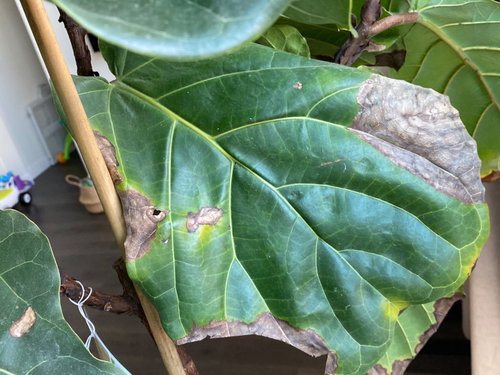
Fiddle Leaf brown yellow leaves

4 years ago
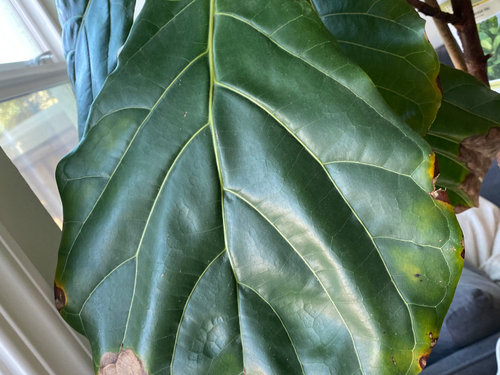
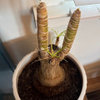
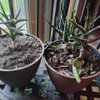
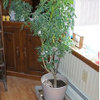
The last month or so i notice my fiddle leaf has an increase of brown and yellow leaves. My guess is becuase i was using water that is soften (my sink water)? does this look consistent to too much acid? anyonr have advice? i water her about every 2 weeks.


Comments (4)

  • 4 years ago
    last modified: 4 years ago

    If you're saying the water you're using for irrigating plants has been routed through an ionic exchange softening system that uses salt as the exchange medium, you need to find another source of water for the plants because water from ionic water softening systems undoubtedly contain phytotoxic (toxic to plants) levels of Na and Cl (sodium and chloride). That has little or nothing to do with the water's pH (acidity/ alkalinity). Also, I can't get a sense of how large/small the plant and container it's in are, but it would be best to start monitoring moisture levels deep in the pot with a wooden "tell" you can make yourself. See more about using a "tell" below. Have you been fertilizing regularly? Supplementing your plants nutrition is an essential part of the care regimen, so just ask for guidance if you think you/ your plants would benefit from it.

    Using a 'tell'

    Over-watering saps vitality and is one of the most common plant assassins, so learning to avoid it is worth the small effort. Plants make and store their own energy source – photosynthate - (sugar/glucose). Functioning roots need energy to drive their metabolic processes, and in order to get it, they use oxygen to burn (oxidize) their food. From this, we can see that terrestrial plants need plenty of air (oxygen) in the soil to drive root function. Many off-the-shelf soils hold too much water and not enough air to support the kind of root health most growers would like to see; and, a healthy root system is a prerequisite to a healthy plant.

    Watering in small sips leads to avoid over-watering leads to a residual build-up of dissolved solids (salts) in the soil from tapwater and fertilizer solutions, which limits a plant's ability to absorb water – so watering in sips simply moves us to the other horn of a dilemma. It creates another problem that requires resolution. Better, would be to simply adopt a soil that drains well enough to allow watering to beyond the saturation point, so we're flushing the soil of accumulating dissolved solids whenever we water; this, w/o the plant being forced to pay a tax in the form of reduced vitality, due to prolong periods of soil saturation. Sometimes, though, that's not a course we can immediately steer, which makes controlling how often we water a very important factor.

    In many cases, we can judge whether or not a planting needs watering by hefting the pot. This is especially true if the pot is made from light material, like plastic, but doesn't work (as) well when the pot is made from heavier material, like clay, or when the size/weight of the pot precludes grabbing it with one hand to judge its weight and gauge the need for water.

    Fingers stuck an inch or two into the soil work ok for shallow pots, but not for deep pots. Deep pots might have 3 or more inches of soil that feels totally dry, while the lower several inches of the soil is 100% saturated. Obviously, the lack of oxygen in the root zone situation can wreak havoc with root health and cause the loss of a very notable measure of your plant's potential. Inexpensive watering meters don't even measure moisture levels, they measure electrical conductivity. Clean the tip and insert it into a cup of distilled water and witness the fact it reads 'DRY'.

    One of the most reliable methods of checking a planting's need for water is using a 'tell'. You can use a bamboo skewer in a pinch, but a wooden dowel rod of about 5/16” (75-85mm) would work better. They usually come 48” (120cm) long and can usually be cut in half and serve as a pair. Sharpen all 4 ends in a pencil sharpener and slightly blunt the tip so it's about the diameter of the head on a straight pin. Push the wooden tell deep into the soil. Don't worry, it won't harm the root system. If the plant is quite root-bound, you might need to try several places until you find one where you can push it all the way to the pot's bottom. Leave it a few seconds, then withdraw it and inspect the tip for moisture. For most plantings, withhold water until the tell comes out dry or nearly so. If you see signs of wilting, adjust the interval between waterings so drought stress isn't a recurring issue.

    Al

    alexis R thanked tapla (mid-Michigan, USDA z5b-6a)
  • 4 years ago

    Thanks Al. very good information. i was using a water meter and realized how inaccurate it was! i will try the tell method you mentioned. it is in a rather large pot, 14”. i usually use water from outside that does not go thru salt. but my two choicer are ”hard” water or water from softening systems. i just hope i can save this plant

  • 4 years ago

    Try using rain water, or snow melt if it snows where you live. In summer, you can use condensate from air conditioners and dehumidifiers to your plant's considerable advantage. If you have the funds and the inclination, you could purchase a small (will make up to 75 gallons per day) reverse osmosis filtration system, which is what I use. It is quick and very easy to install.

    If you happen to have a friend with a R/O water filtration system, they would probably supply you with water enough for plants. It's good that you already know using water coming from an ionic exchange softener is not going to be sustainable from the perspective of your plants, continued viability, and tapping into plumbing prior to supply water reaching the softener is your best bet if you can't access water with a low TDS (total dissolved solids) level.

    If you HAVE used the softened water, I would flush the soil with unsoftened water asap by slowly pouring through the soil a volume of room temp water equal to at least 10x the volume of the pot the plant is in.

    Al

    alexis R thanked tapla (mid-Michigan, USDA z5b-6a)
  • 4 years ago

    al makes a presumption about your softening system.. is it correct???


    if not.. tells us what kind of system you have ... if its a service machine.. call your service company.. and ask them about it all.. and then report back ...


    and it might be a good place to start.. by having your water tested ... then we might have some facts to work with ...


    my system uses salt ONLY to backwash the membrane.. aka filter ... and it is flushed repeatedly before the system goes back online .. if all the salt wasnt removed.. i would have probably have died of hypertension long ago .... my tap water is just fine for my houseplants ...


    i know nothing about al's ION system ... and if his presumption is correct ... then im sure he is spot on ...


    all plants shed leaves .. usually the oldest.. lowest leaves.. and its often related to the low light levels of winter ... your pic only show on leaf .. could we see the whole plant.. including the pot ... are there accumulated salts just above the media????


    is the whole plant affected?? .. if not .. then it might not be a problem solely related to the water...


    why did you guess acid.. do you know something you didnt tell us??? .. i want to make sure you dint lead us down a blind alley by mentioning such .....


    ken