Software
Houzz Logo Print
daninthedirt

holes in philodendron leaves?
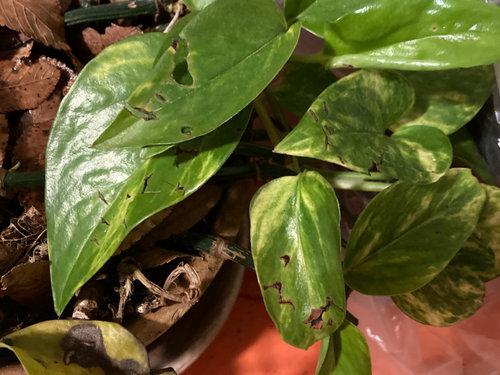
I have a couple of indoor plants that keep developing holes in their leaves. Other phil plants have absolutely none. I keep pulling those leaves off and, as others grow, more end up with holes on those plants. No bugs at all. Am I looking at some kind of philodendron disease? Should I trash those plants entirely that have holes in their leaves? I am very reluctant to get those holey plants anywhere near those that don't have holey leaves. All plants get watered and fertilized in the same way.


Comments (7)

  • 4 years ago
    last modified: 4 years ago

    Other than mechanical injury, there are 2 main causes of what might seem to be idiopathic holes or tears in plant leaves. One cause is low humidity as the leaf unfurls. RH levels on the low side can cause the leaf to stick to itself, causing tears/ holes as it opens/unfurls. The second is imperfectly formed cells in localized areas of the leaf, caused by a Ca deficient. This can be caused by deficient levels of Ca in the grow medium, but more often the deficiency would be culturally induced. Too much water in the grow medium limits Ca uptake. I'm sure you understand how essential it is for Ca to be present in the nutrient streams at all times. When it isn't, cell walls will be imperfectly formed or very weak, which leads to failure of the cell walls and leakage of the cell's contents into the intercellular spaces in tissue, resulting in what appears as holes or tears in leaves. Some other factors that would be considered as contributing to a culturally induced deficiency would be cool temperatures, low light levels, stagnant air movement, soil compaction, severe root congestion, high humidity ......... virtually anything that slows movement of the nutrient stream.

    Al

  • 4 years ago

    Thank you. That's very informative. I'm puzzled because these two plants are a few feet away from other phils that don't have the problem.So humidity, temperature, and mechanical injury (we have cats, but they don't mess with the phils) likely aren't the problem. But they were potted at different times and in somewhat different media, so Ca deficiency is certainly a possibility, as is soil compaction and root congestion. I will work on those. I take it that there is no obvious disease that will do this.

  • 4 years ago

    It doesn't present as being caused by a pathogen. It's not viral or fungal, and, if it was bacterial you would have noticed wet lesions where the holes are now. Also, if it was bacterial, you should see that when the lesions initially appear, they would be inhibited from spreading beyond the boundary formed by leaf veins.

    Is there a chance you're using a medium that wasn't limed with dolomite when it was made?

    If you're going to try to treat this as a Ca deficiency, I think the wisest move would be to correct any suspected cultural issues other than fertilizing. I would avoid trying to supply anything aimed at treating "just a Ca deficiency". Foliage-Pro 9-3-6 has all nutrients normally absorbed by the root pathway in a 3:1:2 ratio; and, it contains Ca and Mg as well. Most synthetic fertilizers lack at least 1 of these nutrients, often both. Flush the soil thoroughly next time it needs water, and fertilize with a production strength dose immediately after. The flush will reset the EC/TDS levels to close to 0, and with the FP 9-3-6 on board you can avoid fretting about nutrient deficiencies unless there is a major pH issue, which you would almost certainly be aware of already.

    Al

  • 4 years ago

    Very good advice. I should say that I'm leaning away from Ca deficiency, since they are potted with an admixture of native soil, which is limestone based. I do occasionally throw some MiracleGro on. But holy moley, when I repotted just now, they were DESPERATELY, HIDEOUSLY, root bound. (Yeah, they hadn't been repotted in maybe a decade. My bad.) So I'm thinking that root congestion might have been the issue. I'll see how they fare in the weeks ahead.

  • 4 years ago

    Just to follow up on this, after repotting, my phils are doing great. Yes, that horrendous root-bounding was the cause of their troubles.

  • 4 years ago

    Good deal!

    An aside: Don't be tempted to think what you're seeing now, in terms of growth rate, is a "growth spurt". It's not, it's normal growth unimpeded by root congestion, and can rightly serve as quantification of how much growth potential was sacrificed to root congestion. Along with that reduction in growth, came a reduction in vitality, eye appeal, and the plants ability to defend itself against insects/ disease, all due to the root congestion. IOW, your plant could have been growing as well as it is now, all along, had it not been limited by the root congestion. That is in no way meant to be critical. It's just meant to shine a different light on that whole "growth spurt" after repotting or potting up thing.

    People get confused about what vigor is. There are many factors that can affect a plant's ability to grow to its genetic potential. Some have mentioned my regular use of the term 'vitality' when I write. It is actually a plant's level of vitality that we hold any sway over, not its vigor. 'Vigor' is constant. Mother Nature provides every plant its own, predetermined level of vigor by programming it into each plant. Vigor is the genetic potential every plant is encoded with, and the measure of vigor is the plant's ability to resist stress and strain. Vitality, in contrast, is variable - a dynamic condition that is the measure of a plant's ability to cope with the hand it's dealt, culturally speaking. A good way to look at the difference between vigor and vitality is to look to genetics for the level of vigor and to things cultural for the plant's vitality. It's up to us to provide the cultural conditions that will ensure our plants' vitality. Vigor and vitality are distinctly different, and a good case could be made that they are unrelated, but there is no need to delve deeper into that point. A plant can be very vigorous and still be dying because of poor vitality. Far more often than not the term 'vigor' or 'vigorous' is misapplied, where in their stead the terms 'vital' or 'vitality' would have been more appropriate. Reduced vitality is what we witness when our plants are growing under stress or strain due to the fact they are being asked to grow close to or beyond the limits they're genetically programmed to tolerate.

    Al

Sponsored
Miller Woodworks
Average rating: 5 out of 5 stars23 Reviews
Franklin County's Trusted Custom Cabinetry Solutions