Software
Houzz Logo Print
chris_mara61

Fiddle Leaf Tree Pruning Advice

4 years ago
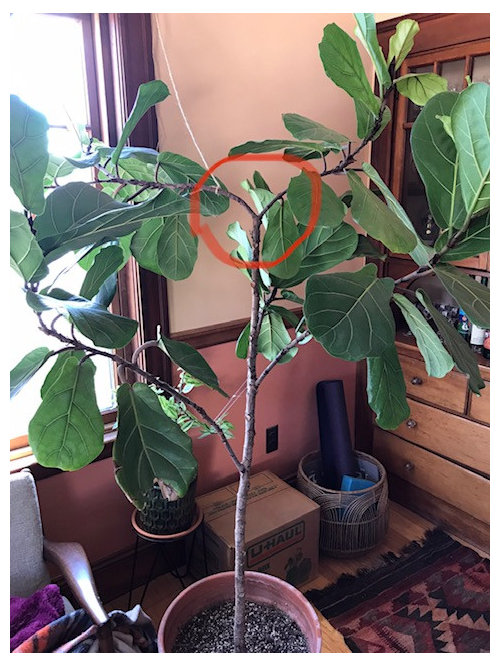
I’ve been facing the issue of how to prune my fiddle leaf tree for awhile. During a growth spurt last year (after some hard times) it grew two branches at the top of the trunk that split evenly into a “V” shape. I was hoping that the trunk would find a way to continue to grow vertically but it never happened. Do I have to remove both of these branches? Can I only chop one? My instinct is to cut the trunk below the two branches and just deal with it looking bad for 6 months. Any advice is appreciated!!


Comments (2)

  • 4 years ago

    Where you live is an essential piece of information if you're looking for advice tailored to your specific situation. I'll assume you're living in the Northern Hemisphere and not within 20* (latitude) from the equator. Here are the steps I wold take to improve your plant's level of vitality and what I would do to cut it back to something you can build on in terms of the plant's shape:

    Step 1) Flush the soil thoroughly by slowly pouring through the soil a volume of water equal to at least 10X the volume of the pot the plant is in. This will reset the fertility level of the soil solution as close to 0 as possible.

    2) Immediately after flushing the soil, fertilize with a production strength solution of Foliage-Pro 9-3-6 fertilizer. This fertilizer will serve you well as a complete nutritional supplementation program as a single source; and it provides several other notable advantages as well.

    3) Get in the habit of flushing the soil each time you water and checking the moisture level of the soil deep in the pot through use of a 'tell', which will allow you to determine what the appropriate intervals between waterings are. This is important as over or under-watering can be very limiting. See below for more about making/using a 'tell'.

    4) Move the plant outdoors as soon as night temps are reliably above 55*; or; move the tree in and out to take advantage of the added light and temps above 55* and protecting it from colder temperatures. The added light and air movement will cause the plant to respond with more growth and and improve its o/a level of vitality. In turn, the boost in it's metabolic rate will a) increase the enthusiasm with which the plant responds to the pruning I'm about to describe, and b) decrease the amount of time it takes to recover from the pruning (and the repot if it needs one)

    5) Assuming again you live in the Northern Hemisphere, I would plan on pruning the plant around Father's Day or the Summer Solstice (21 June). The pruning would go like this a) prune all primary and secondary branches back to 2 leaves, so every branch will have 2 leaves left on it.

    This ficus cutting ^^^ has been cut back to 2 leaves. Notice the new BRANCHES that are forming in the leaf axil (crotch). If your tree is healthy and growing well when you cut it back, the same thing should happen to your tree. During the remainder of the summer, when the 3rd leaf on any branch Is starting to open, prune that branch back to 2 leaves. When you follow this habit of pinching, it rapidly increases the fullness and ramification (branch and leaf density) of the tree. Follow the pinching schedule to about mid-Sep, then stip pinching and just allow the tree to grow all winter. Next June, you'll be able to identify the winter growth because internodes (distance between the leaves) will be very long. All winter growth should be cut back (every June) to the previous summer's growth. This ensures that only the tightest growth and shortest internodes remain as part of the composition.

    6) When it's time to do the pruning (June), lift the plant from the pot. If the root/soil mass comes out intact (doesn't fall apart), the plant will benefit from repotting, which consists of bare-rooting, root pruning, and a change of existing soil to fresh soil; and, hopefully it will be a medium that allows you to flush the soil at will w/o you needing top worry the soil will re,main saturated for a n interval long enough that it conspicuously limits root function, or worse, wreaks havoc of root health. What you choose as a grow medium has much influence over what kind of opportunity you'll be able to offer your plants to realize as much of their genetic potential as possible. An inappropriate grow medium can rob your plant of more than 90% of its potential in terms of growth rate, vitality level, eye appeal, and yields where applicable, so it's worth getting right.

    Using a 'tell'

    Over-watering saps vitality and is one of the most common plant assassins, so learning to avoid it is worth the small effort. Plants make and store their own energy source – photosynthate - (sugar/glucose). Functioning roots need energy to drive their metabolic processes, and in order to get it, they use oxygen to burn (oxidize) their food. From this, we can see that terrestrial plants need plenty of air (oxygen) in the soil to drive root function. Many off-the-shelf soils hold too much water and not enough air to support the kind of root health most growers would like to see; and, a healthy root system is a prerequisite to a healthy plant.

    Watering in small sips leads to avoid over-watering leads to a residual build-up of dissolved solids (salts) in the soil from tapwater and fertilizer solutions, which limits a plant's ability to absorb water – so watering in sips simply moves us to the other horn of a dilemma. It creates another problem that requires resolution. Better, would be to simply adopt a soil that drains well enough to allow watering to beyond the saturation point, so we're flushing the soil of accumulating dissolved solids whenever we water; this, w/o the plant being forced to pay a tax in the form of reduced vitality, due to prolong periods of soil saturation. Sometimes, though, that's not a course we can immediately steer, which makes controlling how often we water a very important factor.

    In many cases, we can judge whether or not a planting needs watering by hefting the pot. This is especially true if the pot is made from light material, like plastic, but doesn't work (as) well when the pot is made from heavier material, like clay, or when the size/weight of the pot precludes grabbing it with one hand to judge its weight and gauge the need for water.

    Fingers stuck an inch or two into the soil work ok for shallow pots, but not for deep pots. Deep pots might have 3 or more inches of soil that feels totally dry, while the lower several inches of the soil is 100% saturated. Obviously, the lack of oxygen in the root zone situation can wreak havoc with root health and cause the loss of a very notable measure of your plant's potential. Inexpensive watering meters don't even measure moisture levels, they measure electrical conductivity. Clean the tip and insert it into a cup of distilled water and witness the fact it reads 'DRY'.

    One of the most reliable methods of checking a planting's need for water is using a 'tell'. You can use a bamboo skewer in a pinch, but a wooden dowel rod of about 5/16” (75-85mm) would work better. They usually come 48” (120cm) long and can usually be cut in half and serve as a pair. Sharpen all 4 ends in a pencil sharpener and slightly blunt the tip so it's about the diameter of the head on a straight pin. Push the wooden tell deep into the soil. Don't worry, it won't harm the root system. If the plant is quite root-bound, you might need to try several places until you find one where you can push it all the way to the pot's bottom. Leave it a few seconds, then withdraw it and inspect the tip for moisture. For most plantings, withhold water until the tell comes out dry or nearly so. If you see signs of wilting, adjust the interval between waterings so drought stress isn't a recurring issue.

    ..... questions or concerns?

    Al

    Chris Mara thanked tapla (mid-Michigan, USDA z5b-6a)
  • 4 years ago

    Wow, incredible. Ill give this another read tonight, and switch up my fertilizer. Ive done a few of these things (flushing the soil, dowel for checking moisture) but not to the extent that youre explaining. I really appreciate you taking the time to explain everything.