Software
Houzz Logo Print
kendrahhendra

Top spoil and compost?

4 years ago
last modified: 4 years ago
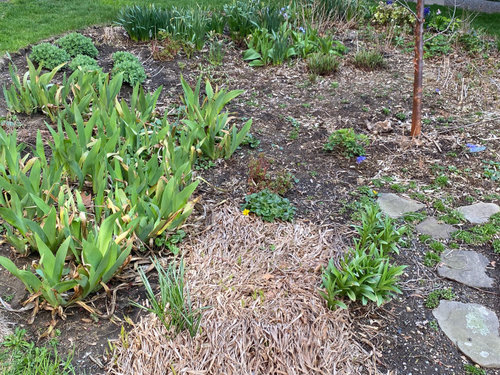
I have joined a garden group and been assigned to help tend to this already established area. Others in the group keep pushing me to order top soil and compost for this garden. (They will pay for it.) Maybe I am just a lazy gardener, but I have never used top soil and compost on a yearly basis in an already established perennial garden.

When or why would this need more top spoil and compost? This is on a very windy hillside. Does that have something to do with it? What would you do?


Comments (69)

  • 4 years ago

    In the first pic to the left of the irises is what looks like a spent mound of scraggle grasses. Do you think this is something I can just cut back and new growth will come?


    Again, thank you all for the education and variety of responses, which actually point in much the same direction. Not sure where the North Carolina location got into this thread. I live in New York City, which makes it even more so special to be able to tend a garden this large in Manhattan.

  • 4 years ago
    last modified: 4 years ago
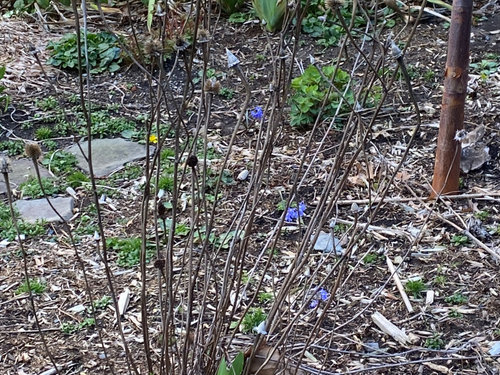
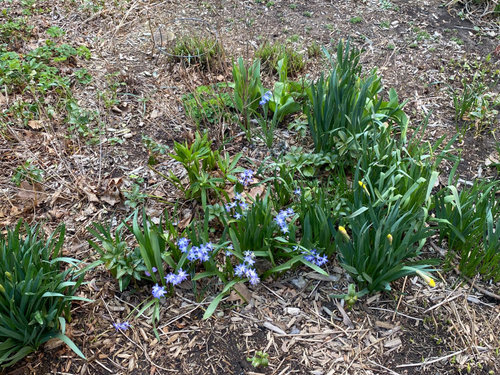
    While you’re looking at the plants, note that you have Lesser Celandine all over the bed. This is considered an invasive species in many parts of the US, including NY. http://nyis.info/invasive_species/lesser-celandine/ 

    Can you post a close up of the ‘scraggle grass’ so we can id it for you?

  • 4 years ago

    My bad. For some reason I thought you were in NC.

  • 4 years ago

    It's fun and informative to take photos of a plot throughout the growing season. If I did that, for instance, I wouldn't dig into my late-appearing platycodon every year.

    If they show you some appreciation, you could even make a chart.

    Kendrah thanked annpat
  • 4 years ago

    Floral-UK - You beat them to it. I got an emergency email a few hours ago. I was afraid the world was coming to an end or perhaps we had another subway shooting, but in fact with was notification of what you had realized - lesser celendine invasion. Thanks for pointing it out.


    I friend suggested getting a soil sample tested through an univerity extension program - $13, to see what if any nutrients are missing from the soil. This sounds smart to me instead of just throwing various organic matter at it without knowing what is what. Has anyone here soil tested a perrenial garden before? Was it useful?


    I'll take a close up of the scraggle grass early next week. Traveling for Passover tomorrow. Thanks all for your support!

  • 4 years ago
    last modified: 4 years ago
    Yes, you can give whatever the scraggle grasses are next to the iris a haircut and if it is a perennial, most likely, it will grow back just fine.

    An online tussle between the compost people and the mulch people is just a small peek behind the genteel veneer gardeners like to present. Everybody has their own special recipe.

    A NYC public garden is going to have its own unique challenges. Getting mulch delivered would be one of them. I'm a mulch person. It's just younger compost. Since I live in the forest, leaf compost would be redundant.

  • 4 years ago

    I've gotten soil tests for my yard on several occasions. Never for my garden. The garden would be challenging because it's always a mix of soil/compost/osmocote/decayed mulch. So, it's not easy to get a sample that's representative of your entire garden. At least I know my native soil is pretty good. Just needs lime from time to time to keep the ph up.

  • 4 years ago

    "A NYC public garden is going to have its own unique challenges. Getting mulch delivered would be one of them."


    It is actually on private property and the group has mulch, compost, and top soil delivered with a space for storage. I'm telling you, this is such a rare opportunity to be involved with in the middle of the city that I'm determined to stick it out despite the snooty-pants gardeners.


    I'll investigate the scraggle grasses when I return from the holiday weekend and report back.

  • 4 years ago
    last modified: 4 years ago

    That scraggly grass is already growing. See all the green shoots coming through?

    Chris, you missed the point. I can tell from your post that you can't define 'mulch'.

    None of us in the Compost Mulch Camp care a fig what people use on their own gardens. (Well, I do, because I don't like seeing unnatural-looking, commercial mulches everywhere I go. But that's just me.) What we do care about---especially here on the Soil, Compost and Mulch forum---is that people understand that commercial wood garden product manufacturers hijacked the term 'Mulch' and have almost succeeded in making it eponymous. But not on my watch!

    When I use the term 'mulch', which I dig from my 'mulch pile', I can guarantee you that I'm not talking about the same sawmill by-product that you're talking about. All we're asking is that people specify which mulch they're using, because it makes a world of difference in how a garden is tended. Anytime someone uses the term 'mulch' without specifying, I'm going to ask what they mean, just to keep dumbing-down from happening on a forum devoted to mulch, compost and soil-building.

    Oh, this was shared to the landscape forum, too? Now, that makes sense.

  • 4 years ago

    @Kendrah - within reason you can go ahead and add organic matter as a mulch (i.e. on top) without worrying about getting the soil test first. Organic matter is helpful and while it has nutrients, not in such concentrations that it will seriously skew the test or what's needed in the short term (over the long term, will have some impact). Test the soil, not the mulch. "Within reason" - not 18 inches on top, not dug in so that the newly-added organic matter is half the soil 12 inches deep, not huge amounts exclusively of 'rich' materials (eg fresh manure with lots of urine in it).

    My analogy is that organic material as a mulch is a bit like 'roughage' in the diet - it's not directly about the nutrients.

  • 4 years ago

    Have at it annpat. I don't have the energy to type out all the nuances of this regionally diverse horticultural conundrum of countless special recipes.

    As a landscaper, mulch is large size plant parts. Texture and source can vary widely.

    Compost is decomposed plant parts in fine particle size.

    Gravel and what not is a separate category. Gravel.

    Top soil is still mostly a unicorn.

  • 4 years ago
    last modified: 4 years ago

    Chris, I was responding to this quote of yours:

    "I'm a mulch person. It's just younger compost. Since I live in the forest, leaf compost would be redundant."

    You're a "mulch person"? What does that mean to you?


    I hope my tone isn't too confrontational; it comes from years of frustration. I'm okay with people on the Landscape forum not understanding mulch or compost, because they can come here to get accurate information, which is why we proud mulchers have to set the facts straight.

  • 4 years ago
    last modified: 4 years ago

    What is important here is the understanding that "mulch" is not any single product. It is ANY material applied to the surface of the soil for a variety of reasons. Mulch can be organic or inorganic.......rocks, gravel, grass clippings, leaves, bark, wood chips, sawdust, compost, manure, ground up tires, carpet remnants are all common mulches. There are even such things as green or living mulches.

    It would be great if we could all go back to the origins of the term when it was only a verb describing the activity of applying any of these products to the surface of the soil but that ship sailed a long time ago :-) So for the benefit of all, when using the term 'mulch' as a noun, please be specific about what you mean.....cuz it could be just about anything!!

  • 4 years ago

    I thought my definition of mulch versus compost was quite clear. What you do with them is not part of the definition which is the opposite of gardengal's stance.

  • 4 years ago

    "I thought my definition of mulch versus compost was quite clear."

    Your definition is clear....just not accurate :-) It is what it is and has nothing to do with opinions or "stances". Pretty darn easy to find scads of evidence for this. btw, the usage is KEY to the definition!!

  • 4 years ago

    Language is not static. Meanings do change. I may never be willing to call old carpet mulch.

    ".rocks, gravel, grass clippings, leaves, bark, wood chips, sawdust, compost, manure, ground up tires, carpet remnants are all common mulches." You left out landscape fabric.

    For me, the different properties and results from all of these is key to the definition and why I would break them down into further more specific categories not known as mulch.

    At least we can all agree that the specific ingredient of top dressing used is important.

  • 4 years ago
    last modified: 4 years ago

    Chris, not to patronize you, but it's a common confusion, which is why after several people sounded vague about mulch, it seemed like a good time to clarify the subject. You're also a little confused about compost. Compost is not just a breaking down of a thing. Wood chips, after they break down, do not become compost. Leaves do not become compost. They become leaf mould. Compost is a stage when a mixture of ingredients breaks down.

    For some reason, I can't make my language not sound insulting tonight, but that's not my intent. Anybody who gardens* is fine by me.

  • 4 years ago

    Annpat, all I can tell you is I use the language my clients understand.

    One of the main ingredients of compost is forest products as in woodchips. It's right there on the label on the bag.

  • 4 years ago
    last modified: 4 years ago

    Just because your clients don't know their stuff doesn't mean you shouldn't.

    Whoops. I did it again.

    The compost you buy contains wood chips. Yes, as part of a mixture.

    But if you were to buy a bag of straight wood chips, it would not be labeled 'compost'.


  • PRO
    4 years ago
    last modified: 4 years ago

    Hey all folks... I know everyone chipping in has a lot of good and valid points.... but our going from discussing to arguing about it like this might be kind of akin to the kind of behavior that is off-putting the OP from asking those ladies for help. A bit too many pros over the newbies head- only here we aren't leaving the OP out with all of this, right?

    Don't get me wrong, it's awesome we are offering good advice here. And some of it might really be helpful to the OP as they start to write up ordering for garden dressings after the weekend.

    It might be more helpful to the OP situation if folks didn't leave a huge weekend worth of debate of what is/isn't mulch to work through.

    Though I really do think a frank and open debate topic opened in the S,C,M, and LD, and also veggie gardening would be a great third topic choice for the excellent current debate going on on.

  • 4 years ago

    Annpat, it is the clients who know their stuff and have all these potions and special recipes for every garden problem that make me the most crazy. Those are often the very same people with the most troubles in their gardens, Doctoring their poor plants to death.

  • 4 years ago
    last modified: 4 years ago

    It's not a debate. We're talking facts. No one's arguing. It's an important distinction that should be clarified every single time it comes up. Because it matters. And we have people here who want to learn how to grow stuff.

    And, beesneeds, the OP question was exactly what we are addressing. She wants to know about topdressing a garden.

  • 4 years ago

    "You left out landscape fabric."

    No I didn't :-) Landscape or weed fabric is rarely ever used as a mulch or topdressing. Used under a mulch, yes. But as the sole covering of the soil??.....almost never! And for sure never in my decades of experience.

  • 4 years ago

    That, Chris, I could not agree more with. That, and people who think that every insect and every spot on a plant needs to be addressed.

  • 4 years ago

    Compost source for people in the Northern VA, DC, MD area: Veterans Compost. $25/month for a bin that they deliver, pick up, and replace every week. Only food scraps (includes turkey, chicken carcasses). They also give you a small bag of compost free every spring. I usually get a bulk delivery which I use to 'mulch' my beds in the front yard. May expand that order and extend to part of the back yard as well this year no that I have a brand new knee and might be able to haul it more easily! Anyway, someone asked about where to get it, so thought I would share. Apparently, they have contracts with restaurants and schools in the area, too. It is lovely compost.

  • 4 years ago

    IMO, unless stated otherwise, mulch is made up of some sort of shredded wood. Compost is decayed organic matter. Go to any big box store, mulch is made up of a shredded wood product. Compost is pretty much black looking dirt. The only exception is rubber mulch which states rubber mulch on the bag. And not simply mulch to distinguish itself from the wood product. I worked landscaping for several years when I was a teenager, every time we mulched a yard, it was a shredded wood product. Never anything else. Every web site I've looked at that does bulk delivery. Mulch is a shredded wood product. Compost is black dirt.


    cy427, thanks for the info. Might look into it. Do you have to sign a contract for a period of time? Because I don't think I need a steady supply. Maybe 1 or 2 deliveries a year.

  • 4 years ago

    I guess if one's experience with mulch products is limited to bagged stuff from home improvement or box stores, it is not entirely surprising that one would assume ALL mulch was a shredded wood/bark product. It's cheap and readily available and stores indefinitely. But personal opinions aside, the definition of mulch is clear and NOT limited to wood products.

    Bulk soil purveyors tend to have broader offerings and typically sell a number of mulch products created from a variety of ingredients. The four most popular bulk mulch products in my area are ALL compost based:

    Pacific Garden Mulch - "A dark, recycled material made from composted yard and garden waste. As an amendment, adds nutrient elements and water retention properties to the soil. Makes an excellent ground cover, providing color contrast to landscape plantings."

    Fertil-Mulch - A composted mixture of cow manure, horse manure and sawdust.

    Oly Fish Compost - A 2 year old product that is a blend of hardwoods and the offput of the commercial fishing industry.

    Cedar Grove Landscape Mulch - Recycled yard waste and aged forest products. (Cedar Grove may be the largest yard waste recycling company in the US)

    Clearly, there is a whole mulch world out there beyond just bark!!

  • 4 years ago

    The bottom line of this semantic conundrum being it is perfectly acceptable to use compost as a mulch.

  • 4 years ago

    I never stated all mulch is a shredded wood/bark product. What I wrote is almost everyone will assume it is unless stated differently. And all my mulch experience isn't with bagged mulch from big box stores. I've purchased and spread bulk mulch many times.

  • 4 years ago

    I used old carpet under my leaf corrals last fall, hoping the tree roots wouldn't come up into the leaf compost quite so fast, plus it might be easier to scrape up the compost with the tractor bucket without digging into the soil, and because I had some carpet left over from lining a new piece of driveway before putting down gravel


    So, tongue firmly in cheek, I ask all of you: Is that considered mulch, compost, or landscape carpeting?


    :-D

  • 4 years ago

    Astroturf.

    tj

  • 4 years ago

    Did you buy carpet to go under your gravel driveway or was that leftover? I have a canvas tarp covering part of my garden, which I consider a mulch "layer".

  • 4 years ago

    This piece from the RHS clearly defines and explains mulches and mulching. https://www.rhs.org.uk/soil-composts-mulches/mulch It’s not complicated.


    And yes, carpet can be a mulch, albeit an undesirable one.

  • 4 years ago

    Tox - I have a stack of pool table slate about 2x4 feet ea. If I put that under a raised bed:


    Is that; "So, tongue firmly in cheek, I ask all of you: Is that considered mulch, compost, or landscape carpeting?" oops pool table slate not carpeting?

  • 4 years ago
    last modified: 4 years ago

    Poor annpat. A gardening term was hijacked. You have just bumped into a landscaper who is a gardener. I've been planting private gardens from scratch for the last 35 years. My special recipe is the plant has to live with the soil that's there. That isn't a hinderance to a having a good garden.

    Come see my garden Outsideclyde. See how I do things in the wild. No compost or much mulch to speak off is involved at all.

  • 4 years ago

    @John D Zn6a PIT Pa, I'd call that a base.

  • 4 years ago

    I would think with the inch thick slate the tree roots would work in.

  • PRO
    4 years ago

    Heheheeh, I have a couple bits of carpet in the garden. Kills the eff out of what's under it, as it's intended to. Messy as hell sometimes, but gets the job done over a season or two. Only use them as something to stand on rather than something for under leaves- that might be kinda gross, lol. Old carpet more formally gets used in the gardens as drag flaps on the lawn tractor for grooming the trails out back. I think the term landscape carpet rather cheeky, I kind of like it :)

    I think if it was a raised bed on slate that might be considered a vole-proof raised bed or perhaps more into the realms of container gardening on open bottom to hard surface sorts of senarios.


    Though wind the fun back up a second and back to the OP. Those beds they have do need some edging. Perhaps some stone tiles would look nice for that. Probably not 2x4 pool table slate. But maybe something akin to or complemenary with the footpath stones already there?

  • 4 years ago

    My bathroom sink surround is made from pool table slate, John.


    Chris, I agree some people garden intuitively with great success; perhaps that's you.

    I live in the woods, too, if that's what you mean by "wild". My yard is not mowed, for instance. I do try to grow more and more native plants, but if I were not to amend my gardens, I'd be somewhat limited in what I could grow well for non-natives. I don't alter my garden ph much; I spread wood ash around plants that like it a little less acid---my beet and onion rows, for example. I mostly need weed control, and if the weed-suffocating mulch also feeds my garden, and improves its texture and tilth, I'm especially happy.


    I'm off to see your garden.


  • 4 years ago

    Very nice. Your land is lovely.

  • 4 years ago

    Go to any big box store, mulch is made up of a shredded wood product. Compost is pretty much black looking dirt. The only exception is rubber mulch which states rubber mulch on the bag.


    Hmm... by this reasoning, I could put my old clothes into a big bag, print, 'NEW CLOTHES OF THE LATEST FASHION AND PERFECT FIT' on the box and *voila* I'd have something half way decent to wear even though I hate shopping.

  • 4 years ago

    No. That would be a lie. A better analogy would be if you went to a restaurant, ordered a burger with fries. And received a burger with fried squash. You didn't explicitly state you wanted fried potato, even though that's what everyone would expect.

  • 4 years ago
    last modified: 4 years ago

    Here's a better analogy. There's a rock on a nearby lake called Junk of Pork. The rock has always been called that because it resembles a piece of salted pork that sailors used to carry with them on long ocean journeys to season their food. The sailors called those hunks of salt pork 'junk'---unrelated to our understanding of the word 'junk'. There's also a Junk of Pork in the ocean off the coast of Maine and there's a Junk of Pork off England. I would guess that 50 % of the people who jump off Junk in the summer now call it Chunk---Chunk of Pork. If you correct them, and I do, they'll say, "Junk?!! What's that? That makes no sense! It's Chunk of Pork. My father's had a camp here since the 70s and that's what he's always called it."

    I do not reply that a lack of curiousity, and a contentment to dwell in an unnuanced world can be genetic. By not acknowledging the world of mulch, you're contributing to the squelching of some very ancient, successful, methods in gardening

    And when Shakespeare spoke of 'mulch', he was not talking about a product he or the local sawmill ran through a chipper.

  • 4 years ago

    Oh, do tell, what was the Bard referring to?


    To answer an earlier question, no I didn't buy new carpet only to bury it in gravel. Neighbor redid their carpet and put out all these nice rolls 4 ft long. I filled my pickup truck. It is my mission in life to stand between people and the landfill, and intercept their stuff to give it additional lives. I am currently working on a scheme to retrieve a number of bowling balls from a Superfund site to make a very large pendulum. But that's another thread.


  • 4 years ago

    I would imagine the Bard was referring to compost. Decay would have been a relevant topic back then.

  • 4 years ago

    @toxcrusadr, Just a word of warning about using old carpet in the garden. The previous occupant of my house used carpet as mulch. When we moved in, it was starting to break down, and the sodden, mildewy mess had to be disposed of. 25 years down the line, I am still finding loops of carpet fibers in my garden. I use old pieces of plywood or multiple layers of cardboard under my compost

  • 4 years ago

    Kidhorn, no contract for the compost service. Mostly, you are supporting vets with a $25/month fee to pick up your food waste (no flowers, yard waste since they can't guarantee pesticide-free in those cases). They automatically give you one small bag as a thank you every spring. If you want a bulk order or multiple bags, you would contact Fritz and he will set up delivery. This year, I am just not sure where to have them dump the load. Usually, I get 3 yds. I will link the website. It will have all the info. Everyone who works there is just so nice. I think they love working there and I so appreciate that this is available to me. Ooh, I see they are offering even more now including a plant sale. Uhoh, I am in trouble.

    veteran compost

  • 4 years ago

    @NHBabs: Point taken. So far it's ONLY gone under two large leaf corrals, and under about 75 ft of gravel driveway. I normally don't use synthetic stuff in my gardens, and I can imagine the hassle and ick factor of soil filled with bits of carpet fibers. I will probably end up pulling it out before too many seasons, especially if (when) it starts to fall apart.


    It will hopefully help the gravel not sink into the clay/mud so fast when it's driven on, which makes driveways around here a constant gravel sink unless you put something like landscape fabric down. I came across the carpet idea on a thread about driveways where a guy said his old man neighbor suggested it when he bought a place in the country, and it worked like a charm.

  • 4 years ago
    last modified: 4 years ago

    Kendrah, what's your (the group's) vision for this garden? Often a garden, including mine, has some boring stuff that was "gifted", because it grew (spread) so well in the donor's garden. I've got some really pedestrian day lilies that don't add a thing to my garden---gifts from an aunt. Your group might first decide what adds nothing to your vision. Is there a ground cover in that bed? Do you want it? If there's anything on an invasive list, as Flora noted, you'd want that gone. Part of the problem with invasives is that people admire them---they're often pretty---and, then, they decide they want them, too. You don't want to inadvertantly promote bad stuff.

    You've got some ehinachea, and some poppies near them, I think. The echinachea area looks ready for an application of whatever mulch you decide on.

    Last year, looking around at some real losers I've planted over the years, I decided to check out plants that won accolades---Perennials of the Year---in both the U.S. and the U.K. Everyone here probably alreadys knows Aralia cordata 'Sun King' (Perennial of the Year 2020), but I didn't, and it's going to work well, I hope, to brighten a shady corner of my garden. I splurged on several others on those lists, but your group could purchase one annually, if the budget allows, after researching them together.