Software
Houzz Logo Print
melissaaipapa

(OT) Plant passions through the seasons

Henry Mitchell wrote about this: the tendency to get fixated on a certain class of plants when they're in their season of beauty, then pass on to the next passion once the object of desire's flowering is over. I certainly do this. Which plants draw a gardener into the vortex depends on the gardener's tastes and what she/he can grow. In late winter I go through a period of violet desire, partly because there's not much else going on then, partly because our sweet violets offer considerable variety and are totally adorable. Along with violets I moon over the woodland floor wildflowers: primroses, hepaticas, dogtooth violet (Erythronium dens-canis). After this, with any encouragement at all, I fall into daffodils. These I historically have difficulty with; all the same, this year there was quite a bit to look at, puzzle over, and construct future dreams around. Daffodil season is currently drawing to an end: just in time for peonies. I've been keeping an eye on my colony of 'Mollis', which I was afraid might have been ravaged by last year's nasty summer--it wasn't--and noting with satisfaction the sprouting of various Officinalis cultivars and the plants, mostly Lactifloras, emerging in the Peony Walk and other places. I saw my first bloom today! Actually, no: it was a day or two ago my splendid tree peony from seed opened its vast and delicate flowers. And I'm wrong again, because the white tree peony out in the garden has already come and gone. I'm going to watch whether it sets seed. The seedling grown tree peony looks a lot like its parent, only tending more to pink than to lavender: both are semi-double and handsomely marked with purple flares. Tree peonies have gotten so expensive, and methods of presenting them for sale so murderous to the plants, that I'm wondering if I ought not to try growing more from seed. I'm not good at this, but, patience: the garden needs more of these wonderful shrubs. The peony that opened today, instead, was, I think, 'Red Charm', a Lactiflora-Officinalis cross, and it certainly lived up to its name, being very red and very charming. I have the Mediterranean peonies on my mind: my P. peregrina has never set seed, but what if I got a different cultivar? There are a couple of varieties pretty widely available in commerce: 'Otto Froebel' and 'Fire King', I believe. P. peregrina is the most brilliant scarlet conceivable, and babies would certainly be pleasant. The Lactifloras come a little later: once they begin to bloom, I'll begin obsessing over them.

I could go batty for irises, but the porcupine eats them all. Well...most of them. So I don't commit to irises. The first wave of rose bloom is beginning. I can see the double yellow Lady Banks quite well in the top of the still-leafless flowering ash, its canes gracefully waving; and 'Mme. Alfred Carriere' and 'Mrs. B.R. Cant' are growing and flowering wonderfully on their pergola. How they can produce such large, shapely blooms with as little water as they've had since late last summer is beyond me, but they achieve it somehow.

Comments (14)

  • 4 years ago

    Melissa - it is always a joy to read your notes/stories about your garden. I also do have some favorite plants in addition to roses. Most of them are plants I did not plant, but which were "inherited from the ancestors", and were here when we moved in. One of my favorite is a medium tall bearded iris called "Crimson King". (it is dark purple, but does I guess have a slight cast towards red). It was introduced in 1893, and in our climate starts blooming in the wintertime - Jan/Feb. Then various plants of it keep taking turns blooming - we have a lot still blooming now in April, and it usually continues through May. When we moved in 32 years ago the surviving plants of it were all sitting in deep shade - no blooms. My FIL told me how to dig them up, and how to plant them, and suggested that I move them into the sun. So I did, all over the garden, and they are still happily growing and blooming, and of course need digging up and dividing sometimes. I have given them to all of our relatives on my DH's side, with the explanation that they are family heirlooms.


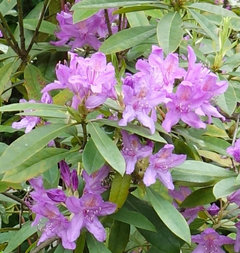
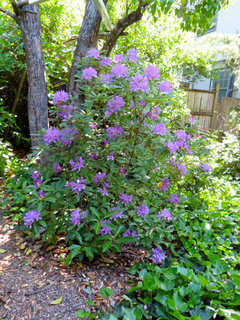
    There is a very old fashioned rhododendron which is also an heirloom. It has delicate, elegant blooms, not the huge ones of modern rhododendrons. I tried to find an ID on the rhododendron forum, but all I got was a fairly dismissive "probably root stock". Ha! From what I know about rose rootstock, that only means it is a very old cultivar, which I already knew. Here is a pic of it:


    Jackie

  • 4 years ago

    Sheila, thanks. We have hares, too, (though, oddly, no wild rabbits that I know of) and I like them very much and am glad to see them, even in the garden. I close my mind to the possibility that they might be damaging plants.

    Jackie, gardens do need to be about so much more than one class of plant, at least, for my taste. A community of plants, each with its personality, history, and role. I'm personally ready to love modest plants, having a low-voltage kind of temperament in any case. Acidophile plants have no place at my place, unfortunately, but then we're so lucky in many ways as to the variety of plants we can grow..

    It's clear from the amount of my post that was dedicated to peonies that they're the current obsession. A couple of weeks ago it would have been narcissus. (I'm also very much enjoying the roses, but they're just there, not requiring any effort.) Can you grow them? I was wondering about gardeners in U.S. Mediterranean climates that get too little winter chill for temperate climate plants, and whether they could grow the Mediterranean peonies: the Officinalis cultivars, and relatives such as 'Mollis' and the forms of Paeonia peregrina, and hybrids. Though I suppose area nurseries thought of that a long time ago and supply these peonies if they can be grown in warmer areas.

    Just a postscript about my original post: I wasn't clear about P. peregrina and why I wanted to have two varieties: I was wondering whether plants aren't self-sterile, and that might be why mine has never set seed (that I've noticed). This places me under the necessity of buying two plants of two different varieties, since I don't know which cultivar it is I'm growing now. Oh, the woe....


  • 4 years ago

    Peonies - I have not done much research, but every peony I have seen advertised says it would not be happy in our climate. However, there was one at my MIL's house 4-5 blocks away from here which grew and came up every year happily for at least 30 years. There is another one in a garden down the street from us which has been there at least that long also. I will have to look into those Mediterranean ones you mentioned.


    That happens a lot around here (the "experts" announcing that some plant or other cannot be grown here - they have even done that with some plants like Valerian, which have naturalized here, and are all over! I have learned that the only way to find out is to try.


    Jackie

  • 4 years ago

    Jackie, that's interesting: I wonder what peonies they were. After all, we do get winter chill here, so I can't say how our Mediterranean peonies would do without it. But there are species and varieties that I'm not personally acquainted with that are relatively tender, though I believe rare in commerce.

    The commonest Mediterranean peony in commerce is P. officinalis 'Rubra Plena', an herbaceous (all this group are) peony which, as the name says, is very red and very full. It's pretty widely available, I believe also in the U.S. and is a handsome and bombproof plant. I see it growing around town here.

  • 4 years ago
    last modified: 4 years ago

    A wonderful post, @Melissa Northern Italy zone 8! I think you are gardening at the heart of the matter—diverse, seasonal plants!!

    Honestly, this is why once-blooming roses are fine with me. I enjoy the seasonal anticipation and appreciation. I pay closer attention to each one. Prior to my roses, there are, as you praised, the harbinger of spring itself—narcissus…and there are also hellebores, lilacs, sweet woodruff, violets, forget me nots, etc. And there is Rosa banksiae. Blooming alongside the late spring-early summer non remontant roses, there are clematis, honeysuckle, peonies, daylilies and irises. And afterwards there are hydrangeas, more daylilies, more clematis, more honeysuckle and then phlox, hibiscus, fireweed, sunflowers and more daylilies. My latest season bloomer is my tea camellia in November. I cherish its waxy and very fragrant nodding blooms just before the winter!

    @jacqueline9CA you might check out Old House Gardens. It carries heirloom plants on a rotating basis and often sells peonies, narcissus and other classics for warm-hot climates. I know I’ve seen a couple of peonies “for the south”. I believe that OHG offers the peony Melissa mentioned, P. officinalis 'Rubra Plena'. Link below.

    @Sheila z8a Rogue Valley OR I had no idea that hares like irises! Do you know if it is particular kinds, like siberia or germanica, or is it irises in general?

    Carol


    Old House Gardens Link

    Melissa Northern Italy zone 8 thanked portlandmysteryrose
  • 4 years ago

    Carol, I have bearded iris chomped up. My siberian iris are OK so far. It is irritating but sporadic. They are not eating them all, thankfully. I think I have more hares around this year.

  • 4 years ago

    Annie's Annuals sometimes has herbaceous peonies suitable for low-chill areas. One time I stood in front of their rare plant table agonizing over a Moroccan peony, but hesitated purchasing it because it was too expensive. Now I regret it.


    Years ago, I had a beautiful tree peony that I bought as Paeonia lutea var. ludlowii, but that clearly wasn't. I tentatively identified it as Paeonia ostii. I thought it was going to live for 100 years, but died at a young age from a fungal infection. I would like to find it and grow it again.

  • 4 years ago
    last modified: 4 years ago

    I love this topic!

    Of course I do really love my roses and am reveling in their beauty right now, but there are so many interesting and beautiful plants with which to supplement the garden. I am in zone 10, Sunset zone 24 - so not even a hint of frost and only a very few hours of "winter chill" 45 degrees and under each year. But I have an Apple tree which faithfully produces apples each year - enough for a pie and apple crisp if the squirrels don't get them all. And I have several Blueberry bushes growing in pots with acidic soil mix and they give quite a good harvest of berries for two or three months at a time - all being enjoyed by mockingbirds and squirrels at the moment...

    I have discovered that Hellebores do exceptionally well here in early morning sun, but mostly shaded on the north side of my house. Some varieties have been blooming since December.

    I have some daffodils which have naturalized and bloom reliably every year for many years now. Spanish Bluebells - Scilla hispanica - are gorgeous bulbs which have naturalized and I so look forward to them each year in March and April. They have spread (by seed, I think) into the lawn so each year when I see the foliage starting, I have to remind (gently request) my husband not to mow them. He just asked yesterday if he could mow them now that they finished blooming. "No, they need their foliage to store nutrients for next year". There are even species tulips - Tulipa clusiana which come back reliably for me. One bulb which I just love is the Fritillaria meleagris. Unfortunately it is not cold enough here for it to naturalize, but I often buy them on-line and refrigerate them to pot up for a lovely little spring bloom.

    One year I planted Shirley Poppies from 6-packs and I am now graced with their offspring each year, even in spots that are rather far from the original planting. Forget-me-nots are equally as productive. In 2001, on a trip to Butchart Gardens in British Columbia, I discovered Cerinthe major and I am lucky to have them self-seeding ever since. Annie's Annuals has them. I love them in among the roses.

    Ahhh...peonies...my nemesis. Of course since the herbaceous ones won't flower here without significant winter chill, they are my most wanted.

    Formerly RBEHS Z10A/S17 - I saw the Majorcan Peony on line at Annie's - $35 bucks! - well, I sprung for it in 2017. I babied that little thing - terrified that it would die every year that it went deciduous - for 4 years - then I moved it from it's 4" pot to a larger clay pot for year 5. Guess what?!?! in year 5 it bloomed! 3 gorgeous pink flowers! I was so excited that I emailed Annie's to let them know that after 5 years it finally bloomed. I wonder how many people gave up on it. They were so happy to get my email as usually they only get negative feedback. Anyway, it now has seed pods. I am waiting to see when they start to open, then maybe I can start some more plants?

    Over the last couple of years Monrovia nursery has begun offering Itoh peonies. They are hybrids of herbaceous peonies and tree peonies. Bred especially for warm climates. I now have three of these beauties - quite expensive at over $100 - but they are gorgeous. I got two last year and kept them in their pots. They re-bloomed this year, but not quite as spectacular, so I just planted one in the ground - will see how it does. I got another this year and it bloomed spectacularly. I think they are similar in size and longevity as herbaceous peonies. Melissa - I will have to look up the officinalis and mollis.

    portlandmysteryrose - thanks for the link to Old House Gardens. And I totally agree about the once-bloomers - so fun to look forward to each year. Right now I am especially enjoying my Rambling Rector!

    Jackie - funny about Valerian. It even self seeds around here on dry hillsides with no rain after winter. Another one I love in among the roses.

    Alas, not sure I can grow rhododendrons - but I've never tried!

  • 4 years ago

    I'm glad to see all these happy comments. I have quite a thing about lilacs, and ours are in bloom right now. This is another category where we're not yet up to strength, but I'm working on it, while hoping hard that climate change doesn't ruin our ability to grow them. So many wonderful plants!

  • 4 years ago
    last modified: 4 years ago

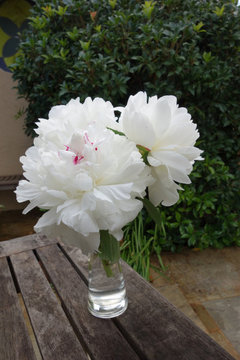
    The many peonies I grew in Massachuesetts were immense and spectacular, and it is one of my favorite flowers and scents. Here, though, it is too warm for most and several of the varieties I've tried have dwindled away and been lost over time. However, one of the heirloom varieties I grew in MA and one of my all-time favorites, the beautifully scented 'Festiva Maxima', does respectably here in a cool, partial-shade position. A species (non-hybridized) form of Paeonia lactiflora, obtained from the U.C. Berkeley Botanical Garden plant sale deck, which is single and red, also blooms well -- extremely well, actually. But, it's a total disappointment, scent-wise, smelling more or less like an old goat.


    'Festiva Maxima':


  • 4 years ago

    Ahhh...Lilacs...

    I tried the cultivars specially developed for warmer winter areas with absolutely no luck. Well, they grew fine, went dormant every winter and new leaves emerged each spring, but nary a flower. I should try again because it was a long time ago and I am sure that I didn't give them the right amount of organic amendments.

    I am trying a new one - Syringa oblata 'Betsy Ross' - also from Annie's. I have it in a pot (it came in a 4" pot) and it actually bloomed last year. I need to find it a permanent home.

    Even if I can get a few of these to grow and flower here, I am afraid they will be nothing like the large hedges of giant specimens covered in blooms that I have seen (and smelled) in cold winter areas of the country. I love the mix of purplse, lavenders and pinks with an occasional white. That's what I am envisioning yours will be Melissa, given a little time.

  • 4 years ago
    last modified: 4 years ago

    That's the idea, BirdsLoveRoses! When it comes to lilacs, only overwhelming will do.

    I've been madly in love with common lilacs, the many varieties of Syringa vulgaris, for decades, but have found that there are others that have charms of their own. I like S. x laciniata a lot, and have another, low growing and very fragrant of cloves, that I think may be S. microphylla 'Superba', but I'm not sure. I really need to think more about these two, and possibly others outside the S. vulgaris group, because they're marvelous shrubs, just not the kind of plant I find in local nurseries. But when I think 'Lilac', it's the Vulgaris cultivars I have in mind.

    That's a near universal, or at least, very widespread gardener's longing, to grow plants your conditions don't support. My must-do-without is acidophile plants, and magnolias. While I can live without rhododendrons, fragrant deciduous azaleas would be nice, and so would blueberries, and camellas, while not being able to grow magnolias does hurt a bit. All the same, though, I can grow an awful lot and consider myself very lucky. And, if we could all grow everything, I think there's a risk our gardens would look too much alike. The big commercial nurseries would love it if they could grow the same plants for everybody.

  • 4 years ago

    Ha Ha! Yes - only overwhelming will do! That's what I want for my roses, too.

    My soil is very alkaline and so is the water that I put on it. But I have had some success with Azaleas and Camelias using an acidic mix for planting and mulching and then the acidic fertilizer and Cottonseed Meal.

    New to me for only a couple of years, are flowering Magnolias -soulangiana 'Black Tulip' and stellata 'Royal Star'. They seem to be doing well. New this year is "Rose Marie". I am limited to the smaller varieties, but I can only imagine the sight a large 30 foot specimen in full bloom would be.

Sponsored
Mary Shipley Interiors
Average rating: 4.8 out of 5 stars34 Reviews
Columbus OH Premier Interior Designer 10x Best of Houzz