Software
Houzz Logo Print

Comments (31)

  • 4 years ago

    While I respect Tony Avent, I don't buy it. All species of hosta are herbaceous perennials and ALL herbaceous perennials need a period of dormancy. There are definitely some that do not require extended chill periods and are used to breed more heat tolerant cultivars but never NO dormancy! Perhaps that was what was meant - lower chill requirements - but somehow that got garbled into something else?

    btw, even those sources that develop more heat tolerant hosta varieties warn that while all hostas will emerge the following spring after a low-chill winter, they are usually quite weak and proceed to deteriorate during the subsequent season. That sure counteracts the argument for "no dormancy"!!

  • 4 years ago

    I'm certainly not a botanist, but it seems to me that chill requirements and dormancy are two different things. Not all trees are evergreen, even in South Texas.

    bkay

  • 4 years ago

    i went back and listened to the program to make verify. He said, ”…you can grow it year round in your greenhouse.” (!!!)

  • 4 years ago

    i want to breed with it but it always dies off for me since it has a late dormancy and freezes the buds.


    ==>> maker????


    did you mean the seed pods freeze before the seed matures???

  • 4 years ago

    could someone go to the library.. and find schmids tome on plantiginea... and report back??


    i do have some vague recollection.. that it was one of the first hosta sent back to england back in the plant exploration days. ... and just maybe i recall it was in some greenhouse in kew or whatever they call that garden bed over there.. lol ...


    ken

  • 4 years ago

    In Schmid's tome the following:


    In the colder, more northern areas, blooming is frequently aborted and the season is not long enough to allow the production of viable seed.

    And: Its distribution world-wide has revealed its preference for warmer and wet climatic areas. Mirroring its (assumed!) native habitat in China, this species flowers in late summer when the temperatures are high and rainfall is abundant.

    This species requires a long season with adequate rain, between 1.5 in/week (about 38 mm/week) before and during the bloom period.


    No mention anywhere of it not going into senescence nor if its chill requirements.


    Pieter

  • 4 years ago

    https://www.hostalibrary.org/species/pdf/plantaginea.pdf


    from that link ..


    bazinga:


    H. plantagi nea was the first hosta known
    on the c ontinent of Europe, grown from
    seeds sent from Macao by French Consul
    Charles de Guignes before 1784. I


    pretty close on this part:


    n 1790, the first live
    plants wer e imported into Engl and b y
    George H ibbert (t ogether wi th H.
    ventricosa, whic h see) . Due to its t ropical
    look, it was first grown under gl ass. Some
    mature specimens were part of a
    collection of rare, ornamental plants
    Madame Josephine Bonaparte had
    assembled at the gardens of
    Malmaison.


    boy does that flower comparison pic look familiar.. lol ...


    H. plantaginea
    most likely evolved in the te mperate and subtropical lo wer elevations of southern
    China. Chinese fo lklore has a le gend that a goddess dropped her hairpin from
    which this beautiful hosta gre w. While not science, it does confirm the presence of
    and the love for this hosta among Chinese people. Documentation of use as a popular
    garden plant, as food, as a medicinal herb and as a sou rce for aromatics goes back
    centuries to the Han Dynasty ( 漢朝; 206 BC–220 AD). Luo Yin ( Zhaojian ─ 昭谏)


    well that is a lost hour lol.... ken


    ps: thats what happens when you copy from a pdf i guess ;...


  • 4 years ago
    last modified: 4 years ago

    In minnesota its been a problem for me keeping it alive. thus my attempt at protecting from early freeze and long harsh winters.

    i asked solberg and he said it will freeze and kill the eyes but new ones will form and grow.

    so far that hasnt worked for me.

    most hosta seem to benefit from chill giving them more vigor.

    plantaginea seems to be a species vastly different from the rest.

    apart from its inherent fertility issues, i have no problem getting seed to finish with the fragrant hybrids. the problem is strength of fragrance. it is diminished. my seventh heaven seedlings iare good. i would like larger flowers too. my thoughts are to go back to the species crossing with the new fragrant tetraploids. solve the fertility issue then move forward from there.

    hansen and beilsteen are having fragrant success with tetraploids.

    i will see what doug b has to say when he stops by for a visit after the convention.

    this conversation was a good reminder. i just brought it in for early rising and blooming. assuming it doesnt adhere to strict photoperiodism …it may


    here is a visual of schmids classification

    you can see plantaginea stands alone.

    https://www.hostamill.be/ENG/ENGSpecies/ENGHGHostaSpeciesSchmidt.htm

  • 4 years ago

    apart from its inherent fertility issues, i have no problem getting seed to finish with the fragrant hybrids. the problem is strength of fragrance. it is diminished. my seventh heaven seedlings iare good. i would like larger flowers too. my thoughts are to go back to the species crossing with the new fragrant tetraploids. solve the fertility issue then move forward from there.


    Doug, like you I have trouble keeping plantaginea going, never mind flowering, let alone set seed. Out on the We(s)t coast it doesn't get hot enough for long enough. If you're intent on pursuing your above stated goals you might consider getting pollen from someone who's further south and gets it to set seed regularly, worth a shot!


    Pieter

  • 4 years ago

    The last time I was at The Dallas Arboretum (a few years ago), they had a huge planting of plantaginea. I'm not sure they kept it as it was in full sun and fried, but in full bloom in August. Our first frost date is November 15, so it would have had time to set seed.

    I'm not sure that information of any value to you, but thought I would throw it in.

    I tried it once in a pot and it never really got started. It died soon after planting.

    bkay

  • 4 years ago
    last modified: 4 years ago

    Pieter i will see what happens. i figure its all about the pollen.

    i see herb benedict had a cross ventricosa with planatginea to get rippled honey. back then he figured things out.

    i wonder how fertile it is and if fragrance diminishes. invincible seedlings get weaker smell wise and fertility is bad.

    i tried a couple of times to get kevin vaughn to speculate on his fragrant crosses. he seems to be still angry over the aden theft. he moved to pacific northwest and said they dont grow well in his yard and is breeding chicks and hens.

  • 4 years ago

    Thanks to all for that information! Very interesting!

    debra

  • 4 years ago

    i tried a couple of times to get kevin vaughn to speculate on his fragrant crosses. he seems to be still angry over the aden theft. he moved to pacific northwest and said they dont grow well in his yard and is breeding chicks and hens.


    Doug, I'm just across the border from WA, fractionally north of the 49th parallel and I have no trouble growing cultivars such as 'Guacamole', 'Fragrant Bouquet', 'Invincible', 'Sugar and Spice', 'Frozen Margarita' and 'Stained Glass'. Wonder what Kevin's encountering...

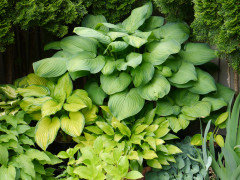
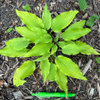
    Here's one of my 'Guacamole's, it gets to be a pretty good-sized plant wherever I locate.


    Matter of fact, this is 'Guacamole' x 2 and a 'Stained Glass'. They're all in pots.

    Pieter

  • 4 years ago
    last modified: 4 years ago

    He said he had alot of pine trees in his yard. but ultimately i got the jist that he had moved on to something different. breeding hosta is alot of work since you need many plants to work with to get a really good one. starting over in retirement isnt for everyone.


    he must be mid 70s to 80 by now.


    florence shaws grand daughter remembers him coming over to her grandmas garden,

    ps

    she said she was a blue baby thus the name blue angel.

  • 4 years ago

    I'm in the PNW and hostas grow like weeds here....provided the deer or slugs and snails don't find them :-) Naylor Creek is/was just up the road and Jack and Gary introduced a number of hosta varieties into the trade so selective breeding is obviously achievable in this climate.

  • 4 years ago

    They also went thru alot of struggles keeping it open when they got older.

    i showed jack red hosta but thought it was wise not to introduce through them since i didnt think they could keep it up forever.

  • 4 years ago

    "They also went thru alot of struggles keeping it open when they got older."

    Of course they did!! As would anyone running a mail order nursery of that caliber without lots of help. And they had almost none. It wasn't until after Jack's death that there was a fulltime assistant.

  • 4 years ago
    last modified: 4 years ago

    Pieter do all species grow well for you?

    some info from a study.

    invincible which is a plantaginea hybrid, without chill did as well as plants that had a chill period.


  • 4 years ago

    Doug, I only have clausa var. normalis, venusta, sieboldii 'Alba' and rectifolia f. pruinosa. All grow well for me. While I have good luck with fragrant hybrids I have not been able to keep plantaginea thriving in my yard, just don't get enough direct sun and I've given up on it....

    Pieter

  • 4 years ago
    last modified: 4 years ago

    Interesting pieter, maybe plantaginea has a narrow tropical preference. i was thinking of making some crosses based on the idea of being hardy in most climates. plantaginea would be key for warmer areas. but cloudiness never occurred to me. so maybe tardiana would be the partner. would probably take at least two generations and 3-4 species

    do you have moonlight sonata? Warwick essence? ventricosa? fortunei tet hybrids? longipes and reds?

    how about sieboldiana hybrids? And blues? how many chill days do you get? below 40f

    what should i stay away from?

  • 4 years ago
    last modified: 4 years ago

    Doug,

    Where I am these are the historical averages: November 49H-39L, December 43H-35L, January 43H-35L, February 47H-38L, March 50H-39L Yes, we get freezing temps but not for any long stretches and of course we do see occasional snow, but not much by and large. Because of all the precip we get over winter I tend to shelter my potted hostas to keep them from getting root rot and because they are sheltered they break quite early for me. I can expect to see pipping on clausa and 'Chinese Sunrise' most years by mid-Feb.

    The only Fortunei tets I have are 'Minute Man' and 'Revolution'. Other tets are 'Touch of Class', 'Touch of Frost' and 'Ben Vernooij'. My reds include 'Red October', Gooseberry Sundae', 'Raspberry Sunday', 'Island breeze', 'Fire Island' and 'First Blush'. Don't have MS nor WE nor ventricosa. I have 'George Smith', 'Nightlife' as sieboldiana hybrids.

    Some of what I have can be rather prone to sporting. The most extreme case is a fully medio variegated division of 'Ice Age Trail' that came back the following year as good 'ol 'Big Daddy' and I'm now going through something similar with a "Stained Glass' I have, last year it sported back to 'Guacamole' and this year it looks to be all-green, guess that makes it 'Vino Verde'. My 'Revolution' regularly throws all-greens which I refer to as "Green Revolution" and my 'Risky Business' does an all-green I call "Finished Business".

    Pieter

  • 4 years ago
    last modified: 4 years ago

    pieter

    it sounds like you might have just enough chill days to get a wide spectrum of hybrids to do well. thats good.

    not sure if your sporting issue relates to buds popping early or not

    i checked my plantaginea today and it has new green buds that will emerge soon.

    so my approach of bringing it inside to go dormant and protecting from extreme temps, then putting it outside for some chill days, worked for the first time for me.

    i also ordered fragrant tets this year to give it a good try. i'm excited to maybe see the flowers on double up and compare it to the diploid

    i'm growing a few big daddy streaked from an old winterberry plant this year. got some odd yellow and green streaks in them. it would be nice to get a really big yellow and green sport.


  • 4 years ago

    Excuse me for butting in (you two have quite the conversation going on). I bought some of Beilstein's Tet seeds a few years ago including this fragrant (Mojito x Touch of Class) x Purgatory. Despite having 1.5 fragrant parents the flowers do not have much fragrance in them. They do have exceptional flowers and nice shape on vigorous plants so they may be something to build on.


    I also bought Doubled Up in 2018 so I'm thinking (thanks to you) that may be a good avenue to persue. I'm happy to share seed and/or pollen if you like.


  • 4 years ago
    last modified: 4 years ago

    cool steve,

    did double up set any pods? was the flower as large as the diploid?

    always willing to share seed with someone willing to take on fragrance.

    i think its the hardest of all to breed for. I also have grown beilstein fragrant seed, and also gotten no fragrance from the seedling. so fertility and fragrance aren't necessarily linked. and may be recessive ...so again grow alot to get a few good ones. ...not to mention the wait to see if they smell, all the while watching a solid colored, possibly boring plants.

  • 4 years ago
    last modified: 4 years ago

    Just have to say, as a lurker 😁 really liking this conversation. So much to learn, and no wonder new items can seem expensive.

  • 4 years ago

    I haven't seen any pods on Doubled Up but haven't fertilized with a Tet (yet) and there are none nearby. Although, Liberty (4-2-2) is close. The flowers haven't seemed as big as the diploid which I don't grow.

  • 4 years ago
    last modified: 4 years ago

    I'm going to experiment with everything. Tets to tets, dips to tets, even trips to tets.

    when you look at sum and substance who can argue with trying to make a few triploids.

    If you can get diploids and tetraploids to play nice, i've been told the seedlings will be a mix of dips, tets and trips. figuring out what they are later will be a challenge.

    from what i've observed triploids put more energy into vegetative growth than reproductive. so really strong growers

    for fragrance i'll try to cross only fragrants to other fragrants. thats where the tets play a big role in hopefully souping up the missing fertility gene in the dips.


    i could be wrong but (would need a microscope to compare pollen size to sagae)

    i believe liberty pollen would be a diploid, from the center. my understanding is the first number is the margin and the last 2 are center and roots. although the roots are infered so there is still some debate whether hosta have 3 layers. the tet margin makes it huge in old age.

  • 4 years ago
    last modified: 4 years ago

    at the risk of boring some, i can break down in simplistic terms what makes hota tick.

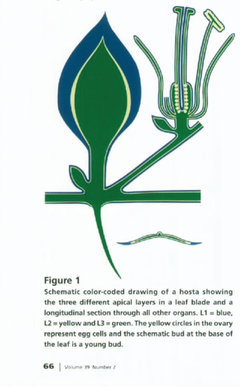
    I always thought the drawing was a bit crude. this is what they came up with to explain the layers. i dont think they have any visual proof that layer 2 and 3 are seperate layers. I wish they could definitely prove or disprove it.

    kevin vaughn doesnt believe layer 3 exists. i think mainly because he has only seen 2 colors in seedlings. and others suggest more than one color can exist on a layer. streakers are intermixed cells in the meristem that have yet to form stable layers.

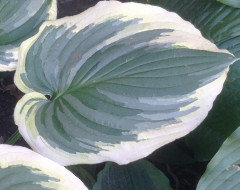
    and overlapping cells feathering into each other can create multi color effects like wildest dreams


    Wildest dreams


    blues are greens with wax coating

    yellows are greens that are missing a chromosone.

    white are cells lacking chlorophyl

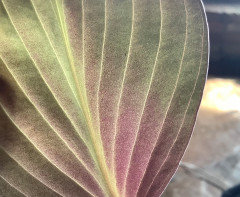
    and then we come to blushing which is anthocyanin compounds that ripen with the sun hitting the surface/epidermis. then dissolving when the shading effect isnt needed.

    Bloodline


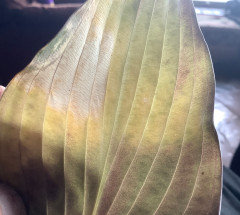
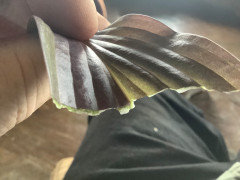
    Desiccated leaf of bloodline

    The back of the leaf is transparent with veins support structure.
    Top left is transparent where layers have burnt/dried up.


  • 4 years ago

    Wait, my brain hurts - J/K. Great pic and explanation of the numbers. Then Kevin believes layers 2 and 3 are the same. It seems nearly all the plants listed in Don's list have the same 2nd and 3rd numbers except for sports/progeny from Sum and Substance. Does Kevin not believe that those exist either? (Sorry about my rude comment in an attempt at humor. It's a character defect of mine). I wonder if that supports the 3 number theory. Do those weird numbers making breeding with them difficult or impossible? I had assumed that tets breed with tets and dips with dips but that obviously isn't true. Is it just easier to breed along those lines? I'd love to breed with How About That! but heard it was sterile (although it's not on Don's list) perhaps it's just difficult and needs some TLC. Are there any tricks to getting these fussy breeders to procreate? Too many questions. I should probably just read a book.

  • 4 years ago
    last modified: 4 years ago

    steve i am skeptical about 2 layers. but open to it. they say layer 2 and 3 are really the same. most list the same chromosone count for 2 and 3.

    kevin said he is working on a paper. havent seen it yet.

    you can cross anything. its just a matter of what each species influence will accept.

    see dons list

    http://www.hostalists.org/hosta_list_inter.php

    don and doug are coming by after the convention and i have questions.

    ive been working with sum and substance seedlings. its interesting. i have theories to the origin but no proof. some look like tets. others maybe quasi dips or trips. …….nothing looks exactly like the mother.

    the assumed tets are super slow growers. and have yet to bloom

    sum and sub seems to be better at seed setting on older plants.

    ploidy is not disputed, just whether that infered premise of roots being on different layers. it takes abit of reading and rereading to absorb it all. ploidy is a factor as in daylilies it changed the game. hosta may see it evolve in a different way. ie more fragrants, durable heat tolerant, more vivid blushers etc.