Software
Houzz Logo Print
webuser_94913999

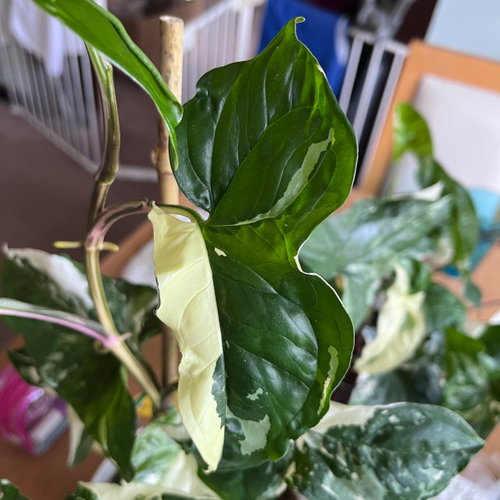
Syngonium Albo - weird shaped leaves
4 years ago
last modified: 4 years ago


House Plants · More Info


House Plants · More Info

Hi everyone, I hope you’re having a great weekend!

I have an issue with my 3 mature Syngonium Albo plants. I acquired them all in the last 3-4 months (long story!). The first issue is that they seem to be developing weird leaf shapes, plus the whiter parts on some of the leaves seem to be a lot smaller than the green parts, making them really misshapen.

Another issue I'm facing (not sure if it's normal or not) but the newer leaves that have white variegation seems to be coming out a lot yellower than the older leaves. Not sure if they'll get whiter with time?

A bit of information...

  • I have one of the plants in my indoor greenhouse under LED strip lights with a humidity of approx. 70% - this one arrived with misshapen leaves and seems to be getting a little better.
  • The other plant is on my coffee table, about 15" from LED grow lights and sat right next to a small humidifier (all I could afford right now - do want to get a bigger one).
  • The other plant is sat on another table - and is quite a way away from the humidifier and is not as bad with the yellower whites of the leaves but still has weird leaf shape developing.

I've fed them since I got them with organic fish mix fertiliser and have recently added a little CalMag just in case of a deficiency. I'm careful not to overwater my plants, but had to water them a little more over two weeks (about a month and a half ago) as I used nematode solution to combat a minor fungus gnat infestation (not a huge infestation but wanted to get in there before they completely took over lol!) But the weird leaf shapes had started before I did the nematode thing.

Anyway sorry for the long post, just wanted to give you a bit of back info too. Thanks so much in advance for any help I may get - it's really appreciated!

Comments (4)

  • 4 years ago

    When you see hooked or misshaped new leaves, the most likely cause is a culturally-caused deficiency of Ca(lcium). Ca is essential to the formation of cell walls, so for cells and tissue to form normally, Ca must be in the nutrient stream at all times. Even when there is an adequate supply of Ca in the soil solution, a waterlogged grow medium can prevent Ca uptake. I suggest you start monitoring your moisture levels at the bottom of the pot through use of an inexpensive tell you can make from a wooden dowel rod (14 Or 5/16 diam - any hardware or home imp store) for next to nothing. See "Tell" below.

    Also, it's unlikely the fish meal product you're using is appropriate for your plant. Plants use about 6X as much nitrogen as phosphorous and about 3/5 as much potassium as nitrogen. Fertilizers with a 3:1:2 NPK RATIO provide nutrients at almost precisely that rate. NPK %s are different than the ratio of each ingredient to the others. Examples of the NPK %s of some popular 3:1:2 ratio fertilizers are 24-8-16, 12-4-8, and 9-3-6. I've been using Foliage-Pro 9-3-6 for all my plants for decades, and have seen nothing else on the market that makes me even want to consider a change to anything else. I can list all the reasons it's a superlative product if you'd rather not take my word for it.

    Using a 'tell'

    Over-watering saps vitality and is one of the most common plant assassins, so learning to avoid it is worth the small effort. Plants make and store their own energy source – photosynthate - (sugar/glucose). Functioning roots need energy to drive their metabolic processes, and in order to get it, they use oxygen to burn (oxidize) their food. From this, we can see that terrestrial plants need plenty of air (oxygen) in the soil to drive root function. Many off-the-shelf soils hold too much water and not enough air to support the kind of root health most growers would like to see; and, a healthy root system is a prerequisite to a healthy plant.

    Watering in small sips leads to avoid over-watering leads to a residual build-up of dissolved solids (salts) in the soil from tapwater and fertilizer solutions, which limits a plant's ability to absorb water – so watering in sips simply moves us to the other horn of a dilemma. It creates another problem that requires resolution. Better, would be to simply adopt a soil that drains well enough to allow watering to beyond the saturation point, so we're flushing the soil of accumulating dissolved solids whenever we water; this, w/o the plant being forced to pay a tax in the form of reduced vitality, due to prolong periods of soil saturation. Sometimes, though, that's not a course we can immediately steer, which makes controlling how often we water a very important factor.

    In many cases, we can judge whether or not a planting needs watering by hefting the pot. This is especially true if the pot is made from light material, like plastic, but doesn't work (as) well when the pot is made from heavier material, like clay, or when the size/weight of the pot precludes grabbing it with one hand to judge its weight and gauge the need for water.

    Fingers stuck an inch or two into the soil work ok for shallow pots, but not for deep pots. Deep pots might have 3 or more inches of soil that feels totally dry, while the lower several inches of the soil is 100% saturated. Obviously, the lack of oxygen in the root zone situation can wreak havoc with root health and cause the loss of a very notable measure of your plant's potential. Inexpensive watering meters don't even measure moisture levels, they measure electrical conductivity. Clean the tip and insert it into a cup of distilled water and witness the fact it reads 'DRY'.

    One of the most reliable methods of checking a planting's need for water is using a 'tell'. You can use a bamboo skewer in a pinch, but a wooden dowel rod of about 5/16” (75-85mm) would work better. They usually come 48” (120cm) long and can usually be cut in half and serve as a pair. Sharpen all 4 ends in a pencil sharpener and slightly blunt the tip so it's about the diameter of the head on a straight pin. Push the wooden tell deep into the soil. Don't worry, it won't harm the root system. If the plant is quite root-bound, you might need to try several places until you find one where you can push it all the way to the pot's bottom. Leave it a few seconds, then withdraw it and inspect the tip for moisture. For most plantings, withhold water until the tell comes out dry or nearly so. If you see signs of wilting, adjust the interval between waterings so drought stress isn't a recurring issue.

    Al

    HU-94913999 thanked tapla (mid-Michigan, USDA z5b-6a)
  • 4 years ago

    Hi Al!

    Firstly I want to say a big thank you for your very informative reply, that’s extremely helpful.


    I’ve only just starting using the CalMag so hopefully I’ll see a change in the leaf shape of the newer leaves soon. I’ll also be changing my fertiliser on your advice. I recently bought a bottle of Liquid Gold Leaf - not sure what you think of that one if you’ve heard of it, although the NPK is 9-5-16?


    I do at the moment use a SUStee moisture meter in my more expensive plants, this goes down to the bottom of the pot, which measures the PF-Value - do you think that the yellow tint to the whites of the newer leaves can be down to overwatering? It’s just I’m really careful not to overwater my plants. But maybe the culprit was the extra water needed for the nematodes. Is the yellow tint something that may whiten over time as it only seems to be on the newer leaves?


    Thank you once again for all your extremely helpful advice - it really is much appreciated.

  • 4 years ago

    Also forgot to mention in my reply that I’m in the UK, so not sure that Foliage Pro is available here. I’ll give Liquid Gold Leaf a try for now & keep my fingers crossed lol.

  • 4 years ago

    I’ve only just starting using the CalMag so hopefully I’ll see a change in the leaf shape of the newer leaves soon. That would be helpful only if it's not a "cultural" deficiency where a wet soil is blocking uptake of Ca.

    I recently bought a bottle of Liquid Gold Leaf - not sure what you think of that one if you’ve heard of it, although the NPK is 9-5-16? Because more N is used than any other nutrient, we usually base how much of each of the other nutrients are required as a factor of the amt of N applied. Based on 9% N, the fertilizer is quite high in P (almost twice what's required) and very high in K (almost thrice what's required). It's probably better o/a than the fish product, though; and, that it has all nutrients essential to normal growth is a plus as well.

    I do at the moment use a SUStee moisture meter in my more expensive plants, this goes down to the bottom of the pot, which measures the PF-Value ..... - That is different than the meters that test electrical conductivity rather than actual moisture levels and are unreliable. I can't attest to the reliability of what you're using, so I would suggest you try using a tell to at least validate the readings you're getting. Moisture management is a major player when it comes to maintaining healthy roots, a prerequisite to healthyplants.

    do you think that the yellow tint to the whites of the newer leaves can be down to overwatering? It’s just I’m really careful not to overwater my plants. But maybe the culprit was the extra water needed for the nematodes. Is the yellow tint something that may whiten over time as it only seems to be on the newer leaves? It is more the rule than the exception for new foliage to come on line a different shade or even color than what it ends up being when mature. Many plants emerge as red or very light green and only change to dark green at maturity.

    Also, even subtle changes in CELLULAR pH (as opposed to soil/ grow media pH) has a lot to do with how pigments are expressed in blooms/ foliage, and there are many influences which can change pH at the cellular level.

    Al

0