Software
Houzz Logo Print
finndian

The Thermador insert range vent I want needs 10 inch duct.

4 years ago
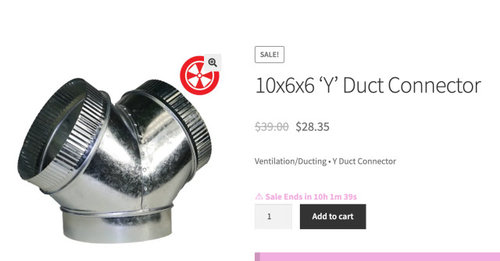
I don't have that space 10 inch. I can go with a 6 inch duct 20 feet up to the roof OR go with 8 inch duct, 20 feet across to the vent out the wall.


Is splitting the air flow a thing? What do you think about adding this? I have the room.


Comments (13)

  • 4 years ago

    Go with a less powerful range then.

  • 4 years ago

    Has anyone tried it?

  • 4 years ago
    last modified: 4 years ago

    There is a third option, but it will likely be noisier than a 10-inch duct solution. Use an exterior blower with 8-inch duct and be sure from the blower's fan curve that the CFM you need will be available given the duct restriction (pressure loss at that CFM) and some estimate of the hood's baffle assembly pressure loss at that CFM.

    Have you evaluated the CFM you need for the cooktop and hood overlap that you plan to have? Have you planned your MUA approach? A hood or hood insert that needs 10-inch duct is certainly going to need a blower large enough to call for deliberate MUA.

    Paul F. thanked kaseki
  • 4 years ago
    last modified: 4 years ago

    It is an induction cooktop so I guess I could go with a 1000CFM and take the CFM hit by using the 8 inch duct. I'm just letting Thermador or Miele make the pairing for me with one of the wifi connected vent, as it is 4 feet off the cook surface.

  • 4 years ago
    last modified: 4 years ago

    I really know nothing about venting, so ill get that out of the way. When we had a commercial gas range with the high heat ouput, we had a super strong, loud vent to evacuate the heat and grease and smoke from the stove. Fast foward to our new home, we have the thermador freedom induction cooktop with the insert that thermador reccomends that is connected via blue tooth so it automatically runs with the cooktop. I was cleaning yesterday and unlike the vent for the gas range, after 6 months of use, it still looks new and clean. I dont get that high heat mess and splatter from the induction that I did from the gas range. You have so much immediate control over the heat output. I m not sure of the duct size.. Just giving you my experience. Youre going to love induction, Id never go back to cleaning grates, or (while I was renting) chiseling off an electric cooktop.

  • 4 years ago

    Induction removes the gas combustion component of cooking plumes, but not the cooking plumes themselves containing grease particulates and moisture. Many induction cooktops can supply more heat into pans than counterpart gas burner cooktops, so grease splatter and/or oil vaporization and smoke can exceed that from a gas burner if not closely supervised.

    Capture: Nominally one wants a hood with a capture area that overlaps the cooktop by enough that the rising and expanding cooking plumes are fully (technically mostly) captured. This requires (at a minimum and excluding the back wall if present) that at the height of the hood entry area over the cooktop (h) the hood overlap equal at least h x tan(10deg) relative to the outer contours of the largest pots and pans to be used on the peripheral hobs. More than 36-inches height may require even more to compensate for drafts moving the plumes.

    Containment: Cooking plumes can exceed 1.2 m/s velocity upwards. Probably for most residential cooking with induction the likely highest is closer to 0.6 m/s, but this can be exceeded by dumping a steak onto a searing pan, or throwing stir fry components into a hot wok. To ensure that the momentum of such plumes stays in the (typically low reservoir volume residential) hood, the plumes have to be immediately entrained into the baffle slot air flow. Otherwise plumes may partially "reflect" out due to momentum conservation. It seems that containment requires a flow rate over the capture entry area of 60 to 90 (depending on cooking) ft/min, which is equivalent to 60 to 90 CFM per square foot of entry area. Hence take the area (sq.ft.) resulting from the capture paragraph above and multiply by 90 (or 60 if you are feeling lucky).

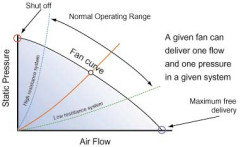
    Blower: The flow rate available from a blower is like that shown in the image below. More pressure loss means less flow rate. Choose a blower that is rated (zero static pressure = free air flow) about 1.5 times the calculated containment flow rate.

    Cleaning: The baffles collect grease particulates from the larger end of the particulate size spectrum, so any grease or oil cooking will leave a deposit on the baffles. These need to be cleaned, at least for aesthetics, and can be done in a dishwasher for any decent baffle assembly made of stainless steel.

    Make-up Air: The MUA required is that calculated in the containment paragraph, and may require a blower rating that is approximately that of the blower paragraph. Note that pressure losses in the baffles and hood ducting may or may not exceed those of the MUA path (with filtering and possibly with heating) so the blowers may not need to be identical. If there are no combustion appliances in the residence connected to kitchen air, it may do to have a passive (no blower) MUA system.


  • 4 years ago
    last modified: 4 years ago

    Kaseki, do you have real life experience cooking with both induction and gas or just what you’ve researched. From my experience, a frying pan that gets overheated on gas takes a much longer time to cool on the cooking grates than the same pan on induction. The gas setup holds residual heat through the grates and to the pan than the instant cooling down on an induction cooktop. All things being the same, side by side, i would think that induction would end up sending less particulate into the air (if overheated) and into the hood. Is that wrong?

  • 4 years ago

    I haven't used gas since I was a child (many decades ago). I would expect anyone done with cooking in a particular pan would move it to a cooler spot, but maybe that is just me.

    [The rate of generation of] Particulate matter from a given source, peanut oil say, will increase as its temperature approaches and then reaches the "smoke point." It doesn't matter whether the pan is heated with gas or induction; only the temperature the contents reach affects their conversion to vapor and smoke. Gas may generate additional particulates in its own combustion products, particularly is there is incomplete combustion for some reason. This should be rare with gas ranges.

    Rereading your question, I should note that I am usually writing in terms of cooking plume flow rate, not total plume volume. I don't doubt that if one were to raise the temperature to smoke level in a pan and then shut the induction power off, versus raising it and then shutting the gas off, the total emission of products from induction heating will be slightly less than from gas heating due to grate thermal mass.

  • PRO
    4 years ago

    "You do not split ventilation ducts. That creates cavitation that deposits aerosolized grease instead of exhausting it."


    I think you've confused the terms "cavitation" and "impingement." Cavitation occurs only in liquids. It involves the formation and collapse of gas bubbles when the pressure drops below the vapor pressure. That said, the build up of particulate matter and grease at the Y connection is a legitimate concern. The extent to which accumulation occurs and creates a safety hazard is a function of the amount of use and the efficacy of the grease filters in the range hood. If the Y fitting is accessible for routine inspection and maintenance and they actually get performed, there's no reason it won't work provided there is enough fan hp available to exhaust at the required flow rate.

    Paul F. thanked Charles Ross Homes
  • 4 years ago

    I'm going to try it if I can. I'll do 6 inches one way and 6 inches the other.

  • 4 years ago

    For this approach wouldn't you want a 10-inch input dual 6-inch output splitter?

    I thought you had the option of 8-inch ducting.

    Also, a hood 4 ft off of the cooking surface (typical of commercial systems) requires a fairly large overlap of the cooking zone in order to ensure capture.

    30 ft of 8-inch duct moving 666 CFM will have a pressure loss of 0.22 in w.c., while 30 ft of dual 6-inch duct moving 333 CFM per duct will have a pressure loss of 0.25 in w.c. The latter will require slightly more blower capability. Note that the baffles may have commensurate pressure loss. No bends are included here, so both options pressure losses will likely be higher. Inadequate MUA will also add a pressure loss. Air velocity will be higher in the 8-inch duct, but the increased noise this will generate per square inch of duct wall, integrated over the duct wall area, might be exceeded by the noise from the lower speed but greater surface area of the 6-inch ducts. 6 x 14 rectangular duct should have lower loss than dual 6-inch duct if you can fit it.

  • 4 years ago

    In my city kitchen, I have a 36” Blue Star gas range, so lots of power. I chose a 1200 cfm Modernaire hood, but then realized I clould only fit an 8” duct. I made sure we had only one turn between the hood and the outside wall. its going on 10 years and its been perfect, although a bit louder than it likely would have been had we been able to do the 10” duct. Sometimes, something has to give.