Software
Houzz Logo Print
bscruggs99

Nutrient information for compost materials?

4 years ago

I'm curious if anybody knows of a source to find the nutrient make-up of foods we compost. Something like (completely made up numbers) 100g of banana has Xg carbon, Yg phosphorus, Zg potassium etc. I'm trying to figure out, roughly, nutrients in, nutrients out, to say something like if I make a compost pile of 20lbs of banana peels, 5lbs of tomatoes, 3lbs oranges and whatever browns, I can expect the nutrient profile of the compost to be xyz. I hope I'm explaining this clear enough. Or I suppose really if there's anywhere that has information on the chemical contents pre/post decomposition, that would be helpful as well. Please let me know if this isn't very clear and what I need to make more clear. Thank you all for any help with this.

Comments (9)

  • 4 years ago

    Here's a link that may be helpful: NPK of everything. However, this data is all before composting. Finished compost - regardless of ingredients - is typically rated with an NPK of around 1-1-1.

    While it does provide some nutrient impact, compost is not considered a fertilizer....only a soil amendment.

    David Scruggs thanked gardengal48 (PNW Z8/9)
  • 4 years ago

    awesome, thank you. I always assumed if your compost was higher in this or that to start with, it would also be higher in this or that after the composting process. Perhaps that's the case with other nutrients? like higher iron going in results in higher iron content coming out? I'm not sure but I'll do more digging. Thank you very much for the information!

  • 4 years ago

    A fair amount of nutrients are consumed or lost during the composting process, which explains why the NPK of compost is so low. But most compost is a mixture of various ingredients. I guess if you have a single ingredient compost that was high in one of the primary nutrients, the resulting compost may test out higher in that same nutrient as well.

    But I don't know that for a fact :-)

  • 4 years ago

    It's very difficult to find those numbers for compost ingredients. First, it varies a lot - for example grass clippings will be very high in N right after you fertilize the lawn, but lower later in the season, and will vary by type of grass too. Also, food waste is the parts of food we don't eat. What's the K content of a banana PEEL? No one cares very much as it's a 'waste'.

    This is why it's good to have a variety of ingredients as much as possible. Compost everything you can.


    I did a very small research project once, measuring NPK and micronutrients on a dozen or so commercial composts plus homemade. There was an interesting variety of micros - sometimes a factor of 10 between different products. One would have very high iron, but low copper, and so on. The one with the most balanced? My own homemade compost.


    I also noted during that project that bagged composts (the ones that actually put an NPK rating on the bag at all) rated themselves as low as .05 - .05 - .05. The highest I saw on a bag was .5-.5 -.2. Of course they aren't measuring every batch, it's kind of a ballpark. There will be differences amongst brands and types. Again, homemade is usually best in just about every category. It's slow-release too, so you can't hardly compare compost NPK numbers to fertilizers.


    I can see how you'd be interested in this but in the grand scheme of things, it's a rabbit hole that in the end will not yield treasure. Rather, place the brown gold into the soil, and treasures will grow.


  • 4 years ago

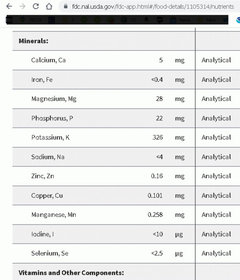
    For 100 grams of bananas:

    https://fdc.nal.usda.gov/fdc-app.html#/food-details/1105314/nutrients

    It lists over 50 individual nutrients. Nitrogen is near the top; scroll down to see the dozen minerals. There's clearly much more potassium than sodium. Their focus is on the edible portion, not the peel (which might be somewhat lower in the nutrients of interest). Of course when the food dries out and loses some of the water content, the remaining components become more concentrated. Back when I analyzed for these things in a food testing lab, this USDA Standard Reference database was (and still is) the gold standard, pretty much the best worldwide. Very reliable data, compiled and re-examined going back many decades.


  • 4 years ago

    Thanks for the link. I guess the hard part will be finding the post-composting nutrient contents. Well, and finding the nutrient content of the parts people general compost.

  • 4 years ago

    The peel will definitely be different in nutrients.


    There are so many variables besides just the input materials, that it is very hard to predict results even if you do have the input numbers. What's the ratio? Too many greens will give off ammonia, and the pile will lose nitrogen much faster than with a proper mix. Covered pile or exposed? Rainy climate or dry? This will make a huge difference in nutrients leached out. The result is that (in my estimation) you can't predict compost results from inputs with any degree of accuracy even if you have the NPK of the inputs.


    Really the only scientific way to do it that anyone would bother with is designing a mixture with specific inputs when you have a massive and constant supply of them. Got avocado and mango processing waste and a source of coffee chaff? It might make sense to figure out an ideal mix, with observation of the piles and tests of the results. If you were going to compost the same way every time this might be useful.


    About all most people can do is use what they have, optimize the process the best they can for their situation, and you get what you get.

  • 4 years ago

    That's fair. I was hoping there wouldn't be so much variation but i guess when dealing with nature, we can't really predict much at