Software
Houzz Logo Print
webuser_389322572

Need help with the range hood...

4 years ago

Hi all, I am looking for some help deciding about the range hood for our new house that is being built and is at the framing stage. We bought a 36-inch 6-burner cooktop with a 7 ft extension because of the ceiling height. The appliance sales guy suggested an 1100 CFM range hood. The project manager says we will need to install return air vents due to decreased air pressure because of 1100 CFM. The costs will run in five figures. I understand that for every 10,000 BTU the cfm is 100, Googled it. My questions are:

-- How to calculate the BTU for my range? Should it be the highest BTU that counts or the total of all 6 burners?

-- Do we really need to have an 1100 CFM hood? I think it is overkill.

-- I read somewhere that makes sense to me that the fan should be above the bigger burner where it matters the most. Please correct me if am wrong and suggest any other aspect to consider before deciding.

-- Which brand do you suggest? If I get at least 2 to 3 names, I can compare. As of now the one that the sales guy suggested is the SIRIUS brand.

Thank you all for reading this and appreciate all your help in advance.

Comments (8)

  • 4 years ago

    Doesn't the cooktop have a minimum CFM listed for a hood? It should say somewhere in the manual. I would look there first, but also make sure the vent diameter is correct for whichever hood you choose.

  • 4 years ago

    Kaseki is the expert here on ventilation. Is yours a professional range? You need the hood to extract all the fumes, grease, steam, etc., not just from one burner. Let's say you're frying chicken, boiling pasta and making vindaloo - that's a lot that needs to be extracted.


    In many jurisdictions, anything 600 cfm and over requires make-up air, which needs to be heated and cooled. It often costs as much as the range, so your quote is not outrageous.

  • 4 years ago
    last modified: 4 years ago

    You need the 42”-48” 1100 CFM pro style vent to go with the pro style cooking appliance. And you need the code required make up air.

    Or you need a lower powered, smaller, consumer grade, range.

    You want a big pro style powerful range? Gotta pay the costs to be the boss. You can’t have the range without ventilation system. Period.

  • PRO
    4 years ago

    I have a 36" 6 burner all gas range Betazzoni is the brand very high BYU since it has a wok burner I have a 36" 1200 CFM vet a hood and it has been great for 15 yrs. BTW I run a catering biz from my home so my range is often all burners going. I live in a 1956 MCM ranch not totally airtight like new bulds and we do not have a gas furnace so no MUA required

  • 4 years ago

    Heh! Verbo strikes again.

    Well, I have described here many times the requirements for capture and containment, but the OP evidently hasn't had time to search them out yet. They can be described in a limited amount of space, but this doesn't help with choosing brands, or comparing aesthetics, or hoping that one can have performance, aesthetics and low cost at the same time. A review of a significant number of hood threads here is advised, along with make-up air (MUA) threads.

    En brief, hot cooking over induction or gas or whatever generates cooking plumes, which can have significant momentum. The plumes rise and have to be captured by the hood, and then expelled (preferably) to the outside, i.e., contained. I will go over the suggested parameters below. The OP is advised to keep in mind that most of the CFM vs. BTU rules of thumb were created for standard commercial hood and cooking devices, and not upon fundamental principles adapted to residential hoods. To see how the rules of thumb differ, I recommend the first dozen or so pages of the Greenheck guide, available at: https://www.tagengineering.ca/wp-content/uploads/2015/02/KVSApplDesign_catalog.pdf

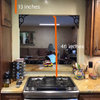
    In order to capture most of the rising and expanding cooking plume, the hood entry aperture (canopy base) has to overlap the plumes at the height of the hood base. We assume a 10 degree expansion half angle from the pan edges or flame boundary, whichever is largest around the contour of the cooking zone. (Actual plumes differ by cooking type, have a velocity distribution with angle, and may be deviated by cross drafts.) Usually, a simple 3 extra inches all around relative to the cooking device is sufficient for the 30 - 36 inch hood height, with wall hoods not needing added distance at the back. Twenty-four inches deep is good, 21 is probably OK if the worst plumes are kept to the back burners.

    The plumes rise to the hood using their own momentum, but will reflect out of the hood if the air velocity through the baffles is insufficient to entrain the plume effluent on the first arrival (for residential style hoods; commercial hoods are taller and larger and can get away with some internal reflections and still achieve containment).

    In my opinion, one wants the full power air velocity across the base of the hood to be about 90 ft/min, equivalent to 90 CFM/sq. ft. So having decided on a hood that is large enough, then multiply the area by 90 to get the desired full power flow rate.

    But wait, there's more. All blowers have a characteristic curve of flow rate vs. pressure loss in the system, where the system is the hood baffles, ducting, outside, MUA system, back to the hood. For simplicity without any data, choose a blower rated at 1.5 X the flow rate calculated above.

    For example, a 3.5 ft x 2 ft hood has an entry are of 7 sq. ft., calling for 630 CFM, requiring approximately a 1000 CFM blower. 1100 is not too large.

    The MUA has to provide 630 CFM, and may need different blower performance depending on the MUA path design, and whether other back-draft-sensitive combustion appliances are present and in contact with the kitchen air. If such have their own MUA, a passive (no blower) MUA may be feasible.

    I don't recommend hoods I haven't owned, so Wolf is my only quality example. I again recommend reading the many hood threads for comments by others here about their particular hoods, and in some cases about manufacturers not meeting their standards for support.

    We haven't addressed duct size, blower location, and use of a silencer yet, but the above will provide some material to digest first.


  • 4 years ago
    last modified: 4 years ago

    We have a 60” all gas high btu Bluestar range and a 60” Bluestar/Prizer 1200 cfm internal blower hood…it works like a charm! I was worried that not getting overhang (a wider hood to catch spreading effluent) would be a problem since my hood was the same size as my range, but after two years and a LOT of high heat cooking (and sometimes greasy…I have a griddle and we have a fryer we set up under there as well), it has taken care of the HOGS every time! Like Patricia, our home is from 1967, so not the completely airtight version you’re likely building, and we don‘t have a gas furnace, so MUA wasn't needed.

  • 4 years ago
    last modified: 4 years ago

    There is always MUA. No air leaves the kitchen via the hood that isn't replaced somehow.

    If windows are not open, the incidental MUA is provided by cracks around windows, recessed lights, etc. This causes a number of undesirable effects, but for the purpose of this note the primary one is pressure drop between inside and outside. This pressure drop can have the effect of significantly reducing the air flow rate that the "1200 CFM" blower can achieve to a flow rate below that amount it would achieve if only restricted by hood baffles and duct pressure losses.

    For experiment, turn the hood on high with the windows closed and then open one window and observe the breeze that results. Open a second window and observe the additional air flow that results (air velocity will be lower). Even window screens will cause an MUA pressure loss that drops with additional open window area. However, one large opened screened window will be sufficient to drop the MUA pressure loss to a value that will avoid significant hood system restriction (for most blower designs), and, if there are no back-draft sensitive combustion appliances, likely be sufficient to avoid pulling fiberglass and gypsum dust from the walls and attic into the house. Moisture may be pulled into the walls in some areas. A fireplace may not have sufficient draft.

    In areas where winter precludes open windows, heated MUA is needed when operating at the multi-hundred CFM level. A large duct with filter and heater can be used where combustion appliances are not an issue, or air can be let into some room (mud room, basement, or similar) that is provided with an oversized auxiliary heater.

    The graph below shows approximately how much heat is needed for a given air flow rate to raise the air temperature by one of the four values listed to the right. If your 1200 CFM rated blower were actually achieving 800 CFM (which it might with low pressure loss MUA), and the outside air temperature were 50 degrees lower than comfortable (red line), then roughly 30k BTU/hr would be needed. (For electric MUA heating, 30k BTUh equals 9 kW.)

    [click image to expand]

  • 4 years ago

    Thank you everyone for your valuable input, learned a lot.