Software
Houzz Logo Print
blueberrybundtcake

Time to Repot my Monstera

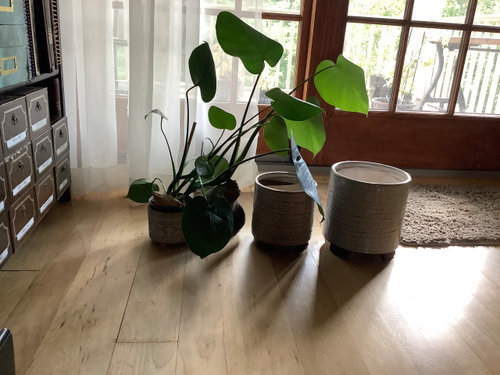
My Monstera Deliciosa is in serious need of repotting. I got it a new planter (will have inner pot), but I'm not sure which size to pot it up into. Staying in its current pot is absolutely not an option; it will fall over without the rock to weight the pot and the frog to lean on. Any advice welcome!


Medium
Large
Neither, get another option

Comments (13)

  • 4 years ago

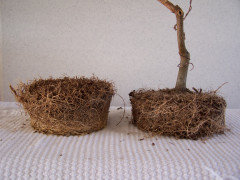
    Whether or not a plant needs repotting is best determined by how congested the roots are. If you can lift the root/soil mass from the pot intact, it needs repotting. There is a considerable difference between repotting and potting up. Repotting, which includes removal of a good measure of the lower root mass and as much soil as possible, relieves all stress associated with root congestion (being root bound). Potting up only somewhat eases the stress of root congestion, and should be considered a half measure.

    Mid-June is the best time to do a full repot, but you can pot up almost anytime without much trouble, though it's still best to pot up in June as the plant will best tolerate the stress and recolonize the new soil mass faster when days are longest and sun most intense, both of which peak on 21 June, the summer solstice.

    If it was my plant, I would pot up now, with an eye toward doing a full repot next June.

    The advice to "repot or pot up only to a pot about 1" larger than the pot it's currently in is based on the assumption that you'll be using a commercially prepared potting mix based on all fine particles. What determines pot size are A) The size of the current root mass, and B) the grow medium you choose to use. The media I use has no upper limit insofar as what size pot is appropriate. With no ill effects I could pot a tiny seedling in a 55 gallon drum of soil if I choose to. If you pot up now, it's a pretty sure bet there is enough good light left (in this growth cycle) so the roots will fully colonize the new soil and it won't stay wet for extended intervals between waterings. THAT is what you want to avoid. With that in mind, I'd go for the larger pot. If you repot next June, you'll be able to reuse the same pot.

    If you're watering correctly, you should be fertilizing about every 3rd or 4th time you water. Tying the frequency with which you fertilize to the number of times you have watered (since last fertilizing) makes better sense than using the calendar because watering correctly flushes out accumulating salts (from tapwater and fertilizer solution). In winter when plants aren't growing much, you might fertilize only every 2-3 weeks, while in summer you might fertilize weekly or more often. That is why how many times you have watered is much more important than how long it's been since you last fertilized. Foliage-Pro 9-3-6 would be a very good choice for your houseplants for a number of good reasons. Ask if you have interest. It's a complete nutritional supplementation product from a single container, and few fertilizers can make that claim.

    Al


  • 4 years ago

    I guess I've never thought about the difference between potting up and repotting. I need to pot up, so it doesn't fall over; I don't know if I need to repot.


    I don't think I've ever fertilized it ... I've had it for a little over a year. I water it when it gets dry by watering through with tap water; if it gets really dry (as in verging on drooping), I might let it soak in a cup for a short period, as at that point, through watering just runs through without wetting the media.

    Is that fertilizer applicable for all non-succulent foliage house plants? I've got a pothos, a Monstera adansonii, a Fatsia japonica, a Syngonium podophyllum, a Raphidophora tetrasperma, and a Swedish ivy ... generally all watered from the top; some drain over the sink; some have saucers. Also, I have cuttings that are rooting in water of the Monstera adansonii and the pothos that are ready/almost ready to be potted (I was considering potting them together). Should new cuttings be fertilized early on or do they have a waiting period?

  • 4 years ago

    I guess I've never thought about the difference between potting up and repotting. I need to pot up, so it doesn't fall over; I don't know if I need to repot. As I noted above, when your plant gets to the point where you can lift the root and soil mass from the pot intact, so the soil doesn't crumble away from the roots,

    your plant will benefit significantly from a full repot. Potting up only offers a fraction of the benefit that repotting does. Once a plant gets to the stage where roots and soil look like the plant above, the limitation imposed by root congestion remains until someone actually gets there hands into the roots and corrects the congestion. Your plant will be easy to repot as all you'll need to do is saw off the bottom 1/2-2/3 of the root mass and tease what soil you can away from the remaining roots. That type of work is best done in June when the plant will tolerate it readily due to its stored energy reserves and its current ability to make food (carry on photosynthesis) will be at peak levels.

    I don't think I've ever fertilized it ... I've had it for a little over a year. Is that fertilizer applicable for all non-succulent foliage house plants? I've got a pothos, a Monstera adansonii, a Fatsia japonica, a Syngonium podophyllum, a Raphidophora tetrasperma, and a Swedish ivy ... generally all watered from the top; some drain over the sink; some have saucers. Several nutrients are considered to be mobile in the plant. That means the plant can rob mobile nutrients from old leaves and use them to fuel growth of new leaves. That's very likely what is occurring in your older leaves. Magnesium is mobile in the plant and happens to be at the center if chlorophyll molecules. Chlorophyll is a green pigment, so when magnesium is removed the green can no longer mask other pigments which have become expressed in the older leaves. It will also cause the older leaves to be shed, and what I see is consistent with the shedding process. I had to ask about sunburn before I could be sure about what is actually occurring. When you start fertilizing, the older leaves will still be shed (because the shedding process ir irreversible once started, but it will stop occurring in the existing unaffected leaves until they are shed through natural senescence (aging).

    There are very few plants that won't do exceptionally well on a supplementation regimen using Foliage-Pro 9-3-6. You won't need any other fertilizers or gimmicky tonics for the plants you listed. If you use it for tomatoes or hibiscus, all you need to do is increase the amount of potassium you provide. If you ever get to the point you need help with those 2 outliers, just ask and I'll help you through it; otherwise, you can use the 9-3-6 as your 'go to' fertilizer for all your containerized plants.

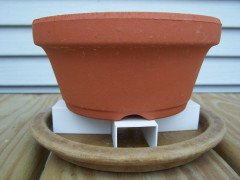
    Top watering is best as it will flush accumulating salts from the soil. Too much in the way of salts and skewed nutrient ratios are not good for the plant, which is why watering correctly is so important. If you depend on a saucer to collect the water that exits the drain hole(s), you shouldn't let the pot sit in the water that collects in the saucer, as that arrangement allows the salts a pathway back into the soil. Set your pot up on some sort of supports so it's above the water in the saucer.

    Should new cuttings be fertilized early on or do they have a waiting period? Newly rooted cuttings should be fertilized as soon as they are potted. Reason: they will have exhausted (or nearly so) all their stored nutrients and food/energy to produce the new roots. An already rooted and established plant (other than a cutting) being transplanted will colonize the soil mass faster if it is not fertilized for a couple of weeks after transplanting.

    Al

  • 4 years ago

    All the leaves on the Monstera are the same tone of green, no sunburn either. (Any color variation is just light coming through them.) I would describe the light in this location as very bright indirect; the deck you see through the doors behind the plant has a roof, so it diffuses the light. The Syngonium might be having the issue you describe with mobile nutrients, though. It was repotted earlier this year (changed the media and got it into well draining pot). The Fatsia japonica is recovering from being missed on a water check (and has been moved from its corner where it wasn't getting enough light or attention - how it got missed), so it lost some leaves to that but is doing okay now. The Raphidophora is a rescue plant that is still a bit of a mess (cold damage) but is alive ... Swedish ivy is prolific, and pothos and Monstera adansonii had to be pruned to reduce doggy temptation of dangling vines (created the aforementioned cuttings).


    I will definitely try to pick up some 9-3-6 fertilizer. I have 4-3-6 from my Aerogarden, which I've used for tomatoes before if they started showing nutrient deficiency symptoms; is that a poor choice for that? I have a little tomato (8"-12" expected height) that I just started and intend to grow inside; what would it want? Are sweet peppers in the same boat as tomatoes? I was considering trying to grow some inside for winter; I often bring my outdoor pepper plants in come frost/freeze, but without expectation for them to thrive, just finish producing. I think I might try to actually grow a pepper plant or two indoors this winter (under lights, of course). No Hibiscus here ... or at least none that we planted (we occassionally get Rose of Sharon volunteers outside).


    I use the saucers to prevent (in theory) flooding of the table/cabinet while watering, and then dump the water out of saucers after.


    Okay, so the CUTTINGS do get fertilized but don't fertilize the Swedish ivy DIVISIONS?

  • 4 years ago

    The other option to it falling over is to give it some support within the existing or new pot. Bamboo stake, moss pole, or coir poles or even a trellis.

    Hope that helps.

  • 4 years ago

    BB can correct the tendency of the plant to tip over by changing the planting angle when she pots up or repots. Simply reposition the plant more vertically so it's evenly balanced.

    Al

  • 4 years ago

    It does have a dowel stake. It was adjusted last time it was repotted, last year, and that stake was added; the stake has moved and the plant retied a couple times since, though I have limited ability to reorient it at this point, and it needs a pot that it can't lift off the floor quite so easily. It will likely keep its stake during pot change.

  • 4 years ago

    I have 4-3-6 from my Aerogarden, which I've used for tomatoes before if they started showing nutrient deficiency symptoms; is that a poor choice for that? I have a little tomato (8"-12" expected height) that I just started and intend to grow inside; what would it want? Upthread, I mentioned that tomatoes and hibiscus are outliers that need more P and K than most plants. The 4-3-6 is well suited to either of those plants. For houseplants. 4-3-6 has too much P and K. Anything extra or unnecessary in the soil solution has the potential to be as limiting as a deficiency, so should be avoided. I was considering trying to grow some inside for winter; I often bring my outdoor pepper plants in come frost/freeze, but without expectation for them to thrive, just finish producing. I think I might try to actually grow a pepper plant or two indoors this winter (under lights, of course). No Hibiscus here ... or at least none that we planted (we occassionally get Rose of Sharon volunteers outside). You'll need high power lights if you expect to raise a tomato or pepper crop indoors. It won't be easy.

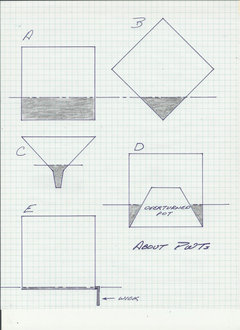
    I use the saucers to prevent (in theory) flooding of the table/cabinet while watering, and then dump the water out of saucers after. If you allow the saucer to sit in the effluent that exits the drain hole, the level of salts in the saucer and the salts in the soil solution will quickly reach the state of isotonicity, which means the level of salts in both solutions will be equal. That pretty much trumps the reason you flush the soil as you water. Best practice is to deny any pathway by which salts flushed into the saucer can make way back into the pot. Raising the pot above the bottom of the saucer or allowing the plants to drain in the sink will accomplish that. Also, if you tip your plants at a steep angle after you water (compare B to A below)

    you can eliminate a good measure of excess water from a planting. Excess water (perched water) is always limiting to terrestrial plants, so it's best to eliminate as much as possible. The pots in the drawings are full of soil and the shaded area represents the fraction of soil that remains 100% saturated even after drainage has stopped.

    Okay, so the CUTTINGS do get fertilized but don't fertilize the Swedish ivy DIVISIONS? Correct. Wait 2 weeks to fertilize the transplants that were already well established in another pot.

    Al

  • 4 years ago

    Sometimes we all need some froggy to lean on.

  • 4 years ago

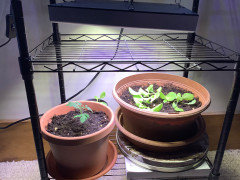
    This is my light set up ...


    It's the same set up I use with my seedlings before they can be hardened in the spring. (Yes, I know the lettuce is scraggly ... that's from before it went under the light and before it got its riser.) The light is similar to what's in the Aerogarden ... which is higher on this same shelf.

  • 4 years ago

    Unfortunately, that set up will provide nowhere near enough light to fruit tomatoes or peppers.

    Al

  • 3 years ago

    Strong work!

    Al

Sponsored
AIS Renovations
Average rating: 4.5 out of 5 stars15 Reviews
Custom Craftsmanship & Construction Solutions in Franklin County, Ohio