Software
Houzz Logo Print
gardenfanatic2003

Is this icky spot anything to be concerned about?

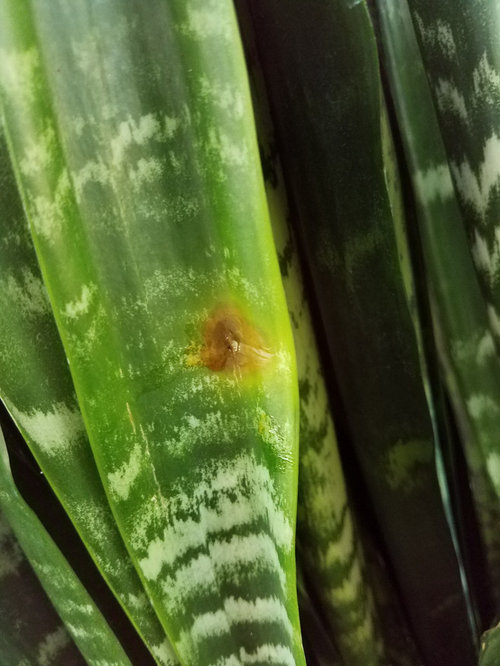
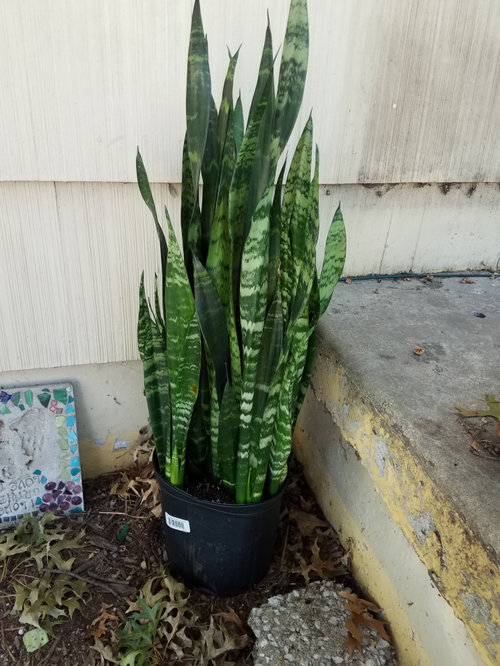
Got this big sans today and I noticed it has a wet icky spot. Should I just let it dry up and leave it be or should I cut the leaf off?


Also, does this look like a black coral sansevieria?


Thanks!


Deanna

Comments (9)

  • 3 years ago

    It looks like it could be a mechanical injury (think 'bruise'). If so, it is of little concern beyond detracting from eye appeal. If it is caused by a disorder called oedema/edema, you should be more careful about watering at more appropriate intervals. If you're watering thoroughly and the soil is remaining soggy for more than 4 or 5 days, you'll probably find yourself battling your grow medium for control of the plants vitality level (health). One of the most important choices you will make as a grower is the grow medium you use. Excess water retention can severely limit your plants' opportunity to realize as much of its genetic potential as possible.

    More about oedema:

    Oedema

    Oedema (aka edema) is a physiological disorder that can affect all terrestrial plants. It occurs when the plant takes up more water than it can rid itself of via the process of transpiration. The word itself means 'swelling', which is usually the first symptom, and comes in the form of pale blisters or water-filled bumps on foliage. Under a variety of circumstances/cultural conditions, a plant's internal water pressure (turgidity) can become so high that some leaf cells rupture and leak their contents into inter-cellular spaces in leaf tissue, creating wet or weepy areas. Symptoms vary by plant, but as the malady progresses, areas of the leaf turn yellow, brown, brown with reddish overtones or even black, with older damage appearing as corky/ scaly/ ridged patches, or wart/gall-like bumpy growth. Symptoms are seen more frequently in plants that are fleshy, are usually more pronounced on the underside of leaves, and older/lower leaves are more likely to be affected than younger/upper leaves.

    Oedema is most common in houseplants during the winter/early spring months, is driven primarily by excessive water retention in the soil, and can be intensified via several additional cultural influences. Cool temperatures, high humidity levels, low light conditions, or partial defoliation can individually or collectively act to intensify the problem, as can anything else that slows transpiration. Nutritional deficiencies of Ca and Mg are also known contributors to the malady.

    Some things that can help you prevent oedema:

    * Increase light levels and temperature

    * Monitor water needs carefully – avoid over-watering. I'd heartily recommend a soil with drainage so sharp (fast) that when you to water to beyond the saturation point you needn't worry about prolonged periods of soil saturation wrecking root health/function. Your soil choice should be a key that unlocks the solutions to many potential problems.

    * Avoid misting or getting water on foliage. It slows transpiration and increases turgidity.

    * Water as soon as you get up in the AM. When stomata close in preparation for the dark cycle, turgidity builds. If you water early in the day, it gives the plant an opportunity to remove (for its own needs) some of the excess water in the soil.

    * Put a fan in the room or otherwise increase air flow/circulation. Avoid over-crowding your plants.

    This should help you with determining appropriate watering intervals:

    Using a 'tell'

    Over-watering saps vitality and is one of the most common plant assassins, so learning to avoid it is worth the small effort. Plants make and store their own energy source – photosynthate - (sugar/glucose). Functioning roots need energy to drive their metabolic processes, and in order to get it, they use oxygen to burn (oxidize) their food. From this, we can see that terrestrial plants need plenty of air (oxygen) in the soil to drive root function. Many off-the-shelf soils hold too much water and not enough air to support the kind of root health most growers would like to see; and, a healthy root system is a prerequisite to a healthy plant.

    Watering in small sips leads to avoid over-watering leads to a residual build-up of dissolved solids (salts) in the soil from tapwater and fertilizer solutions, which limits a plant's ability to absorb water – so watering in sips simply moves us to the other horn of a dilemma. It creates another problem that requires resolution. Better, would be to simply adopt a soil that drains well enough to allow watering to beyond the saturation point, so we're flushing the soil of accumulating dissolved solids whenever we water; this, w/o the plant being forced to pay a tax in the form of reduced vitality, due to prolong periods of soil saturation. Sometimes, though, that's not a course we can immediately steer, which makes controlling how often we water a very important factor.

    In many cases, we can judge whether or not a planting needs watering by hefting the pot. This is especially true if the pot is made from light material, like plastic, but doesn't work (as) well when the pot is made from heavier material, like clay, or when the size/weight of the pot precludes grabbing it with one hand to judge its weight and gauge the need for water.

    Fingers stuck an inch or two into the soil work ok for shallow pots, but not for deep pots. Deep pots might have 3 or more inches of soil that feels totally dry, while the lower several inches of the soil is 100% saturated. Obviously, the lack of oxygen in the root zone situation can wreak havoc with root health and cause the loss of a very notable measure of your plant's potential. Inexpensive watering meters don't even measure moisture levels, they measure electrical conductivity. Clean the tip and insert it into a cup of distilled water and witness the fact it reads 'DRY'.

    One of the most reliable methods of checking a planting's need for water is using a 'tell'. You can use a bamboo skewer in a pinch, but a wooden dowel rod of about 5/16” (75-85mm) would work better. They usually come 48” (120cm) long and can usually be cut in half and serve as a pair. Sharpen all 4 ends in a pencil sharpener and slightly blunt the tip so it's about the diameter of the head on a straight pin. Push the wooden tell deep into the soil. Don't worry, it won't harm the root system. If the plant is quite root-bound, you might need to try several places until you find one where you can push it all the way to the pot's bottom. Leave it a few seconds, then withdraw it and inspect the tip for moisture. For most plantings, withhold water until the tell comes out dry or nearly so. If you see signs of wilting, adjust the interval between waterings so drought stress isn't a recurring issue.

    Al

    gardenfanatic2003 thanked tapla (mid-Michigan, USDA z5b-6a)
  • 3 years ago

    whats the hurry???

  • 3 years ago

    I would cut that leaf off. It looks like the rhizomes are so crowded, the pot is contorted. Is that true, or just a trick of the pic? If so, I would repot it as soon as convenient.

    gardenfanatic2003 thanked Tiffany, purpleinopp Z8b Opp, AL
  • 3 years ago

    Tiffany, yes the pot is very crowded!

    @tapla (mid-Michigan, USDA z5b-6a) when using a tell, seems like once you've put the tell in one pot you wouldn't be able to use it for another pot right afterwards because it might possibly already be wet. Correct? Then what?


    Deanna

  • 3 years ago

    Ken, what's the hurry for what?

  • 3 years ago

    From a single 48" dowel rod, you can make 2 tells with 2 ends each, so that gives you 4 shots, however, after using you can usually wipe any moisture or soil from the tip with a paper towel, an old terry towel, or any absorbent rag, so it's immediately dry enough to use again.

    I don't use a tell because the media I use are very fast draining and difficult to over-water, leaving me unconcerned about lost potential or damage due to excess water retention. That's the ideal path to be on, in my estimation. I started out where virtually everyone else started - using media that held too much water to offer anything but mediocre results. When I finally arrived at the place where I no longer had to battle the grow medium for control over my plant's vitality level (health), it was transformational and made all aspects of growing much easier - especially watering and fertilizing.

    Al

    gardenfanatic2003 thanked tapla (mid-Michigan, USDA z5b-6a)
  • 3 years ago

    Those skewers are so handy for so many things. Shish-ka-bobs, of course, but also as the tell, micro support stake, pushing a wick up through the soil, squirrel proofing, reminder marker, poking a hole to insert a cutting.

  • 3 years ago

    Tapia, would love to know your what medium your growing in.... I can't seem to find one I'm happy with.

Sponsored
Haus Studio
Average rating: 4.8 out of 5 stars28 Reviews
Franklin County's Preferred Custom Cabinetry & Design Studio