Software
Houzz Logo Print
ruthj98

Do sansevieria usually need to be staked?

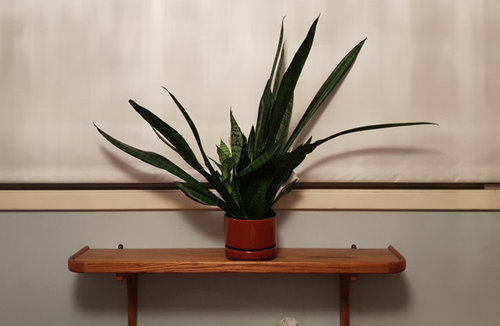
With my first sansevieria ever, I goofed up and didn't rotate the plant often enough so the leaves grew every which way! After that I vowed to rotate regularly.

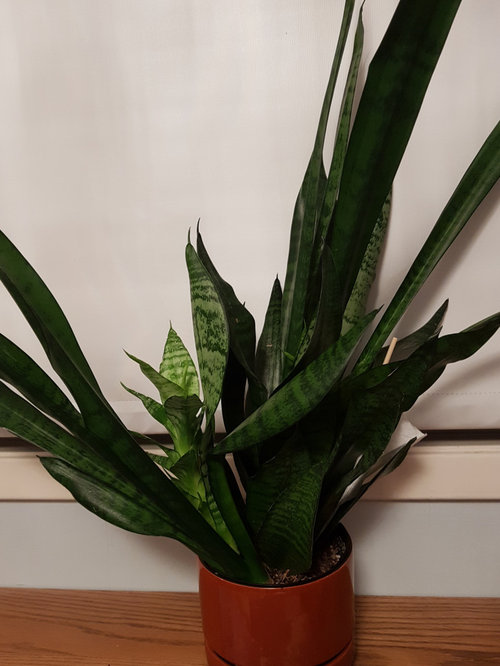
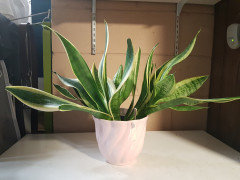
I have done pretty well with this plant, but the plant is actually almost falling over. Each stem seems almost too weak and is wobbly. Is this normal? I obviously have to do something. I plan to repot and I feel I have to stake this plant. I am looking for advice about how to do this so it continues to grow straight and continues to look attractive.


Comments (37)

  • 3 years ago

    They are not usually staked. It looks like it needs a slightly larger pot.


    newhostalady Z6 ON, Canada thanked lgteacher
  • 3 years ago

    Not usually staked . . . hmmm. I was thinking that it may need a larger pot, but would that help to anchor the stems and not have them so wobbly?

  • 3 years ago

    It looks like it was so crowded, it was forced to lean. I suspect the pot is so full of rhizomes that they are pushing upward and contributing to the lean in that way too.

    newhostalady Z6 ON, Canada thanked Tiffany, purpleinopp Z8b Opp, AL
  • 3 years ago

    Also, individual rosettes do not last forever. It's OK to snap off the old sections and compost them, or use to start a 2nd pot.

    newhostalady Z6 ON, Canada thanked Tiffany, purpleinopp Z8b Opp, AL
  • 3 years ago

    After repotting, you will find the stems flop over and need support. I use an old inner bike tube tied around the whole lot to hold them upright until they can support themselves again.

    newhostalady Z6 ON, Canada thanked s g
  • 3 years ago

    Yes they are pot bound but to keep the leaves upright I use tomato cages. You will need help to place it in place so you don't break any leaves. Some use sticks with ties.

    newhostalady Z6 ON, Canada thanked Stush2049 Pitts. PA, zone 6
  • 3 years ago

    Or a few decorative rocks placed strategically on the soil surface.

    newhostalady Z6 ON, Canada thanked Tiffany, purpleinopp Z8b Opp, AL
  • 3 years ago

    @Tiffany, purpleinopp Z8b Opp, AL Does this makes sense as a process to get each leaf section to stand up straight when repotting: separate the leaf & root sections as though dividing. Then place each segment into new potstanding upright. New pot size TBD after removing from current pot, untangling roots & assessing size needed - not too big but not too small either.

    newhostalady Z6 ON, Canada thanked KW PNW Z8
  • 3 years ago

    That does sound good. I've never repotted a Sans that could stand up by itself afterward. I always need some rocks to keep them up until the roots get settled into the new soil.


    I took pics of repotting some a few yrs ago:

    https://garden.org/thread/view/96766/Repotting-snake-plants-Sansevieria/

    newhostalady Z6 ON, Canada thanked Tiffany, purpleinopp Z8b Opp, AL
  • 3 years ago
    last modified: 3 years ago

    Tiffany: "It looks like it was so crowded, it was forced to lean. I suspect the pot is so full of rhizomes that they are pushing upward and contributing to the lean in that way too."

    I don't know about that (yet). I guess I will find out when I repot. I have found that when there are new rhizomes, and the pot is too small, the pot gets distorted. I don't think this is happening in this case.

    "individual rosettes do not last forever." What? I never knew that. As for this particular plant, I have only had it for 3 years.

    s g, thanks for the suggestion about the inner bike tube for supporting the stems.

    Stush, tomato cages is a good suggestion too. I do have some extra long bamboo sticks that might do the trick.

    Rocks on the surface temporarily sounds good Tiffany.

    I do hope that the plant will not need support after it settles into the new media.

    Love the pictures Tiffany! Excellent job!

    This sans is currently in a bark media. I plan to repot with cactus/succulent soil mixed with 50% pumice. Does that sound OK?

  • 3 years ago

    I had another look at my plant's pot. The pot is plastic and I can squeeze the pot. Seems like there isn't a lot of roots perhaps? I wanted to keep the original stalk with the new one (only 2 there), but I think they are growing too close together. My plan now is to separate the two. I will let you know what I find when I repot.

  • 3 years ago

    Tapla, as much as I love hearing from you, I believe you meant to add this comment to another post?

  • 3 years ago

    Looks like I've contracted a bad case of the 'dumb ass' today. My bad. I'll fix it and see you down the line! Thanks for the heads-up. Tomorrow Ida been thinking, "I KNOW I posted something to that thread yesterday, so where the heck did it go?!"

    Al

    newhostalady Z6 ON, Canada thanked tapla (mid-Michigan, USDA z5b-6a)
  • 3 years ago

    @tapla (mid-Michigan, USDA z5b-6a) I wondered about your info relating to this thread too but I know, from reading other plant threads that you are held in high regard so I took it as helpful info to something I’m pondering. That is, last winter I put my small pots of different types of sanseveiria & Jades in my insulated garage. In spring summer they’re on my west facing covered porch. I’m wondering how risky it is to leave them there this winter & cover them with a cloth when night temps below freezing. I’m in PNW zone 8. So, your post made me think garage might be best again Garage has windows so some light in there

    newhostalady Z6 ON, Canada thanked KW PNW Z8
  • 3 years ago

    OK, so I'm back.

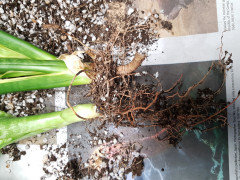
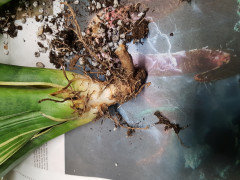
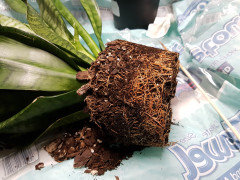
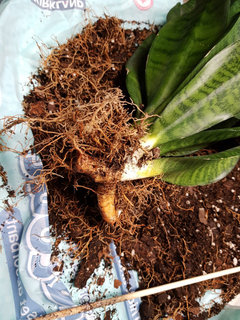
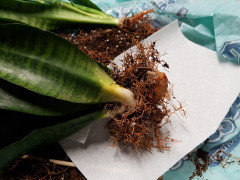
    I did a repot. I was disappointed to find that there had been a good amount of roots, but there was root rot! So I cleaned it up.


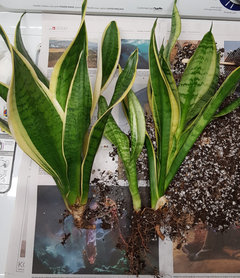
    The offset broke off while I was cleaning up the roots.


    This is what I ended up with.


    Continuing . . .

  • 3 years ago
    last modified: 3 years ago

    (continued)

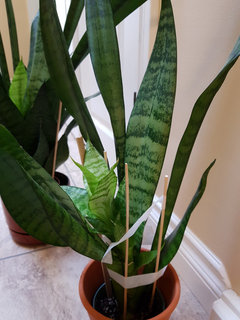
    I did pot them both up. The original one looks good. It's not that easy staking them up---especially the offset---big plant, small root system.

    I have some questions:

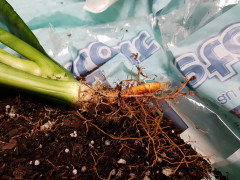
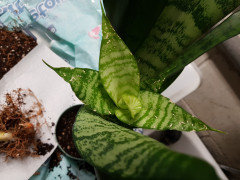
    (1) why does the offset have these marks?


    (2) why does the offset seem to have a high neck before it seems to branch out?

    Final result:


    I thought I was doing so well with these plants (sans). Now I'm not sure.

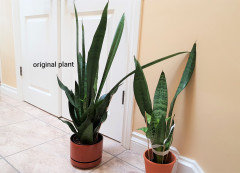
    I also thought more offsets would make the plant bigger and better. (I like them big!) Now I don't think so with this particular plant. I like the original plant better without its offset.

    I have another sans that has one offset. I think it's going to turn out to be like this one---root rot and a high neck for offset. Darn.

  • 3 years ago

    (1) why does the offset have these marks? The lighter colored corky blemishes on the foliage are indicative of a physiological disorder, oedema/ edema. Since over-watering is the primary driver of the disorder, the root rot you found would tend to add additional support to the diagnosis. See something I wrote about it below.


    Oedema

    Oedema (aka edema) is a physiological disorder that can affect all terrestrial plants. It occurs when the plant takes up more water than it can rid itself of via the process of transpiration. The word itself means 'swelling', which is usually the first symptom, and comes in the form of pale blisters or water-filled bumps on foliage. Under a variety of circumstances/cultural conditions, a plant's internal water pressure (turgidity) can become so high that some leaf cells rupture and leak their contents into inter-cellular spaces in leaf tissue, creating wet or weepy areas. Symptoms vary by plant, but as the malady progresses, areas of the leaf turn yellow, brown, brown with reddish overtones or even black, with older damage appearing as corky/ scaly/ ridged patches, or wart/gall-like bumpy growth. Symptoms are seen more frequently in plants that are fleshy, are usually more pronounced on the underside of leaves, and older/lower leaves are more likely to be affected than younger/upper leaves.

    Oedema is most common in houseplants during the winter/early spring months, is driven primarily by excessive water retention in the soil, and can be intensified via several additional cultural influences. Cool temperatures, high humidity levels, low light conditions, or partial defoliation can individually or collectively act to intensify the problem, as can anything else that slows transpiration. Nutritional deficiencies of Ca and Mg are also known contributors to the malady.

    Some things that can help you prevent oedema:

    * Increase light levels and temperature

    * Monitor water needs carefully – avoid over-watering. I'd heartily recommend a soil with drainage so sharp (fast) that when you to water to beyond the saturation point you needn't worry about prolonged periods of soil saturation wrecking root health/function. Your soil choice should be a key that unlocks the solutions to many potential problems.

    * Avoid misting or getting water on foliage. It slows transpiration and increases turgidity.

    * Water as soon as you get up in the AM. When stomata close in preparation for the dark cycle, turgidity builds. If you water early in the day, it gives the plant an opportunity to remove (for its own needs) some of the excess water in the soil.

    * Put a fan in the room or otherwise increase air flow/circulation. Avoid over-crowding your plants.

    Al

    newhostalady Z6 ON, Canada thanked tapla (mid-Michigan, USDA z5b-6a)
  • 3 years ago

    @newhostalady Z6 ON, Canada your newly repotted two plants certainly look better han the original single plant did.

    newhostalady Z6 ON, Canada thanked KW PNW Z8
  • 3 years ago
    last modified: 3 years ago

    Al, thank you for explaining about oedema. I would have never figured that out! I thought I had somehow damaged the foliage for it to have such markings---or perhaps it was some kind of disease or insect. I am making note of it and how to prevent oedema from appearing.

    I have been watering the plant maybe once a month. It seemed so infrequent to me that I started to write down the dates I watered it on masking tape and taped it to the pot! I know Al, that you advocate a better draining mix and that my plants would be healthier for it. I had intentions to try a better mix; had difficulty getting the correct sized bark (impossible here!); did actually find turface; but gave up due to the unavailability of the bark. I also worried about how often I would have to water, as I am an under waterer! I know my plants could be better though.

    Thank you KW for saying the plants look better! Always nice to hear that one's work had made improvements! I like my original plant again now and I will love it when it's roots are strong enough to hold the plant in the soil without much support. As for the offset, all that oedema is disappointing to see. I know those marks will be easily visible for a very long time. I do look forward to seeing no more oedema forming!

  • 3 years ago
    last modified: 3 years ago

    I have to be honest and say you got me thinking about this compost pile and post thing Al! I was even wondering if I dared to ask what you were talking about! LOL! So glad you clarified. I had a good laugh at myself!

    It breaks my heart to throw away plants so my plan is to wait and see what happens. If the oedema continues, then I will throw the plant out. I will have to reassess my media. I understand that it will take a long time for these damaged leaves to be shed.

    So I will plan on repotting my other sans which may also have root rot. The good thing though is that I don't see any oedema. It has one offset too. The mother plant shed two outer leaves recently. Maybe that was a sign of poor root health. I guess I just have to have a look and see.

    My "plan" was to ask the forum about other sans---more unusual attractive varieties---so I could see if I could purchase some. But there is no point if I can't keep the ordinary sans going without difficulty.

  • 3 years ago

    These look great! I think you're putting too much mental burden on yourself. If a few oedema spots were a reason to declare that things aren't going well for a plant, or that someone is not worthy of getting more of them, that's just too strict. That happens to various individuals among my collection while they are outside. I can't stop the temp fluctuations and it doesn't seem more concerning of an issue than a person getting a zit. In perfect conditions, a perfect plant can be expected. Perfection is great, but so rarely meets reality. Of course we all want picture-perfect plants, so don't leave your scissors out of the equation. It's normal that, just like branches, occasional roots will die and others will replace them. There will be imperfections, plants are living things. You can cut off any part of a leaf that is distracting from your enjoyment. (Imagine how great people would look if we could be "lightly pruned!") Aside from a few spots on a few leaves, I don't see anything wrong with your plants or anything that looks like rotting in your root pics, although that determination can require tactile information.


    The variegated varieties you might see at a BBS are identical in care requirements to the plain species that you have. If you see one you want, I would encourage you to get it, and give it the same care as your existing plant(s), making use of the soil info that Al provided. In addition, there's always clay pots to try. A totally different experience for a plant vs. being in a plastic pot.


    If you can provide a bit more light, the leaves will be more upright, less splayed, but now we're talking about style, not health.

    newhostalady Z6 ON, Canada thanked Tiffany, purpleinopp Z8b Opp, AL
  • 3 years ago

    Tiffany is an experienced grower. I agree.

    newhostalady Z6 ON, Canada thanked Stush2049 Pitts. PA, zone 6
  • 3 years ago

    Thank you, Stush. :+)

    newhostalady Z6 ON, Canada thanked Tiffany, purpleinopp Z8b Opp, AL
  • 3 years ago

    Tiffany, thanks for the pep talk. I needed it!

    "Perfection is great, but so rarely meets reality." How true that is!

    I wish I could give my plants more light, but as I became a lover of plants, I discovered my home isn't that great for plants---not indoors nor outdoors! I have no south facing windows. The east sun is minimal and the west sun is available in winter and early spring only. Come spring/summer, my two huge trees leaf out and take away most of the sunlight. I always think my plants must be confused. The sun gets stronger by late winter/early spring and then bang! seems like one day the sun is gone.

    The sans grow reasonably well I guess. I didn't know that the splayed look was due to having less light. I think the sans would be happy to be outside for a while, but I worry about bringing in any insects so I haven't tried that yet.

    The next sans I will repot has splayed leaves. The offset seems to be getting pushed out and the offset is rather loose. No oedema noted! I think the plant will be happier separated and repotted.

    Thanks for your words of encouragement Tiffany!

    I believe you Stush.

  • 3 years ago

    My pleasure! I know what you mean about shifting shadows and varying light in spots. The struggle is real for all of us! : )


    Other plants that can do OK without much light, that you might like, Pothos (Epipremnum), self-heading, shrubby Philodendrons, lucky bamboo (Dracaena braunii), Chinese evergreen (Aglaonema).

    newhostalady Z6 ON, Canada thanked Tiffany, purpleinopp Z8b Opp, AL
  • 3 years ago

    Thanks for the other plant suggestions Tiffany! I will look into them. By the way what plant do you mean when you say "shrubby Philodendrons?"

  • newhostalady Z6 ON, Canada thanked Tiffany, purpleinopp Z8b Opp, AL
  • 3 years ago

    Well that's cool Tiffany! I have never heard of it before. I will be on the lookout for them!

  • 3 years ago

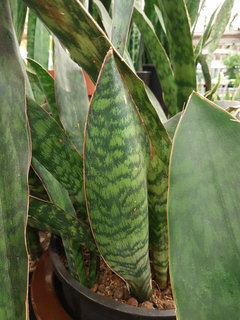
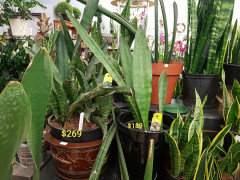
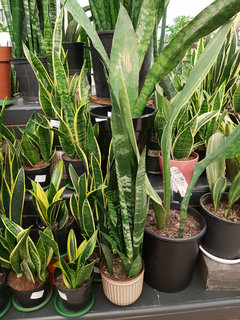
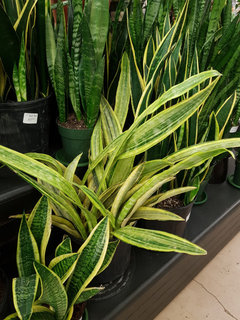
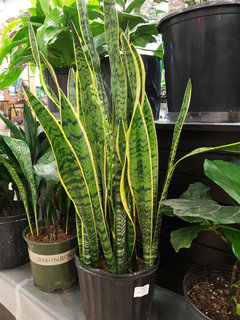
    Oh, almost forgot---I just had to go into a garden nursery since I was shopping right next door. Took some pictures while I was there.


  • 3 years ago
    last modified: 3 years ago

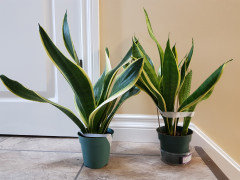
    I had one more sansevieria with the same problem as the plant above---plant was wobbly in the pot and splaying out. So I separated the plant into two.


    I found that the offset had decent roots but the original plant had few roots!

    The next picture is of the two offsets which I kept together:


    The next photo is of the mother plant:


    So I now have the original plant in one pot and the two offsets were kept together in another pot. They are looking much better now. Hopefully the mother plant will get more roots. Noted: a couple of leaves with oedema. I will work on getting a picture of how they look now.

  • 3 years ago

    Took a picture as they look now.


  • 3 years ago

    Very nice!

    newhostalady Z6 ON, Canada thanked Tiffany, purpleinopp Z8b Opp, AL
  • 3 years ago

    If you get tired of the tape and don't have any rocks, sponges can gently prop a plant without causing gouge marks or scrapes. Might need to cut to shape.

    newhostalady Z6 ON, Canada thanked Tiffany, purpleinopp Z8b Opp, AL
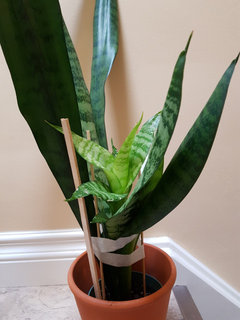
  • 3 years ago

    Don't buy any more sans right now. Come spring when I take my plants out, I will be giving a bunch away again. Post me any time to be put on list.

    newhostalady Z6 ON, Canada thanked Stush2049 Pitts. PA, zone 6
  • 3 years ago

    Tiffany, I am not sure how one can prop a plant with sponges. Do you have a picture to show me? Sounds like something that I should learn. If I were to use rocks, what size would be best? I actually have some turface and some decorative gravel. Would either of these be good or did you mean larger rocks?

    Stush, were you mentioning for me not to buy any sans? How sweet of you! Unfortunately, I am in Canada so I will not be able to receive any of your plants. (Now I want to move to the US!) Darn! Anyways, you must have quite a list of people who are interested in your plants. I hope they are grateful of your generosity!

  • 3 years ago

    Either rock or sponge, something the right size to fit between the base of the plant and the side of the pot, so the plant can't fall over. It just depends on the size of the space that needs to be filled - until the plant is well rooted and sturdy again.

    newhostalady Z6 ON, Canada thanked Tiffany, purpleinopp Z8b Opp, AL
Sponsored