Software
Houzz Logo Print
lisas285

Why is my yucca sad?

3 years ago
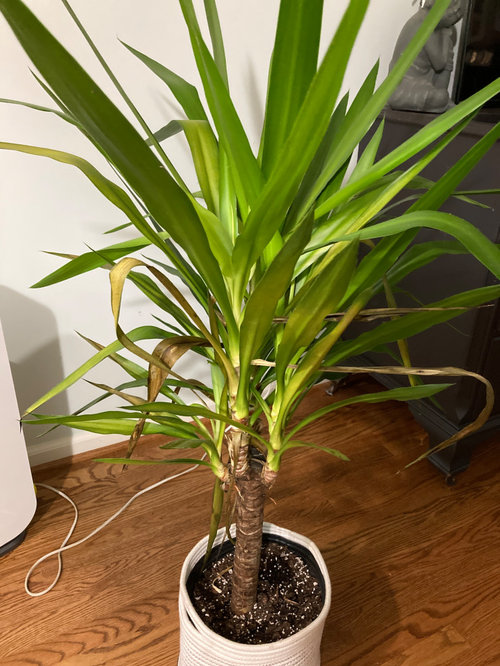
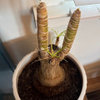
I’ve had this yucca since spring and it always looked healthy and has grown several new leaves. Over the past month its been on a decline though I haven’t done anything new to upset it. The leaves are losing their dark color, some have a light yellowing and some others are drying out. I didnt see any pests and my watering schedule is about once a month or as needed. Medium light, and a blend of different soils mixed with bark and perilite. Thank you every

one!

Comments (3)

  • 3 years ago

    Not enough information.

    Do you fertilize? with what? how often? Does the pot have a drain hole? Do you allow the plant to sit in any effluent that exits the drain hole? "A blend of different soils" can mean practically anything. It only takes a small fraction of garden soil or topsoil to fill all the pores between soil particles, leaving the plant in a muddy soil regardless of the addition of bark and perlite. If a grower wants to take advantage of the superior aeration and drainage some grow media offer, it is essential that the media are based on a very large fraction of coarse ingredients and contain only a small fraction of fine materials - just enough to bring water retention up to a level that provides watering intervals you're willing to work with. There is far more potential in a grow medium that requires you to water daily or every other day than in one that provides watering intervals measured in weeks or months.

    The plant is chlorotic (yellow). That can be related to poor nutrition, over or under-watering, low light, a high level of dissolved solids (salts) in the soil solution, insect herbivory, ...... Very often, figuring out what the problem is requires us to first eliminate what it isn't. More often than not, that requires an exchange of information, and hints derived from recognizable patterns. When all's said and done, it's almost always the simplest diagnosis that accounts for all the symptoms we learn along the way.

    Al

    Lisa S thanked tapla (mid-Michigan, USDA z5b-6a)
  • 3 years ago

    Currently, the plant is in the growers pot (I gave it new soil when I bought it) within a decorative basket, and a plastic saucer. When I fertilize, its with Jacks brand and I do so every few months. My soil is a mix of general purpose, spagnum, cactus, orchid bark, and perilite. I’m careful not to overwater so that the water does’t puddle and sit. My water is softened and neutralized, so maybe it’s the lack of minerals? I can use RO water, but I avoid it due to the waste it creates, and with well over 100 plants, it would be a lot of waste. I would love to buy a light meter, but for now, I’d say the plant is about 5-6’ from a south facing window.

  • 3 years ago

    "My water is softened" jumps out at me as something that needs looking into. If you have an ionic exchange water softener, one that uses a less pure form of sodium chloride (table salt), and the water you use to water your plants is routed through that device, there is no question that the level of sodium and chloride are at levels well beyond the toxic threshold; and, this would be especially true when watering in smaller amounts to ensure water doesn't puddle and sit in the collection saucer. That type of watering strategy ensures that all dissolved solids in the softened water remain in the soil and build to highly toxic levels.

    I have issues with (bi)carbonate build-up in my grow medium in the winter when I can't flush the soil as freely as in summer when plants are all outdoors and watered with a hose and water break. To combat the build-up of carbonates, I bought a small r/o water system that produces water at 0 ppm dissolved solids. Your ionic exchange system removes the magnesium and calcium carbonate and replaces those ions with with sodium and chloride. While plants need both sodium and chloride to grow normally, they need both in minute quantities, which makes this a situation where 'the poison is in the dosage'.

    Here is what I would do, and pay particular attention to the part in italics:

    Flushing Soils

    When you water, you should be able to flush planting's soil to eliminate the potentiality of salts from fertilizers and tapwater accumulating in the soil, thereby limiting the plant's ability to take up water and the nutrients dissolved in the water. If you think you shouldn't flush the soil during your regular water applications for fear the soil will remain saturated for a lengthy period, limiting root function or worse, you should consider a different soil or take steps to reduce the amount of excess water your soil can hold. By whatever means necessary, getting to the point you can water correctly is going to make a very big difference in the opportunity to realize as much of it's genetic potential as possible. Once you can water correctly, you no longer have to do battle with a water-retentive medium over control of your plant's vitality. There are several methods of limiting how much water your planting can hold, all but 1 or 2 are completely passive, requiring no effort on your part other than set-up, which is monkey easy. I can help if you have interest in that, I'm continually improving my proficiency at monkey easy tasks.

    To flush the soil of a planting: Water with room temperature water until the soil is completely saturated. Allow the planting to rest for 15 minutes to an hour to allow as much of the salt accumulation as possible to go into solution, then slowly pour a volume of room temp water equal to at least 10X the volume of the pot the plant is in through the soil. This will remove most of any accumulation of offending salts and resolve any skewing of nutrient ratios.

    It's a good idea, no matter what time of year, to fertilize most plants immediately after flushing the soil. Try to be sure you're using a fertilizer that has a ratio as close as possible to the ratio at which the plant uses nutrients. The NPK % listed on fertilizer packaging is not its ratio. 7-7-7 and 14-14-14 are 1:1:1 ratios. 9-3-6, 12-4-8, and 24-8-16, are all 3:1:3 ratios. Container growers should try very hard to avoid use of fertilizers advertised as 'bloom-boosters', or any number with a middle number (Phosphorous) higher than either the first or third numbers (Nitrogen or Potassium). These fertilizers can badly skew nutrient ratios with even the first application). On average, plants use about 6x as much N as P, so there is NO potential for a positive outcome when supplying many times as much P as the plant requires. I, and a large number of other members, use Dyna-Gro's Foliage Pro 9-3-6. It's designed to closely mimic the uptake ratio of the average plant, and has many other attributes not commonly found in other fertilizers. It also has ALL of the nutrients essential to normal growth. Summarized, it makes fertilizing as easy as it can be, and from 1 container.

    Do you have any thoughts/ questions/ concerns? There is no way to determine to what degree the plant is damage. Using r/o water would be best; but, if you're not willing to go that rout, it would be better to use water not routed through the water softener if you can find a source. Usually, the outdoor hose bib supply plumbing will not have been routed through the softener. You could tap into that supply line or look for other plumbing routed around the softener.

    Al