Software
Houzz Logo Print
snappity

Range hood help

4 years ago

I am looking to buy a range hood for my kitchen reno, which will go over a 30" induction range and will be vented outside. I have searched the forums but am looking to spend under $1000, and even knowing the pros/cons of filter types, CFM, etc. would be helpful. Based on what I've read, I can add that our house is heated by minisplit 90% of the time, we have an oil burner furnace in a basement that we use as needed, and SFAG is ~1000sf in two stories, and we live in Maine (I will have to see if there are code requirements for make up air.). Because of our small house, the more we can get cooking smells outside the happier I will be. We don't do any frying.


My current range hood is original to the house, as far as I can tell, from 1954. The hood is the original Youngstown Kitchen steel, and is vented outside. I see no markings to know any specs on what the CFM would've been 70 years ago. It works, but I am assuming that modern hoods are far more efficient. Is there any way to figure out what my current hood does? The actual intake is set to the back and left, and not actually directly over the range, as the hood is 45" wide (probably to accommodate a wider electric range back in the day.)


The ones that look appealing to me from my LAS website are from XO Appliance. They also sell the major brands like GE, Whirlpool, etc. I prefer to use the LAS but if there's a compelling case for a brand they don't carry I am open to it.


Thank you for your help.


Comments (7)

  • 4 years ago

    Please provide some photos of your existing hood, including looking up into it.

    Modern commercial hoods maximize capture and containment performance for given electrical usage. In this sense they have an efficiency requirement that they try to maximize. Residential hoods that emulate to some degree commercial hoods (sometimes called Pro hoods) are less concerned about electrical power usage, but rather fitting into the residential space, meeting some minimal standard of aesthetics, and still capturing and containing the rising cooking plumes. The primary points of similarity are baffle filters and significant air flow rate (CFM) blowers. Often noise minimization is a concern, but achievement can be expensive.

    Your price point likely excludes Pro style hoods and blowers. You might be able to get close with mid range equipment, such as might be obtained from Broan or several other brands that you might learn about by reading some of the many hood threads on this forum or discover for yourself at distributors, on-line or local.

    To perform the required function you desire, however, there are certain performance requirements that we can address.

    • Hood intake entry aperture should overlap likely pans by enough to capture the rising and expanding cooking plumes. For a 30 inch cooktop this means about 36 inches wide, and at least 24 inches deep (to the wall).
    • Flow velocity at the entry aperture for induction when no searing or wok cooking is envisioned should not be less than 60 ft/min, or 60 CFM/sq. ft. of entry aperture. Otherwise use 90 ft/min.
    • A motor rated at 1.5X this value is recommended to deal with pressure losses.
    • A remote motor may be quieter than one in the hood is there is significant duct length
    • Duct diameter should keep the full power flow rate in the 1000 to 2000 ft/min region.
    • Use a baffle filter if possible
    • You cannot allow the hood system to depressurize the house sufficiently to back-draft combustion appliances and introduce CO into the house. And this level of depressurization is a minute fraction of an atmosphere. So some form of MUA is needed, even if it is passive. Oil burners can be back-drafted unless they have an MUA package for themselves. (Intake via duct from outside.)

    Your quest is best accomplished by reading many of this forum's hood system and MUA system threads to gain perspective.

  • 4 years ago
    last modified: 4 years ago

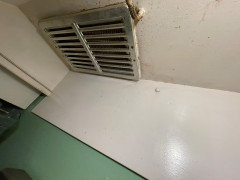
    Thank you! I have read a lot of the threads but they seem to be focused on gas, large ranges, etc. Basically, I am looking for what 30" hood (or hood features - like baffles) works best for a run of the mill residence. Here is the intake, it's not even over the range really, but in the back left corner of the 45" hood. I look at this and think really just about anything would be an improvement, right?

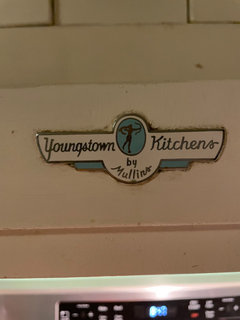
    And for fun, the emblem from the hood itself.


  • 4 years ago

    Thank you for the photos. Capture/Containment/Reservoir volume is good, but the rest is ready for the great steel recycler in the sky.

    Did you mean run of the mill cooking? The residence can be modest or extravagant, it doesn't matter for generation of greasy cooking plumes. All that matters for hot oil cooking is the pan temperature and pan size. For intermediate cooking, use of induction instead of gas removes the hot gas combustion products from the plumes, and that can reduce the requirements on the hood blower under those conditions, but for searing and wok cooking, the transient plumes from the pan interiors will dominate.

    You may have missed the deliberate generalization of my messages in the many threads I have contributed to. Air flow rate is per square foot of hood intake aperture. Hood size is determined by the need to overlap expanding plumes, which occur no matter what the range or cooktop size is. You can determine how modest your cooking is and hence what minimal hood you need.

    For very low flow rates, mesh filters will suffice, so long as they are cleaned very often. Otherwise, baffles are better because they can get very dirty and still achieve their function.

    I do not recommend a 30 inch hood over a 30 inch cooktop unless there are side cabinets and hot cooking is performed on rear burners (hobs for induction).

    I don't recommend particular components unless I have owned them, and none of mine apply to your case.

    Last, for the moment, I wish to encourage treating the hood system as a system. That means taking into account the duct, whether it can be enlarged or moved, as well as the hood, and as well as the MUA system (trivial as it might turn out to be). So some relevant questions are: If you change to a 30 or 36-inch hood, how are you going to adapt the duct to it? What path does it take to the outside? Can you change it? Enlarge it if needed? Where, exactly is your blower?

  • 4 years ago
    last modified: 4 years ago

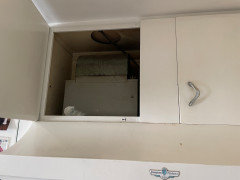
    thank you! There will be cabinets on the side, so I will be with a 30" hood. It is ducted straight out the back wall, as it's on an exterior wall, but we have flexibility to move it anywhere in that general area - no plumbing or other encumbrances in that area. The blower for this one is in a cabinet above. And yes, run of the mill cooking - we don't deep fry, any grease comes from pan cooking chicken, etc. Here is a photo of the unit it's connected to, everything is coming out to the studs in the renovation.


    I guess just knowing that baffles are good to have, I know I want LED lighting, but the cfm I see numbers like 600 and wonder if I NEED that, if even 3-400 will be a noticeable difference to what we have now. Here's a photo of the fan unit.


  • 4 years ago

    Thank you so much! We have CO detectors anyway and your information is very helpful. I appreciate you taking the time to answer!

  • 4 years ago

    Some info here: https://bamasotan.us/range-exhaust-hood-faq/


    Whether code requires MUA or not, you want to do proper MUA. You do not want any air being pulled in through wall leaks or driven in to the walls through leaks.