Software
Houzz Logo Print
md7112

Trees for Privacy?

3 years ago
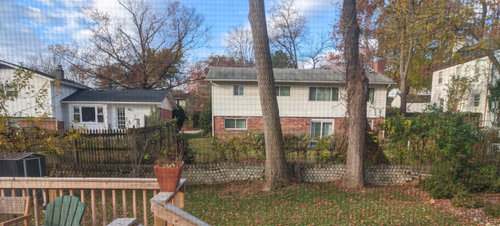


This is the view from my backyard. My lot is approximately 70 feet wide. The two tall trees whose tops you can't see are tulip poplars. I was thinking of planting a stand of arborvitae to the left of them to at least block the neighbor on the left. Is there anything I can plant between the poplars, and to the right of them that will provide privacy but won't harm them? Will whatever this is go with arborvitae? Or is there another single species I could use all the way across? Whatever it is, I need it to grow to a height of about 15 feet. I'm in zone 7a. Thanks!

Comments (17)

  • 3 years ago

    Is the fence yours? Is the wall yours?

  • 3 years ago
    last modified: 3 years ago

    Indicate geographic locaton to get suitable plant variety suggestions. Otherwise: is being on display while on the deck the biggest concern? Then plant primarily near the deck, instead of near the houses. In other words where you are looking from is instead of at. Because that way your screening will not have to be as big. Cutting down on waiting time. (Which is still going to be a matter of some years whatever you plant and wherever you put it). And you won't have to fight with the planting site conditions present near the property boundary. Including there being two Liriodendron in a big part of the involved area.

  • 3 years ago

    I would plant a variety (google layered gardening) to give it interest etc. In my year one neighbor planted a row of arborvitae and the other de groots spire on the fence lines. both will do the intended job once they grow but have no visual interest. i am in 7b and have planted blueberry bushes and native shade trees and lilacs etc. and plan to do a layered approach.

  • 3 years ago

    I don't actually know who owns the retaining wall. I was looking forward to covering it up though. Embothrium - I'm in 7a. Good thought on planting closer to the deck-- unfortunately, I have a giant maple right at the end of the deck, just out of frame of the picture on the left, raising the same problem as with the poplars against the retaining wall. The perspective in real life is the same as in the photograph-- the roof line of the house on the right is at about the same height as the notch in the poplar on the right. I went out and measured it and it's about 15 feet high, so anything I'd plant along the retaining wall would need to be that height.

  • 3 years ago
    last modified: 3 years ago

    USDA Zone 7a only tells what your average annual minimum temperature range is. And is not a geographic location descriptor like "southern Alabama" or "Los Angeles basin" carrying with it an implication of particular precipitation patterns, growing season temperatures and soil types being likely. Pest and disease issues also vary regionally.

  • 3 years ago

    According to Google Maps, Zone 7a is in Vietnam.

  • 3 years ago

    For fifteen feet, Id look into tall shrubs and small trees to create a denser and more interesting screen. You coukd also grow climbing hydranges up the two tulip trunks. They extend broadly from their supports and will fill in that space nicely. I would determine the status of that wall and responsibility for maintenance. Are there weep holes for drainage? Whose house is older?

  • 3 years ago

    Go to a local nursery and talk to the people there. Take photos with you. They can help you develop a plan within your budget and time frame. They know the quirks of the climate and soil in your neighborhood. If they don’t, go to another nursery.

  • 3 years ago

    I'll go for Alabama, but then it could be New Jersey. Either way it is eastern N. America.

    I too would suggest a mixed small tree, large shrub planting over a row of boring Arborvitae. Redbuds and Dogwood when happy are very fast growing, the right size and would take out a good chunk of the view of the neighbor's houses from one plant, if you can handle a deciduous screening. They grow naturally under Tulip Poplar. Add in some large flowering shrubs for filler if needed. Shrub choices are plentiful. Unless you are in Vietnam, then nobody here will know what to suggest.

  • 3 years ago
    last modified: 3 years ago

    Dan Hinkley and others have been bringing back native mountain climate plants from Vietnam. So what grows there, is of decorative interest isn't actually completely unfamiliar to gardeners in the western world.

    Northern Vietnam, March 2016 – Daniel J. Hinkley (danieljhinkley.com)

  • 3 years ago
    last modified: 3 years ago

    I bought Dan Hinkley's Golden Crane Hydrangea. It was from Southern China. Close enough to Vietnam. It was less cold hardy than a Hydrangea macrophylla and barely root hardy, with a zone 6 rating. The gardeners in the western world familiar with those plants is likely to be very small. Besides, I still think we are much closer to Alabama.

    I think those mountains Hinkley has been collecting in are more of a tropical persuasion. My mountains have more of a Canadian bent. Yesterday we were having a hurricane. Tonight it is snowing.

  • 3 years ago
    last modified: 3 years ago

    Mike-- I would second the mixed plantings. I have a mixed planting bed and it always has something pretty to look at. I have 2 flowering cherries, a white dogwood, a pink dogwood, a Gem Magnolia, J Maple, Limelight hydrangea and a bottle brush buckeye in the back row. In the 2nd and third rows toward the house side there is a gardenia, a orange flowering tea olive, azaleas, 3 different hydrangeas, forsythias and a rose bush. I am planning to add a camellia in a spot that an evergreen died. If you intersperse in some evergreens they help block the neighbors in the winter. Plus they stop your eye and keep you from looking beyond. You will have to keep up with the pruning though. Even though I tried to plant with plenty of space between, after 25 yrs things are touching if left to their own desires. You don't have the space I have but you could do 2 rows.


    Christopher--is your Golden Crane Hydrangea surviving? I am curious about the fragrant flowers. Has yours bloomed and how would you describe the scent.

  • 3 years ago
    last modified: 3 years ago

    "Southern China" usually indicates a warm climate area. Otherwise, whoever first came up with the "Zone 6" for the hydrangea may have been talking about something other than the USDA system - there are a lot of books and catalogs that have hardiness zone maps in them that are not specifically indicated as being the USDA ones. Then there is the chronic and widespread problem of it not being understood just what the USDA zones refer to. Resulting in misassignments. Such as plants freezing between 0 and 10 being designated as "hardy to USDA 7" and so on.

    After I typed the preceding I went back to Dan's site and searched the hydrangea. It's not from southern China.

    Hydrangea angustipetala ‘Golden Crane’ DJHT 99021DJHT 99021An exciting Hydrangea selection with very early flowers of white centered by golden yellow fertile florets in late March and April. Fragrant! Hinkley, Taiwan, 1997.

    Koppen-Geiger climate map of Taiwan.

    https://upload.wikimedia.org/wikipedia/commons/3/30/Koppen-Geiger_Map_TWN_present.svg

  • 3 years ago

    On my lot green giant arborvitaes planted, say, 10 ft apart provide a pretty solid barrier in about 5 - 6 years. My particular ones are now 35 ft tall after 17 yrs, so they do get big and wouldn't be a good idea near power lines.

  • 3 years ago
    last modified: 3 years ago

    Ask the nursery about planting natives. I am in Northern VA with clay soil which is either wet or dry like cement during summer droughts. I have worked in compost every year and the soil where I have done that every year is wonderful now...or getting better. You could do lasagna gardening now and it will be much nicer come spring. I am planting lots of native shrubs on our property line between trees and many will get 6-8 or more feet hign. Not sure where in Maryland you are, but if you are in the greater DC area like I am, you can usually plant deciduous trees and shrubs now through November with no issues. I would wait on evergreens. A mixed hedge would be lovely!


    ETA: If you are near Germantown, White's Nursery is the best place for azaleas and Mike does have native azaleas now, too. I have some of the non-native ones I bought from him that are over six feet tall and wide now. Amazing. white's nursery

    Mike thanked cyn427 (z. 7, N. VA)
  • 3 years ago

    If the Liriodendron are spontaneous certain things about the site can be inferred by their presence. Including what other species would be natural associates, adapted to the same conditions.

    Liriodendron tulipifera L (usda.gov)


Sponsored
Peabody Landscape Group
Average rating: 3.5 out of 5 stars8 Reviews
Franklin County's Reliable Landscape Design & Contracting