Software
Houzz Logo Print
smokeythebear4

What erosion control should I plant?

3 years ago
last modified: 3 years ago
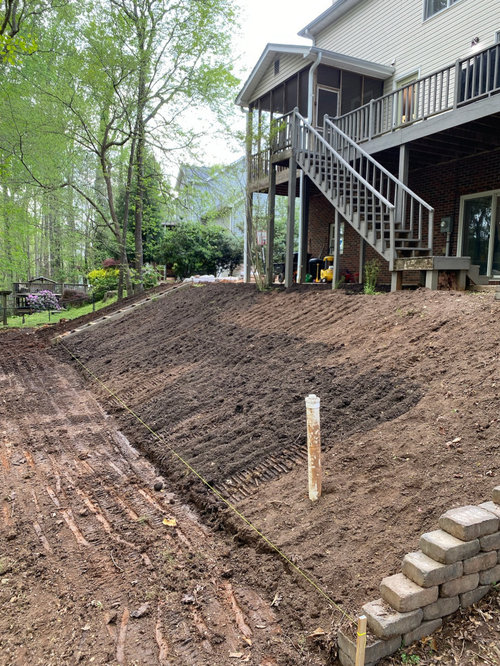
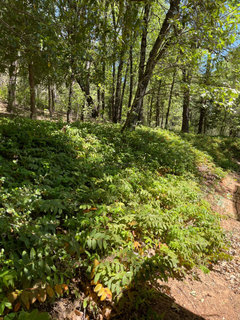
Hi! I live in the Greenville, South Carolina area in a transition area between zones, 7 and 8. I recently cleared a hill

in my backyard and would like to plant erosion control. I am looking for something that is low maintenance and also that grows close to the ground (no large bushes, etc.). Snake resistance would also be a plus because I am near a creek/woods. The area is about 47 x 16 and gets a good bit of sun. Do you all have any suggestions?


We are currently considering Asiatic jasmine from a local nursery. Just the generic variety, not one of the specialty types. Does that sound like a reasonable option? We were recommended to plant them either 18 or 24 inches apart, but at their price of $3 per small plant it could add up to a big difference to do them at 18 inches.


Thank you in advance!


Comments (16)

  • 3 years ago

    What is planned for the strip at the bottom of the slope, and what is currently under the raised deck ( soil, concrete, gravel?

  • 3 years ago

    The jasmine will make a homogeneous groundcover look. However it will spread to adjacent areas & has to be policed pretty regularly to stay in one area, and is hard to eradicate, which is why I asked about the other areas.

    Once filled in, it also benefits from a haircut mowing ( high setting) or weed- whacking every year or so to keep it from building up to a deep layer of undergrowth. So that could be hard to do if slope is steep. But otherwise it’s kind of slope groundcover material, unless one has time & energy to develop and maintain a more diversely planted slope.

    I don’t know of any “ snake- proof” planting. Thick groundcovers of most sorts can provide cover for creatures that snakes like to eat.

    smokeythebear4 thanked marmiegard_z7b
  • 3 years ago

    To contain any type of groundcover the border needs root block strips as deep as you can find …to stop spreading..

  • 3 years ago

    This is from 6 plants of St.Johns Wart ..over a few years…luckily it went uphill…made a lovely presence among the trees..stopped only be an access road…

    smokeythebear4 thanked btydrvn
  • 3 years ago

    But ..perfect cover if you have snakes

  • 3 years ago

    Thank you for your comments! The strip at the bottom will be a row of landscape block matching what is currently at the right edge of the picture. Then grass will be planted below that portion in the 'yard' area. I was worried about the groundcover migrating over/under the to-be-built landscape wall but it sounded like Jasmine might be less aggressive that some other plants? I had never seen root block strips before, but those looks nice (just Googled them). I could definitely put a barrier between the inside edge of the landscape stone and the planting area, but I won't be able to bury anything below the surface easily given the clay.


    The area under the deck is a concrete patio, so no concerns there. I'm comfortable with the ground cover growing up to that point.

  • 3 years ago

    It will send out thin wiry runners over a barrier, and grow between pavers if there’s soil. So you may want to plan sort of a zone of defense at the bottom edge.
    It’s hard to kill with herbicides but not impossible. So for example, I wouldn’t plant plugs very close to the bottom edge to start.

    I bought a house with jasmine, ivy, and duh, ivy growing into jasmine. Don’t ask how a gardener could have done that. Mostly on a very steep hill going up to street, must have been planted long ago. No way for me to re- do that, but I have reclaimed a few flat areas lower down to rehab for shrubs & perennials.

    Apparently over some years it cascaded over the lower terraced wall to the ground , shaded out the grass and rooted in a strip along there. Not sure if it would invade healthy thick turf but it is considered aggressive.

    We were in part of that very hard freeze this winter, down to 3 degrees , below our usual zone rating, which wounded it severely , so had to cut back to wall edge & I don’t plan to let it drape as before and am digging it out of the ground.

    But, that is also how I found that due to the slope and difficult access, no one had likely trimmed it back much if ever, so there was a lot of stem buildup to cut back.

  • 3 years ago

    I wouldn't use Hypericum calycinum, St John's WOrt. It spreads relentlessly and needs annual grooming. In my climate I would plant this as a grassy bank with spring bulbs and meadow wildflowers. Don't know if that would work for you. A couple of mows per year with a hovermower, or scythe if you're keen on traditional methods. Imo a single species would be dull to look at and bad for biodiversity.

  • 3 years ago

    The root block strips don’t require much to insert..even in clay soil…all you have to do is slice the soil with bladed tool and tap them in…I feel like an accidental “authority” on St. John’s Wort…but I never had to groom it..it never grew much taller than 15” or so…and tho’ it spread relentlessly it did stop where our road base driveway was and thrived in the hard clay soil with no watering after being established

  • 3 years ago

    There are a couple of drawback one should be aware of with groundcover St John's Wort, Hypericum calycinum. It is not fully evergreen even in my very mild winter climate and it is prone to a very disfiguring rust disease that seems to peak just when the plant is flowering and makes the foliage brown and unsightly. It is hard to control. Best to mow down in late spring or early summer, rake away and destroy all debris and avoid any overhead watering.

  • 3 years ago

    Wow..how interesting …we get snow and cold winter in the mountains regularly..no unsightly brown leaves…no rust disease…no watering but the overhead watering what Mother Nature offers…i did go out to and noticed it hasn’t really spread for quite a few years…what I love most about it is..it absorbs the dust nicely from the dirt road above and behind the house ..but I am sad to say we are gone all winter and sometimes miss the flowering feature…

  • 3 years ago

    We also live in a oak forest that makes the soil acidic..so that may be a factor🤷🏻‍♀️

  • 3 years ago

    I'd do Tiarella. Foamflower. You want the creeping kind, not the clumping kind. It's low enough to the ground that you will probably see any snakes. The Pollen Nation sells plugs for about 3.50-$4/each, but only have ordering once/year.


    Anything called a "groundcover" will spread. It's basically in the definition. Anything called "Asian" is not native. Therefore, your Asian jasmine will spread to wild areas. It might be mildly invasive, it might be, under the right circumstances, massively invasive. Find a native.

  • 3 years ago

    What does “ a good bit of sun” mean?

    As it pertains to shade- loving plants like Tiarella.

  • PRO
    3 years ago

    I’m in savannah so a different climate zone but jasmine was my Immediate thought for this area. Cheap, fast growing, and spreads readily. I get mine from classic ground covers in Athens, they ship fast with great pricing.