Software
Houzz Logo Print
jared_underberg

Yucca Plant - Brown Leaf Tips

3 years ago
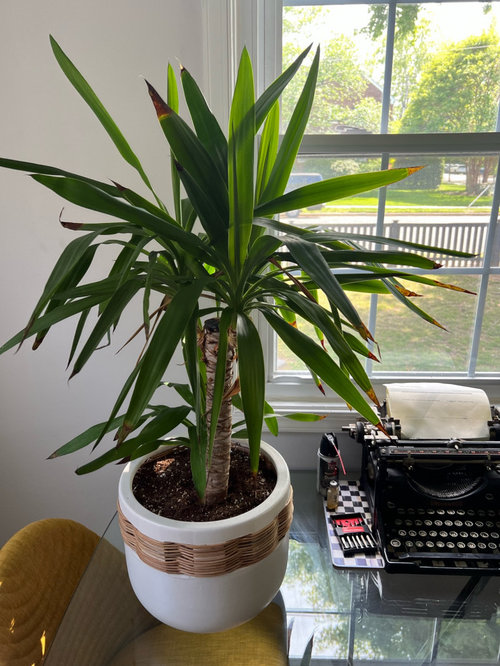
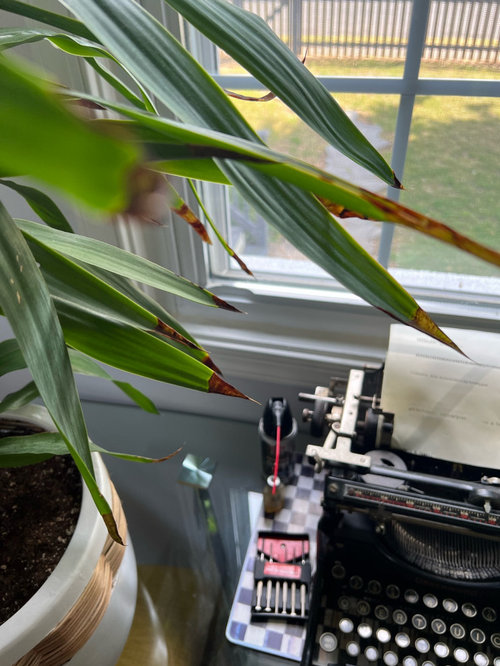
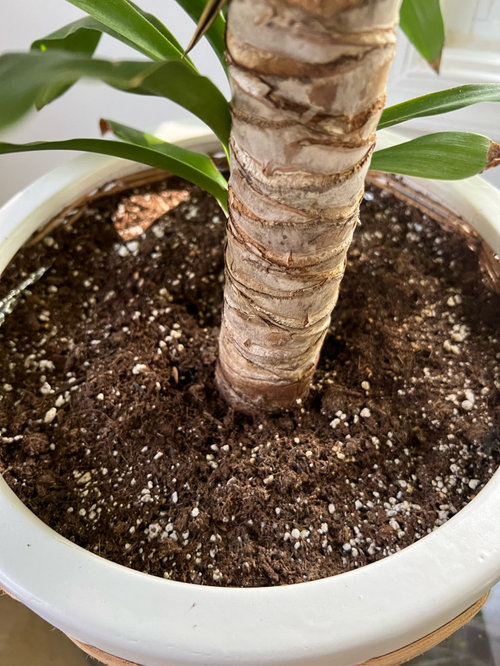
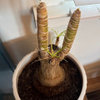
Hi, I’ve had the same Yucca plant for 2 years now. It’s been growing great and seems healthy except some of the leaf tips are brown. The yucca plant is placed nearby a window that receives plenty of natural sun throughout the day. I water only when the soil is dry. Other than the tips of the leaves the plant seems to be healthy.

I’m trying to be proactive and am wondering if anyone can tell me why the tips are brown and what I need to do to properly care the the yucca plant so it’s leaves are fully green. Appreciate your advice!

Comments (5)

  • 3 years ago

    no plant holds it leaves forever..


    all the scars on the trunk.. are the remnants of old leaves that fell off or were removed..


    remove all the lowest leaves.. and see if you dont remove a majority of the damaged leaves..


    if so .... its annual.. and you just need to remove them as needed..


    look to the center or newest leaves to see if any other current problem is ongoing.. its when the new growth is damaged.. when you know you have problems... if this is the issue.. advise for further suggestions...


    there is a houseplant forum..


    it appears your pot has no drain holes.. or water runs all over the table its on.. if there is no drain hole.. the plant needs to be repotted ...


    if you dont know how to do that.. do a post in the houseplant forum.. and im sure Al will tell you how to do it .. and how to make his special houseplant media..


    ken

  • 3 years ago

    If the pot has no drain hole, it's very difficult to manage appropriate moisture levels unless you're using a 'tell' to 'tell' you what moisture levels are deep in the pot, where it counts. For the most part, what moisture levels are in the top 2" of the soil column are is irrelevant unless the soil in your pot is less than 4-5". In a 10" pot, when the top 2" of soil feel completely dry to the touch, the bottom 6" can be completely (as in 100%) saturated with excess water. This robs roots of the oxygen they need to function normally and prevents the plant from moving water to it's most distal parts, leaf tips, which is why leaf tips and margins normally serve as harbingers of root dysfunction or diseases.


    Complication the no hole scenario is the fact that all dissolved solids from tapwater and fertilizer solutions remain in the soil where they build-up to levels that male water/nutrient uptake increasingly difficult, which compounds the burned leaf tip problem.


    The spoiled foliage is definitely not related to natural senescence, so I'd resist the urge or suggestion to start wholesale removal of a large fraction of the foliage until you get things sorted out. Each leaf is a self-contained food factory that produces the plant's true food (sugar/glucose), and it doesn't make good sense to strip the plant of its energy source when it most needs it.


    First though, before we get too far off on a tangent, we need to know if the pot has a drain hole. If not, what material is the pot made from?


    Occasionally, plants react poorly to fluoride in the water or fertilizer products, but that is less common than most growers believe. Most damage to yucca, dracaena, and other plants known to be sensitive to fluoride is the result not of fluoride toxicity, but a TDS level (level of salts/dissolved solids) in the soil solution being too high.


    Lets see what you say about drainage, how you determine when it's time to water the plant, and what you do insofar as nutritional supplementation.


    Al


  • 3 years ago

    Brown tips on the leaves of a yucca plant can indicate several different things, but most commonly it is due to dry air or inconsistent watering.


    Yucca needs more light. Place it somewhere where it can receive more light.


    Water the plant consistently: Yucca plants prefer to be kept moderately dry, so only water it when the top inch of soil is dry to the touch. When you water, make sure to thoroughly saturate the soil, then let any excess water drain away. Be careful not to overwater, as this can lead to root rot.


    Increase humidity around the plant: As I mentioned earlier, dry air can cause brown tips on the leaves of a yucca plant. You can increase the humidity around the plant by placing a tray of water nearby or running a humidifier in the room.

  • 3 years ago

    Thanks everyone. Tapala - No I don’t have a drainage pot. The pot I have now I put a few drainage stones at the bottom. I suppose I need to buy a drainage pot that comes with a plate to lay the pot on correct?

  • 3 years ago

    Over-watering and a high level of total dissolved solids (TDS) in the soil solution are the most common causes of tip burn. The plant is very well adapted to low humidity levels, so homes with central air and heating are not much of a problem unless roots are compromised by over-watering or a TDS level too high.

    No I don’t have a drainage pot. The pot I have now I put a few drainage stones at the bottom. I suppose I need to buy a drainage pot that comes with a plate to lay the pot on correct? Yes. As I noted, a high level of dissolved solids (salts from fertilizer solutions and tapwater) is one of the primary causes of tip burn in a wide variety of plants, including yucca. A high TDS level limits the plant's ability to efficiently take up and move water from roots t o it's most distal parts, leaf tips. When you are unable to flush salts from the pot as you water (no drain hole), you really are shooting yourself in the foot because it ensures a continual rise in TDS levels. It's also very difficult to maintain the necessary degree of control over soil moisture levels, so the plant is being hit with a double whammy of conditions most likely to cause burned leaf tips.


    Stones at the bottom of the pot, if used correctly as ballast - to displace grow medium that would otherwise be saturated with water, can be a very effective tool, but if used incorrectly, can cause excess water to perch well above the "drainage layer".


    If we assume you've resolved the 'no drain hole' issue, much can be learned from looking at the images below:

    The area shaded with a pencil represents perched water, which is water that remains in the pot, defying gravity and refusing to drain. Perched water is what does all the damage in overly water-retentive grow media. Typically, most commercially prepared media support 3-6" of perched water, which remains a limiting factor until it no longer exists in the pot. The left image is typical of conventional container culture. Center image shows what occurs when small stones/gravel are used as a "drainage layer". It causes water to 'perch' in the medium above the layer. The right image, illustrates how ballast can reduce the amount of excess water a planting is capable of holding.


    Al


Sponsored
Buckeye Basements, Inc.
Average rating: 5 out of 5 stars40 Reviews
Central Ohio's Basement Finishing ExpertsBest Of Houzz '13-'21