Software
Houzz Logo Print
ontario_canada5a_usda4b

Question on rainfall

3 years ago
last modified: 3 years ago

By definition, 10 mm of rain per day (which is a lot of rain) means 10 liters per square meter per day (which is not a lot of water for your plants)

Anyone can explain how a lot of rain is not a lot of water for your plants?

Comments (24)

  • 3 years ago

    A downpour is all too much excessive rain coming down all too quickly that the majority of it instead of soaking into the ground it just runs off the surface and drains away. Different say if one has a low lying gardens that the water pools and soaks it, then indeed the ground can become overly saturated.

    Ontario_Canada5a_USDA4b thanked FrozeBudd_z3/4
  • 3 years ago
    last modified: 3 years ago

    Thanks, I edited my OP to say 'a lot of rain is not a lot of water for your plants'.

    My total annual precipitation is around 1000 mm which is about 3 mm per day on the average. Water from the garden hose can easily be multiples of that and you can easily overwater. Surprising (to me) is how little water for the plants rain is.

  • 3 years ago

    By definition, 10 mm of rain per day (which is a lot of rain) means 10 liters per square meter per day


    ==>> what definition.. where???


    my rain gauge would say that that is the amount of rain that hit the one square inch rain tube i have... how does that transfers to a square meter??? or in my case.. 3 square feet or so... perhaps we are getting lost in the math????


    anyway.. imo.. since forever.. the cloudy cool day.. and sometimes the day before and after... are almost more important than the supply of water... those are the days you should be watering.. so the water YOU PUT DOWN... is actually absorbed... and anything God provides is just a bonus..


    when its 100 in the sun.. [thats really effin hot in celsius....lol] ....or 75 on a cloudy day.. just give me more cloudy days to catch up on proper deep watering.. and thank you for the bonus rain ....


    ken

  • 3 years ago
    last modified: 3 years ago

    OC is mathematically correct. ;-)

    10 million cubic mm (1,000,000 sq mm (sq meter) x 10 mm deep) is equivalent to 10 liters.

    But 10 liters over that square Meter is less than a half inch of rain (10mm = 0.393701").

    Last night it started raining pretty good for about 15 minutes, then turned into a downpour for another 10 minutes, then went back to a steady rain for another 15 minutes.

    There was no wind, and everything came straight down the whole time.

    I checked the rain gauge and we had barely 1/2" total. So not a lot considering coarse silty loam soil here.

    So, soil drainage it the all-important factor as Terry alluded to above.

    Ontario_Canada5a_USDA4b thanked BillMN-z4a
  • 3 years ago
    last modified: 3 years ago

    I'll agree with ken on 'catching up' on water.

    The last few years, a rain of 1/2 of a tenth of an inch (0.05") to one tenth (0.1") have been common when forecasters tell us rain is imminent.

    I've many times, watered the night before, then with the additional 0.025" to 0.15" or whatever we get, it's been somewhat satisfactory.

    Now rain will penetrate my soil to a depth of 12" for every inch of rain. Generally that's nice *if* you get regular rains.

    Too much rain here and it can be detrimental because with the porous soil, the water will drain through carrying nutrient and whatever else down past the root zone (called leaching). The meters depth of sand underneath our topsoil prevents any real 'storage' when it's hot for any length of time because the excess water moves down more than it moves up.

    If the soil is dry, the half inch we received last night was nice but after weeks of little rain it takes more than that to replenish the moisture that is sucked out of the ground by the large trees around the area and evaporation.

    I watered good Thursday evening, then 1/2" rain on Friday and things are looking pretty good outside this AM. And I'm not complaining, it was a nice, but we could use ~1" (25.4 mm) about every week when summer weather brings 90's and full sun, also with windy conditions sometimes.

    bill

  • 3 years ago

    I'm pretty sure I've killed more plants with overwatering than I've killed with underwatering. The "right" amount of water remains something of a mystery to me, but I keep getting surprised by how well plants can do with relatively little rain.

  • 3 years ago
    last modified: 3 years ago

    Yes DeanW45, and this can all affected by differences in soil and sub soil type (and other climactic variables).

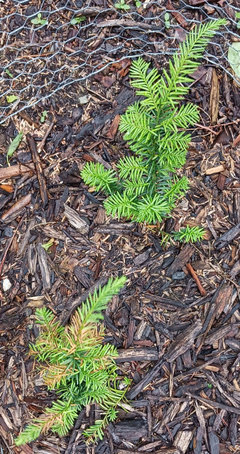
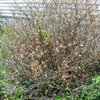
    With these dry years, I've learned to how tough plants can be, so I don't get concerned too much about the established trees and shrub. Although my Taxus canadensis did have some browning when I was gone for 5 days with 90's and little rain.

    The plant on the bottom has the sun peak around the corner an hour or so ahead of the one on the top, so that must've made the difference (Both growing fine now). :-)


    I have a short 'harangue' here (everyone gasps) ;-)

    Back in the day, on my old place, most of the 'farmable' soil was 4-5" thick of dirty beach sand with 10-15' clean beach sand underneath. The shallow water table was about 15-20' below the surface and could be accessed by a 'Sand point'.

    During the drought years of 1976-77, snow was absent with very little rain. We were adding electric fencing to the wooded areas, for the cattle, because the pasture grass was getting negligent and hay prices had gone through the roof.

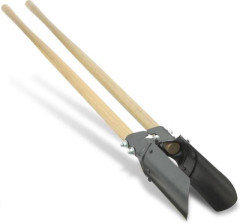
    When working on the high ground, using what we called a 'Stomp Auger' to dig corner posts (4' deep), the sand was so dry in those years, it would drizzle out of the clam shaped configuration of the Auger so you couldn't lift the sand out of the hole. We had to pour water that we carried in buckets, into the hole while digging to moisten the sand, so it would stay in the auger until the auger was lifted out of the hole (I was much younger then).

    When digging in the lower dips of topography, the soil with more organic matter and the water table shallower, things went better but still was bone dry several feet down. I lost all the Tamaracks growing in the low grounds that are generally wetlands and large-scale forestry problems arose with pine bark beetles and forest fires.

    So, what I'm saying is you need to get to know your own particular 'Happy place' and the plants you are growing there. And as ken would say, dig down and check for moisture and see if the plants really need water.

    Too much water for some plants is no big deal, while others drown. ;-)

    And like deanw45 said, established plants are tough and generally are large enough to store a certain amount of water inside the tree/shrub, so you don't have to panic if a week or two goes by without rain. And of course, the variable here is the moisture holding capacity of your particular soil and sub soil.

    Stomp Auger (for reference).


  • 3 years ago

    Another variable, that people seem to forget, is the amount of humidity in your air. Where I am, near the East Coast, high heat almost always comes with high humidity. The forecast is for scattered thunderstorms, but it can be weeks between rain in a particular location. However, because of the humidity, nothing is drying out, but the obedient are out there with their hoses since they've been told you should water when it gets hot.


  • 3 years ago

    Comparing water consumption of plants and humans.

    A typical Canadian consumes 122 tons of water annually.

    As I alluded to in a previous post, my local annual precipitation is about 1 ton per square meter. Assuming for now that a plant gets its water from the roots only, then a plant having a root area of 122 square meters (like a small tree or a big shrub) consumes as much water as a typical Canadian like me LOL (if the plant gets parts of its water from other parts of the plant, then its root area can be correspondingly smaller)

    Anyway, this gives me a feel for how much water my plants consume (on the average) compared to myself :-)

  • 3 years ago

    Um, I use 10 litres per square metre as a rough rule of thumb...once a week in summer. Every day would be death.

  • 3 years ago

    The growth stage and type of plants/trees need also to be taken into consideration.


    Many times, I water not because I'm afraid the plant will die, I water because I would like to see them grow normally and continually throughout their season.

    I could realize 3"-6" of growth per season on trees that are considered 12" to 24" annual growth trees. Just the way it is in droughty soil without regular precipitation.

    I'm not talking large mature trees here but ones that are generally planted small and for the next 8-10 years.


  • 3 years ago

    Well, I baby new plants/transplants for a month or so but then it's basically 'sink or swim' for them, with the occasional help as appropriate.

  • 3 years ago

    What kind of soil do you have there OC?

    Have you been in the same drought conditions as many locations?

  • 3 years ago
    last modified: 3 years ago

    I don't know what soil I have LOL but it's good for my beloved conifers and not so beloved weeds LOL and apart from the cold, the climate is good for hardy conifers too, there are short dry spells but no prolonged droughts, there are temporary hot spells like in purgatory but no eternal hell :-)

  • 3 years ago

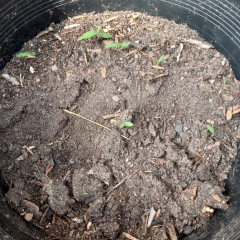
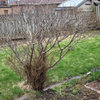
    Here is a sample of my garden soil, what is it?

    Can I grow a bristlecone pine ( Pinus longaeva , Pinus aristata ) in it? Or is this kind of soil too rich? My annual rainfall is 1000 mm (about 40") or is it too much water? I want my descendants 100 generations down to remember me LOL anyway it's an issue that lead to my OP.

  • 3 years ago

    ' Fortunately, this is a climate where most years, I don't have to do a whole lot of watering, either of my garden or my potted plants.'


    Lucky you! We have years where the hose lays rotting in the sun, but we tend to be 'on the dry side' at for a couple or three months of the year.


    'Here is a sample of my garden soil, what is it'


    From the picture I can tell you it's a clod of dirt. :-))


    The link below gives instructions to analyze soil content.

    https: Mason Jar Test:

    It will give you a rough but better idea of what you're dealing with in your location.


    Speaking of water collection:

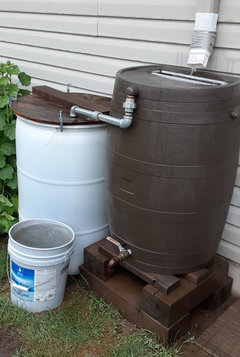
    My city water is not too bad price wise. But I have about 20ft. of rain gutter above my deck area.

    A 0.15" of rain or so will fill the brown 45 gallon barrel, another 0.15" tops off the white 55-gallon drum.

    I could put more barrels, for overflow because anything over a third of an inch will overflow the white barrel and that all just goes into the ground. But generally it's not that dry here so it's just nice to have a supply of 'warmer', 'soft' water, mostly for the flowering pots and new plantings.

    You'd be surprised how many gallons a week 4-5 hanging potted flowers can take when it's windy and dry (our humidity this year has been very low). But this year, with some small showers, I've still emptied these barrels by watering 4 or 5 times already.


  • 3 years ago

    " hose lays rotting in the sun"

    Any opinions about metal garden hoses?

    I have one for the front yard, it's excellent. I consider buying one for the backyard, where I already have an ordinary garden hose, and can't really justify the cost.

  • 3 years ago

    " hose lays rotting in the sun"

    That was just a play on words.

    I've had the same hoses I bought when I moved here 10 years ago and they're just like new.

    Just stay away from all that cheap stuff.

    ;-)

  • 3 years ago

    I realize it is a play on words, but this thread has been meandering, so I took the opportunity to toss up metal garden hoses. The one I have for the front yard is as I alluded to, excellent, it is light weight, very flexible and kink free.

    I saw a TV commercial on a metal version of the old expandable/shrinkable garden hoses. I had the non-metal, ordinary version of the latter, it was bad. I wonder if the metal version combines the best of both worlds.

  • 3 years ago

    Ontario, I'd say a bristlecone pine would prb'ly suffer from too little oxygen in the soil and/or root disease. Perhaps if planted as high in elevation as you can, in full sun in a dug-out hole filled w/coarse sand into a hill/berm, it might survive a while.

  • 3 years ago

    Yeah Wikipedia says that bristlecone pines are hard to cultivate.

    Curiously enough, the ACS database finds 2 cultivars of Pinus longaeva and 4 cultivars of Pinus aristata

    Frankly, I find look of young bristlecone pines nothing special and if they live for only 10 years in the garden, I have my hesitations.

  • 3 years ago

    Or you do what is done for firs, and graft a bristlecone pine onto a Pinus rootstock that could deal with non-alpine soil conditions.


  • 3 years ago
    last modified: 3 years ago

    Wow, great idea, David! Perhaps that's what has been done, at least for some of the bristlecone cultivars! Anyone knows? If there are chances of long term survival in the garden, I would consider an aristata scion that still shows the resin drops on the foliage after grafting.

    Edit:Pinus aristata 'Horstmann' Now have to find an Iseli retailer in my neck of the woods!