Software
Houzz Logo Print
_____________3720

Help with dried up Fiddle-leaf Fig

Hi all!
I need an advice on saving my FLF.
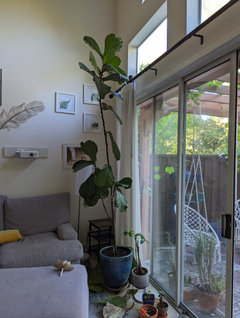
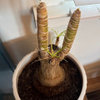
One stem, about 10 ft tall. It was doing fantastic in it's spot but I had left it unwatered for a month (don't ask, please) and now it's dropped most of its wonderful leaves in the middle, leaving small bunches at the top of main trunk and ends of two brunches.
Ideally I would love to bring it back to single stem, about same height or a little shorter.
Do I get it right that there's no way to sprout new leaves in the middle of the trunk?
The options I see:
1) cut back the main trunk, wait for new growth, make one branch tye new lead, cut the rest
2) cut back the main trunk, make the longer branch a new lead (will it straighten up?)
3) cut off the leafy top and try to root it, forget about the bottom part.
4) anything I am missing?
What would you recommend?

Comments (16)

  • 3 years ago


  • 3 years ago

    Al, thanks a lot for your advice!

    Do you think if I cut it below the lower branch, leaving just the main trunk, it would sprout? That would leave me wih 1.5 ft of bare trunk and the roots.

    As I mentioned, I need to keep it single stem, without branches, column- rather than tree- shaped.


    I'm

    AA

  • 3 years ago

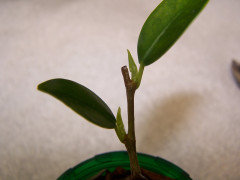
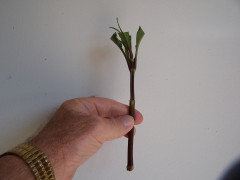
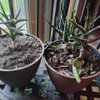
    Yes, it will be obligated to do so, just as this little rooted cutting of Ficus microcarpa became obligated to grow the 2 new branches you see in the leaf axils when I removed the branch apex.

    Your only concern is, you must be careful about avoiding over-watering if you do that. Transpirational water loss will be nearly 0. My suggestion would be to use a "tell".

    Using a 'tell'

    Over-watering saps vitality and is one of the most common plant assassins, so learning to avoid it is worth the small effort. Plants make and store their own energy source – photosynthate - (sugar/glucose). Functioning roots need energy to drive their metabolic processes, and in order to get it, they use oxygen to burn (oxidize) their food. From this, we can see that terrestrial plants need plenty of air (oxygen) in the soil to drive root function. Many off-the-shelf soils hold too much water and not enough air to support the kind of root health most growers would like to see; and, a healthy root system is a prerequisite to a healthy plant.

    Watering in small sips in order to avoid over-watering leads to a residual build-up of dissolved solids (salts) in the soil from tapwater and fertilizer solutions - which limits a plant's ability to absorb water – so watering in sips simply moves us to the other horn of a dilemma and creates another problem that requires resolution. Better, would be to simply adopt a soil that drains well enough to allow watering to beyond the saturation point, so we're flushing the soil of accumulating dissolved solids whenever we water; this, w/o the plant being forced to pay a tax in the form of reduced vitality, due to prolong periods of soil saturation. Sometimes, though, that's not a course we can immediately steer, which makes controlling how often we water a very important factor.

    In many cases, we can judge whether or not a planting needs watering by hefting the pot. This is especially true if the pot is made from light material, like plastic, but doesn't work (as) well when the pot is made from heavier material, like clay, or when the size/weight of the pot precludes grabbing it with one hand to judge its weight and gauge the need for water.

    Fingers stuck an inch or two into the soil work ok for shallow pots, but not for deep pots. Deep pots might have 3 or more inches of soil that feels totally dry, while the lower several inches of the soil is 100% saturated. Obviously, the lack of oxygen in the root zone situation can wreak havoc with root health and cause the loss of a very notable measure of your plant's potential. Inexpensive watering meters don't even measure moisture levels, they measure electrical conductivity. Clean the tip and insert it into a cup of distilled water and witness the fact it reads 'DRY'.

    One of the most reliable methods of checking a planting's need for water is using a 'tell' (more reliable than a 'moisture meter'. You can use a bamboo skewer in a pinch, but a wooden dowel rod of about 5/16” (75-85mm) works better. They usually come 48” (120cm) long and can usually be cut in half or in several pieces, depending on how deep your pots are. Sharpen both ends of each tell in a pencil sharpener and slightly blunt the tip so it's about the diameter of the head on a straight pin. Push the wooden tell deep into the soil. Don't worry, it won't harm the root system. If the plant is quite root-bound, you might need to try several places until you find one where you can push it all the way to the pot's bottom. Leave it a few seconds, then withdraw it and inspect the tip for moisture. For most plantings, withhold water until the tell's tip comes out nearly dry. If you see signs of wilting, adjust the interval between waterings so drought stress isn't a recurring issue.


    Al

  • 3 years ago

    Thanks again, Al!

    I'm a little scared to cut that much of the tree off, leaving just a stump, but I guess there's no other option, so I'll go for it.


    Really appreciate your insights!

  • 3 years ago

    Why not cut the main trunk back to immediately above the left branch and allow the left branch to become the new leader?


    You could also cut the main trunk back and leave a long stub that you can tie the left branch/ new leader to to ensure it grows vertically.

    You asked a question and I answered, but that wouldn't be how I would approach shortening the tree unless you really do want to 'start over from scratch'.

    Al

    Ольга Минаева thanked tapla (mid-Michigan, USDA z5b-6a)
  • 3 years ago

    I don't want to make the branch a new leader, because it is also bare on the bottom. If I leave it as is, that leaves me with even more bare trunk. If I trim it, the tree is left with no leaves, so I guess It won't be different from just cutting below the branch,


    I hear you, but I think I do want to start from scratch, It's lost too many leaves for my liking.


    One more question if you allow: if I cut the trunk, provided that it does sprout more than one new branch, should I keep one or all? Is it realistic to have a narrow-shaped tree or will it get too tight and I'd better just keep one and trim the others?


    Olga


  • 3 years ago

    It's very likely you'll get several new branches. I would allow the plant to grow unchecked by pruning until next summer. You can decide then which trunk you want to keep. More leaves means more food = a faster recovery from the chop. It's good to give a tree the opportunity to restore its energy reserves after working it hard. If you're brave, and after you gain a little more confidence in my advice, perhaps I can talk you into doing a full repot next summer. A full repot includes bare-rooting, root pruning, a fresh change of grow medium, and a new lease on life. IOW, its very reinvigorating. All my trees (200+) undergo full repots at regular intervals.


    Al

    Ольга Минаева thanked tapla (mid-Michigan, USDA z5b-6a)
  • 3 years ago

    Thank you once again, Al!

    I'll follow your advice, chop it and let it recover till next summer.

  • 3 years ago

    Don't forget us. We enjoy hearing what progress is being made and any obstacles you hopefully don't encounter. Best luck!

    Al

  • 3 years ago

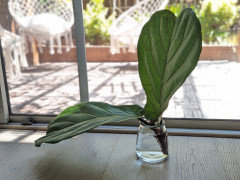
    Thank you, Al. That's very kind. It's been a week since I chopped it and so far I have a stump that gives no signs of sprouts and five cuttings in water with 2-3 leaves each and no sign of roots. I know they all need much more time, so I'm waiting patiently.


  • 3 years ago
    last modified: 3 years ago

    To realize our works have forced us to adopt the pace of nature, is to know patience.

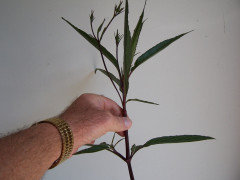
    About the propagule. The amount of leaf surface pretty much ensures the it will lose more water via transpiration than it can take up w/o roots. This will likely lead to the plant initiating its primary response to drought, which is to shed the leaves. I would reduce the leaf surface by cutting both leaves in half across venation to prevent that from occurring. Example of how I prepare a cutting:


    Al

  • 3 years ago

    Update, as promised


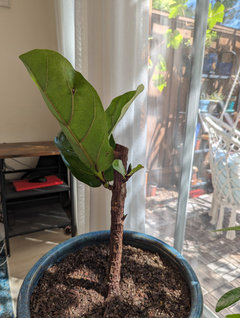
    It's been about a month and I'm happy to report that the chopped stump have sprouted 3 branches (granted one is no more than a woken bud yet).


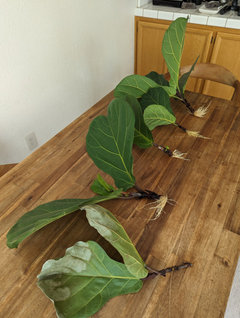
    Out of five cuttings 4 have rooted and only one died. I ended up not cutting the leaves, since I wanted them to look nice around the house, and it still worked. Stuck them in water and kept near windows.


    Now I need to decide what to do with them, since I definitely don't need 4 new fiddle-leaf figs (though it is tempting)


  • 3 years ago

    Strong work, and congratulations!


    I often see the suggestion to add more cuttings to the pot to increase "fullness", but you can achieve the same results by pinching the plant while young, forcing many new branches that will serve admirably as additional trunks as your tree grows.


    Learning how to override a plant's natural growth habit by using pruning, pinching, and other things like grafting or partial defoliation, raises the plane on which we interact with our plants. It also increases the potential for greater personal rewards. Now that you know how to create a full/compact plant with multiple trunks growing from a common root system, arranging multiple cuttings in the same pot seems like a step back.


    Keep us posted with regard to your progress, please.

    Al


  • 2 years ago

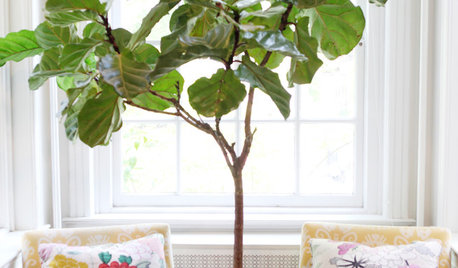
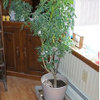
    Here what it looks like 7 months later - saving succeeded :)


  • 2 years ago

    Good job - mission accomplished. If you want your plant to become much fuller, cut back the branches to 2 or 3 leaves a bit before the summer solstice. This will force new lateral branching from nodes immediately proximal to the pruning cut. Refer to the first image I posted to your thread. Good luck!

    Al