

Going (almost) native
Many apologies for a long and rambling post...
So, I feel as though I have spent 30 years dithering in the wilderness as literally thousands of plants have passed through my hands yet never have I really managed to make an appropriately iconic garden for my region. Even the last couple of years, I felt I was almost in reach of having a clear and coherent plan...but unfortunately, I seem to have made a common assumption...that dry East Anglia equates to some sort of mediterranean fantasy. Not helped because of falling under the influence of certain dryland gardeners who all seem to have nurseries in Greece, South of France, Portugal...and have at their command an inventory of 1000s of landscape plants. Well first off, the fens are emphatically not mediterranean...just because we have a dry climate. Secondly, and most importantly, in my frustration with the many concepts relating to design (I loathe this part of gardening after years in the business of design and build) I feel that I have somewhat neglected the most basic feature - the genius loci...or spirit of the place...which east anglia has in plenty.
I have had a busy summer and the garden and greenhouse is full to bursting with many plantlets, almost ready for planting out. While all have been carefully chosen to be low-water plants, I am struggling to see any coherent themes or styles or...anything really, to tie a completely disparate set of plants together. I was feeling almost close to despair so took myself for a bike ride around the beechy woods and out on the fens towards Ely...where I had a kind of epiphany. There are 3 or 4 plant genera which are absolutely fundamental to our local flora and any garden which defines the genius loci really should find space for these iconic plants.
I have always been a bit sniffy about native purists - an island with a geological history of late glaciation is always going to be a little sparse...while otoh, the Brits have been completely in the forefront of plant hunting, diverse nursery culture and, of course, an often shameful history of imperialism and exploitation. Along with a temperate maritime climate...well, you can see the temptations. But anyway, I have the glimmerings of a sensible plan to carry my allotment and garden forward into a sustainable future which addresses the ethics of environmentalism and still offers a pleasing aesthetic. I can still grow some mediterranean cushiony hummocks of tough landscape plantings (so keeping the stachys, ballota, thymes and euphorbias...but growing 3 distinct fenland genera - the umbelliferae (always sound so more resonant than apiaceae), the mulleins and the asteraceae (but knapweeds, hawkbits and wild lettuces).
From my Keble-Martin wildflower guide, I identified over 30 different umbels...from the rare and special Cambridge Milk Parsley (selinum carvifolium) to the fearsome giant hogweed (hieraceum mantegazzanianum), the poisonous water dropworts (oenanthe crocata) to the numerous edible (dill, fennel, wild carrot etal), these are probably the seminal east anglian plants...and, coincidentally, the genera I have always adored. Mulleins though - I grow quite a few of these - from the enormous and unruly giant mullein (verbascum thapsus), to the dainty moth mullein (v.blattaria), the large flowered v.phlomoides and, of course, a range of garden hybrids including the colourful v.phoenicium. They are always obvious in the landscape, beloved by pollinators and have a special architectural austerity which offers such a visual contrast to the low growing alpines and subshrubs of the garrigue or maquis. And finally, I love knapweeds, hens and chicks(hieraceum aurianticus) and the heartbreaking blue of chicory.
I realise why I had been struggling with growing a mediterranean palette after seeing the Delos Garden at Sissinghurst castle, as well as my local botanics. East Anglia does not have either hills or rocks...we have huge open skies and the flattest sea-level landscape in the UK. Gravel gardens, scree gardens, alpine collections etc. are all very well but are not going to cut the mustard on a flat, rectangular, uninspiring public allotment. Of course the landscapes of Thomas Doxiades, Olivier Filippi, Jenny Gay are always going to look fabulous, even during summer dormancy - there is grandeur and drama on Antiparos or Cap Corso or Carcassonne or the Taurus mountains...which is not present in New Street allotments. Duh! But we do have a special, austere beauty akin to the high desert or prairies of the US. And we have a handful of standout, native (or naturalised) or even those plants which have become common in our landscape, even though their provenance is locked in to our maritime exploring history.
I think I might be getting somewhere.
Comments (29)
 2 years ago
I find the whole ’native’ planting focus contains a lot of mostly unstated assumptions re chosing a time and place to fix as an ’ideal’ ecology - i.e. one that is human-centered and fixed in a particular time. The reality is that the world/earth has constantly changed - starting long before the human race began. The difference now is humans’ active role in driving the change without consciously doing so to maximize benefits to the maximum number/types of inhabitants of the world. If you look to the past, at one time Antarctica was a forrest and the Arctic also was a tropical forest/ecology when the tectonic plates under it were in the Caribbean area geologically. Humans appear to originate in Africa. ’Native’ North and South Americans crossed the then-existing land-bridge across the Bering Strait into this continent. Moving to more recent times, one branch of our family orininated in northern Europe several generations ago while another branch originated in central Europe. In a multi-cultural country isn’t it more important that people work to make a positive contribution that benefits as many as possible rather than just a smaller group? So, taking a long view, ’native’ is a vaguely defined concept. So,rather than focusing on a plant being ’native’, I want a plant that grows well in the conditions I now have and am likely to have in the near future and that benefits existing biological members of the local ecology. I focus much less on where the plant originated geographically. The argument that ’native’ plants suit the local conditions best seems weak when viewed in the context of a changing local context…
But I know I’m an odd-ball on this issue :-)
rosaprimula UK (Cambridge) Z8/9
Original Author2 years agoI agree, Woody, that our entire environment is man-made and dynamic and as such, the idea of'native plants' is freighted with ideology and culture and must always be interrogated and contested. Nonetheless, even though the majority of us live in urban environments, we do still recognise landscape and respond in surprising ways. Even within the confines of a very small island, there are variable geographical and climatic differences; the Welsh hills are only 300miles away from the east anglian fens yet may as well be on different continents. And not just geology, rainfall, soil types...but the history of industry and human movements has also been written on the landscape. This must also be the case in the US and Canada so the idea of native purity is kinda laughable...and yet, I do understand the desire to garden in a more holistic, wildlife-defined way.
I do contend that while I want to grow plants which are best suited to my environment, there is also a vernacular, a language of place which felt right to me, especially since I have certain restrictions (land ownership, budgets) which does really rule out creating a garden space which is grounded in a sort of fantasy...although I am aware that any human-made garden is indeed 100% artifice. I don't want to spend ridiculous amounts of money on heating, lighting, expensive plants, hardscape, and irrigation...which has to be sustained indefinitely.Related Professionals
Bainbridge Landscape Architects & Landscape Designers · Muskegon Landscape Architects & Landscape Designers · Sebring Landscape Contractors · Lexington Landscape Contractors · Hilton Head Island Decks, Patios & Outdoor Enclosures · Lancaster Decks, Patios & Outdoor Enclosures · Quincy Landscape Architects & Landscape Designers · Covington Landscape Architects & Landscape Designers · Southaven Landscape Architects & Landscape Designers · Traverse City Landscape Architects & Landscape Designers · Twin Falls Landscape Contractors · Kahului Landscape Contractors · Chicago Home Builders · Albert Lea Home Builders · Middletown Home Builders- 2 years agolast modified: 2 years ago
I agree that gardens (and other places) should be more holistic, considering needs of more than just the directly involved people. But I think that requires a broader and more thoughtful appoach to many things. In the context of this garden specifically, I spend no or minimal money on ’heating, lighting, expensive plants, hardscape, and irrigation’. While many people interpret the rectangular lawn in the backyard as a ’formal’ element in the garden, a childhood friend who visited the garden many years ago immediately recognized what it was - an abstraction of my grandfather’s horse pasture that was surrounded by ’bush’ and a tractor path! That is the ’reference landscape’ from the east coast of Canada that inspires my southern Ontario garden! The white trilliums in the garden are the provincial floral symbol of Ontario; there are also a few red trilliums that were common where I grew up - so I understand your comments about plants and sense of place and how that can differ across a country. I’d love to plant, for instance, the acid-lovers that thrive down east but have to deal with the more alkaline soil here… And BC and other parts of Canada are very different again… So I’m a strong believer in planting what is suitable for your conditions, thinking broadly and open to lots of ideas.
rosaprimula UK (Cambridge) Z8/9
Original Author2 years agolast modified: 2 years agoI think I am constructing a thesis to put some bones on a very loose idea borne out of feeling anxious and frustrated by too much choice, too many different plants and my own personal failings (limited attention span, prone to wild enthusiasms and worst of all, still failing to settle on a sensible, coherent way of doing gardening after years and years of arsing about...
Sounds plausible though, don't you think? A particular selection of a few iconic foundational plants to set the scene as it were. A 'reference landscape' indeed.
I think I have a dislocate between my former professional life doing design and build and my own gardens which are, in many ways, the absolute opposite to the idea of drawing up a plan, sorting a budget and doing it all over a month or so, then walking away.- 2 years ago
Indeed! I think all gardens are personal spaces that need iconic elements (plants and/or other things) to set the scene for you within a context that also applies an appropriate design approach that appeals to you and suits the space you are developing to be a garden. My main design ’element’ that shapes the garden is incorporating the ’negative space’ idea - which is also what the rectangular lawn is.
 2 years ago
Natives are not planted merely for the conditions in which they will thrive-many non-natives thrive in our landscapes as well. However, natives provide food for insects and birds. I have never seen a caterpillar, butterfly or bee on crape myrtles which are very popular around here. My Magnolia virginiana on the other hand is filled with birds devouring the seeds and a joy to watch. I have more than ten oaks and various other native trees here. My non-native azaleas do not support any wildlife. Bees are abundant on my native perennials as well as some non-nive ones, but none of those are host plants for caterpillers of moths and butterflies. With insects and birds disappearing across the globe at alarming rates, I have decided to plant only natives from here on out. They have evolved for thousands of years alongside the wildlife. Doug Tallamy has written several books that are wonderful resources if you are interseted in finding out what trees and other plants support the greatest number of insects, birds, and other wildlife. The two books I have are Nature's Best Hope and Bringing Nature Home. Both are terrific reads and resources.
Here in Virginia, we have a "Digital Atlas of the Flora of Virginia" that is accessible on line. It shows native plants county by county if you put a name in the search box. It will also tell you if it is introduced rather than native. Invaluable resource and I find that I need to check that even if my state native plant society labels something as native. It may very well not be here where I live. I do not know if there is something similar in other states, provinces, or countries, but it is worth checking into, I think. My bottom line is that I believe we share this planet with many other animals and we have no greater claim on it than they do, so I do anything I can to support all of them. 2 years ago
RosaPrimula, you clearly have given this a lot of thought. It sounds like you are on the right track and have come up with a good plan and for reasons that make sense. I imagine these new decisions will give you some relief from struggling with the question and more enjoyment from putting your plan into action from this point. I wish you much success!
As far as the 'native' issue goes, I have evolved from one position to another over the years I've been gardening. I started out in 1980 with just a vegetable garden. I was fortunate to gain a new friendship with someone who had an organic vegetable garden and I was inspired. I'd never gardened before, I had grown houseplants and that was it. But the whole idea of organic gardening and garden ecology made so much sense to me. I have always loved the natural world. I'm old enough to have experienced untouched natural growth even in areas where I lived. I can remember driving along the roads at night in the summer and the fragrance was indescribable. It wasn't just a certain plant that you could smell, it was the whole shebang! It just had a fragrance that no longer exists in the over developed areas that I experience now. And what is more awe inspiring then untouched virgin forest with native wildflowers and ferns and mosses. In our area, you come across a wooded lot or area and it is barren in comparison with many standing dead trees and leaf litter and saplings etc. And the difference in insect population is hard to accept. I barely find a moth around our back porch light and when I was growing up you'd have to fight your way through the moths if you went out at night under the back porch light. We had turtles and possum in the yard until a developer eliminated a wet area to put in a new subdivision. Then there are all the imports that have taken over natural areas and destroyed habitat for the natural plants that belonged there.
So I feel deeply about what we have lost. And at the same time, I started out aiming to add a lot of natives, and I have, but surprisingly, a lot of them did not thrive here and it became frustrating to spend money and devote time and energy only to see it peter out and disappear. So I've come to terms with my own garden and I now lean more toward Woody's position, that choosing what will thrive in your garden has to be a priority, regardless of native status. Of course, within the boundaries of not doing any harm to natural areas.
Unfortunately, it seems like there are too many people on the planet and it has become overdeveloped. And now that we have climate change to the point that many parts of the world are experiencing forest fires that wipe out thousands if not millions of acres of woodland and are burning out of control....how do we reconcile that?
Still, if you have a property that can be preserved or restored in a meaningful way, then you are very lucky indeed.
- 2 years agolast modified: 2 years ago
Cyn427, You point to a Crape Myrtle as a shrub that you have never seen a caterpillar on. It made me think of Butterfly bushes. Here in my zone 6 garden, I grew Butterfly bushes for a good ten years. They are not native and in some areas of the country they can be invasive into natural areas. I don’t believe that is true in my zone 6 garden because I never saw even one seedling from any of them and they are not on our state list of invasive plants. I would be lucky if they would come back each spring. And when they did, it would be from the base. They do happen to flower abundantly right up until frost and I always deadheaded to keep the blooms coming. I did lose one, over one winter and I removed the other because it was in my front bed and it was just too messy and informal for the effect I was trying to get. I really miss those shrubs, for many reasons, but the biggest reason is because of how many pollinators of all kinds that it attracts, including butterflies. And hummingbirds as well. I haven’t seen anywhere near the amount of pollinators since I stopped growing them.
And I have grown Asclepias - three varieties of it - for probably 15 years, and I rarely ever see caterpillars on it. And I was lucky if I see 4 butterflies in a season. I did add a hybrid aster about 4 years ago and that draws Monarchs late in the season more than any other plant I have.
Where are Sedum Autumn Joy native to? I’ve grown that plant for 35 years and every year it is covered with bees. Where is Gaura native to? I just added that 3 years ago and they bloom non stop until frost and every morning I come out to the garden, there are bees swaying on the Gaura stems. Parsley and Dill have caterpillars on them more consistently than Asclepias has for me.
The point being that choosing natives is not a guarantee of attracting pollinators and wildlife. And some non natives are better at it than natives.
- 2 years agolast modified: 2 years ago
prairiemoon, the Autumn Joy sedum (Hylotelephium 'Herbstfreude') is not native to Virginia. They are native to Asia, Europe and North America, but other than that, I cannot tell you where in North America they are native. Just know they are not native here.
Coincidentally, this article on invasive plants popped up in my box today. Interesting. Virginia Mercury
ETA: Which Asclepias do you have? Sorry you only rarely get caterpillars. Perhaps something else is interfering with them. - 2 years agolast modified: 2 years ago
Cyn, yes, that was my point, that they are not native for me and evidently for you, but they attract a lot of pollinators. And they have a lot of qualities that make it a valuable garden plant. I just looked it up......
Specifically references Sedum Autumn Joy
I do agree with finding a way to stop invasives from destroying native habitat, but it would seem that nurseries need to stop offering them for sale in areas where they are invasive. That would make a big difference. How can anyone still be growing and selling Bradford Pear?
- 2 years ago
Good food for thought.
I am currently gardening in harsh conditions- poor but compacted soil, rocks, periods of drought with limited reach of the hoses, and deer.
I planted things I’d grown just a few miles away under heavy deer and rabbit pressure, but the deer here ate them. And possibly rabbits helped.I got quite enamored of other native plants, the most deer resistant ones of course but also looking a lean soils, drought resistance. But several I’m trying are struggling. I think because it’s all relative— drought in thd right amounts/ times, sun conditions, soil lean in some ways but correct drainage, sun not only the “ hours but even time of day. Various native things establish where they like the conditions to begin with— it might be a pocket of the right soil, a protecting rock, rain runoff just right, able to establish deep roots for the yearly droughts.
I’m agreeing with the comments on experimentation—I read and read , and observe my sun patterns, and try to see right plant/ right place, and dig/ adjust soil a bit, but still a number of things have worked out. Yet!I also can see certain non- natives doing ok, some already established on the property of course, and I want at least a few things that are green— so repeating some junipers, non- native ferns.
One problem is the sun/ shade thing. In a lot of places I don’t seem to have enough day- long sun for sun lovers except if can water through some drought. Or if an area seems shady but then gets sun from light changing too soon in early fall, the plants fry.
Then am seeing some new things do well, epimedium, plus favorites like hellebores, so getting more into “ more of what works” than feeling like I have to try ALL. the goodies for sale. - 2 years agolast modified: 2 years ago
Marmiegard, How long have you been gardening there?
Early on when I first began to seriously garden, I was using a book called Right Plant, Right Place. And while I didn’t get a lot of specific plants that worked for me from that book, I at least had that concept from the beginning that every plant has specific needs. Hasn’t there now been research indicating that there is often a community of plants that develop that support each other’s growth?
But if you stop and think about it, many of the garden worthy plants that many gardeners have used over decades, are the plants that are less picky about the specific conditions. Like Sedum Autumn Joy. That plant has performed for me and other gardeners I’ve talked to, in many different soil types. Whether the summer is rainy or hot and dry, it still performs very well. You can fertilize it or ignore it. Once I repotted some AJ divisions and one division that never made it into a pot was overlooked and left for a full year, just lying on the ground and it was still living and was planted and grew just as perfectly as the rest.
I had a similar experience with Epimedium. Some plants are so delicate and difficult to establish while others can be indestructible.
BTW, I have increasingly had difficulties with rabbits here. This year was a nightmare. 10 years ago, I would get rabbits in the yard and they would just munch on the grass and the clover. Then for many years they favored my Hostas. This year they ate everything in sight. They ate my entire collection of Epimedium to the ground and they didn’t come back. They removed all the foliage 1.5ft up the canes of all my roses. And that didn’t keep them from also making a mess of the Lilies and the Hosta. It’s odd to me how they changed over time. AND they ate natives too. Calycanthus stems all the way to the ground. Clethra. Phlox. Asters.
I think there are many natives that once established are very garden worthy. It just isn’t as easy as finding a list of native plants and going shopping. It becomes a lot of experimentation too.
I’ve also mapped my sun patterns in the yard. And had my soil tested. I have a lot of mature trees on and around my property so I only have one 20ft bed in full sun in the front of the house. So anything that requires sun has to go in that bed. [g] I tried for years to get some sun lovers to grow in my back which is more part and full shade than anything, but not a lot of things work well there. That’s when I switched in the back to Hostas, hellebores, epimediums etc. And now it’s rabbits.
- 2 years agolast modified: 2 years ago
'it would seem that nurseries need to stop offering them for sale in areas where they are invasive.'
Yes! That is what the Virginia Mercury article is discussing.
ETA: oh and pollinators are great, but we need the host plants to ensure their survival. Picture me on my knees begging everyone to read Doug Tallamy's books. You can even check them out of the library if you don't want to buy them!
- 2 years ago
Right!
I love Autumn Joy as I have also used it for cut flowers. I have about 5 medium pots of it I brought as transplants from my previous house. But, the deer ( or something) will eat it. So they’re kind of in less exposed areas ; some I planted various got eaten.
But, in a couple weeks I plan to plant some of it “ out” in a dry area that I know needs tough stuff. And keep some in pots- I swear it survives on air alone. Always wanted to try Calamintha, from description in White Flower Farm, but never did until this year when found it in local nursery. Got 2. It has bloomed non- stop , covered with little buzzing things ; watering it to hope it establishes & can eventually go without ( much extra). So that’s on my “ grow more and go with the flow” list. I started some cuttings also. I’ve been at new place about a year and a half, and of course spent time just moving in. And planted a lot of things I dug up from other house. Created a bed of better soil in one of my sunniest areas that can be watered, & small raised veggie bed & containers ( these are fenced).Planted coneflowers and Amsonia and Rattlesnake Master out in a wild area, which is where deer chomped the coneflowers off. I don’t they really liked them, so if they’re still coming up next spring I’m going to spray them & see if deters.
- 2 years agolast modified: 2 years ago
Cyn427, of course, if a gardener has an interest in attracting pollinators, butterflies among them, they would be aware that they do need host plants. And without even reading Tallamy’s books, it took me 2 seconds to pull up an article on ‘what are host plants for butterflies’.
Looking at the list, for the Eastern Black Swallowtail it lists, Parsley, Fennel, Dill, Phlox and Gaillardia. I grow every one except Gaillardia which I won’t be growing any time soon. [g]
The Long Tailed Skipper , Bean plants, Pea plants, Hog Peanuts, Wisteria, Bougainvillea, Mexican Sunflower. I am a vegetable gardener at heart and I always grow beans and peas and I’ve grown the beany vines, but no chance I’m going to be growing the rest. I’ve considered growing Mexican sunflower and bought seeds a couple of times, but I just can’t find a place to grow a very large orange plant.
There are a few butterflies on the list that must be in other growing zones, because the list are plants I don’t normally see growing in this area.
The Painted Lady, Hollyhocks [another full sun plant and it rusts badly here] Thistles [no way I’d ever grow that on my property] Asters I grow, Hibiscus I grow. An interesting aside, the photo of the Painted Lady in the article is resting on …. A Butterfly plant bloom! LoL
Gulf Fritillary - the name alone says - Southern East Coast, doesn’t apply to me. Passionflower, does not grow well in my zone. Verbena bonariensis, I grow. Lantana, Zinnias, I grow some years.
Monarchs, Milkweed - I have had a lot of that, despite not really having an ideal place to grow it. It has been petering out for me. Last year’s drought killed off some of it, surprisingly. Coneflowers, I grew for over 10 years and replaced them and miss them and trying to find another place to fit them in. I have limited space.
Goldenrod - have flirted with the idea of growing it but, I don’t enjoy it first of all, and 2nd it has a reputation for spreading and reseeding that discourages me. And I grow asters in the Fall that Monarchs cover. Oh, and look at that, Cosmos and Butterfly Bush make the list of plants that are host plants for Monarchs both of which I grow. And Lilac, which I also grow.
I also grow Spicebush - from Wikipedia.... "Many animals feed on the leaves, twigs, and berries of spicebush. Some mammals include whitetail deer, Eastern cottontail rabbit, opossums.[7][8] [Which is interesting, because there are no deer here and if I see another rabbit I'll pull my hair right out. And really, we are overrun in this neighborhood with rabbits and it's an urban style neighborhood with few gardens and no other spicebush in the neighborhood but mine. I haven't seen a possum in 10 years and it's really funny that we used to see them before I grew spicebush. So some other contributing factor that is out of my control is keeping the possums away] Over 20 species of birds including both gamebirds and song birds such as ring-necked pheasant, bobwhite, ruffed grouse [again, my urban neighborhood has never seen one of these in 45 years] and others have been known to feed on spicebush.[7][8] The berries are a favorite food of wood thrushes.[7]" and ... "Spicebush is a favorite food plant of two lepidopterous insects: the spicebush swallowtail (Papilio troilus) [I do see swallowtails] and the promethea silkmoth (Callosamia promethea).[18] It also supports the caterpillars of the cynthia moth, eastern tiger swallowtail, imperial moth, and the tulip tree beauty.[10]."
So I guess I am all set.
- 2 years ago
Marmiegard, Glad you are enjoying Autumn Joy, it's a wonderful garden worthy plant. I think Calamintha can be native in some areas of the country. Good luck with your new home and garden, sounds like you are off to a good start.
- 2 years agolast modified: 2 years ago
" Cosmos and Butterfly Bush make the list of plants that are host plants for Monarchs both of which I grow. And Lilac, which I also grow." Sorry, that is incorrect.
National Wildlife Federation (among others): Monarch caterpillars feed exclusively on the leaves of milkweed, the only host plant for this iconic butterfly species. As such, milkweed is critical for the survival of monarchs. Without it, they cannot complete their life cycle and their populations decline.
Here is a link for more info. If you google, you can find many articles confirming that milkweeds are the only host plants for Monarch caterpillars. Please share your sources if you find that everyone else is wrong. Thanks.
- 2 years ago
Cyn - I think there is a difference between host plants monarch butterflies need to feed on for breeding and raising caterpillars and plants they feed on as adults to - for example - provide themselves energy for migration and routine mobility. In the migration period in good butterfly years, we have had 50-100 monarchs feeding and resting in the heptacodium tree. Bees and hummingbirds also love that tree. Coneflower and butterfly bushes are also common nectar sources for all of them. So, while there is no doubt that milkweed is necessary for them due to the toxins it provides them, they seem to have a more ordinary nectar need too....
- 2 years agolast modified: 2 years ago
Cyn427, That’s fine. For the purposes of what I was trying to illustrate, for me personally, I’m doing pretty good in the department of having the right plants for Pollinators. As I said, I grow two varieties of Asclepias and apparently A. incarnata, of which I have two varieties, are their favorite in one research study I just read.
But I think you missed the point of my post in the context of this discussion of natives vs. non natives.
Since I have grown Asclepias for over 10 years and have many plants for nectar as well, and I still barely see more than a handful of Monarch butterflies in any given season, just encouraging everyone to add a lot of natives isn’t always the answer. It could be an oversimplification.
In addition, what I said was that my Asclepias is in decline over the past few years. And in looking at a couple of research papers on this today, I see that Asclepias grows in wet areas and declines in drought. Drought, which is a consistent topic of discussion here on GW with many gardeners across the country, me included. And I start out with a property that is very much on the dry side to start with. But apparently it will not only be an issue that affects only me, but the whole country that continues to see drought and heat increase.
And it was also interesting today, to see an explanation of what researchers “think” was the reason for the rapid decline of Monarchs and it was a pesticide used in the Midwest that wiped out Asclepias that had been host to Monarchs in the soy and corn fields of farms. So Asclepias in my garden or lack thereof, was never the problem.
Look at Woody, for instance, I seem to remember she has said before that she is in an area that is in the path of Monarch migration. Is that right, Woody? Not everyone is in a position to provide a quality source of habitat for any particular wild life. And just adding natives alone, especially when they don’t thrive in your garden as well as some non natives, is an exercise in frustration.
So, I would think, the better goal is to applaud any gardener who makes the least effort to provide any habitat for wildlife and support their individual efforts. Rather than providing general recommendations across the board that don’t always fit.
Personally, I think gardening and appreciating wildlife go hand in hand. Many gardeners have a soft spot for birds and butterflies and even d#%@ rabbits. So, appreciation for that could go a long way.
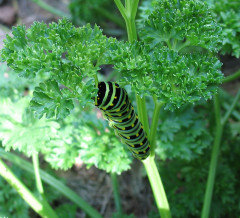
Cecily, if the definition of 'host' plant is that the cats eat the foliage, then what are cats doing on my Parsley in my garden? What would you conclude? I believe this may be a Swallowtail cat, which is basically one of the few times I see any kind of cat in my garden. So since growing Asclepias has not increased the butterflies in my garden, I grow more parsley to at least help out the Swallowtails.
- 2 years ago
Yes, parsley is a host for swallowtails. Carrots and dill are also so hopefully you'll see lots of cats in your veggie garden.
Asclepias tuberosa is drought resistant so please consider adding that for monarchs.
- 2 years ago
pM2 - yes we are on the migration route for monarchs. In good years, there can be rivers of them fluttering across the sky! In those years, the monarchs flock heavily to the heptacodium tree to rest and feed. Two neighbours across the street grow the milkweed, but have seen a decline in the monarchs on them. So far this year we have only seen a couple of monarchs so we are all waiting to see if that improves this week. The tree has just started to bloom.
- 2 years agolast modified: 2 years ago
Cecily, I do grow Asclepias tuberosa and again, for over 10 years and still, I see a half dozen Monarchs in a whole growing season, even with all the other plants I have. I don't understand why my posts above did not pesuade you that I'm doing a very good job of paying attention to having a garden that is pollinator friendly. Nor do you want to acknowledge that I've made a point. The subject of this thread isn't even about Monarchs, it's about natives. And since I've been talking about the nuances of growing natives, I'm just surprised that you had no interest in addressing that. That would have been more helpful.
Cyn427, Again, that's all you got out of my post, that my source of information was wrong about the host plants for Monarchs. Even though I was correct in the plants I've chosen for host plants for Monarchs.
I've made the attempt to give you some helpful feedback and really I can't spend any more time trying to explain my point. If you didn't get it from the posts I've already made, then....not much chance anything I say will make a difference.
- 2 years ago
Woody, I was just talking to another gardener who has a Heptacodium Tree and she used to get more Monarchs and they seemed to be in the pathway of a Monarch migration but in the past few years, for some reason she's barely seeing a Monarch. So, clearly there are other factors at work that are not easy to figure out. I hope you get more Monarchs this year!
- 2 years ago
Prairiemoon I did not evaluate, judge or criticize your garden or your philosophy I only corrected the definition of host plant. I have no idea why you attacked me. If you enjoy hating random people on the internet then knock yourself out.
- 2 years agolast modified: 2 years ago
Cecily, I can see that you don’t understand, but I don’t understand how you misinterpreted my post as an attack or hate.
You did correct the wrong information, which I had no problem with. Glad to have the correct information. Unfortunately, you were riding on the coattails of Cyn247’s post. It was the combination of both your posts that I had a problem with.
It was not a huge mistake made in both your posts. It is subtle and repetitive here on GW. And not just here, but other sites as well. That native enthusiasts can sometimes be almost evangelistic in their fervor to ‘convert’ people with an appeal for natives only. And believe me I’m not alone in experiencing that.
I’m trying to be helpful by providing feedback about how that approach is received and if you aren’t interested in hearing that, I’ll be sure to keep it to myself next time you post.
And can I offer an alternative way of encouraging people to keep Monarchs in mind? Take a look at the Pollinators thread on the Perennials forum. No one is trying to tell anyone what they “should” do. Everyone is just sharing what they are doing in their own garden and posting lots of photos of all the pollinators and the plants in their garden they are using. That is just a friendly conversation between garden friends. It’s very interesting and exciting and well received. I’ve already seen a couple of plants that I might try to add to my garden.
Hope that clears it up.
 2 years agolast modified: 2 years ago
I don't know where East Anglia is or what growing Zone you are in but your local nursery will have ideas of plants that will grow easily. NOT a big box store.
All plants need at least some water...especially in the first year before they become established.
- 2 years agolast modified: 2 years ago
Like Cecily, I was just just trying to correct one incorrect statement. That is all. Without the host plants, there will be a loss of butterflies. Not playing "gotcha" and not implying that anything else you said was wrong.
I will bow out. - 2 years agolast modified: 2 years ago
Cyn427, I never thought you were trying to play ‘gotcha’ or that you implied that anything else I said was wrong. I have explained what the problem was for me. The fact that … from my post above....“native enthusiasts here and around the internet, become evangelistic in their fervor to convert people with an appeal to natives only.”
You posted before my ‘host plant’ error, explaining how invested you are in supporting wildlife and natives. Making suggestions on the thread about where people can find out more information. Explaining how you have chosen to only plant natives. And this was in response to Woody’s post explaining why she doesn’t limit herself to natives. You continued by suggesting people read Doug Tallamy.
Later in a response to me, after I had already posted a lengthy post to illustrate that I care about wildlife, and pollinators and use natives, you said….
“Picture me on my knees begging everyone to read Douglas Tallamy’s books.”
And Cyn427, I’m sure it has to be over a year ago that you were posting on another thread about natives that I was on, recommending this book by Tallamy.
Please don’t misunderstand. It’s to your credit that you want to do all that you can. And that you feel strongly enough to plant only natives. And you should never feel that you can’t express that here on the forums. You just step over the line, when you clearly really really want to convince everyone else to do the same.
And you haven’t been open to anyone else’s point of view. You remain unconvinced evidently that the way you are going about it is not effective. Hey, maybe I’m wrong, and a lot of people respond positively to this approach, but I personally don’t. I think it is heavy handed. Native enthusiasts who really really want to persuade everyone to go natives only, are starting to get a reputation not unlike Jehovah’s Witnesses who show up at the door to proselytize.
You can believe me or not, but I’ve talked to at least 2 people on GW who feel the same way I do about natives only and the heavy handed effort to convert everyone to it. I’ve also had the same conversation with people on Facebook in garden groups.
So, there’s really nothing else for me to say. I hope you will continue to share what you are doing in your own garden. I’m sure a lot of people would be interested. I already shared the effect the Pollinator thread had for me. That’s it…
Sorry Rosaprimula if we took the thread off track.



cecily 7A