Software
Houzz Logo Print
webuser_341243473

Is my Snake Plant doomed?

2 years ago
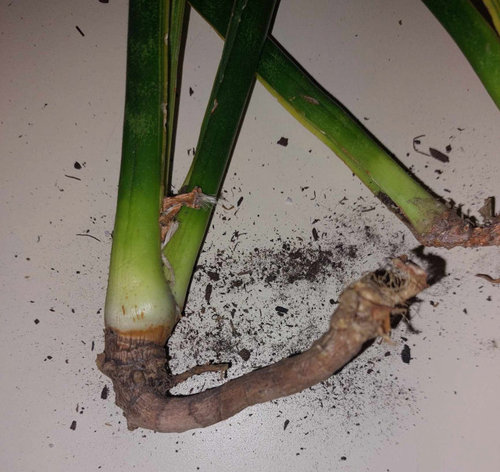
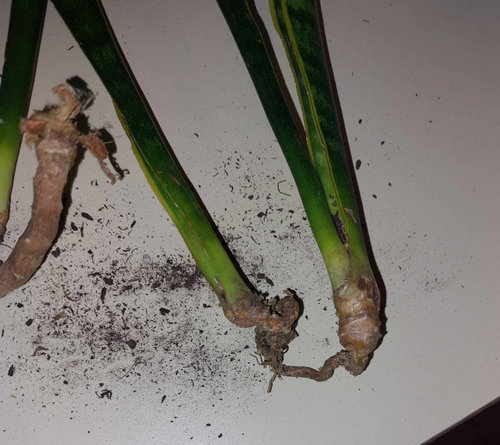
These are the roots of my snake plant. It will not stand in the pot and I fear it is beyond saving. Is there any hope?


Comments (9)

  • 2 years ago

    I think there is still a likelihood that it can recover if it looks like that from getting too dry.

  • 2 years ago

    I think my pot might be too big for it. I am using a soil for snake plants. I am not very good with plants but this one was doing well for a few years. I don't want it to die but I find explanations online to be too vague or too complicated.

  • 2 years ago

    A big pot is fine. This kind of plant makes very big roots. To stabilize it, hold it with 1 hand and use the other hand to place a few rocks on the soil surface so it canlt wobble. After a while, the roots will have grown enough to keep it from falling out of the pot. I like to use rocks about the size of a baseball for this.

  • 2 years ago

    They make a number of products designed to provide stability for plants that show a tendency to laying over when they get a bit top-heavy. They will work better than many other methods of providing stability because they change the fulcrum point to a spot well above the soil line which reduces and in some cases nearly eliminates the leverage that causes plants to topple in the first place.


    Whether or not you should use a large or small pot depends almost entirely on your choice of medium and/or any methods you might use to reduce the amount of water a planting can hold, and there are several very easy trick that employ simple science to achieve that end. One thing you want to avoid is using a pot so large that soil at the bottom of the pot is 100% saturated after a thorough watering. This is especially true if you choose a pot made of plastic, high-fired ceramic, or other materials that do not allow gasses to pass through the pot walls. When you situate plants with poorly developed root systems into a water-logged grow medium, roots are extremely reluctant to colonize the saturated soil. This causes anaerobic composting of the grow medium, the result of which is a grow medium that is saturated for extended periods, accompanied by waste gasses (CO2, H2S [sulfur dioxide], methane, .....) that displace oxygen and fill soil pores above the saturated area. Any practice that limits the roots' essential access to oxygen should be avoided because roots can't function w/o oxygen.


    If you're using a chunky, porous grow medium that holds little or no water between soil particles:

    there is no need to fret about excess (perched) water and its deleterious effects, that type of medium is extremely rare in the retail market. If you choose a medium that does hold excess (perched) water, the more perched water it holds, the more difficult it is to deal with. This is especially true as we go into winter and the plant's usage of water from the soil drops precipitously.


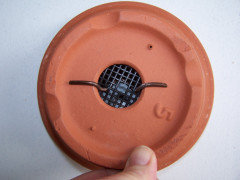
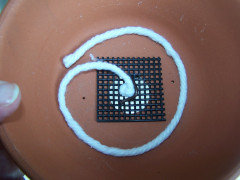
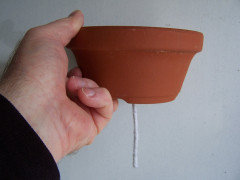
    I'll step into your shoes for a moment to describe how I would approach this issue. I would use a low-fired clay (terra cotta) pot that holds 1-2 cups of grow medium. I would fashion a wire stake to provide stability. I would use a wick through the drain hole to markedly reduce the amount of water the planting can hold.


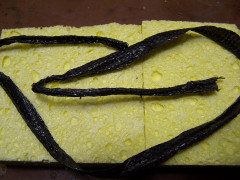
    The wick works by increasing the gravitational flow potential of water in the pot by "fooling" the water into "thinking" the pot is deeper than it actually is. As water travels down the wick "searching" for the pot's bottom, the weight of the water in the soil and at the top of the wick pushes water at the bottom of the wick off of the wick. For the wick, you can use a single strand from a 100% rayon mop head, a strip of cloth from a man made 100% rayon chamois (automotive department), or a poly closure used to securely close bags of onions or fruit.

    Or, I would use this simple trick to ensure ALL excess water is removed from the pot:


    Newton's First Law

    For conventional container culture, it's a given that saturated/partially saturated media rob roots of the oxygen they need to function normally and efficiently. At best, soil saturation robs your plants of immense measure of potential in areas like growth, appearance, yields, ….. At worst, plants unable to cope with the strain of drought stress caused by saturated media will succumb to it. This isn't a 'scare tactic, it's a very simple and straightforward observation that will be difficult to disagree with a straight face.

    Newton's First Law of Motion states that an object will remain either at rest, or in motion at a uniform rate and in a straight line unless acted upon by an external offsetting force. In this case, we will designate the 'object' as excess water in your potting medium. At risk of my being redundant, the 'law' can be seen as a simple statement about inertia, that objects will remain in motion and in a straight line unless a force acts to change the motion. To put the law to work for you/your plantings, you should water to beyond the point of total soil saturation - so the medium has been completely saturated and at least 15-20% of the water you have applied has exited the pot. Unless your soil is purposefully constructed to eliminate all/nearly all excess water, it's extremely probable, when the pot has stopped draining, there will be too much water in the potting medium for the plants' liking.

    To eliminate this excess water: immediately after a thorough watering, hold the pot in one hand over the sink, lawn, or over-sleeping significant other and move it downward, then sharply reverse the direction to upward. You'll immediately note that a good measure of 'excess' water will “continue downward in a straight line” and exit the drain hole. The sharper the reversal of direction, the more water exits the drain hole. When you have repeated the exercise until water no longer exits the drain hole on the reversal of direction, you will have eliminated all excess water and your plants will regard you with a newfound sense of awe.


    Finally, it's crucially important to make sure your watering intervals are monitored to ensure they are appropriate:


    Using a 'tell'

    Over-watering saps vitality and is one of the most common plant assassins, so learning to avoid it is worth the small effort. Plants make and store their own energy source – photosynthate - (sugar/glucose). Functioning roots need energy to drive their metabolic processes, and in order to get it, they use oxygen to burn (oxidize) their food. From this, we can see that terrestrial plants need plenty of air (oxygen) in the soil to drive root function. Many off-the-shelf soils hold too much water and not enough air to support the kind of root health most growers would like to see; and, a healthy root system is a prerequisite to a healthy plant.

    Watering in small sips in order to avoid over-watering leads to a residual build-up of dissolved solids (salts) in the soil from tapwater and fertilizer solutions - which limits a plant's ability to absorb water – so watering in sips simply moves us to the other horn of a dilemma and creates another problem that requires resolution. Better, would be to simply adopt a soil that drains well enough to allow watering to beyond the saturation point, so we're flushing the soil of accumulating dissolved solids whenever we water; this, w/o the plant being forced to pay a tax in the form of reduced vitality, due to prolong periods of soil saturation. Sometimes, though, that's not a course we can immediately steer, which makes controlling how often we water a very important factor.

    In many cases, we can judge whether or not a planting needs watering by hefting the pot. This is especially true if the pot is made from light material, like plastic, but doesn't work (as) well when the pot is made from heavier material, like clay, or when the size/weight of the pot precludes grabbing it with one hand to judge its weight and gauge the need for water.


    Fingers stuck an inch or two into the soil work ok for shallow pots, but not for deep pots. Deep pots might have 3 or more inches of soil that feels totally dry, while the lower several inches of the soil is 100% saturated. Obviously, the lack of oxygen in the root zone situation can wreak havoc with root health and cause the loss of a very notable measure of your plant's potential. Inexpensive watering meters don't even measure moisture levels, they measure electrical conductivity. Clean the tip and insert it into a cup of distilled water and witness the fact it reads 'DRY'.

    One of the most reliable methods of checking a planting's need for water is using a 'tell' (more reliable than a 'moisture meter'. You can use a bamboo skewer in a pinch, but a wooden dowel rod of about 5/16” (75-85mm) works better. They usually come 48” (120cm) long and can usually be cut in half or in several pieces, depending on how deep your pots are. Sharpen both ends of each tell in a pencil sharpener and slightly blunt the tip so it's about the diameter of the head on a straight pin. Push the wooden tell deep into the soil. Don't worry, it won't harm the root system. If the plant is quite root-bound, you might need to try several places until you find one where you can push it all the way to the pot's bottom. Leave it a few seconds, then withdraw it and inspect the tip for moisture. For most plantings, withhold water until the tell's tip comes out nearly dry. If you see signs of wilting, adjust the interval between waterings so drought stress isn't a recurring issue.

    Al

  • 2 years ago

    I will try your instructions, thanks. I have pretty bad ADD and sometimes get overwhelmed by what seem to be very complex instructions for tasks and that negatively impacts my skill with plants. Also, i like your Little Prince icon.

  • 2 years ago

    The Little Prince by Antoine de Saint-Exupery ..... my favorite book, ever. I read it at least once each year.


    I hope you benefit from the advice, Michael. Good luck.


    Al

  • 2 years ago

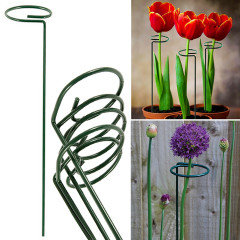
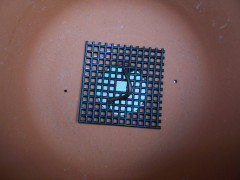
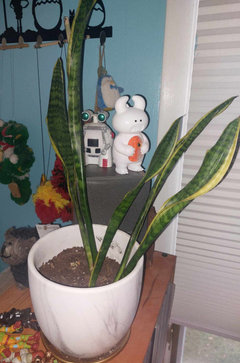
    Hi again. I purchased some stakes to hold the plant up. Sadly I have been very busy so my work on this has been limited. The pot I am using is ceramic


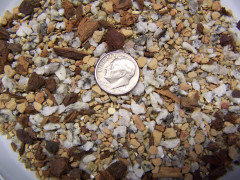
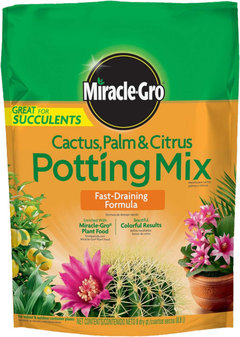
    As for the medium I have been using this


    My plant did very well for a few years. It was originally inthe green plastic container from the store but I moved it to the ceramic maybe a year and a half ago.

  • 2 years ago

    Does your pot have a drainage hole? All succulents must be planted in containers with a drainage hole. I hope your snake plant will make it, it should be easy to grow new roots with proper watering.