Software
Houzz Logo Print
grasswhisperer

Heritage Birch vs Jacquemontii Birch?

2 years ago

Hi folks - would like to add some birch to our landscape and I know not all birch are the same. We are looking for a white birch - and I've seen some that do NOT seem to have such peeling bark. I'm not sure if the bark is due to particular varieties or if it's a seasonal thing (aka do all birch trees shed bark in the fall, etc.?)


Regardless - looking for white and I've come across some good end of season deals for Heritage Birch and/or Jacquemontii Birch.


I believe both of these would be considered a "white" birch and I've tried to research online, but for each of these I see so many conflicting info and pictures. I can't get it straight so hoping somebody here can weigh in and help me discern the difference?


Thank you!!!

In Eastern MA

Comments (20)

  • 2 years ago

    Found this on Arbor Day Foundation

    I don’t know if it will help.

    “The river birch is a popular shade tree in the United States. This Heritage variety offers the most colorful bark of any cultivar on the market — displaying curls of light brown, orange, and purple all year long. It’s also fast-growing, disease resistant, drought and flood tolerant, and great at withstanding severe weather.

    Features spreading limbs and colorful, peeling park
    Provides beautiful yellow fall foliage
    Does well in both dry and wet conditions
    Can withstand strong wind and ice
    Grows two to three feet each year”

    https://shop.arborday.org/heritage-river-birch

  • 2 years ago

    “Himalayan birch
    The classic Himalayan birch (Betula utilis var. jacquemontii) is variable, but there are excellent AGM varieties guaranteed to develop that desirable white bark. These include ‘Doorenbos’, ‘Jermyns’, ‘Silver Shadow’ and ‘Grayswood Ghost’.

    “Seek out these medium-sized trees from specialist tree nurseries and then add a carpet of vibrant spring-flowering plants to flatter their ghostly form. Choose either deep-pink Cyclamen coum, or dusky hybrid hellebores or purple crocus - keeping the planting simple.

    Benefits: striking white bark, easily available”

    Common name:
    Whitebarked Himalayan Birch
    Pronunciation:
    BET-u-la EW-ti-lis jack-MONT-e-i
    Family:
    Betulaceae
    Genus:
    Betula
    Synonyms:
    Betula jacquemontii
    Betula utilus subsp. jacquemontii
    Type:
    Broadleaf
    Native to (or naturalized in) Oregon:
    No
    Deciduous tree, 30-50+ ft (9-15+ m), pyramidal, upward branches, white "paper" bark on trunk and often on young branches. Leaves alternate, simple, 5-7.5 cm long, rounded or slightly cuneate (wedge-shaped with straight sides) at base, margin double serrated, dark green above, glandular below, pubescent on veins, 7-9 vein pairs.
    Light to part shade, especially afternoon shade. Best in cool, moist, well-drained soil; like other birches, the roots are shallow, so it is not for high traffic areas. Listed as having "some borer resistance" in the Sunset Western Garden Book, but other authorities (e.g., Univ. Minnesota, Extension) consider it "highly susceptible" to the bronze birch borer (BBB). This pest is common east of the Cascades but was essentially unknown in western Oregon before 2003; now it is becoming an increasing problem in the Portland area and Corvallis.
    Hardy to USDA Zone 5 Native to the western Himalayas”

    https://landscapeplants.oregonstate.edu/plants/betula-utilis-var-jacquemontii

  • 2 years ago

    Try to find out locally which will do well with pests and disease. Birch can be pretty susceptible in some areas. As far as the bark peeling, I don’t know which peel less. We had a white birch growing up and I don’t remember the peeling bark being very much trouble. Are you concerned about it being on the ground? Birch are gorgeous trees so I hope you can figure out which will work best. You could try your local university extension. Or contact Michigan State University horticultural dept. I’m sure you would have one where you live though. They are normally super helpful and knowledgeable. Best of luck!!

  • 2 years ago

    Thank you!


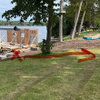
    Yeah I've seen a bunch of info online - but then I see this and many others that say this (pic) is a Heritage river birch:


    so maybe that's just in the fall? but that ain't what we're looking for :)


    I'm thinking that the Jacquemontii/Himalayan is probably what we're seeking, just trying to make sure as these young trees don't really have mature bark yet.

  • 2 years ago

    or this is also a picture (seemingly NOT in the fall) of Heritage birch, which does not appear all that white:


  • 2 years ago

    River birch, (Betula nigra) of which 'Heritage' is a cultivated form, do not have white bark at any stage in their life cycle or the season. It is a fleshy, salmon pink color, maturing to a reddish-brown or grey. And its bark is also more flaky than peeling.

    If you want white bark, B. jacquemontii or papyrifera are your best bets.

  • 2 years ago

    Why would you choose a non-native Himalayan birch when our native white paper birch is so pretty? Get them from Fedco.


    Paper Birch - Fedco Trees (fedcoseeds.com)

  • 2 years ago

    Thanks @gardengal48!


    @sigrid - Why? because I don't know anything about birch trees and I'm trying to learn :)


    Thanks for the advice.

  • 2 years ago

    " Why would you choose a non-native Himalayan birch when our native white paper birch is so pretty? "

    Because our native paper birch has a very narrow range of suitability, is rather short lived and stressed trees (summer heat, drought) are highly prone to BBB.

    Despite all the propaganda to the contrary, native species are not always the best choice :-))

  • 2 years ago

    Another point that I’d disagree with in the Arbor Day Fndn description of the Heritage Birch ( including bark color as noted above) is the strength of the branches— here in VA we lose many branches during ice storms and winter weather. I do like them but don’t think of them as hardy wrt wind & ice.

  • 2 years ago

    Jacquemontii birch is definitely susceptible to BBB. Our native paper birch is actually relatively resistant to BBB compared to non-native white bark birch species like jacquemontii, especially when it is grown within its native range (which includes eastern MA)


  • 2 years ago

    From what I read, the requirements for Himalayan birch and paper birch are pretty much the same. Neither are fond of heat or drought.


    Native species outside of their normal range have problems --- ie native to the US, but not your area. But, species native to your area, as paper birch is to Eastern Mass are usually the best choice.


    You're supporting wildlife, birds, butterflies, the ecosystem.

  • 2 years ago

    See this excellent article from the BYGL Bronze Birch Borer Remains a Threat

    Scroll down to "The Hosts with the Most": "Research conducted at OSU and elsewhere showed that all birches are not equal when it comes to BBB. Our native birch trees co-evolved with BBB, so natural selection favored native trees that have a defense against BBB. Conversely, birch species that evolved in Europe and Asia are BBB fodder in North America because natural selection never advanced defense mechanisms against BBB"

    In other words, even healthy, non-stressed Himalayan birch (and other non-native white birches) are quite susceptible to BBB, while the native paper birch, when grown under favorable conditions, is quite resistant to BBB.

  • 2 years ago
    last modified: 2 years ago

    I'm kinda with Sigrid on this -- eastern Massachusetts should be OK for paper birch (which is a tree for relatively cold climates). Even here in west MD there are some very elegant, semi-weeping specimens, tho they do seem here to be rather short-lived, say 50-80 yrs.

  • 2 years ago
    last modified: 2 years ago

    Even in my location amid the native range of this tree (betula papyrifera), you don't want to plant them on high, sandy ground. You can get them established in such, but dry spells/doughts can add to their susceptibility to branch die back, cankers and BBB.

  • 2 years ago

    Well, I'm in Maine and I have a ton of birch on poor, sandy, rocky soil up and down a steep slope. Have had no problems with any diseases. Really old birches do tend to get Chaga mushrooms (looks like burnt spots) but that's well over 50 years down the road. I suspect there aren't enough Himalayan or other exotic birch planted 50 years ago for comparison.


    Further, I drive from Maine to Eastern Mass often and see plenty of healthy paper birch growing wild. I see hemlocks suffering from what I assume is woolly adegid, suffering ash (Emerald Ash borer?). Pines with problems, but healthy Birch.


    If you buy an expensive tree, the people marketing it will extol all its virtues. If you buy an inexpensive, common tree, no one will. Don't get sucked in by the marketing.


  • 2 years ago
    last modified: 2 years ago

    Actually, I have what was advertised as a "hybrid Himalayan" birch bought from OIKOS -- I suspect they didn't narrow it down more because of all the cross-pollination on their grounds. It's near 40 ft tall now after 19 yrs & has handsome white bark that stands out in winter. Overall, tho, it has little "elegance" and loses alot of leaves in late summer, so I'm not really much impressed.


    In addition, I had a river birch and for reasons cut it down. It was crowding more desirable baldcypresses and frankly had alot of yellowed leaves during the summer which made it a bit of an eyesore.

  • 2 years ago

    ' I have a ton of birch on poor, sandy, rocky soil '

    Yeah, and then there's poor sandy soil that 100 to 300 ft to bedrock.

    I don't know, yours might be similar.

    Not to mention our 6-10" annual rainfall. ;-)

    But I've notice right in town here, mature B. papyrifera are declining with some exceptions.

  • 2 years ago

    “Not to mention our 6-10" annual rainfall.”

    Bill, is it your opinion that conditions are noticeably dryer over the past several years, or is this the typical amount of seasonal moisture?

  • 2 years ago

    I only mentioned that to bring to light that we don't get near as much rain as they do out east.

    I've encountered seasons with more or less than that over the last 50 years or so that I've paid any attention to it.