

Anyone have Heat Pump AHU knowledge with regards to insulation?
Hi,
I have a Bosch Heat Pump AHU installed in the attic. This is fairly new to my area of New England so I want to make sure I understand properly, to make sure my contractors do things right. The unit is in the attic space on this new construction. What would be the best way to insulate the attic to make sure it doesn't cause any issues with the handler? I am reading some say spray foam, but then there's the debate of open and closed. Then it sounds like i need to make sure the attic is airtight? Anyone have experience with this?
Comments (35)
 2 years ago
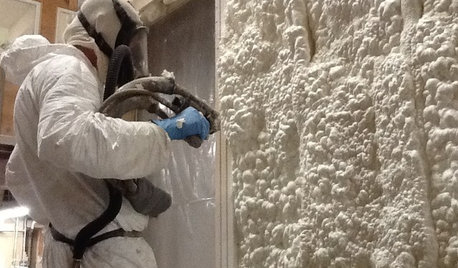
Spray foam seals your attic and puts all your HVAC ducting inside your insulation envelope so you don't have cold blasts of air in winter and hot in summer when the Heatpump first kicks on. Open cell is less expensive but half the R value per inch and not watertight. So long as water isn't an issue and you have the room it‘s the more economical choice.
Related Professionals
Houma General Contractors · Greenville General Contractors · Cincinnati General Contractors · Lake Charles Home Remodeling · Decatur Bathroom Remodelers · Pine Bluff Bathroom Remodelers · Greenville Architects & Building Designers · Ottumwa Architects & Building Designers · Rochester Architects & Building Designers · Baton Rouge Design-Build Firms · Beaumont Design-Build Firms · Auburn Design-Build Firms · Elgin Design-Build Firms · Taunton Design-Build Firms · Fergus Falls Design-Build Firms PRO2 years agolast modified: 2 years ago
I think you're asking about the best way to construct a conditioned attic. I built four new homes with conditioned attics and retrofitted the attic of my personal home to a conditioned attic. I highly recommend them where HVAC equipment and/or ductwork is installed in the attic. Building Science Corp. has some excellent information resources available on line;
Note that the attic isn't air tight; it should have a vapor diffusion port.
- 2 years ago
Making the attic air tight would only apply if the attic is part of the conditioned space. Conditioned space is any part of the structure you want to heat and cool, so the attic would be within the same envelope as the rest of the house.
Rarely are attics part of the condition space and would require a considerable amount of expensive work to do so. In most cases the air handling units placed in an attic is insulated along with all the duct work to and from the air handler including the condensate drain pipe when an AHU is located in the attic. If you have reason to question the contractors competency consider hiring a independent inspector before closing and taking possession of the house.
- 2 years ago
I would not expect an air handler to be installed in an unconditioned attic of a new house in the New England area. The energy loss can be high.
- PRO2 years ago
With proper air sealing and insulation, air handlers and duct work can perform just fine in unconditioned attic spaces. If the OP finds the cost of conditioning the entire attic to be outside their budget, they may wish to consider a conditioned mechanical room in the attic to house the air handler as an alternative.
 2 years ago
The pinnacle of enlightened modern building technical engineering excellence comes from Building Science Corporation, its staff and founder, Joseph Lstiburek.
I've never understood the acceptance and prevalence of putting any part of a home's HVAC system in unconditioned attic space. Other than, I understand it's cheaper and easier than other approaches. That in part explains its presence in tract housing construction. Even in my mild weather area where HVAC needs and usage are limited, there has to be seasonal heat gain and loss (summer vs winter) that could have been avoided. As is being learned now with tightening energy efficiency building standards, better methods are known and aren't free, and sometimes aren't cheap, but are obviously worthwhile over the life of a structure. Many offer rapid payback.
 2 years ago
"What would be the best way to insulate the attic to make sure it doesn't cause any issues with the handler? "
You shouldn't have any "issues" with the heat pump in an uninsulated attic other than a very slight loss in efficiency due to the uninsulated AHU. Air handlers and furnaces have minimal insulation but the ductwork should be at least R8. Other than that, there's not much else to do until you start insulating the attic space/building a small insulated room in the attic for the HVAC.
- 2 years agolast modified: 2 years ago
I think we can all agree that having an AHU and ducts in an unconditioned space is not ideal. Whether it should never be done would be a debate that we don't really need to have here.
To put some numbers on it, my energy rater put it at something around 17% loss. Now if you use $100 to heat and cool the second floor (assuming 2 story house), that would be $17 a year. Wasted, for every year the house survives.
I didn't plan on it but had to have ducts in an unconditioned attic. To be fair, I could have foamed the roof-line but it is exceptionally tall so it would not have been financially a good idea. We elected to insulate a mechanical room and then bury the ducts in a ton of blown fiberglass. I live in a milder climate and probably have lower electricity costs than NE.
I just ran the numbers and we pay about $150 to condition the upstairs per year. Foaming would have been $10k and at best would have saved $30 of that. I spent a lot of money to save on future energy costs but not foolish money.
NE could be 10X that cost and the foam maybe a lot cheaper since the attic may be smaller/less tall. But why not ask a local energy rater? Most of the answer is local and unknowable by someone on a forum unless given a ton more information than the average HO would have.
There is the side issue of AHU longevity and just so hard to quantify but should not be ignored.
- PRO2 years agolast modified: 2 years ago
"To put some numbers on it, my energy rater put it at something around 17% loss." Your energy rater might have been a little "heavy handed" with the calculator when estimating the energy penalty. The good folks at BSC estimate the energy penalty for locating an air handler and ductwork in an unconditioned attic is 10%.
It's worth noting that locating air handlers and ductwork in conditioned attics was promoted beginning around 25 years ago, based in large part on typical duct leakage rates of 10% to 20% in newly constructed homes. Code revisions since then have required improvements in duct construction and performance. The 2018 International Residential Code (which forms the core of most statewide building codes) requires leakage testing of duct work. Duct leakage can't exceed 5% (it's actually stated as n.t.e. 4 cu. ft. /min/100 sq. ft. of floor area so the percentage varies with ceiling height.) BSC also estimated the increase in equipment longevity by placing the air handler in the attic. I don't recall the exact estimate (a conflict in terms, n'est-ce pas?) but I believe it is small; less than 5%
- 2 years ago
I would love to see how the 10% - 17% energy loss is calculated for equipment and duct work installated in an unconditioned attic. Do energy raters use a rule of thumb or is all the information entered into a software calculator?
- 2 years ago
" I just ran the numbers and we pay about $150 to condition the upstairs per year. Foaming would have been $10k and at best would have saved $30 of that. "
Hold on here. You have solar panels, no? If this is your estimate of the net utility bill AFTER applying solar production consumed for no operating charge and credits for any excess, is $150 an amount relevant for anyone to know without an explanation?
- PRO2 years agolast modified: 2 years ago
@mike_home,
I can't vouch for the energy rater's calculations, but the 10% energy penalty determined by BSC research was determined from computer model simulations:
https://buildingscience.com/sites/default/files/document/rr-0917_attics_las_vegas.pdf
you can judge for yourself. Just keep in mind that the BSC guys have pretty good engineering credentials.
- 2 years agolast modified: 2 years ago
$150 is before solar. Solar covers about 80% of our total usage but as you mentioned it wouldn't be helpful to include that in the calculations. With 10c kwh, good insulation, modern equipment and duct and mild climate, we aren't talking big money here. OP is talking new construction so a lot of this applies to him - but not the mild climate and likely the cheap electricity. But NE could be coastal Conn which might qualify as pretty mild.
I like the 10-20% estimate. 17% was definitely done taking R8 insulation for the ductwork into account but not sure what leakage rates.
I am sure it is some modern ROT (the 17%). Certainly a tree shaded roof in a hot climate would be better. The raters need to use some ROT for estimating.
Leakage rates matter a lot. Climate matters a lot - a Las Vegas hot attic is pretty bad as is a very cold climate. Age of ductwork matters too. That linked study is from 1996 and assumes 10% supply leakage rates. Makes you think 10% energy penalty is even a high estimate with modern ductwork.
All of this is a good reminder that a 2023 NE build (presumably strict codes) is probably not where we need to worry about energy waste.
- 2 years ago
@Charles Ross Homes,
Thanks for sharing the Building Science Corporation Research Report 0917 dated Nov. 14, 1996. I read the report. The only place I could find about a 10% energy savings was in this sentence:
When typical duct leakage was modeled (10% return leak, 5% supply leak), the sealed “cathedralized” attic could save 10% on space conditioning energy.
The data appers to be taken over two non consective days on houses built in Las Vegas. There is no explanation how the computer simulations were done in 1996 or how the data showing how the 10% energy savings was derived.
A simulation model to determine the energy lost by HVAC equipment installed in an unconditioned space needs several input parameters. The insiulation value of the duct work, the length, and circumference would be needed. The temperature of the conditioned air inside the duct, and the air temperature of the attic is required. This would determine how much heat is lost and gained by having the duct sitting in the unconditioned attic. Then the calculation is repeated for condtioned space conditions. The difference is the additonal heat gain and loss.
Here is something to think about. The temperature of an attic can go to 120 F degrees in the summer. This is the reason the recommended minumum attic insulation is R38 in order to reduce heat gain to the floor below which is being cooled to 75 F degrees. However the duct work in the attic is rated for R8 and the conditioned air is 50 - 55 F degrees. If the attic is 2000 sq feet or more the losses will be significant in my opinion. A similar loss happens in the winter when the attic is at 25-30 F degrees and the condtioned air is at 110 F degrees.
The amount of the loss is very dependent by the size of the house and the climate. My rule of thumb would be a 20% energy loss. David Cary came up with a good soultion of insulating the mechanical room and surrounding the duct work with additonal insulation. Insulting an attic is very expensive and if not done properly can lead to future problems.
- PRO2 years ago
Heat transfer between an attic and the living space below and the heat transfer to/from an air stream in a duct where the time in the duct is measured in seconds are quite different scenarios. The required insulation R-values reflect that.
The most significant energy penalty is duct leakage because the homeowner paid to condition the air and it is not being directed to condition the living space.
 2 years ago
There is a huge misunderstanding of what a "conditioned" attic is, in this hypothetical scenario. When you convert a vented attic to an unvented attic (meaning sealing it off with spray foam and closing all passive attic ventilation), it is considered a "conditioned" attic. That does not mean it has supplied HVAC (heat or cool) in the space for living purposes. That is what Tim @CharlesRossHomes first described, and can be a route taken.
Nick
Original Author2 years agoSo if you sealed it off you'd even want to seal any soffit vents etc so there's no air movement?
- 2 years ago
The run time of an HVAC system in a typical home is in the range of 200-300 hours per year. I am not sure why you say the heat transfer within a attic duct is measured in seconds. If you use temperature set backs lasting several hours to save energy, the air sitting in the attic duct will eventally be as cold or as hot as the attic air temperature. When the air handler turns on after the set back period a blast of hot or cold air will enter the home. I doubt energy raters account for this in their efficiency calculations.
Unconditoned attics get very hot and cold. It is not a good environment for HVAC equipment and duct work. There will be additional energy losses. If we are serious about reducing fossil fuel consumption then this practice should not be allowed in new home construction in my opinion.
Nick
Original Author2 years agoI spoke to the HERS rating and insulation guy a moment ago - their plan is either to 3" of closed cell, then 7" of open cell. or for $3k more ($9k) all closed cell. They will seal all venting.
- 2 years ago
Nick, if you are insulating the roof plane instead of the ceiling plane, then you must seal off all outside air flow to the attic or it will make the roof plane insulation useless. This has become a common method in Texas, as thee typical suburban home's air handlers are usually installed in those huge attic spaces.
Nick
Original Author2 years agoIt sounds like that's the plan. To seal the roof with the spray foam and all passive venting. Then no insulation between 2nd floor and attic space.
- PRO2 years ago
Unvented (conditioned) attics need to be carefully designed and constructed. Follow the requirements specified in section R806 of the 2018 International Residential Code. That includes the requirement to supply conditioned air to the attic space. I recommend you have a blower door test performed after the insulation is cured. If the ACH 50 is less than 0.35 you'll need to install a fresh air ventilation system (e.g., energy-recovery or heat-recovery ventilator,) too, because you will likely have reduced the air infiltration rate below a safe number of air changes/hour.
- PRO2 years ago
In general, the best place to install an ERV is so it introduces fresh air into the bedrooms since occupants generally spend 8 hours/day there. If it's integrated with HVAC ductwork vs. dedicated ductwork, make sure it will deliver the required ventilation rate even when heating and air conditioning is not called for.
- 2 years ago
All good info. Just one anecdote, my HVAC runtimes can be 200 hours per month in peak months. Obviously all situations are different but it would seem that a well designed system with small as feasible units in a mixed humid climate would have runtimes closer to 1000 hours per year. My upstairs unit does not run that much in the winter because we live in a relatively warm area and heat rises. It still hits 700 hours per year or so - mostly June thru Sept. Downstairs ran 1400 in last 12 months.
Either way, pretty far from 200-300 hours per year.
That 2100 hours is roughly $400 which is probably significantly less than average HVAC costs. This is for seer 15 2 ton units that draw about 1.8 kw. No sign defrost or aux usage.
- PRO2 years ago
"The amount of the loss is very dependent by the size of the house and the climate. My rule of thumb would be a 20% energy loss." That would substitute whatever special knowledge you have for the results of an engineering study by credentialled professionals. It would also overstate the energy savings of a conditioned attic vs. a conventional vented attic by a factor of two. If you'll read the above linked report more carefully you'll find the following statement:
"Annual simulation results for Las Vegas showed that the sealed “cathedralized” attic, compared to the vented attic with the air distribution ducts in the attic, could save 4% on space conditioning energy, with no duct leakage assumed. When typical duct leakage was modeled (10% return leak, 5% supply leak), the sealed “cathedralized” attic could save 10% on space conditioning energy"
There are sufficient references in the article to identify the software used for the simulations. You can also find the 318-page draft software users manual on line if you've like a deeper dive into FSEC 3.0
- 2 years ago
Happy New Year!
In this engineering study of 1996 I can't find what the R value is of the duct work in the attic. I also don't see how many of feet of duct work are exposed to the attic temperature and whether this duct work was lieing the floor of the attic or suspended in the rafters near the roof deck. The set temperature of the house and the run times during these two days are not mentioned. These are things which would effect the results of this engineering study.
Two days were chosen of the Las Vegas house when the outside air temperature was 92 degrees. Why only two days and why not a hotter temperature for mutlipe days? The study makes no mention of losses for cold climtes. Do we assume the losses would be the same for the coldest and hottest climates?
I have no special knowledge when it comes to this topic. However a 10% energy loss seems less than I would expect in a cold climate of New Englang, or a hot climate of Las Vegas. The energy loss can be calculated by simulation and I would be happy to be proven wrong if someone skilled in the art could present the data.
- PRO2 years ago
"In this engineering study of 1996 I can't find what the R value is of the duct work in the attic." If it's not stated, I'd argue that it doesn't matter anyway. The study compares the performance of one home with a vented attic and two with unvented attics. As long as the R-values of duct insulation were the same in the three homes it's not a variable.
"Two days were chosen of the Las Vegas house when the outside air temperature was 92 degrees. Why only two days and why not a hotter temperature for mutlipe days?" Read the report. Construction activities surrounding the site affected the data collection and some of the days were atypically cool. The two days were deemed adequate by the researchers to compare the homes in the same development with vented vs. unvented attics.
"Do we assume the losses would be the same for the coldest and hottest climates? " The purpose of this study is stated in the abstract:
"It has been suggested that by moving the ceiling air barrier and thermal barrier to the plane of the roof, that better building airtightness can be more easily achieved, and that the elimination of heat gain to the attic air distribution ducts would more than offset the additional heat gain caused by not venting the attic (emphasis added.) To investigate this further, both a computer modeling study and an experimental study in Las Vegas, Nevada were carried out."
Except for homes with flat roofs, the heat transfer areas would be different so you couldn't translate the results. That said, the finding that air leakage was the most significant contributor to differential energy usage would, in my opinion, apply to both heating mode and air conditioning mode. There are other ways to reduce with air leakage which may be a more economical alternative and which would eliminate some of the potential drawbacks with unvented (conditioned) attics.
- 2 years ago
Annual simulation results for Las Vegas showed that the sealed “cathedralized” attic, compared to the vented attic with the air distribution ducts in the attic, could save 4% on space conditioning energy, with no duct leakage assumed.
I would think in a newly constructed home it is possible to seal the ends of every flexible duct so the air leakage is close to zero. If that is possible then the conclusion of this engineery study is a conditioned attic could save 4% on heating and cooling costs. If this is true, then it is unlikely there will be a return on investment to condition an attic to try to recoup this lost energy. In this case the original poster was quoted $6K - $9K to spray foam the attic. It makes no sense finacially to do this unless the atttic is to be used as living space.
The original poster was worried the Bosch Air Handler could have issues operting in a very hot or cold environement. The air handler installation manual should list the operating temperature range of the air handler. If the minimum and maximum attic temperatures are within the operating range then there should be no need for a conditioned attic.
- PRO2 years ago
"It makes no sense finacially to do this unless the atttic is to be used as living space." Not every benefit is simple to calculate and not every conditioned attic is driven by energy savings. In hot-humid and mixed-humid climates, much of the benefit is eliminating the potential for condensation and attendant mold/mildew growth potential. For that reason, and to provide usable conditioned storage area, I converted the attic in my former home to a conditioned attic. I'd do it again in a heartbeat.
- 2 years ago
Wait a sec - R value matters. Consider this - no insulation - then the difference between being in conditioned space or unconditioned space is a big difference. Now consider R-50 (which obviously doesn't exist) then whether the space is conditioned or not is less important.
R-8 through a conditioned space is a bit of overkill.
- 2 years ago
In an attempt to satisfy my curiosity I did some research. Here is an interesting article: Ducts in an Unconditioned Attic
Dr. Joseph Lstiburek of Building Science Corporation on the topic of putting ductwork in attics was quoted as saying : “Where were the adults when this decision was made?”
The article goes on to say:
Then there are the energy losses. In winter, the heat escaping from supply ducts warms up the attic, melts the snow on the roof, and creates perfect conditions for ice dams. Researchers at the National Renewable Energy Laboratory have estimated that ducts in unconditioned attics waste about 20% of the output of the furnace or air conditioner, and that may be on the low side. In three western cities with high cooling loads, these researchers estimated that losses on the hottest day of the year could amount to 28% of AC output.
The stated losses are closer to what I think they are in the real world.
The most interesting thing stated in the article was this:
There are two options for locating ductwork in an attic. The first is to move the building’s thermal boundary from the attic floor to the roofline, which places the ductwork inside conditioned space. The other is to bury ducts in a layer of insulation on the attic floor, leaving the balance of the attic unconditioned.
Burying ducts in insulation is the second possibility. But there’s a catch. Even though flex ducts are protected with R-6 or R-8 insulation, moisture in the air may condense on the polyethylene skin of the duct in the summer. This can happen when ducts are buried in a shallow layer of air-permeable insulation like cellulose or loose-fill fiberglass. This is a problem that’s most acute in hot, humid climates, not in the arid West.
I thought the idea of burying the duct work insulation was a good idea. After reading this I am not so sure.
- 2 years ago
The burying duct option has come into favor more recently from what I can tell. Yes, condensation is a potential issue. You have to bury deep. We have R-96 in our attic floor which is pretty darn thick.
I can tell you that there is no feeling of cold air during winter different than a conditioned space duct. There is probably R-50 above the duct.
- PRO2 years ago
There are two issues with installing ducts in unconditioned spaces: 1.) any air leakage is outside the building's thermal envelope, and 2.) energy transfer due to the temperature differential. The evolution of building codes has driven a mandatory reduction in air leakage to 5% or less of total air flow. That leaves energy transfer and the potential for condensation which is a matter of R-value and air permeability of the insulation. A low R-value insulation which is air impermeable can prevent condensation. Taken together, these allow for energy-efficient installation of ductwork in unconditioned spaces and installation which may be more economical than installing equipment and ductwork in a conditioned space.




Mark Bischak, Architect