Software
Houzz Logo Print
melissaaipapa

A rose, and a question

I was out yesterday working around my most prosperous plant of 'Russelliana' and cleaning it out a trifle, and was thinking what a great rose it is. 'Russelliana' is listed as a hybrid Multiflora, a group that has a bad history in my garden, but then along comes this variety and blows my doubts away. It's growing in rocky clay, sometimes very wet, and seems entirely happy. (The wet may be advantageous: it's a stronger plant than the other two I have growing in heavy, more droughty ground.) My plant has been in place a dozen years of so. It has never gotten above shrub size in its starveling conditions, but in the last year or so has begun putting out longer canes, as if it might build in time to become a climber. One thing I notice about it is that it seems to be very little troubled by cane damage--I mean, it experiences cane damage, but the cane is not overly bothered by it--and also has long-lived canes. I don't recall seeing foliage disease, either. All in all, a handsome rose to plant and then not worry about, and know that it will do you proud. Oh, and it roots easily.

My question follows. Many roses sucker out and make new canes from below the ground, including many of the once-flowering old roses: Gallicas, Albas, Foetidas, and others. What I was wondering was, do these roses that renew their canes from their roots ever die of old age, or do they just go on until accident or disease kills them? More generally, how long do roses on their own roots live? Any ideas?

Comments (10)

  • 2 years ago

    We've found old plants that we're pretty sure were in the neighborhood of 150 years old growing strongly with no care at all, watered only by the deity.

    Not Multiflora, you understand, but old Chinas and the like.

    Give them a bit of water, and they do even better.

  • 2 years ago

    Depending upon the variety, as genetics do play a part, own root roses live until something kills them. Some types simply do not generate many new basal breaks (I'm looking at you, Hell and Trouble) while others push new ones so furiously they almost appear to "sucker". As long as they continue to regenerate, they continue living. As long as water and light are appropriate and nothing eats the roots, burns the plant to death or freezes it out, or it continuously contracts debilitating disease to the point of killing it, it keeps going.

  • 2 years ago

    Jeri and Kim, thanks for the replies. I had a suspicion that many roses are essentially immortal, not dying unless they get killed, as Kim says. My own experience is too limited, as I've had no rose longer than twenty years.

  • 2 years ago

    jerijen: your photo reminded me: I planted a young rooted cutting of Grandmother's Hat from Annies Annuals three years ago here in Michigan due to your photos. It is now about 2.5 feet tall, and it bloomed all summer last year. Love it!

  • 2 years ago

    Melissa - We have a bush of Russelliana which I rooted from a cutting I took from 8 inches of a cane which was sticking up out of a privet hedge while I was on a walk, about 30 years ago. It is now about 4 ft by 5 ft tall, and never gets any care (not even any water during our 6 month normal Summer drought). It is right in front of a telephone pole out by the street, and the telephone guys who have to climb that pole do prune it down a bit every time, but very carefully. I do think it would have gotten much taller without this trimming.


    Last year I thought it would be a goner, as we got notice that that area (which is part of the public right of way) would be dug up for the installation of more high tech communication gear. They did dig it up, up to but not touching the Russelliana bush. The area next to that bush was totally dug to 4 feet deep and over 5 feet long and 6 feet wide. They then filled in that hole and covered it with gravel. All that was there before was a gravel path between the street and the sidewalk, and then a lot of paper white bulbs. To my astonishment, some of the bulbs came up through the gravel this month, and more are appearing. (I guess they stationed the dirt they dug out somewhere and put it back).


    Anyway, when I was saying goodbye to the Russelliana bush I thought we were going to lose, I noticed that about 14 inches in front of it there was a baby root sucker growing (1st time in 30 years - I figure the mother bush heard the discussions about the coming assault). I dug it up, so now we have two R bushes.


    Jackie

  • 2 years ago

    I agree with roseseek - our old (I planted it from a cutting 30 years ago) Russelliana bush gets NO Summer water, or anything else, and is only trimmed (very carefully and gently, to my happy surprise) on the top a bit when telephone guys have to climb up the telephone pole it is growing against. I think it would try and climb up that pole, but of course that prevents it. It has put out one baby sucker, about 15 inches away from the mother plant, so now I have two bushes of R.


    Jackie

  • 2 years ago
    last modified: 2 years ago

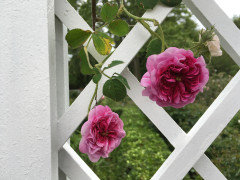
    I love Russelliana. Pic from Brooklyn Botanic Garden. This specimen has been there for over 40 years. Doubtless much longer.


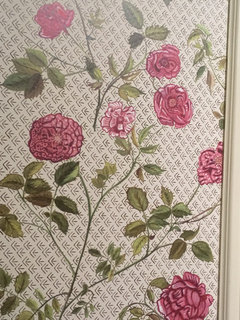
    Emily Dickinson's wall paper, facsimile at Morgan Library Exhibit.


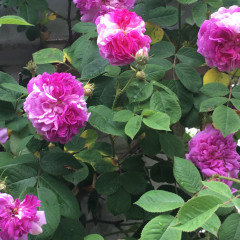
    I'm almost certain this is a picture of Russelliana (also from the BBG) that I took to show its propensity to vary in color on occasion.


  • 2 years ago

    Nice to find friends of this fine old rose. Jackie, utility workers with a care for plants: how fine! They make the world a better place. My rose suckers out slowly.

  • 2 years ago

    O, dear, yet another rose that I want-and I'm supposed to be trying to get to the finish line here, lol.

    Melissa Northern Italy zone 8 thanked User