Software
Houzz Logo Print
teasinggeorgiazone5a

Rose Mosaic Disease?

2 years ago
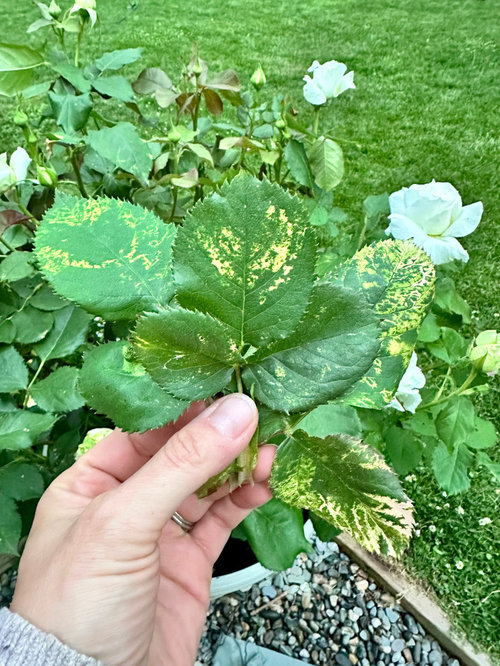
Good evening all,


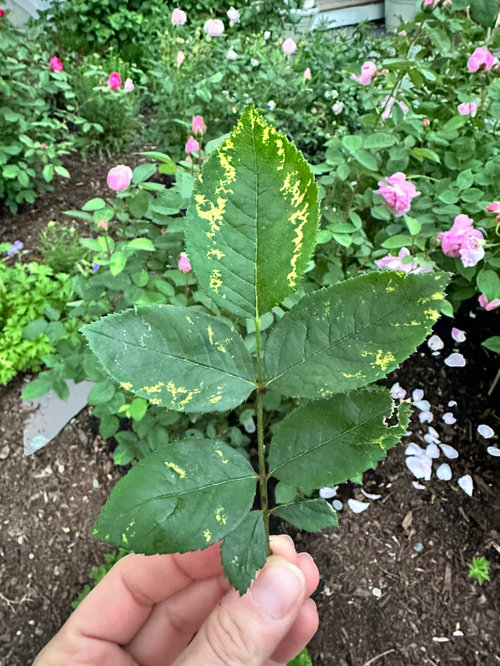
my Alnwick and Pope John Paul II both have an odd discoloration on the leaves. They are across the yard from one another and the issue is isolated to just these two roses.


Could it be rose mosaic?


PJPII:


The Alnwick:


Comments (18)

  • 2 years ago

    I'd say yes. Your pics show pretty classic symptoms of RMV.

  • 2 years ago
    last modified: 2 years ago

    Ditto from me...classic Rose Mosaic Virus. Where and when did you get them?

    Mr Moses


  • 2 years ago

    Thank you Mr. Moses.


    PJPII from J&P two or three years ago and the Alnwick was a bare root from DA three or four years ago. I love these two. They are pretty far apart in the garden & my tool cleaning and practice is fairly sanitary, but I could have cross contaminated. I’m not familiar with the disease beyond recognizing the symptom in the leaf pattern so I’ll have to look into how it’s spread.


    How would you recommend proceeding?

  • 2 years ago

    Shay (5a NH), RMV is spread through the propagation of plants (usually through grafting). It's not going to spread between your plants. I'd request a replacement from DA since you are within their 5-year warranty period. I have to assume they will replace virused plants, not just ones that have failed completely, though I'm not certain.

    Shay (5a NH) thanked windowsill_gardener
  • 2 years ago
    last modified: 2 years ago

    Shay,

    If they were growing in my garden, knowing that through the course of time (years ahead), I would probably inadvertently dead head PJPII and Alnwick and go on to dead head their clean neighbors after dead heading them, thus probably/possibly infecting them through transferral of Infected sap on the pruners. Inevitability plus the foibles of my human nature would work toward infecting all my roses with Rose Mosaic Virus.

    So, at this time I would carefully dig them up and bag them, placing them in regular household trash for the sanitary pickup folks to remove to your municipal waste management location.

    I don't think you have a good case with David Austin honoring their guarantee unless you can positively prove Alnwick came virused and subsequently inadvertently through your normal pruning practices, infected Pope John Paul II. That's simply because which rose came first infecting the other is the question. And, there are the chances, very remote as they are, that both J&P and David Austin sent you virused bushes.

    Many rosarians teach that if virused bushes grow satisfactorily, leave them be, only be very careful to dead head the two infected bushes LAST during a dead head session. Then disinfect your tools.

    The question also arises, how carefully must my pruning tools be disinfected to 100% insure that RMV from infected bushes will not accidentally infect clean bushes by presumed disinfected tools?

    In conclusion, I would remove the infected bushes and wait a year before replanting in the spots they held in your garden. That's obsessed me speaking. One man's opinion.

    Moses

    Shay (5a NH) thanked Moses, Pitt PA, cold W & warm/humid S z6
  • 2 years ago

    The sciencey people (Hi Malcolm, are you out there?) say that you can't transfer RMV through pruners. They've tried. Theoretically, it can travel through root grafts, but that happens very rarely, if ever, in a garden. So I'd say both of those roses arrived virused.

    Shay (5a NH) thanked mad_gallica (z5 Eastern NY)
  • 2 years ago

    It seems RMV symptoms and severity are quite variable and dependent on a number of factors. For me in my last garden I had two out of 10 of my grafted DAs show signs of RMV before there was any chance of me spreading it via pruning so it’s very likely the grafted stock was infected but it never seemed to impact those roses in the 10 years they have been in that garden. That garden also has an ancient vigorous Queen Elizabeth with RMV that would scramble her way up through a huge camillia tree every year despite hard pruning each spring. None of the other 43 roses in that garden have ever shown signs of RMV despite my complete lack of care for sanitizing my shears. Most sources I have found state that RMV cannot be spread via pruning but I don’t know if there have been any conclusive studies on this.


    So for me RMV has simply been aesthetic concern. However, other locations and gardens may have different experiences so it will be up to you how aggressive you want to be about removing these roses.

    Shay (5a NH) thanked Heather RR (PNW 8b)
  • 2 years ago

    I’ve had RMV infected roses for many years and not noticed any decline in performance. So if you are happy with how your roses are otherwise growing and blooming, I’d proceed by just enjoying them as they are.

    Shay (5a NH) thanked BenT (NorCal 9B Sunset 14)
  • 2 years ago

    Numerous comments Indicating David Austin Root stock is infected with RMV quite commonly. And much of the US stock Of doctor Huey is also infected for many years. So probably came infected. Not all route stock isn't affected but Doctor Huey is. They do not have this problem in Europe because their root stock is seed grown In general.

    Shay (5a NH) thanked Vaporvac Z6-OhioRiverValley
  • 2 years ago

    Paul Barden, before he closed his account here, reported he

    observed ”declining”.


    Didn’t prior posters here describe getting the brushoff from DA when contacting them about RMV?


    A Buck rose (Prairie Star) with RMV went downhill here and died - RMV was the main contributor, I believe. It was in a prime location. Its next door neighbor, Earth Song, planted the same time many years ago and with RMV, too, remains vigorous and productive.

    Shay (5a NH) thanked rifis (zone 6b-7a NJ)
  • 2 years ago


    Interestingly, RMV stigmata were evident on Prairie Star year 2; on Earth Song, year 6 or 7. I would prune 1, then the other.

    Findings from MM and others, as reported here by mad, are noted.


    I know made up ”y” words are de rigueur with some here, but seeing ‘sciency‘ from mad was unexpected.

    Shay (5a NH) thanked rifis (zone 6b-7a NJ)
  • 2 years ago

    There are many rose viruses. Without a test you will not know which one(s) are infecting your roses. In your cool temperature zone the immune system of the roses may not be very effective against your virus(es). My rose virus summary is at:


    Rose virus index page (google.com)

    Shay (5a NH) thanked henry_kuska
  • 2 years ago

    Generally speaking, the symptoms of RMV disappear after early spring. If a rose is in general commerce, and budded on 'Dr. Huey' rootstock, the chances of it being virused are something like 99%.

    If you complain, and get a replacement, it will come with RMV, too.

    A high % of my roses, now, came from old, neglected cemeteries and lost gardens, and some from private sources, so I don't really worry about it these days.

    Shay (5a NH) thanked jerijen
  • 2 years ago

    I share Harry Kuska's opinion. In colder environs it is less likely an RMV infected rose will be productive, regardless the variant.


    I am in Iowa. My favorite rose was "Spectra." It had RMV. It had about six good years during which I was enthralled with it. The next 12 years were unproductive. I finally shovel-pruned it.


    My parents in Tucson have a Queen Elizabeth rose with RMV. It is productive despite RMV. I believe climate is a factor in how roses with RMV do.


    My daughter in Iowa has an RMV infected rose. It is a runt. She wants to replace it. You are in New Hampshire .... If it is doing well keep it. It will not infect other plants. At the end of the first year it is less productive ... don't hesitate --- shovel-prune it. There are many good roses out there. I would not be confident DA would be able to replace this rose with one of the same variety that is not diseased. It costs over $3,000 and 2-3-years to cure it through heat therapy. Foundation Plant Services (ucdavis.edu)

  • 2 years ago

    The following was stated: " You are in New Hampshire .... If it is doing well keep it. It will not infect other plants."


    H. Kuska comment: I had covered spread in the link that I gave. Unfortunately, for some reason, some of the subllnks are no longer working. When I have time I will try to correct those sublinks.


  • 2 years ago

    Thanks for that link, Henry. I’m still going through it but it’s very helpful bringing the various studies together with analysis. It’s certainly given me some food for thought when trying to evaluate what level of risk I’m willing to take with RMV.

  • 2 years ago

    All of the 1st degree sublinks should now be working. Of course some of links inside each sublink may no longer work, but for me to check them now would be a major task. I would appreciate that if you find a non working link that you notify me. Thank you.