Software
Houzz Logo Print
kenarscott

Emerald Green Arborvitae - Advice needed - Can I train them?

2 years ago
last modified: 2 years ago
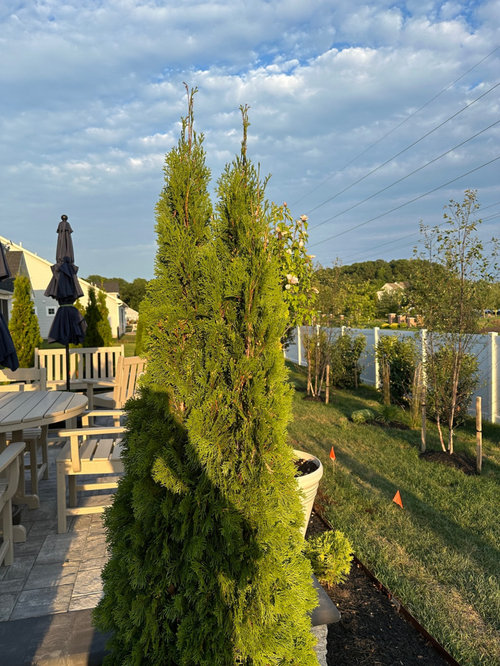
I had 12 Emerald green arborvitae’s planted about three weeks ago. They seem to be doing OK.


Now that they are getting acclimated, a few of them have a little bit of a separation at the top.


Can I strap them together for a few months to try and retrain as one looking unit?


I have Green Velcro gardening tape that I could use. I don’t want to do wire in fear of cutting the trunks.


These are currently 7 and 8 foot tall.


Thanks for advice and guidance!

Zone 7b. Delaware.


Comments (13)

  • 2 years ago

    Oh dear. Double and even multiple leader arborvitaes are not uncommon and Smaragd/Emerald Green seems to be a cultivar somewhat prone to them. In most cases, this is an undesirable feature. It detracts from the tightly columnar or pyramidal shape these arbs are supposed to have and it opens the tree up to splaying or splitting even more from snow or ice loads and even strong wind storms.

    Ideally, one of the leaders should have been removed by the grower early on. Removing it now will likely result in a rather misshapen specimen that will probably never regain a proper form. I'd consult a professional arborist before considering such a radical move. OTOH, you can strap the two together but it's going to need to be a pretty permanent arrangement. The velcro tape or that stretchy gardening tape will work but should be checked and maybe replaced annually.

    Ken A thanked gardengal48 (PNW Z8/9)
  • 2 years ago

    Thanks gardengal. I was thinking the velcro tape could hold them in place better and hopefully train them to grow together. I really do not want to cut them as I am afraid it will ruin them. So am hoping I can bond them together to help visually. Sounds like that would help with any snow/ice also because they wont be able to split as easily.

  • 2 years ago
    last modified: 2 years ago
    in two years.. when fully established.. remove one leader at least one to 2 feet below the other to establish dominance for the uncut one...


    a transplant that size.. should have a root mass as big as the tree seen.. and in 2 or 3 years.. it will.. and that is when you start pruning...

    put down the shears.. and step away...

    and no.. no plastic attachments to trees.. no velcro .... period....

    ken

    Ken A thanked ken_adrian Adrian MI cold Z5
  • 2 years ago

    next time.. personally select all stock. and insist on single leader plants ... ken

  • 2 years ago

    "in two years.. when fully established.. remove one leader at least one to 2 feet below the other to establish dominance for the uncut one...

    a transplant that size.. should have a root mass as big as the tree seen.. and in 2 or 3 years.. it will.. and that is when you start pruning...

    put down the shears.. and step away...

    and no.. no plastic attachments to trees.. no velcro .... period... "


    Well, golly gee........there are so many issues with this comment, I am compelled to respond!! First, 2 years is a pretty tight time frame for the establishment of 7-8 foot EG arbs. Regardless, the issue with secondary leaders with this cultivar occurs very early in the life of the tree and usually starts very low, often just a few inches off the primary. The correct time to remove is while the tree is still very young, not waiting the 5+ years AND multiple years of establishment before removal! Conscientious growers will acknowledge and remove these early on. Waiting will achieve nothing and partial removal will still leave a gap in the foliage cover and an unnatural appearance for years to come, if not forever.

    Second, tying up arbs to prevent splaying or splitting is a very accepted and common practice, even single leadered ones although these are much less inclined to damage. Many tree services and professional arborists recommend it. And yes, garden velcro or plastic ties are the product to use....also natural twine. You just want to avoid cutting into the bark or wood so the tying material needs to be stretchy as well as monitored regularly if left in place more than a few months (many leave these ties in place on a permanent basis).


    " personally select all stock. and insist on single leader plants " This is 100% accurate......unless you purchase small/young enough trees to remove secondary leaders at the appropriate time.

    Ken A thanked gardengal48 (PNW Z8/9)
  • 2 years ago

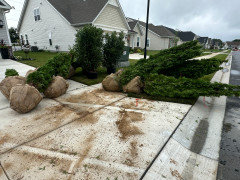
    yes, the root masses seemed massive. this is the day they were delivered. some are 7 ft tall and some are 8 ft tall (in the ground height). They are from a tree farm that dug them out of the ground a couple of days before delivery.


  • 2 years ago

    Mid August is not an ideal time for planting. Watering will be critical. Make sure the rootballs are very thoroughly hydrated before planting.

    btw, the root mass is much smaller than it would be for arbs of this size if left in the ground. Roots were extensively cut while these were being dug.

  • 2 years ago
    last modified: 2 years ago

    Hi Ken,


    No need to worry. This is quite the common occurrence with EGBs. Training your Emerald Green Arborvitae to grow more uniformly can be effective if done carefully. Since your trees were 7 foot tall and already planted, using green Velcro gardening tape (or even nylon string that won’t degrade) is a wise choice as it's gentle and adjustable, reducing the risk of damaging the trunks compared to wire.

    Wrap the tape around the center leaders in multiple parts to encourage them to grow together, but be sure not to pull the tape too tight, as this can dig into the bark as the tree grows and potentially damage the bark. Doing this will avoid potential splitting during heavy snowfall (another reason why a single leader is desirable besides aesthetics).

    Regarding the burlap, it's crucial to ensure that any burlap and twine were removed during planting, as leaving them on can hinder root growth and water absorption. If you didn't remove the burlap, it might be beneficial to check that it's not affecting the trees adversely.

    Ensure they get ample water, especially during dry spells, and consider mulching around the base to help retain soil moisture and regulate temperature. Plsntjng nowbis better than later as it will allow more time for your trees to develop its root system before the onset of winter, helping to prevent cold damage.

  • 2 years ago

    Hi Jordan. Thanks for the helpful advice!


    I think I am going to try the velcro garden tape in a few trunk areas like you suggest, but leaving them a little "loose" to not damage the trunks/bark. Will do a monthly check of them to make sure all is going ok. We do not get much snow here, but sometimes. I figured if it does snow, I can just take a broom and brush off any excess snow on them.


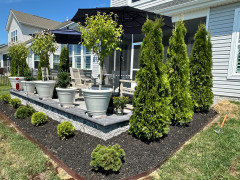
    As for water. They are mulched well, as shown in below pic. I also had the landscaper add a drip line that feeds off of the irrigation system. I have one of those moisture meters, and everytime I check, i reads "moist". I think the dirt in that area retains moisture. But I do run the drip line for 10 minutes here and there for them to "have a drink". They have been in the ground for about 3 weeks now. My logic for planting 3 weeks ago, is so that they can have time to get adjusted to their new home and start getting established before winter arrives. That way I get a jump start on next spring. Just like you mentioned!


  • 2 years ago

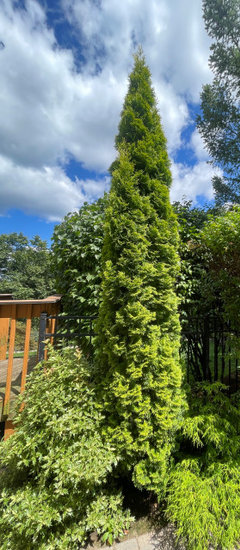
    Its imperative that you don’t let the rootball dry out. Seems like you are doing a good job. The Jantar variety pictured has multiple leaders, believe it not. I check it every year to make sure that the leaders are still held in place and sometimes add a tie or two.


  • 2 years ago

    Looks nice ! what do you use to keep yours together ?

  • 2 years ago
    last modified: 2 years ago

    Hi Ken. I use green nylon rope wrapped twice before tying.