Software
Houzz Logo Print
webuser_873693566

Restoring Cedar Siding

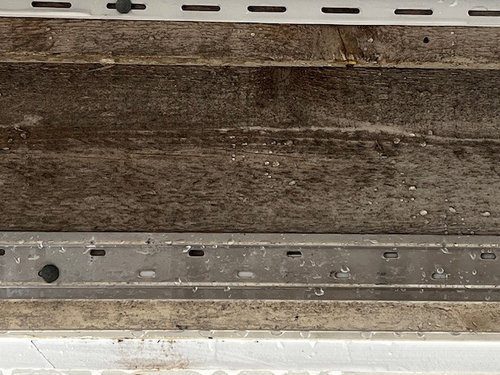
We are about to embark on a whole-house renovation, which includes restoring the cedar siding. The house was built in 1979, and the cedar was covered around '82. I have pulled the vinyl off the protected front and back porch areas, and it looks to be in very good condition (who knows what we'll find in other areas that are still covered). It looks like it was stained in its early days, as there is stain on the top of the cladding nails. There are a ton of nail holes from pulling off the vinyl. I splashed some water on it- some sank it, some beaded up (see pic).


While I will hire pros to do the restoration, I'd like the feedback from folks on this forum to better vet those professionals.


Please let me know your thoughts on the following:

Should the old stain be stripped with something like HD-80 or perhaps sanded? Or just well scrubbed with Cabot Wood Brightener? (I understand that pressure washing is not necessarily a friend to cedar...?)


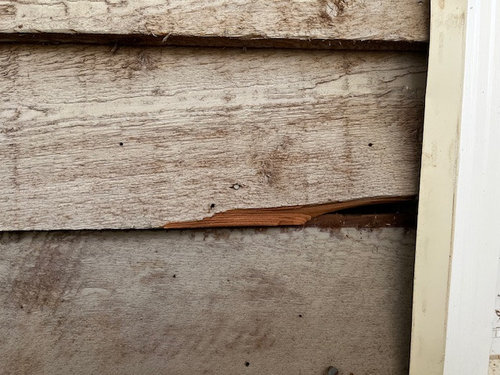
Should nail holes/damage (see pic for one damaged board I've found) be filled with Abatron Wood Epoxy?


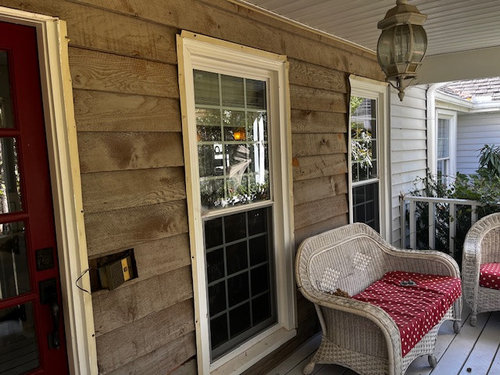
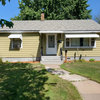
Is a semi-solid stain the way to go? I really want to still see the character of the wood. Thoughts on Ben Moore Woodluxe? (I love their Aura paint for interiors but don't know much about their stains). I'm thinking of taking it a few notes darker than the current grey vinyl (see pic with red front door- vinyl is visible to the right). Perhaps Georgetown Grey or Ashland Slate? Trim/shutter recs also appreciated.


How to deal with damaged boards that need to be replaced with new, since it's unlikely they will take the stain the same way? I don't mind waiting several years to go through a few staining cycles to get new boards to match up with old, if that's even a thing they will eventually do.


I'd love to keep taking off the vinyl, but the house won't get painted until next Spring. How long can the cedar "hang out" in the elements before incurring damage? (We are in Atlanta.)


Tips on upkeep (which I know will be ongoing and much more maintenance than the vinyl...but so worth it IMO)?


Thanks to all for any expertise you can lend.


Damaged board (cladding nail with stain visible directly above damage):


Water beading up:


Comments (10)

  • PRO
    last year

    I’m a Sherwin Williams ‘woodscapes’ guy, use it all the time. I see no reason to use abatron on the tiny holes from the vinyl (don’t get me wrong, it’s amazing) just regular wood filler is fine. DONT caulk the horizontal seams in the boards!

    Esperanza Marischino thanked HALLETT & Co.
  • PRO
    last year

    They installed the vinyl because they were sick of maintaining this stuff.

  • last year

    Yes, it was actually my father-in-law who had the vinyl installed a year after buying the house. Definitely didn't want the maintenance. But the vinyl in some areas is now cracked & faded. I'm prepared for maintenance but want to do it right.

  • last year

    A stain is what it states, it stains the fibers of the wood. A semi solid stain is a play on words to think you're using a stain but is really a diluted paint, and a solid stain is just paint. If you're going to do all this work to restore the cedar don't us paint. You're lucky it was never painted, and the reason people paint over cedar is because they don't want to re stain the siding every 3 or 5 years. Once it's painted you can never go back.

    You can't strip a stain, the wood is STAINED and in the wood so sanding down enough to remove it will take you a life time of Sundays. A wood brightener is a bleach and this will work to lighten the ghetto gray and then stain with a stain, no a diluted paint. The lighter the stain color is proportional to the number of years it will need re-stained. A clear stain may need reapplied biannually, and a darker stain color can go more years because of the level of UV protection.

    Original TWP stain is the only stain registered with the EPA as a preservative. The preservative is harmless but the original has high VOC levels so it's banned in 16 states. This is what I use knowing I need to re-stain every X number of years. If you paint or use a diluted paint it blocks the pores so the wood won't breath and the eventually peel and and will take a month of Sundays to scrape the wood to re-paint. Don't fall for the BS those semi solid paints/stains claim can go ten or twenty years without reapplying. If you look at TWP and decide you want it but you live in one of the nanny states with bans on it go to another state and buy it.


    Esperanza Marischino thanked outpaientzero
  • PRO
    last year

    You say you are prepared to do the maintenance, but every single year, you are prepared to climb the ladder to wash and recoat?

  • last year

    I'd hope to get 3-4 years out of a high quality product, but...yeah. Or pay somebody else to do it.

  • PRO
    last year

    My former home was a two-story clad with cedar clapboards. It was built in the early 1980's in a coastal Virginia climate zone. Most of the siding is original. I found it to be susceptible to rot mainly where it abuts window trim and corner boards. Proper caulking of those areas and maintaining it over time goes a long way to extending the life of the siding. Ditto for periodic washing to remove mildew. I used SW Woodscapes on the siding which performs really well.

    Esperanza Marischino thanked Charles Ross Homes
  • last year

    @Charles Ross Homes - thank you for your feedback. What about horizontal caulking between planks? I've been told both to do it (to keep out bugs....although seems to me I'd be more worried about the kind of bugs that drill into the wood, not creep between the seams) and not to do it (because it looks lousy with stain and prevents wood's natural movement). Any thoughts there?

  • PRO
    last year

    Do not caulk horizontal joints in siding; it prevents water that may get behind the siding from draining.

    Esperanza Marischino thanked Charles Ross Homes