Software
Houzz Logo Print
tazlina_mannix

Help understanding customary quartz countertop installation process

last year
last modified: last year
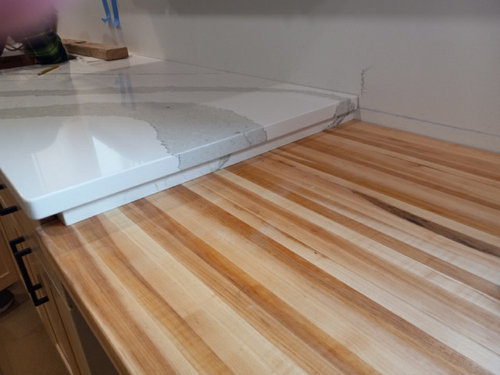
I am remodeling my kitchen and installing two large section of Cambria Brittanicca quartz countertops. My kitchen designer and I were both present when the fabricator came to take measurements. During this meeting, I articulated two specific design specifications:

1. I wanted a "mini waterfall" edge where the quartz countertop met a lower, adjacent butcher block countertop.

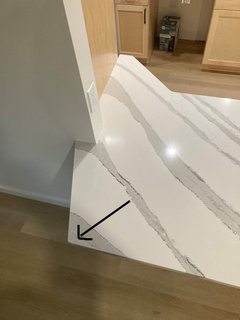
2. I wanted one end of a long peninsula to be cut at a 45 degree angle, rather than a 90 degree angle, to complement an angle on the opposite side of the peninsula.

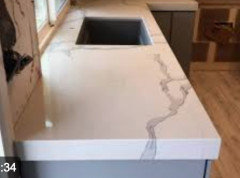
The fabricator recently came to install my countertops (after a six week wait), and instead of a waterfall edge, they tried to put a side splash in the gap between my quartz and butcher block countertops, which looked terrible. The veins from the upper quartz countertop did not align at all with the quartz they wanted to use in the side splash, and the side splash piece wasn't even long enough to cover the width of the countertop. Instead of the 45 degree cut I requested, they also cut the end of my kitchen peninsula at a bizarre angle.

I was not given the opportunity to review and approve shop drawings after the measurement/templating process and would not have approved of these decisions. Is it customary for quartz countertop fabricators to provide shop drawings to customers before installation? We are spending a significant amount on these countertops, and I'm very disappointed with the outcome.


Comments (9)

  • PRO
    last year
    last modified: last year

    A 45 is a poor installation practice and is not done. It leads to the most seam issues possible, as it's the longest possible seam, and creates the most lippage as the cabinets settle. It just isn't done by a good fabricator. Your "waterfall" installation would need to have a different cabinet/counter interface with the butcherblock to actually be a waterfall. And you would have issues with that separating and being gross over time.

    The job is correct. The asks were the incorrect thing, and that would make me question the experience of the designer involved.

  • last year
    last modified: last year

    Thanks, @Minardi. To be clear, are you saying that the corner of a quartz countertop should not be cut at a 45 degree angle? This is the edge in question. Instead of a 90 degree corner, I was hoping this would be cut at a 45 so the corner was less sharp and the cut was more similar to the one on the opposite side of the countertop.


  • last year

    "Is it customary for quartz countertop fabricators to provide shop drawings to customers before installation?" -> Yes. Someone approved these drawings. Whoever that person was, is the party responsible for not catching these errors.

  • PRO
    last year

    Your original statement mentioned a 45 corner, as though it were a seam in a corner, between two pieces. What you are actually asking about is a clipped corner, which is done all the time, and yes, should have been done there.

  • PRO
    last year

    Both of your asks were completely doable, even if somebody didn’t like them. You should’ve been shown shop drawings and approved them and barring that I would refuse to pay the balance until they do this correctly. That detail where the counter meets the butcher block is ridiculous looking right now.

  • last year

    Thanks, @HALLETT & Co. I appreciate this feedback. If our fabricator created shop drawings, which seems like an industry standard practice, they were either approved internally or were only shared with our designer. I was never given the opportunity to review and approve. I'm hoping we can reach an agreement that doesn't involve me being completely financially responsible for these errors, but I'm not sure what my options are when all of this communication happened in person during the measurement process.

  • last year
    last modified: last year

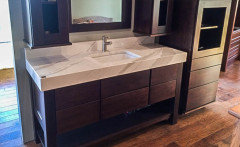
    When I read your post, my understanding was that you wanted a thick mitered edge that came down to meet the butcher block part of your island.

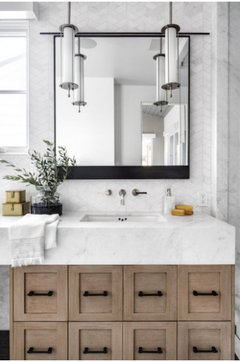
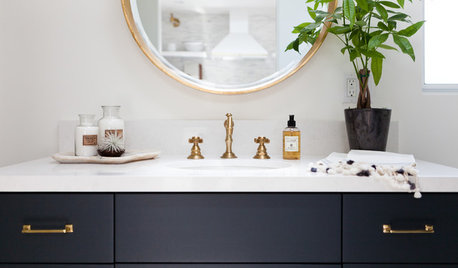
    Using thick mitered edges on bathroom vanities is a trend right now - in fact, that's how my countertop is being made for my primary bathroom (my vanity has been custom made - with two deep drawers under each sink = total of four drawers across the vanity). I didn't want to lose any space in the drawers for the sink installation/pipes - so my countertop has a thick mitered edge (or apron maybe?) that will house most of the depth of the sink - the top drawer has 4-5" of extra depth for the rest of the sink + where drain attaches to plumbing.

    So, this is what I was visualizing based upon what you described was happening on your island. My fabricator is making only the front edge a mitered one (my vanity sits inside of an alcove - so the two sides do not need the mitered edge since they meet walls).

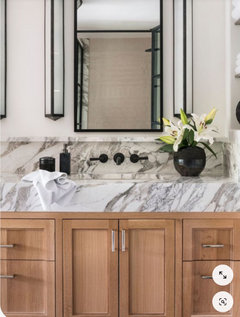
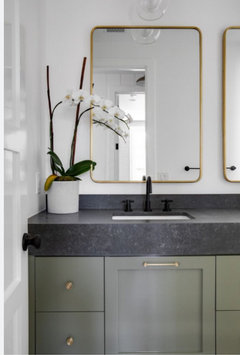
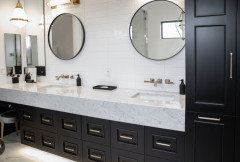
    These first two bathroom vanities are made with natural marble slabs:


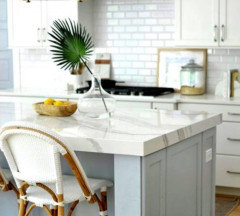
    Here is a kitchen island that has mitered edges in order to make the slab look thicker - and it's done with a quartz with bold veining (similar to yours) - and the veins match up along the mitered edge:


    Here is a vanity that has a mitered edge on three sides - also made with a quartz that has bold veining (the veins don't match up quite as well on this example vs. the one above):


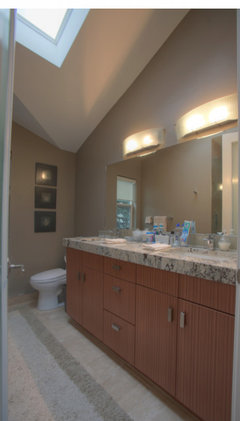
    I assume that this vanity countertop was made using quartz - but it could be a subtle granite that was used:


    This is another one that was made with a marble slab:


    The next one is made with a granite slab:


    Here is one more that was done on the perimeter countertops in a kitchen - it also uses a quartz with bold veining:


    There are TONS of examples all over the Internet - because many people have decided to do this in order for their countertops to look thicker (although, if you look at the undermounted sinks, you can always tell how thick the slab really is).

    I'm not sure why this would have been difficult to understand. It would have looked much better than what they did. I would have your designer address the issue ASAP! The way your fabricator added a separate recessed piece (that isn't even the same length) does not look right.

  • PRO
    last year

    " Is it customary for quartz countertop fabricators to provide shop drawings to customers before installation?"


    I've never heard of such a thing for residential work. I had a project manager on a commercial job relay a customer concern years ago. I told him I had a signed shop drawing from their architect approving my detail. That was the last I heard of that; approvals cut both ways.


    The corner you want clipped is easily done on site in minutes with minimal mess. The waterfall issue not so much. I disagree with Hallet that it looks "rediculous". You'll have to negotiate an acceptable resolution.

Sponsored
Onestop Kitchen Bath
Average rating: 5 out of 5 stars2 Reviews
Maryland & Virginia's One Stop Kitchen & Bath Remodeling Service