Software
Houzz Logo Print
brittany_warner59

White oak flooring poly

last year
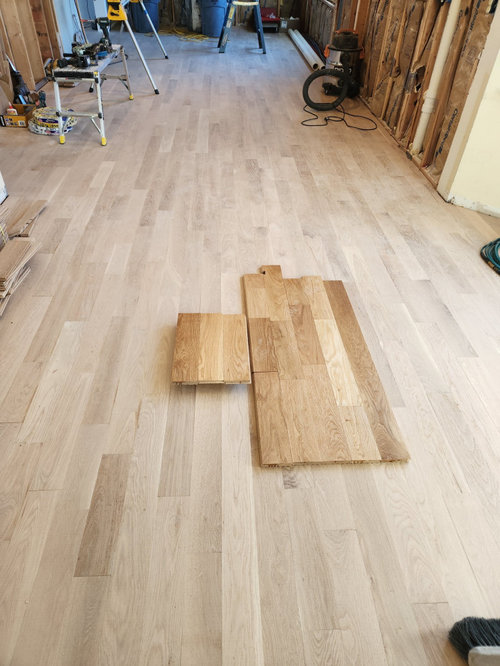
Water base or oil base? We really don't like the yellow tone of oil base on the sample but have read water base may need to be re-done after 5 years which is very high maintainance. Has anyone done water base on white oak flooring that can clue me in?

Comments (12)

  • last year
    last modified: last year

    Disclaimer - I am not a flooring professional - I have gained most of my knowledge re: floor refinishing from flooring professionals here on Houzz with a little independent research done on my own.


    If you use the right type of water based poly, it will not need to be refinished in 5 years. - unless you have a cheap water based poly applied to your floors.

    Bona Traffic HD (a two part system) - (two coats) + a sealer (one coat) is supposed to last I0-15 years. My understanding is that a coat of Bona Mega can be used before using Bona Traffic HD. If you use three coats of Bona traffic HD (or one mega + two traffic = costs less bc the Bona Mega is less expensive than Bona traffic HD) - your floors should be protected for a LONG time.


    Also, there are Loba 2k products. I believe that Loba 2k Supra AT is the top of their line (two part poly - like Bona Traffic HD - but has ceramic in the finish).

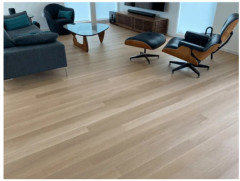
    Here is a photo of rift sawn white oak finished with Loba 2k AT invisible (not supra):


    It does not look or feel like there is a plastic finish on it - you can feel a bit of the wood grain through the finish. They have a gripping - but still velvety and luxurious feeling. Three coats. This is a household with only adults - no kids + no large dog(s). I believe that if there are kids + larger dogs, that you would want to use Loba 2k Supra AT. This finish is supposed to last for up to 30 years (if you go with matte, you may need to finish a bit sooner - people see footprints with matte vs. a satin or other glossier finish).

    There is no stain or sealer on the above floor prior to the Loba 2k supra invisible.


    There is an even more durable water based poly - but I can't remember the name of it right now. I've also heard that Ciranova's 2k is very good - but it is also very expensive.

  • last year

    Ciranova Ecofix Plus with the hardener is the option from French parent company Blanchon.founded in 1832. Wooden Floor & Furniture Varnishes | Ciranova Store

  • last year

    I appreciate your insights, thank you. I am very nervous as we cannot sample these water based ones and they are quite expensive. Is there any reason a contractor would disagree with water based? Should I be concerned if they have only done oil based? I have reas it dries rather fast and may be hard to tell where it was applied.  Did you or your contractor have any issues applying it?

  • PRO
    last year

    Water based technology has outpaced oil based. It costs more because it’s a far better product. It’s nothing like the water based of twenty years ago.

  • last year

    Would you a recommend a satin finish as this flooring is throughout majority of the home including the stairs?

  • PRO
    last year

    You can go with any sheen. The lower the sheen the more work is required to keep clean. Having a zero gloss (raw wood look) will be the most difficult to keep clean, especially for light color floors. Having a low sheen like matte will be easier to clean. The more gloss, the easier it is to clean and keep clean. You will need to look into your lifestyle to determine which finish is best suited for you.

  • PRO
    last year

    Never force a contractor into using a product that he is not familiar with. You are guaranteed poor results with you as the guinea pig experiment. Instead, find the contractor that uses the product that you want to have used in your home.

  • last year
    last modified: last year

    I'd contact the distributor of the product you want to use. Ask who is buying the product in your area. They may have trained or worked with a refinisher. Someone who wants to use oil or a lower grade product should be crossed off your list. Matte is the finish. Here's a video applying the finish. Matt is a woodworker. He milled and installed the flooring.


  • PRO
    last year
    last modified: last year

    So, you know...Manufacturers only train you on how to apply the product. They do not train the surface prep. You need NWFA for that. They will refer a contractor that has had the least amount of issues with their product. Sanding will still be another department.

  • last year

    Waterborne finishes have improved greatly and are still getting better, while oil poly is being phased out in many areas. Some may disagree, but oil poly still provides the best wear for the money. Only the very best waterborne urethanes outperform it. Oil poly is still a better value play. I've seen bitter squabbles over which is better, but I've also noticed something similar with paints. There are few people who would disagree that oil paint is better than latex paint where it matters, on doors and trim. It wears better. It's more impact resistant. It's more dirt and oil resistant. It lasts longer. The main issue is that white paint can yellow.

    " Is there any reason a contractor would disagree with water based? "

    Of course, but I won't jump straight to denigrating their skills. Perhaps they've had bad experiences. Perhaps the people they often work for aren't prepared for the higher prices.

    If you want to eliminate the amber color, none of that really matters, so it's best to focus on what matters and not be distracted by what does not.

    If your chosen contractor doesn't want to use the type of product you want, find another contractor.

    Anyone who confidently states that X floor finish will only last five years can pretty much be ignored. It's nonsense. At one point, the only clear non-yellowing waterborne finish Bona made was their cheapest entry level product, so we used in on white floors for years. It wore reasonably well, but was miles behind what you can buy now.

    Regardless of the exact type, professional maintenance for ALL hard coat finishes is to prepare and recoat. As long as worn areas are addressed before they're too bad, they can be recoated, extending the life of the floor.

    If you want the lighter color, pick a waterborne sealer/finish combo you like and spring for the best one you can afford. Place mats on both sides of every entry door to catch dirt, along with mats where you stand often. Vacuum regularly to remove destructive dirt. Don't slide heavy things around and apply protection to objects that may scuff the finish, like chairs and stools. If you really want to cut down on dirt inside, don't wear your outdoor shoes in your house. Keep an eye on high traffic spots, like under tables, chairs and stools, where traffic paths converge or change direction, and especially where anyone stands and/or shuffles around, like a stove or food prep area. Do not use products that could interfere with adhesion of a future coat of finish. Try to maintain a good relationship with your chosen floor finisher. If they do a nice job, tip them well, so hopefully when you need a recoat, they'll be there. Most refinishers don't like recoats, especially for strangers who own floors done by someone else. Not all areas will require recoating at the same interval, so a good finisher can often recommend a place to stop/start recoating so it's less apparent.

    Good luck.

    Disclaimer: My comments address only the aspects of finish cost, color and durability.

  • last year
    last modified: last year

    "I have reas it dries rather fast and may be hard to tell where it was applied."

    Those are true. Depending on room size/layout, temperature, humidity etc., it can be challenging. There are some techniques that can help overlapping spots that have already started to dry. Seeing where you've coated can be tough with any clear finish. Usually it's best to have two or three people working as a team, though I've seen instances where one person coated huge areas flawlessly. The real issue is that some customers can't understand how someone could have missed a spot, when they can only see it from a place that was already wet when the job was being done. Like painters, we call these a holiday, and they can usually be touched up.