Software
Houzz Logo Print
emma_runner

Kitchen Lighting Design help !!

last year
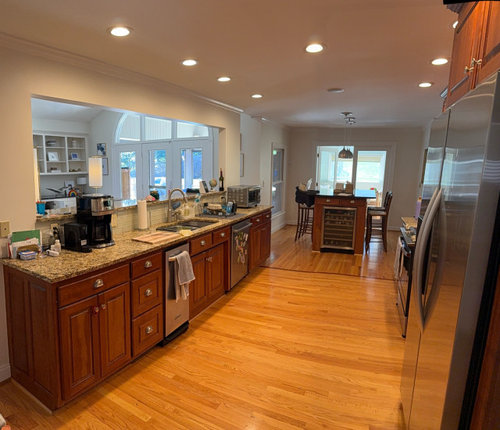
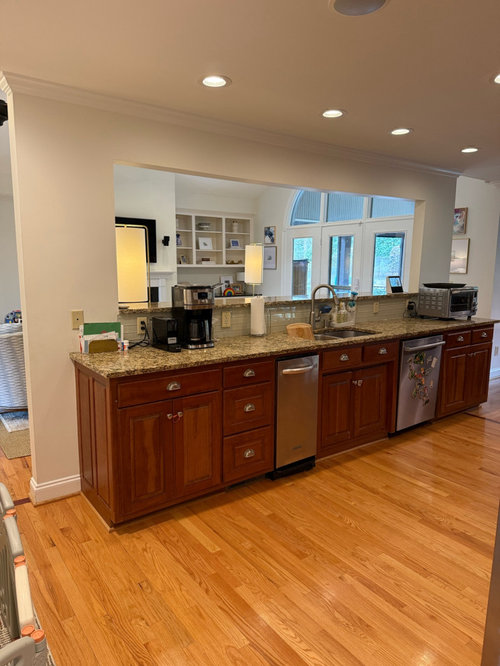
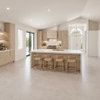
We have really poor natural light in our kitchen. We are going to do a few updates already, replace the sink, replace pendants above the odd island seen in the back, paint the kitchen cabinets (gasp, I know), and replace the countertop. I would love some input on where I could add more ambient, lighting or task lighting. The lighting is just so blah…

My questions are:
-could I somehow install task lighting over the sink, even though I have these recessed lights already above the sink?
-if so, which part, on the ceiling or the wall coming down on the opening above the sink?
-Should I take away a couple of the recessed lights there and replace with a prettier fixture?
-or do I just give up and leave as is ?

Thank youuu

Comments (10)

  • last year
    last modified: last year

    Can you explain "blah," is it the perception of lack of light or color, or a lack of decorative fixtures emitting the light?

    The recessed lights are your task lighting over that counter. There looks to be plenty of ambient light from the counter fixtures and the unnecessary single recessed lighting up the middle of the floor.

    If you install a wall mounted light (meaning mounted above the opening), you would probably want to remove the recessed lights. But having only 1 or 2 over the sink combined with some flanking recessed, or a whole row of wall mount lights without recessed, would look a little odd. You could install sconces (wall mounted lights at human height) on each flanking wall, but those would be just decorative and not add much to function.

  • last year

    Try changing the color temp of your recessed lights to 3000 or 4000K.

  • last year

    And the highest wattage LED bulbs that will fit in the fixtures.


    Your kitchen gets good natural light and has quite a bit of artificial light, I think you can work with what you have.

  • last year

    Changing the color temp won't get more light in there, it will only change the color of the light (Kelvins). If you want more light, you have to either up the lumens of the bulbs that are there already (or change out the fixtures, if they're integrated recessed), or add more lights. I'd start with upping the lumens and see if that gets you the light level you want.


    Lumens = how much light a bulb emits; Kelvins = color (temperature) of the light.

  • last year
    last modified: last year

    The position of your recessed lights is less than optimal. To avoid shadowing from your body, 6" in from the edge of the counter is recommended. Those look like 6" cans. If they can take a regular A19 traditional screw-in bulb, I'd try putting in new higher output bulbs. Specifically, the 17.5W led Feit bulbs from Costco. 3000K Bright White, flood pattern with 1600 lumens at the bulb. Dimmable. Less than $10 for 4. The flood pattern and multiple locations you already show should overcome shadowing. Good lighting is a priority in a workspace. 450 lumens at the counter is the minimum recommendation.

  • last year

    It's tough to tell the spacing of the cans above the sink run, but depending on what you have, you can get a recessed light adapter to install pendants instead. Either one over the sink, or two spaced equidistant toward the edges would add interest for ya. If you did one over the sink, I'd also suggest pretty wall lanterns added on the far left and right. I personally have no problem with the pendant and cans being in a row or switching on together. You don't really notice can lights like you do a hanging fixture.


  • PRO
    last year
    last modified: last year

    Emma ,

    You can educate yourself about kitchen lighting at "Efficient & Effective Kitchen Lighting" then come back with specific questions. I'm afraid you current inquiry is so broad that you may not get the answer you need.

  • last year

    @dan1888, here the sink run of lights do not have upper cabinets. So they can be placed anywhere within the 24" footprint of the base cabinets to perform their function of task lighting. In this particular kitchen the lighting looks to be placed fairly appropriately, it is just a wide galley with the displaced island which makes a cohesive lighting plan a bit more difficult to make simple.

    And, there is no such "recommendation" that recessed fixtures be placed 6" inside the counter edge. In fact, that is a poor location and should stop being always recommend by you, as they will be only 2"-4" from the face of an upper cabinet, which causes a hot(ter) spot on the cabinet, and cannot also light up the inside of the base cabinets.

    Placing them at the counter edge, because you do not lean your belly against the counter edge while you stand there, allows the light to also get inside the base cabinets as it simultaneously lights up the counter and inside the upper cabinets, while not causing a shadow on the counter from your body and reduces the hot spot on the upper face.

    Also, no homeowner will get a photometric done to see that there is 450 lumens on the counter.

  • last year
    last modified: last year

    The simple way for the op to check is to stand at the counter and observe the shadow position of the hands and body when thinly slicing an onion or cutting fish or meat. A standard 4" trim opening centered 6" in from the edge of a 25.5" counter is functionally correct for task lighting. 3 and 2" are also available. The cone of light depends on the beam angle of the bulb. A 15-degree narrow or more common wide spot/narrow flood is a standard choice. Not a 40-degree flood. The different depths of the source also impact what is illuminated. They aren't going to illuminate the interior of uppers. Ambient light is for that at a lower needed lumen level than task lighting. A lumen graph is common for fixtures and bulbs. It's available info for those who look because it's significant for a lighting plan. You may also see footcandles. 10.76 lumens per footcandle. 450 lumens are about 42 footcandles. 70-80 footcandles or 750-860 lumens at the counter is preferred. That means the height of your ceiling will impact your light beam optic choice. And that's why a concentrated beam like a wide spot/narrow flood is necessary to get enough light from a 1500 lumen small opening in the right position over your work zone.

    The op has wider openings and can try 1600 lumen flood bulbs to bounce light around and lessen shadowing. It'll be usable and save from replacing everything.

  • 12 months ago

    @dan1888 you do not have to justify your advice with official sounding numbers. It is as simple as this basic concept:


    And bonus sketch is why you cannot calculate photometrics on a surface from an individual lumenaire's metrics - it requires software.