

Predatory insects for chili thrips control
https://onlinelibrary.wiley.com/doi/10.1111/jen.13066
Hi all. A rosarian friend of mine in the Corpus area of Texas has been experiencing issues with Chili thrips as much as I have. She and a contact from Houston, Tx came upon some research about using ornamental peppers as what they call ”banker plants” where the predatory insects and the chili thrips interact. The banker plants give the predatory insect a permanent habitat (the ornamental pepper plant) that also provides them an alternate food source (pollen and nectar from the pepper plant) so they stay in your yard and feed on the chili thrips as well which reduces damage to roses. There are two predatory insects mentioned in this article - phytoseiid mites Amblyseius swirskii or Amblydromalus limonicus - both are available for purchase online much the same as lady bugs or lacewings are.
So the study was performed in a greenhouse setting, not in an open garden, and the roses utilized for the study were knockout roses.
The study is complex and some of the graphs are a little hard to read, but they used a control, and an experimental group with each individual mite. With the experimental groups, the rose plant had a banker plant, an ornamental pepper for the predatory mite to live on and nectar from.
they also experimented with putting the predatory mites directly on roses without banker plants. They gave the thrips a week to colonize the plants before introducing the predatory mites.
The graphs get a little tricky to read because of all the different test variables. They are testing how many predatory mites of both types were found on both the banker plants, and how many of both types were found on the rose plants that they applied directly without a banker plant Figure 3B (ie, if you dont want to plant ornamental peppers in your garden, and just release the good bugs, will they stick around?). If I’m reading it correctly both of them were more likely to stay if they had a banker plant, but the predatory mite a.limonicus was more likely to hang around either way.
At the end of the study, at ”six.... weeks release, roses in the A. limonicus banker treatment had significantly lower foliar damage ratings than those observed for the A. swirskii banker plant treatment.” ultimately using the ornamental pepper plant and using the predatory mite a.limonicus was the method that produced the best outcome for leaf damage.
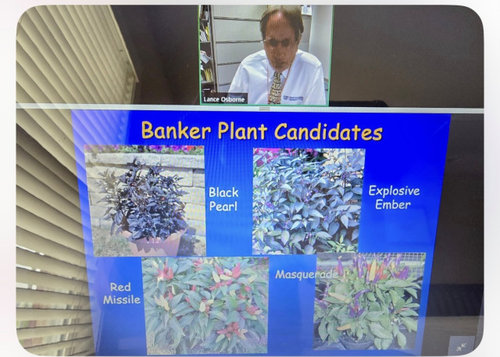
I now know of three Texas rosarians are going to attempt this regimen this summer. I’m debating trying it myself.
Of course all studies have limitations, such as the fact that it was performed in a greenhouse, to minimize variables. Also every treatment has a risk, I’m trying to inform myself on the risk benefit ratio of introducing the predatory mites into the eco system, as they can also cause unintended outcomes.
Have you heard of this? Have you tried it? What have you read or heard about it? Initial thoughts?
Comments (20)
 last year
I haven't heard of this, but remember when Australia introduced rabbits in the beginning and then cats to control the rabbits, etc, etc. Be Careful. Diane
Echo_Texas_zone9a
Original Authorlast yearYes, I am trying to find the consequences and possible negative outcomes before diving in.
Related Professionals
Dover Landscape Architects & Landscape Designers · Southaven Landscape Architects & Landscape Designers · Rocky Mount Landscape Architects & Landscape Designers · Wilmington Landscape Architects & Landscape Designers · Barnstable Landscape Architects & Landscape Designers · Rutland Landscape Architects & Landscape Designers · Waterbury Landscape Contractors · Grand Rapids Landscape Contractors · Mission Viejo Landscape Contractors · El Paso Landscape Contractors · Bowling Green Home Builders · Cherry Hill Home Builders · Utica Home Builders · Butte Home Builders · Rock Springs Home Builders last year
Echo, I would not pretend that it's my own thoughts. :)
Possible Negative Outcomes or Limitations
1. Escape or Wandering of Predatory Mites
Predatory mites can leave the roses if:
There’s not enough food (low thrips population)
The climate becomes too hot/dry or too cold/wet
Even A. limonicus, which had better retention, may wander unless the habitat is just right.
Result: You spend money releasing mites… and they vanish after a week.
2. Effectiveness Can Vary Outdoors
The study was in a greenhouse, where wind, rain, birds, and predators aren’t an issue.
In an open garden, mites may be:
Washed away by heavy rain
Preyed on by other insects (e.g., ants, spiders, predatory bugs)
Less effective if roses are widely spaced and mites can’t easily move between them
3. Banker Plants May Attract Other Pests
Ornamental peppers can become magnets for:
Aphids
Whiteflies
Spider mites (ironically!)
You might end up introducing one pest control strategy but accidentally create habitat for other pests unless you monitor carefully.
4. Temperature Sensitivity
A. limonicus does better than A. swirskii in cooler weather, but still prefers:
Temps between 68–86°F
Moderate humidity (40–80%)
Too hot or too dry in mid-summer = population crash
Too cold in early spring or fall = inactivity or die-off
In some climates, you may need multiple releases per season
5. Cost and Maintenance
Predatory mites aren’t cheap, especially if you need reapplications
Banker plants take space and require maintenance (deadheading, fertilizing, etc.)
It’s not completely passive—you still need to monitor thrips levels and mite survival
6. Slower Action vs Sprays
Mites work gradually—they won’t “rescue” a heavily infested plant
If you already have thrips damage (bud drop, scarred petals), it might be too late for predatory mites to reverse the damage
This is a preventive strategy, not an emergency fix
Echo_Texas_zone9a
Original Authorlast yearThank you both for your words of caution. Elena, thank you for your helpful summary. Unfortunately for me I have small populations of whiteflies, spider mites and aphids already lol.
the predatory mites are supposed to have multiple ”prey”. also as you said, the banker plants which are ornamental peppers are best in a state of flowering to provide a secondary food source of nectar and pollen for the predators so you do have to maintain and have sufficient numbers of preferably flowering pepper plants. 🤪 a lot of work. but consider the other options, its worth noting that in my area almost all the plants become significantly disfigured from chili thrips and are unable to form buds or healthy leaves after a certain point. So option one is - do nothing, rose plants become heavily damaged and do not bloom until it is cold enough to stop the chili thrips in November. My friend in Corpus is experiencing damage already. So she is barely getting a spring flush. So I don’t think it’s unreasonable to say that to ”do nothing,” is basically to not have roses that can functionally bloom.
option two is to spray spinosad. This has to be done every 7-14 days. You cut off affected growth, bag them, spray, and then, many people do not say this - the spray does damage some healthy foilage in some circumstances. I spray in the evening, not in direct sunlight, but it is either the heat or maybe the sunlight the following day, i have a lot of leaf damage from it. So you end up chasing your tail. The thrips cause damage but so does the ”treatment.”The spinosad in a spray bottle costs $12.72. I needed four bottles for one treatment of all my roses. Which is $50 per treatment every 10-14 days. If you buy the concentrate you have to buy a sprayer, which I have, and the concentrate is $29.85. I had to do two ”doses” in my sprayer to finish my yard and I couldnt find how many treatments the concentrate jug contains. But the point I’m making is that it costs money to treat with spinosad too and also involves constant and repeat labor of spraying, removing foliage and bagging and it also damages my plants. And to be honest I have not completely reseached the ”cons” or negative consequences of spinosad itself, which we all know there are always risk/benefits of every action.
The other thing worth mentioning is that the chili thrips are not just disfiguring the roses. Sadly, they also damaged my lantanas, plumbago and hibiscus.
The other thing about spinosad is it is said they can develop a resistance to it.
Some people may ask, ”is the juice worth the squeeze?” 🤣🤣🤣 . That’s up to the individual gardener to determine, is it not?
So what’s worse? putting ornamental peppers around my yard in pots and paying for and opening a couple envelopes? Or trimming, bagging, spraying every 10-14 days and paying for the spinosad? Or deciding (after I have 61 roses) to pivot to a different obsession 😆?
Like Elena mentioned, the little buggers may overheat, disappear, require repeat innoculations, cause an ecosystem imbalance.
Oh the fun we have, chasing our tails in the name of that which brings us joy!
To those that stayed for such a long winded thought exercise, I give you Jude the Obscure blooms from this morning, -the plant a twiglet compared to some of yours- unburdened yet by the dreaded chili thrip.
- last yearlast modified: last year
Echo, just to clarify — we’re dealing with regular thrips, not chili thrips. I’m using Spinosad concentrate on over 100 roses, and I’m not sure why your usage is so high?
I’m also planning to use beneficial nematodes (Steinernema feltiae) — they’re effective against thrips pupating in the soil, though not helpful for chili thrips.
By the way, have you tried blue sticky traps? They’ve been working great for me!
Your roses are amazing! Echo_Texas_zone9a
Original Authorlast yearThank you Elena!
I read the label and applied it as directed. I haven’t used it since last late summer or early autumn, so it’s not fresh in my mind, but it is to coat the tops and undersides of the leaves of the plant but not to the point of runoff. So I bought two spray bottles and walked around and sprayed (after cutting and bagging my affected growth - which reduced the foliage). I only got halfway through my 61 roses and 11-12 knockouts, for a total of about 72-73 plants. I had to buy more of the spray bottle kind. I ended up using another 1.5 bottles, so i had to buy 4 bottles in total. At this point, I realized that I had to buy the concentrate as it was too expensive and was cramping my hand!! lol .I have no frame of reference what ”high usage” means, I would think its relative to the size of the plant.
One of either three things, 1. I sprayed too much, 2. I have more foliage to cover somehow (large plants). 3. You and I may have a different method or idea of coverage, or there is an environmental difference affecting application.- last yearlast modified: last year
I recently bought the sprayer(https://www.amazon.com/dp/B0C5WVBXX6)and I have a feeling it uses spray solution much more economically compared to the hand sprayer I used before.
Echo_Texas_zone9a
Original Authorlast yearI agree with you completely, I think the finer mist stays in a thin coating while the stream from the hand pray bottles is more of a blunt stream that probably doesnt coat as finely and causes more unconscious waste.
. I also wanted to specify, I had to buy four hand held spray bottles, but for application, I only used 3.5. And when I used the sprayer with wand, I had to fill it twice, but only used a small portion of the second jug. PROlast year
I know this is about roses.. but can you plant other stuff in your garden? Minute pirate bug and green lacewings eat a lot... but they tend to also like little flowers like alyssum, dill, fennel, marigolds.. and a lot of other flowers.
Echo_Texas_zone9a
Original Authorlast yearBeesneeds,
yes, that is important.
I know it’s surprising, but these little chili thrips are causing us problems despite having diversity.
For example, I have every plant you mentioned already in the ground and have for years. I have a pollinator garden (host plants and nectar plants), vegetable garden, tea garden, and many companion plants. I have lady bugs and lacewings in large numbers. i looked in one garden bed which had three roses and 13 companion plants, many of them native. I have frogfruit, brazos penstemon, wild petunia, passionvines, mealy blue sage, salvia greggii, native milkweed, greggs blue mistflower, two types of pipevine, I have a tree, -prunus serotina-which is a host plant to over 450 butterflies and moths. I have counted (and photographed almost every one) 55 unique species of butterflies in my yard.
all this! and yet!! maybe this is helping paint the picture of how desperate some of us are to try to mitigate their damage.
I love roses but I am actually butterfly crazy :)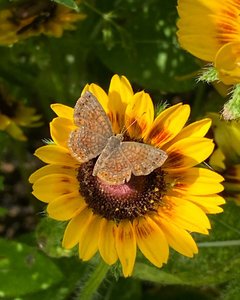
Echo_Texas_zone9a
Original Authorlast yearSome Rue and Fennel saying hi, and a beauty shot of a marigold. I have three different kinds of marigolds.

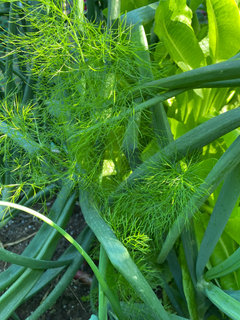
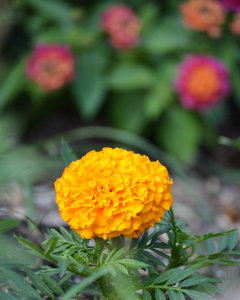
here’s one of my little helpers :)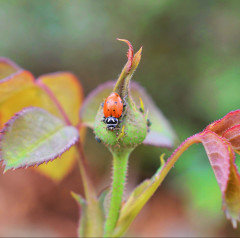
Echo_Texas_zone9a
Original Authorlast yearI was trying to share a video I have of a dragonfly swarm in my yard. perhaps something of a biblical problem is occuring?? 🤣 okay its not locust swarms. Dragonflies also apparently eat thrips (not sure about specifically chili thrips). I’ve seen black, blue, green, and red dragonflies in my yard.
I am triangulated between some retention ponds. in drought they are empty of course, but I’m assuming thats where they are completing their life cycle when there is water. And then they come visit my garden :)
if I can figure out how to put a small video, i’d love to share.
Also worth mentioning, GREAT pest control are bats!! and, I proudly live next to the largest colony of Mexican Free Tail bats in the world with 15-20Million bats only a couple of miles away. people make appointments in the summer to see them emerge from their caves in swarms. All the times slots are booked by naturalists and photographers as it is an amazing sight to behold if you like nature. I will do it someday- but for now I just have to look up at night and you can see them flying around :) bats fly in crazy patterns due to their echolocation, so you can always tell them apart from birds at great distances who fly in straight lines of course.
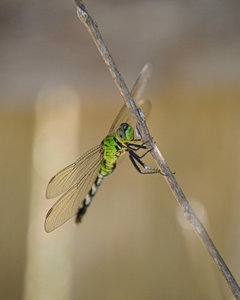
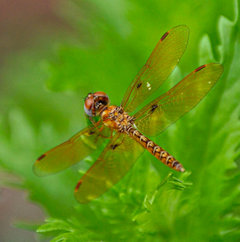
- PROlast year
That is wonderful that you have a diverse garden(s). What do your predator populations look like? Do you see a lot of them, is there a diversity of predators? I know prey can sometimes just become overabundant. I'm just being curious.
- PROlast year
It sounds like you have a nice diverse insect population. And yes, minute pirate bugs are native, so with everything else you listed, I'm going to hazard you probably have those in your gardens too.
- last year
Echo, I love all your wildlife photos. Very impressive. Did you take all of the pics, and did you use a camera camera? Diane
 last year
I do not have any experience with chili thrips but I get lots of the regular thrips in my garden. After a few years of going nuclear with everything I could find and finding no relief I started purchasing minute pirate bugs and releasing them in my yard. I stopped spraying and after a couple of years I started seeing a difference in the amount of damage caused by the thrips. I think these kinds of set up are worth trying, and if the yard is able to maintain a healthy population of the beneficial predator it can definitely work. I still get thrips but my level of damage is acceptable to me since it was never zero even when spraying constantly.
Echo_Texas_zone9a
Original Authorlast yearBeesneeds, I looked up minute pirate bugs on iNaturalist, and indeed, they are locally observed.
Yesterday I went out to cut some rose blooms and I saw a speck of blackish brown and behold, I think I actually saw one! Of course I could be wrong becaue it was so small, but like smaller than a flea! tiny looking beetle. Perhaps there are not enough of them, who knows. Maybe their numbers are normal but the chili thrips are too large a population. We could endlessly speculate.
Diane, I have two cameras that I use on the automatic function and use them like ”point and shoots.” One is about 15 years old, Nikon D3200, I think used they are $200 now. even the lens is automatic focus. When I bought it, friends called it ”a nice little starter camera.” Then my newest one is a Nikon Coolpix p1000. Bought a couple years ago, but its practically doubled in price with the economy. As far as I know, it has the longest zoom you can get on a point and shoot type camera. The dang lens extends nearly a foot! it’s extremely heavy. It has a bird mode and a moon mode. Those are the two things I use it for. I have never learned how to take manual photos, the true art of photography - someday I may try, but I’m happy enough for now. I have never outgrown my starter camera ;)
Echo_Texas_zone9a
Original Authorlast yearThank you so much, Susan! if any if yall are on Instagram my username there is centraltexasbutterflies where roses have kind of stolen the show, but I try to also post birds, butterflies, insects, plants, moon and comets and other naturalist themes.
dianela, This is kind of the feedback multiple people have said. that the minute pirate buts brought it down a lot but not to zero (but neither does spraying). One person in Houston (Roses in Houson) I believe doesnt treat at all - I believe she is also active on this board and has a blog. She has described the time and effortof trying to eradicate them as being too high and now accepts their damage as part of the seasonal rythym much like i have accepted aphids whose numbers rise and fall.
I think some of the ornamental peppers are quite lovely. one has almost purple foliage. The banker plants are for the predatory mites, not the pirate bugs but the chili thrip like chili peppers! maybe they can find a new plant to mess up.

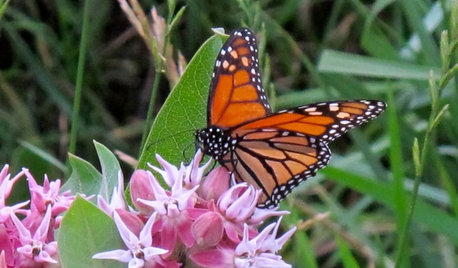





Echo_Texas_zone9aOriginal Author