Software
Houzz Logo Print
suncottage

Plumbing advice for shower

last year

I am about to have a bathroom reno done in a couple months and would like advice or explanation from a plumber who’s done walk in showers.

I’d like to offset the control knobs on to the long wall perpendicular to the shower head wall. This is so I can walk in and fiddle with the water temp so I don’t have to get wet as would happen if I was using the knobs where they typically are, directly under the shower head.

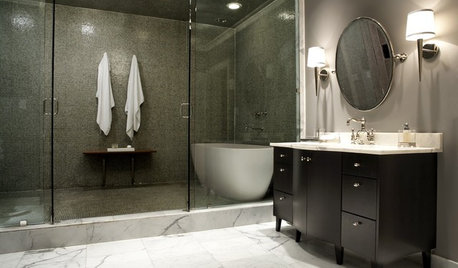
I’ll attach a picture of approximately what I’m thinking of.

I don’t have great water pressure and was reading an article that alluded to that doing this might/could? affect water pressure? Also the article says you need to have the controls 4’ away if you do this kind of design change but then says if the controls are below the shower head (as is normal) that is. It required. It doesn’t make sense to me that just because you move the controls, you are now forced to moving them far away.

Anyway, any advice, explanation would be appreciated.

Comments (11)

  • last year

    Sorry I don’t know how to edit. That one line should say if you put the controls under the shower head you don’t need it to be 4’ away

  • PRO
    last year

    You're right— the 4' rule isn't a strict requirement. It's just a general guideline to keep controls within reach if they're on a different wall. You can absolutely place the valve on the long wall like in your photo.

    To make it work smoothly:

    1. Ask your plumber to run ¾” pipes (instead of ½”) from the water source to the valve, to reduce pressure drop.

    2. Use a thermostatic mixing valve for more stable temperature even if your water pressure is low.

    3. Keep pipe runs as short and direct as possible — fewer elbows = better pressure.

    4. Mount the valve at a comfortable height (usually around 44–48 inches from the floor).

    This layout is very common in modern walk-in showers — it’s totally fine as long as the plumber routes things properly.

  • last year

    Thank you for replying! Just for clarification though, regarding your main comment about distance, and then your #3 point, you mention keeping the pipes short to get better pressure, but my confusion is in the article it says if you put the controls anywhere other than directly under the head, the controls should be AT LEAST 4’ away. In other words the way I read it, the controls HAVE to be 4’ or MORE away from the showerhead. You see why that doesn’t make sense to me?

  • last year

    Yes, I don't know where this nonsense is coming from about 4' and water pressure and flow and such other than from an ergonomic standpoint. It's not going to change things as far as water flow.


    "Don't have good water pressure"... this is such an imprecise statement. Is your static pressure low, or do you have a flow restriction that limits the amount of water?

    A shower head is generally 2-2.5 gpm (some are less). A shower installed with 1/2" lines is going to be able to supply that amount of water unless there is a very significant restriction someplace.


  • last year

    I too am curious why your shower pressure is low. I would have your plumber come investigate that now to see why and if there is a particular design that can help mitigate the low pressure AND includes controls farther away from the head.


    We have low pressure because we are in a pre-war coop on the 12th floor. A thermostatic valve and good Speakman shower head really helped. Again, you have to figure out why in your particular instance it is weak.

  • PRO
    last year
    last modified: last year

    I think the 4' is so you do not get wet when turning on the shower. There are ways to handle this with cutout in the glass shower wall to reach in and control water You aslo need to find a shower system for low water pressure


  • last year

    I live in a condo on the fourth floor. The building is less than 20 years old but the builder cut a lot of corners and did shabby work in various areas. I don’t know if plumbing was one of them. Nobody’s water pressure is that great but I dont know how plumbing works so i dont know if its due to poor construction on his part or if its a town supply issue. I will be getting a shower system that allows stronger spray. I haven’t picked one out yet but I have seen that they exist when I’ve been looking for shower heads.

  • PRO
    last year

    Your biggest issue is that this is a condo, and has shared walls that may not be penetrated for plumbing routes. And other plumbing restrictions. You need to get a knowledgeable kitchen and bath designer and a plumber IN that space together, in order to plan something that can actually physically happen. And talk to the building board, or whomever controls projects in the building. Other people's past experience doing this will tell you a lot.

  • last year

    Minardi, im not changing the plumbing location (water location coming into and out of my bathroom will stay the same) other than wanting to move the water on/off/temp control knobs. Again I don’t know how the controls connect to the shower head to turn it on or off but I just assumed that they were connected by a pipe which would just run from the shower head along the inside of my wall over to the controls? Can you explain it how it works if my assumption is wrong? When I mentioned my idea to the plumber who was in my bathroom (so he knows I’m in a condo and he’s done other bathrooms in this building), he said it would be no problem to do it. I didn’t think to ask him the questions I asked in this post when he was here, hence why I’m asking you experts.

  • PRO
    last year
    last modified: last year

    Yes, it runs inside the walls, or overhead. But some walls can not have plumbing run in the them. Some ceilings can not have plumbing run in them. The walls or ceiling would need to be furred out with an additional stud wall to make that happen. This is why you talk to the building managers. Plus, you need a pressure balancing loop for the install, and that adds a lot of pipe.