Software
Houzz Logo Print
bill_mn_z3b

Cactus Identification please.

4 months ago

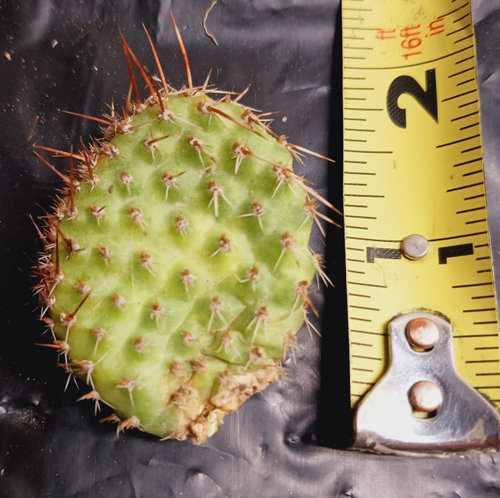
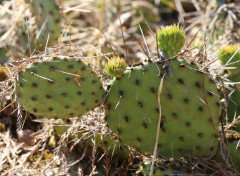
I found this Opuntia spp. in the Hills around Medora ND.


I didn't think to get a picture of the parent plant. The parent plant had bigger pads of 5-6" and very round. This parent wasn't a huge plant, a foot or so tall with ~10-12 pads, a few large pads and a variety of smaller sized pads in a cluster of directions. Mine was pointing downward from a larger pad..


There are only four types of Opuntia said to grow around Medora: Opuntia polyacantha, Opuntia cymochila, Opuntia fragilis and Opuntia cymochila x fragilis (hybrid).


I don't think it's O. Fragilis because that one is said pads easily break off the parent plant. This one took a little work with a couple sticks, twisting it around a couple of times before it broke off completely.


I don't know if it is big enough to root and I wasn't equipped to wrangle a larger pad but I walked up a steep trail for several hundred yards and climbed a cable ladder, a couple of hundred feet, to get to the top of a 400ft. high butte, where this one (and hundreds of others) covered the grassy plain at the top, so it would be interesting to know what species it is.

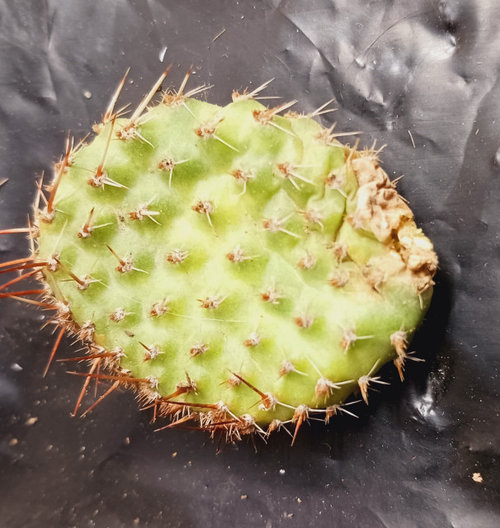
different angle (90d).

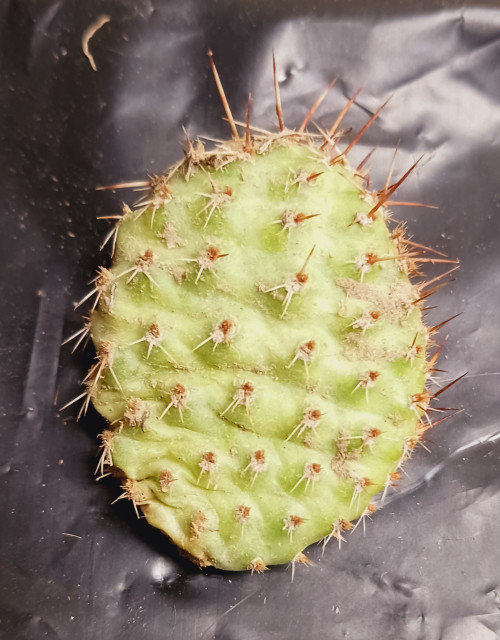
Flip side:

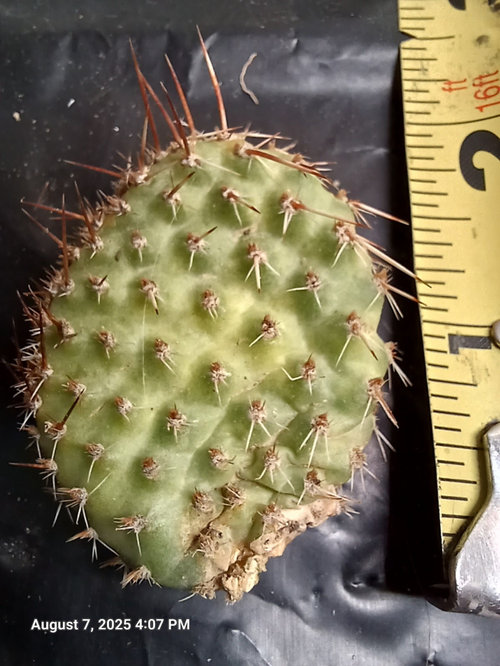
A little different lighting and mode.

TIA

bill

Comments (11)

  • 4 months ago

    Bill, compare the spine lengths of cymochilla to your sample. The maximum pad size for fragilis is 2", and fragilis has conspicuous white areoles, and take into account the difficulty of removing a pad?

    Single pads are easy to root. Just stick the cut side in damp sand and keep it out of direct sunlight for a month or 2. Were any of the cacti in bloom when you saw them? Polyacantha can have red flowers. I didn't look into the named varieties or hybrids. In my area we have Opuntia cespitosa. It used to be Opuntia humifusa until the Opuntia complex was broken up into several new species. DNA analysis has shown that the Opuntia genus started in the southwest, and then migrated into Central and South America, before migrating north all the way into Canada.

    I was just reading a discussion about how damaging prairie fires can be to Opuntia. They get burnt which keeps them at a smaller size. The Opuntia in my garden get much larger than the plants that I see in the sand prairies.


    BillMN-z4a thanked Jay 6a Chicago
  • 4 months ago
    last modified: 4 months ago

    I was incorrect about the origin of Opuntia. It's believed to have started in the southwestern United States and northern Mexico and then it radiated into the Florida Keys and eastern North America as far north as Ontario.

    https://opuntiads.com/records/Taxonomic%20revision%20of%20the%20Opuntia%20humifusa%20complex%20in%20eastern%20usa.pdf

    BillMN-z4a thanked Jay 6a Chicago
  • 4 months ago

    Thanks jay!


    My main mission was keeping up with my two grandchildren but then they helped collecting the cactus pad 'out west' so that was priceless. ;-)


    I'm leaning towards O. Cymochilla too, just from observing 100's pictures on the web.

    Also, I may have notice a little yellow tinge at the parent plants slightly opened flower buds.


    Otherwise, O. fragilis is out, imo and O.polyacantha tends toward longer needles and a little different overall appearance (to my eye).


    The pad was collected Wednesday morning and appears to be already dried at that end.

    I have sand at home here, so I'll dampen some and set the broken end into it.


    Thanks!

    bill

  • 4 months ago

    Opuntia humifusa ?

    BillMN-z4a thanked Dave in NoVA • N. Virginia • zone 7A
  • 4 months ago
    last modified: 4 months ago

    O. humifusa is noted for its lack of long spines (glochids mostly) and it doesn't have enough areoles horizontally across the pad to be the same as mine. Nor does it have raised areoles.

  • 4 months ago
    last modified: 4 months ago

    8-9-2025:


    About as sandy of a sand as you can get.

    Now we wait. ;-)


  • 4 months ago
    last modified: 4 months ago

    Thanks Jay!

    I went partially by this article linked below, for their (updated?) description of O, humifusa.

    https://www.opuntiads.com/opuntia-humifusa/

    I'm not positive if everything on the above site is 'up to date'?

    And I just thought everyone was onto this already as certain documentation about the changes, goes back to at least 2015.

    Thanks, Jay, for enlightening me on these changes, I appreciate it.

    It's all very interesting.

    🌵 I might just call this one my 'Western Prickly Pear' cactus. lol

    eta: Beautiful pictures above! ;-)

  • 4 months ago

    Bill, I was actually leaning towards Opuntia polyacantha myself. I just did a search at inat and there were no observations for O. cymochila, and about 90% of the observations were for polyacantha, with the remainder being O. fragilis. Opuntia polyacantha is actually also a complex, with several named varieties, so maybe at some point in the future the Opuntia polyacantha complex will be revised too. Opuntia macorhiza is closely related to polyacantha. Macorhiza is mainly found west of the Mississipi, but there's a disjunct population in Ohio. After reading more I learned that Opuntia also made it to the Galapagos and radiated into 6 species. I wonder if the Opuntia macorhiza in Ohio was wrongly ID'd as humifusa before the revision?

    BillMN-z4a thanked Jay 6a Chicago
  • 4 months ago
    last modified: 4 months ago

    Jay, that could very well be.

    I would see a very small cactus, when visiting western south Dakota and eastern Montana (I think too north central Wyoming), but the pads were small, 2" maximum, dark in color and very thorny. They hugged the ground except where they mounded in some instances (O. fragilis?) but they never appealed to me, so I never brought one home.

    This one appeared to have at least one pad growing up/out of the pad, that was growing from the ground and had a nice color, structure and needle set, so that's what inspired me to try to start one.

    Botanists got to have fun too! It is nice to know what's the same and what isn't, even though there's probably is not much demand to create varieties commercially and it keeps things a changing. ;-)

    But we'll have to wait to see if this one gets flowers and maybe then we'll be able to tell.

    And this one wasn't collected just west of the Mississippi but west of the Missouri and the continental divide.

    You really know you're 'Out West' then. ;-)

  • 3 months ago

    I found a picture on the web of a Opuntia polyacantha that has a similar form to the one I collected from. I'm hoping mine will grow in a more upright direction like this one.

    8^)