Software
Houzz Logo Print
carolina_cid9023456

Concrete Install Issue?

3 months ago

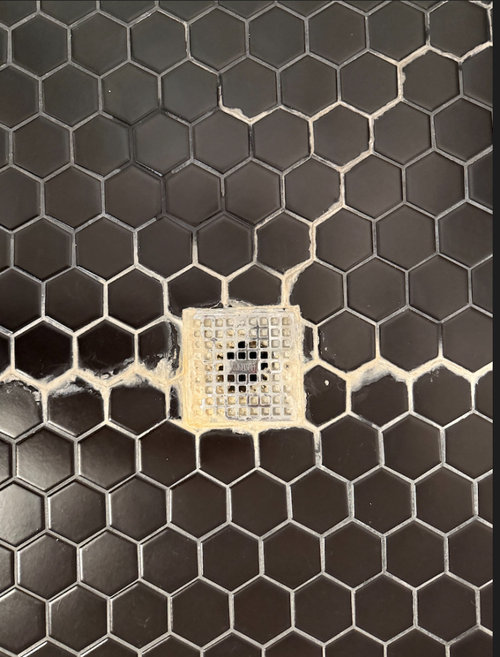
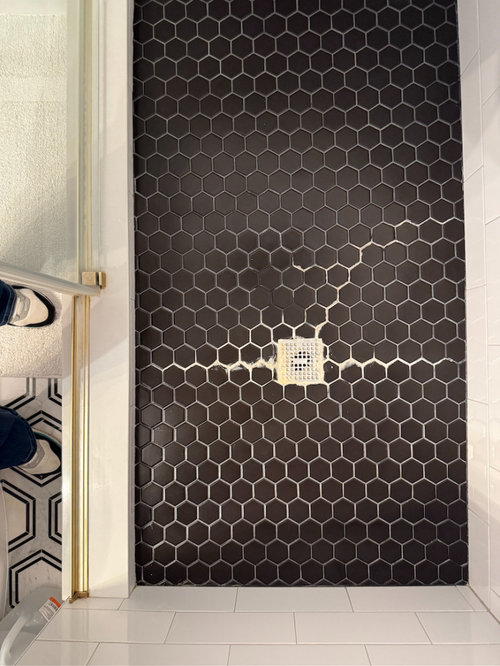
We had our bathroom renovation completed late 2023 as part of an entire home reno, and started noticing this white stuff on the tiles around the drain in early 2024. Our contractor had to come back to make some repairs, and when we brought this to their attention, they cleaned and scraped it up and said it was the products we were using. I have cleaning people come every couple of weeks, and they are not able to remove this with extra strength cleaners they use for lime build-up. We asked a friend who owns a tile company what the issue could be and how to resolve it best. One of his workers looked at the photos and said that the tile was laid over concrete that was not allowed to dry properly, and now the water is seeping through slowly, and the concrete from underneath is coming back up. It is blocking part of the drain and ca

using drainage issues. We were told it would need to be redone, which is not cheap. I was told their work is covered for 3 years under our contract. Looking at the photos, can another tile professional please confirm that's what's happening so I can know what to tell the contractor? We spent so much money on this renovation I just want to get them to make it right before our warranty with them is up.


Comments (9)

  • 3 months ago

    Do you know how the shower pan was constructed? Did you take photos while it was being built?


    Do you know what was used to install the mosaic tile? Was mastic used instead of thinset mortar? Mastic comes in pails - premade - and should not have been used in your shower - especially not to install the tile on she shower pan floor. Thinset comes in a bag in a powder form and must be mixed with water.


    The reason I'm asking is because mastic is water soluble and thinset mortar is not.


    Did the tile look fine when it was initially installed (= no white adhesive coming up betewen grout lines and settling on top of some of the individual mosaic tiles?


    Mastic is an organic adhesive. Mastic simply dries out and hardens. It undergoes a physical change, which can easily be reversed, versus a chemical change, which cannot. When exposed to water, or a moist environment for lengthy periods of time, mastic could absorb water and re-emulsify; it will soften.


    Thinsets are inorganic, they are portland cement based products. Portland cement undergoes a chemical cure when mixed with water. It doesn't simply dry out. It undergoes hydration, a chemical reaction, and becomes something different. The water in the portland cement based mix is "chemically consumed" in the reaction. It doesn't simply "evaporate away" like the drying process that mastic undergoes. Once thinset cures, it is what it is. Wet it, dry it, soak it, dry it - it's still rock hard - and the bond between tile and substrate remains intact through repeated wet/dry cycles.


    Also, just because your contractor provided a three year warranty does not mean that you lose all claims once that three year period has passed. Most lawsuits filed re: new house construction or renovations/services performed at a residential property are not filed as warranty claims - they are filed under other legal theories, such as breach of contract and/or negligence claims.

  • PRO
    3 months ago

    This is almost certainly an installer issue. I would suspect no preslope but it could be several things. Photos during construction would help.

  • 3 months ago

    ^^^^, unfortunately much more info is needed to help diagnose anything but I suspect you will have a large mess on your hands and will be redoing the entire shower in short order. Great that the work is under warranty but if they screwed it up the first time, not sure I would want them back but you may not have a choice in that.

  • PRO
    3 months ago
    last modified: 3 months ago

    I have to agree and honestly a warranty is not much good if the guy is not around anymore either . My bet no waterproofing was done before tile install which says no way is that warranty going to be available since that is a rookie mistake mt bet that concrete is not waterproofed

  • PRO
    3 months ago

    If they laid tile directly on the concrete slab that was poured, then that is 100% your issue. We need pictures of the in progress build of this to confirm. But this is a installer issue.

  • 3 months ago

    There should be no concrete anywhere near this shower. It should be mortar, which is not concrete. A pre-slope mortar bed is best with just sand and portland cement mix ("dry pack"). As others have noted, progress pictures would be needed to understand their layers and waterproofing.

    My guess from the pics would be they have a lime content in their mortar, and you have lime leaching occuring. The reason to put lime in mortar is to make it softer = workability. You do not need a lot of workability for a 3x4 bed that needs to be dense.

  • PRO
    3 months ago

    First and least expensive order of business is to check for clogged weep holes:

    https://stoneforensics.com/understanding-weep-holes-in-shower-drains/

  • 3 months ago

    I think it’s called efflorescence

  • 3 months ago

    @susandefede Although "lime leaching" is a process of efflorescence, it is different. Efflorescence begins with alkalai heavy components in the materials, and results in sodium and potassium sulfates. Lime results in calcium carbonate. All of it is "salt" left behind, but I was careful in my original terminology.

    Excerpt from the Masonry Institute:

    "In the past, hydrated lime used in the mortar was thought to have been responsible for efflorescence. This did make sense to the layperson. After all, anyone can make a logical connection between the white lime and the white efflorescent salts. However, chemical analysis and experimental tests proved otherwise. Hydrated lime (Ca(OH)2) does not contribute sufficiently towards the soluble alkali sulfates necessary for efflorescence to occur (generally only 1 /4 to 1 /10 the efflorescing potential of the cements)."