Software
Houzz Logo Print
webuser_10889494

Pool paver drainage issue

last month

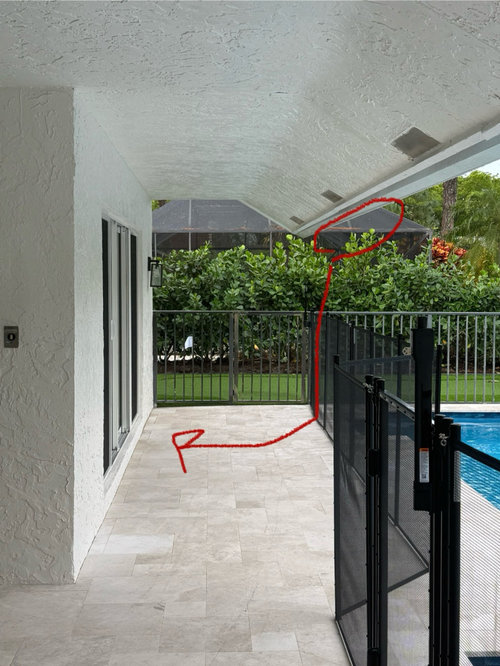
Our living/kitchen sliders open right up to our pool pavers; there is a roof over hang about 8 feet from there and then the pool is just a couple more feet away. There were travertine pavers with sand underneath and a 3” or so channel drain in between the pavers and the house. When it rains water comes pouring over the gutters and pools over the pavers into the house (there is a slight slope into the house on the end that has it the worst - this is also the end where the water pours over the gutters the hardest).

We recently had pavers redone and now there is a sandblasted marble paver. I had asked the contractor of they would keep or replace the channel drain and he said they would get rid of it bc they slope the pavers away from the house (which would move the water into the pool?). My first time doing this so I just went with it. Now that the pavers are installed there is still a slope into the house and water is pooling with nowhere to go. Note, the side of the house that meets the pavers in this spot has artificial turf with a slightly higher elevation than the pavers.

Contractor says this issue is because of the turf elevation but I would say it is not. Turf elevation is not helping but water pools regardless without the drain.

I’m curious what those of you way smarter than me with this stuff would recommend?

My thoughts :

  1. ⁠I don’t want to push contractor to redo paver slope bc I really don’t think that water flooding into the pool is a good idea ?

  2. ⁠ask contractor or another company to cut the pavers and install a new channel drain along the house in the same area? Or possibly closer to the over hang in between the house and pool? Not sure where it would ultimately lead to or if our new turf would have to be cut up? (FYI Same contractor coordinated turf)

  3. ⁠install gutter shields to help divert some of the water overflow from the roof into the gutter system before it hits the pavers (roof has a very steep slant causing this)

Any helpful input here is welcome , thank you.

Comments (15)

  • last month

    "When it rains water comes pouring over the gutters and pools over the pavers into the house"


    Two fold issue. You need to address the gutter issue as there is no way water should be flowing over the gutters. The pavers need to be pitched more as they have to be probably 1/2" slope over 10'.


    "I don’t want to push contractor to redo paver slope bc I really don’t think that water flooding into the pool is a good idea ?"


    Correct overall a poor design. BUT at this point water dumping into the pool is better than into the house.


    "ask contractor or another company to cut the pavers and install a new channel drain along the house in the same area?"


    Water must directed away from the house, not putting a drain at the door. And a drain does nothing without somewhere for the drain to dispose of the water.

  • PRO
    last month

    The issue is that the whole design is poor. The pool is too close to the house, with an impervious surface that is sloped incorrectly. Then the poorly designed gutters don't direct water away from that. The channel drain should be located just past where the gutter overflow happens, to drain the sloped paver surface away from the pool. But that looks like it interferes with the fence.


    That slope away from the house is critical and it will have to happen, no matter what else is done. The big question is what happens to the water that gets sloped. Bandaids won't fix this. But a good start is to fix the gutters, and then see what that does for how much water happens and where. I'd bet that it will still require something far more invasive to happen, like creating a more pervious surface for the pool deck, with the substrate being one large gravel/sand geogrid type virtual drain away from the house and pool. Not cheap, not small. Big money and big dig.


  • last month
    last modified: last month

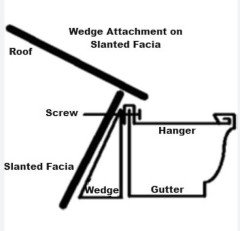
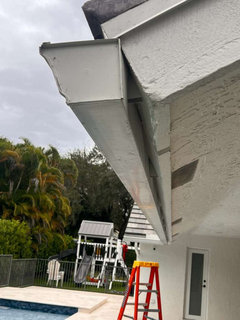
    All of millworkman comments, then I'll add that it appears you have an angled fascia and the gutter follows suit. If so that may be why the water runs right over the gutter. A splash shield is not a substitute for mounting the gutter properly.


  • last month

    If water is pouring over the gutter, I would look at the gutters first as the cause of the problem.

  • PRO
    last month

    What’s happening is pretty straightforward: once the channel drain was removed, there’s nowhere for the water to go. In setups like this, slope alone usually isn’t enough, especially this close to the house and with heavy roof runoff. Pushing water toward the pool also isn’t a great solution.


    The cleanest fix is to add a linear drain back in along the house or just outside the roof overhang and tie it into a proper discharge. After that, the paver slope can be adjusted slightly to feed the drain. Gutter upgrades can help reduce overflow, but they won’t solve the surface water issue by themselves.

  • last month

    You need to have a channel drain in that area.

    Slope towards the house needs to be fixed.

    Artificial turf higher than patio also needs to be fixed.

    I hope you have an overflow pipe for the pool! If that ever gets clogged and we have Helene-like rains, and you haven't made any changes to improve water management, you are going to get lots of water in your kitchen/living area.


    My only regret after building in 2021, was not raising the slab another 18" along with the patio/pool. We've done all we can to manage water around the house after going through the hurricanes the last few years, but those extra 18" would have assured that we would never have an issue.

  • last month

    '' My only regret after building in 2021, was not raising the slab another 18" along with the patio/pool. We've done all we can to manage water around the house after going through the hurricanes the last few years, but those extra 18" would have assured that we would never have an issue. "


    You and millions of other homeowners.

    It defies explanation why so called professionals starting with architects , ending with contractors pouring foundations don't spec slabs 6'" - 12" higher. 25% of homeowners ( beit origional or subsequent buyers/owners would like raised beds somewhere next to foundation. 25% realized drayage problems within 24 months that require $$$ to put band aids on. Another 25% make changes to landscape that result in drainage challenges . It's such a no brainer, so why isn't it industry standard? If the added height doesn't prove beneficial in later years, I can't see how 6"-12" more concrete showing between siding and earth could present a problem.


    Seriously, let's hear from those that normally disagree and question what others say on GW. If your builder suggests making your slab taller than everything else in neighborhood, tell me why you wouldn't want to.

  • PRO
    last month

    It is a cost issue. Slab on grade is on grade. Not elevated. To elevate a home requires stem walls and conventiinal construction. Or, in coastal areas, pier and beam, to allow storm surge to pass through. Both are significantly more expensive than plopping concrete directly on dirt.

  • last month

    In residential, the finished floor elevation being too close to grade is the result of process and money.

    Many projects do not even use an architect. Many projects do not have an as-built survey that includes grade elevations, nor do hardly any have a site plan with full improvements shown. A homeowner usually doesn't want to pay for any of these services as they cannot see the benefit.

    With a typical project, a builder will set the top of finished floor grade elevation with the excavator. Usually that is by backing up from a starting point of the driveway, which starts from grade and the curb cut. "As little slope as possible" and "as little steps up as possible into the house" is often the SOP.

    With slab on grade, raising the building pad is an expense that most homeowners would not want to incur. Paying $75K for another 6" of proper backfill and compaction doesn't benefit kitchen cabinets.

  • 29 days ago

    We certainly would have paid more for another few trucks of concrete! It was a fully custom build. It was never presented to us as an option and as new FL residents it didn't occur to us to make that connection ... why build the slab at the lowest height per code, when we could add another foot and improve drainage all around? It would have been easy to just raise it all up and then slope the whole courtyard driveway up to the house without needing to add any steps.

    I guess this is why people who have build several houses say that they got it close to perfect by the time they built the 4th house! This is out first and last, so it is what it is!


    Luckily the neighborhood drainage was designed well and has functioned well during all the hurricanes. Back to back hurricanes was also a good reminder to get all the major connecting drainage ditches cleared out of debris/sediment/plants and keeping them cleared out.


    Many areas that got flooded have now got state/federal money to have canals dredged to clear 50 years of sediment accumulation. Unfortunately it takes a bunch of houses getting flooded to remind those who manage these waterways that they do have to be maintained and dredged after a few decades.

  • 27 days ago

    @3onthetree thank you for the wedge suggestion. I just had this taken care of as a first step and I hope it helps!

  • 27 days ago

    All of your responses have been so helpful. Thank you

  • 27 days ago

    I think it might also be too much water from that roof valley for just that one downspout at the opposite end of the patio?

    We have super gutters, where our screen cage attaches to the roof, with large sized downspouts and we doubled up on the downspouts after a few rains. Even one of the large downspouts couldn't keep up with the amount of water coming down the roof at the back of our house.

  • 27 days ago

    I think you may be right. It’s been awhile since we’ve had a good rain but ill be curious to see what happens once we get one