
Search results for "Borrowed" in Home Design Ideas
 User
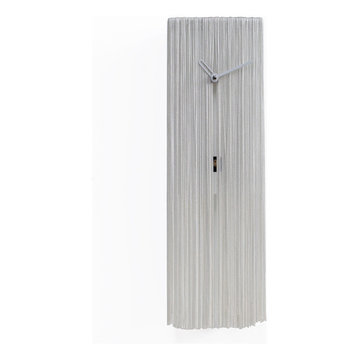
Wall cuckoo clock made in wood. Funny and odd Cousin ITT is inspired by the well-known character of the Adams Family. Battery quartz movement. The Cuckoo strike is switched off automatically during the night controlled by a light sensor.
 Alterra Craft LLC
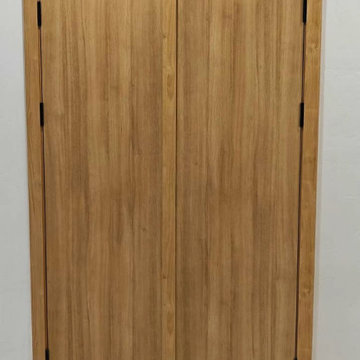
Custom flush double doors with matching frame and casing in a white oak finish and black hinges. Designed, built to measure and installed by Alterra Craft as part of the full interior package for this new Tucson home.

 East Valley Floors
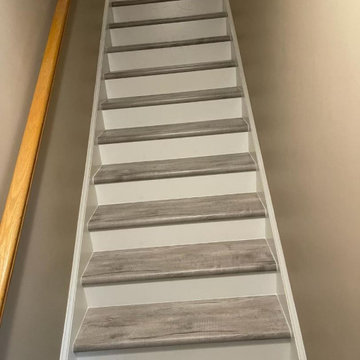
Inspiration for a carpeted curved staircase remodel in Phoenix with carpeted risers
Find the right local pro for your project


 Deb Bayless - Design for Keeps
Kitchen Design by Deb Bayless, Design For Keeps; Photos by Carlos Vergara
Example of a trendy u-shaped medium tone wood floor kitchen pantry design in San Francisco with a single-bowl sink, flat-panel cabinets, beige cabinets, quartz countertops, gray backsplash, glass tile backsplash, stainless steel appliances and no island
Example of a trendy u-shaped medium tone wood floor kitchen pantry design in San Francisco with a single-bowl sink, flat-panel cabinets, beige cabinets, quartz countertops, gray backsplash, glass tile backsplash, stainless steel appliances and no island










 Metamorphosis Design
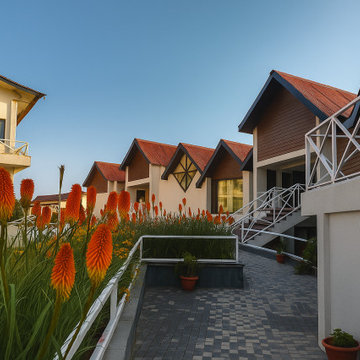
Koti Resorts
(Hotel Project)
Constructed commenced 1991
Location : Baldeyan, Himachal Pradesh
GENESIS OF A HOTEL PROJECT - KOTI RESORTS, NALDHERA, SHIMLA
How does a Newbie make an entry into the HOSPITALITY INDUSTRY.......???
Or, to be specific – HOW DOES ONE MAKE A HOTEL...... GET INTO THE HOTEL BUSINESS...???
Agreed, the business of teaching/learning of getting into this mammoth Industry is also BIG BUSINESS. Considering that almost each and every city in the country has several institutes/colleges/ and even University departments have jumped onto the band wagon of this reasonably popular academic course.
So when a long time friend from the neighbourhood wanted to start a new business/career on a family held plot in the hills – it smelled like a good opportunity. As a student of the University, he was also accidentally pushed into the “business” of running the University Cafeteria – which was on contract to some people. The student leaders (he was part of the Association) were dared to take over the Cafeteria and run it themselves if they had a problem with the then management.
Obviously, EGOS got hurt, and one doesn’t DARE a bunch of University leaders of the Student body running the roost.
So initial experience taught them supply chain management, financial acumen, human resource management, and of course – all about food. All components of running a ‘dicey operation’ such as a Student cafeteria in a volatile environment were experienced and the nut and bolts of the business learnt the hard way.
So it was full confidence and a positive gut feeling that this friend took that momentous decision. And the idea germinated.
Remember when we (almost the entire extended family from here in the plains + the rest from the hills) took off to Shimla to case the joint – to put mildly. Would’ve been summertime then – is all that I can remember.
Caught up with the ‘hill party’ at Shimla for further going towards the Naldhera Golf Course, where we were booked for lunch. The site was en route – a few strokes short, as ad people would put it, of the Golf Course...
On a hilltop called Baldeyan.
Anyway, after the family divisions of the land parcel ownership was settled, we (my friend and yours truly) spent some time at the site to figure out the way ahead. Ideas flew back and forth, including some number crunching – and just like that we zeroed in onto making a Resort Hotel. In the middle of a wild nowhere – with great views all around.
Shimla town visible at 7 o’clock (S/SW), and the snow capped peaks of the Upper Himalayas ranging from the North to the ESE (say 4 o’clock) the radio mast tower dead North, and the Craignano peak due South (that’s where Shimla’s water supply tanks are located}.
The location was a gift from heaven.
And the matter was settled – we all agreed that it was so......!!!!
So the next step – what kind of hotel do we plan for??? What kind of target customer, tariff, rooms, program...........and a thousand other questions befuddled us. I suggested going to a Hotel Consultant.
No ego!
So the both of us drove down to Delhi after zeroing in to the offices of Mr. AN Haksar (the recently retd Chairman of the ITC) – who had only recently set up this office. It hurt when we agreed to pay 1/2 a lakh as consultancy fees – in spite of me being the designated Architect for the job. But then.........cie la vie..........!!!!
Such is life!!!
We got into a quick learning curve of hotel industry terms, and practices. Of things like Occupancy rates, the ARR, peak season rates, and various depts. like F&B, Housekeeping, etc. But what the heck – we both were in our thirties.......!!!
And lapped up the learning without any fuss. And joyfully agreed when they said they’d do the hand holding for a while after the hotel started business.
Of course we’d agree – after all AN Haksar was the Chairman Emeritus of the ITC group – that super successful upstart in the Hotel Industry. With the Hotel Mughal Agra, the ITC Chola, the ITC Maurya, and the ITC Grand Kakatiya, amongst other successful Iconic properties under their belt.
I had already made up my mind on NOT DESTROYING THE ENVIRONMENT with a multi-floor frame structure that was standard pattern in the desecration of the hills. So a low rise low floor concept was a given. And that’s what we did – to achieve what we’d like to think of as the pioneer of hill resort hotel design character.........
We were already in competition with another resort being planned some distance away near Chail – another great resort hotel, and the game was on.
After getting sanctions and a starter loan from the HP SIDC, we borrowed money from family and friends, and – in a small Maruti 800 – took off for the site one summer morning. Also in the car back seat was my old mistri (now appointed thekedar) and his ‘brother mistri’......from their village in UP.
Stopped for a quick lunch immediately after crossing the Dhalli Tunnel, and the on to the site.
Now after throwing all tenets of site planning and architecture down the hill, one walked around to locate the point where we would start CONSTRUCTION OF THE RESORT HOTEL.
Took a few minutes (remember we were freshers in our thirties) and within the hour had laid out the foundation plan for the 1 st Block. Another added advantage – there were no site boundaries and no benchmarks to go by – excepting an old stone water tank used by the village below. And a few pipes going down from there.
Meanwhile left the contractor there in the wilderness for him to locate his construction huts, approach roads, material dump spaces, etc. No idea how he managed.
Within a month we were well into the making of the first ‘residential hut’ that one had envisaged. A block of four rooms – with outer rooms a bit larger with a separate dining space. And a vestibule as one entered. The toilets were located between the dining & bedroom spaces – and well ventilated. There was also an open lobby between the four rooms – giving safe access to all. And interesting approaches planned as per site conditions. With built in housekeeping stores, etc under the staircase landings. And space for 2-3 kilo-liters of water tanks
for the 8 rooms/suites per block.
One also planned for a central heating system – with insulated pipes servicing each block. A/C s were not even in our minds – but we were forced to install them later because of global warming and climate change. Neither were the ubiquitous ceiling fans - which are nowadays a must have in the towns of Shimla and Solan. Among other hill stations.....!!!
In fact one got insulated cavity walls made under duress...........a fact appreciated much later in life.
Incidentally, I think the cost of petrol was around Re. 8/50 or something those days, and it was easier on the pocket to drive up to the site beyond Shimla than stay over night in a hotel. And the Mandal Commission agitation had made us night birds on the highways to Shimla.
VP Singh was the PM, and globalisation of the economy had yet to take birth...........!!!!
The hotel had a soft opening in 1991, I think.
And the first customer stayed for a week. And then came back after a sort while to stay for a month. We felt vindicated.
And the Hotel has never looked back ever since.
designed by www.MetamorphosisDesign.org
Struggling to bring clarity to your vision before starting your dream project?
Let us help you refine your ideas and align them seamlessly with your budget.
Schedule your design consultation today - call - 9316511166
 IQnewswire
The End of the Ultra-Slim Wedding Suit
For several years, men’s formalwear was dominated by narrow lapels, short jackets and trousers cut close to the leg. The style created a sharp outline, but it often left little room for sitting, dancing or eating comfortably. Current tailoring is moving towards a more balanced shape, with cleaner shoulders, a defined waist and trousers that follow the leg without gripping it.This change does not mean that wedding suits have become oversized. The newer approach sits between skinny and loose. It keeps the structure expected of formal clothing while allowing the cloth to hang properly. For grooms, that balance is useful during a day that may involve a ceremony, photographs, dinner and several hours on the dance floor.
Look For Shape Rather Than Tightness
A well-fitted suit should create a clear outline without relying on tension. Collections of Marc Darcy suits include tailored three-piece designs, checks and textured fabrics that suit the current preference for visible structure and considered proportions.
The jacket should sit close enough to define the waist, but the front button should fasten without pulling the cloth into an X-shaped crease. At the shoulders, the seam should finish close to the natural shoulder point. Extra width can make the jacket look borrowed, while a shoulder that is too narrow may cause the upper sleeve to collapse.
Fit should be assessed while moving as well as standing. Reach forward, sit down and raise both arms. A tailored jacket will never feel like casual sportswear, but it should allow the groom to carry out ordinary movements without sharp restriction across the back or chest.
Give The Jacket Enough Length
Very short suit jackets became common alongside skinny trousers, but they can disrupt the proportions of a three-piece outfit. If the jacket finishes too high, the waistcoat may appear longer than the outer layer and the trousers may look as though they begin too low.
A more traditional jacket length usually covers most of the seat and divides the body more evenly. This can make the legs appear longer without shortening the jacket excessively. The correct length depends on height and body proportions, so two men wearing the same chest size may still need different jacket lengths.
View the suit from the back and side rather than relying on a front-facing mirror. The vents should lie flat, and the hem should not lift away from the body. A side photograph can reveal an unbalanced jacket more clearly than the changing-room mirror.
Choose Trousers That Fall Cleanly
The move away from very tight tailoring is most noticeable in suit trousers. A modern tailored leg can still be neat at the ankle, but it should provide enough room through the seat and thigh for the fabric to fall without horizontal lines.
Trouser pockets offer a useful fit check. If they pull open while standing, the waist or hips may be too tight. The fly should lie flat, and the waistband should remain in place without depending on an overtightened belt. Higher-rise trousers can work particularly well with a waistcoat because they reduce the chance of shirt fabric appearing between the two pieces.
The hem should make gentle contact with the shoe rather than gathering heavily around it. A short hem can work with narrow trousers but taking it too far may make the suit look dated once the current cropped style moves on. A slight break is easier to wear with different formal shoes and tends to look balanced in full-length wedding photographs.
Let The Waistcoat Support the Silhouette
A waistcoat adds structure through the centre of the outfit, but only when it fits correctly. It should lie flat against the shirt and cover the trouser waistband. Tightening the back strap cannot correct a waistcoat that is the wrong size or too short.
Current three-piece styling often places greater emphasis on the waistcoat. Double-breasted designs, contrasting fabrics and wider openings can distinguish the groom without requiring a brightly coloured jacket. When the groom removes the jacket later, the waistcoat keeps the outfit looking complete.
Allow room for a full meal and several hours of wear. A waistcoat that feels acceptably close during a brief fitting may become uncomfortable at dinner. Sit down with every button fastened and check whether the lower edge presses into the waist or causes the front to bow.
Use Stronger Lapels Carefully
Wider notch and peak lapels are returning after years of extremely narrow designs. A broader lapel can frame the shirt and tie, balance the shoulders and give the jacket a more formal character. Peak lapels create a particularly strong line on double-breasted jackets and evening suits.
The lapel width should still suit the wearer. A very broad lapel can overwhelm a smaller frame, while an extremely narrow one may look out of proportion on a broad chest. The shirt collar, tie width and lapel should relate to one another without matching exactly.
A wider lapel also leaves less need for decorative extras. A simple buttonhole flower or plain pocket square may be enough. Large lapel pins can crowd the upper part of the jacket, especially when the cloth already contains a check.
Avoid Buying According to the Size Label Alone
The same labelled size can fit differently across designs because cut, fabric and construction affect the garment. Begin with accurate chest, waist, inside-leg and approximate jacket-length measurements. Compare those figures with the retailer’s size information rather than ordering the size worn in another brand without checking.
If the jacket fits at the shoulders but needs slight shaping through the waist, a tailor can often make the adjustment. Sleeves and trouser hems are also commonly altered. Major changes to the shoulder line or jacket length are more difficult and may not be economical.
Do not choose the smallest size that can be fastened. A suit that looks tight in the fitting room is unlikely to become more comfortable during a long wedding day. Cloth should skim the body and return to a clean position after movement.
Balance a checked suit with simple styling
Texture and checks remain popular in wedding tailoring, particularly for country houses, converted barns and traditional venues. These fabrics already add depth to the outfit, so the cut should remain controlled and the accessories relatively quiet.
A plain white, pale blue or cream shirt gives a checked suit a clear foundation. Choose a tie from one of the secondary colours in the cloth rather than introducing another strong pattern. A white pocket square works when the suit contains several shades and does not need further decoration.
Shoes should support the proportions of the trousers. A very slim shoe may appear too small beneath a fuller hem, while a heavy casual sole can pull attention away from the tailoring. Oxfords, Derbies and refined brogues usually provide enough visual weight without looking bulky.
Coordinate the wedding party without forcing one fit
Matching groomsmen suits can become difficult when every member of the party has a different build. Insisting on an identical close fit may leave some men comfortable and others visibly restricted. A better approach is to keep the cloth, colour and main design consistent while adjusting jacket and trouser sizes for each person.
The groom can stand apart through a waistcoat, lapel shape or accessory rather than wearing a suit cut much tighter than everyone else. This creates a connection across the group without treating one silhouette as suitable for every body.
Arrange fittings early enough to identify size and alteration issues. Group orders should be checked well before the wedding, particularly when trousers need hemming or jackets require sleeve adjustments. Each person should try the complete outfit with the intended shirt and shoes.
Judge the suit by the whole day
A wedding fitting often lasts less than half an hour, while the suit may be worn for twelve hours or more. Comfort should therefore be tested under realistic conditions. Sit for several minutes, walk upstairs and check the waistband after moving around.
Pay attention to the parts that cannot be seen clearly in a mirror. The collar should remain close to the shirt at the back of the neck. Jacket vents should not pull apart, and the trouser seat should follow the body without sagging or strain.
The current move towards balanced tailoring gives grooms more room to choose clothes that look formal without feeling restrictive. Clean shoulders, a shaped jacket and trousers with a natural fall will outlast extreme proportions. A suit that allows the groom to stand, sit and celebrate comfortably is also more likely to look composed in photographs taken throughout the day.
199