
Search results for "Competent" in Home Design Ideas

 Staging Beautifully
Kim Roberts, owner of Staging Beautifully, has a passion for creating beautiful spaces. From home staging to redecorating, Kim’s relaxed and friendly approach make even the most challenging project fun and enjoyable.
For those interested in refreshing their space, Staging Beautifully can assist a homeowner in decorating their home with the items they already own and love. Like staging, redesign may include color selection, rearranging furniture, hanging art and placing accessories. It is a cost effective design alternative which will give your home a facelift without the cost of an Interior Designer. Utilizing your furnishings and treasures, we will shop your home to find new and creative ways to display your family’s possessions. This will result in a complete interior transformation which will reflect your personality, style, comfort and functionality to your living space without having to buy anything.
Looking to sell your home, consider home staging to target a higher selling price. Home Staging aims to de-personalize your home and make it appealing to virtually all prospective buyers. The way you live in your home and the way you market your home are two very different things. Your home is competing with every other home on the market. A home that looks like it needs work or isn't move-in ready prompts buyers to low-ball their offers, or eliminate your home from consideration all together. Those homes that are staged to reflect current trends attract and appeal to more buyers, resulting in more offers, faster sales, and higher sale prices. Sometimes, an agent may even recommend your price be increased once your home is staged! A well-staged home can even start a bidding war with multiple offers!
 George Ocampo
Central El Paso Backyard Renovation:
Fifteen years is a long time for a backyard to quietly wait.
At first, it was full of intention—a pool that promised summers, laughter, and long evenings. But time has a way of settling in. The water turned still, then green. Edges cracked. The space became less of a destination and more of something you looked past. Life moved forward, but the backyard stayed behind.
Then came the decision: it was time.
Not a patch job. Not a quick fix. A complete reset.
The transformation didn’t begin beautifully—it began with demolition. The old pool was drained, exposing years of neglect etched into its surface. Crews stepped in, breaking, clearing, reshaping. What once held stagnant water became an open cavity of possibility. Steel rebar formed a new skeleton, precise and intentional. Every line measured. Every elevation reconsidered.
This wasn’t just construction—it was rethinking how the space should live.
The shell was rebuilt. Surfaces were refined. Plumbing, structure, and flow were corrected at their core. What had once been outdated and failing was now engineered to last.
Then the shift happened.
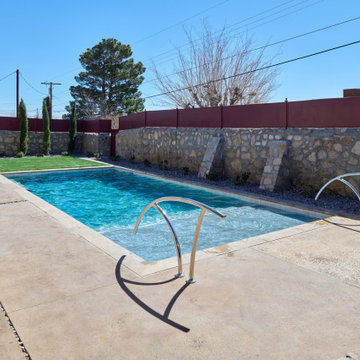
Hardscape came in—clean, warm-toned concrete replacing worn decking. Stone walls, once just boundaries, were elevated into features. Subtle textures, intentional lines. A visual language that matched the architecture of the home instead of competing with it.
The pool returned—but not as it was.
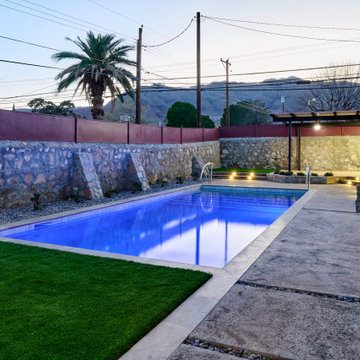
Now it was sharp, modern, and inviting. A long, clean body of water with a shallow tanning ledge that catches the sun just right. Stainless steel scuppers arc water into the pool—movement, sound, life. Steps are crisp, geometry is balanced, and the water reflects clarity instead of neglect.
Around it, the yard found purpose.
Artificial turf introduced contrast—green, controlled, low-maintenance. A pergola structure rose in the corner, creating a destination within the destination. Beneath it, a built-in outdoor kitchen turned the backyard into a place to gather, not just pass through. Lighting stitched everything together, making the space just as alive at dusk as it is under the midday sun.
By the end, nothing felt accidental.
What was once forgotten is now deliberate. What was once avoided is now the center of attention.
Fifteen years later, the backyard didn’t just come back—it finally became what it was always supposed to be.
 George Ocampo
Central El Paso Backyard Renovation:
Fifteen years is a long time for a backyard to quietly wait.
At first, it was full of intention—a pool that promised summers, laughter, and long evenings. But time has a way of settling in. The water turned still, then green. Edges cracked. The space became less of a destination and more of something you looked past. Life moved forward, but the backyard stayed behind.
Then came the decision: it was time.
Not a patch job. Not a quick fix. A complete reset.
The transformation didn’t begin beautifully—it began with demolition. The old pool was drained, exposing years of neglect etched into its surface. Crews stepped in, breaking, clearing, reshaping. What once held stagnant water became an open cavity of possibility. Steel rebar formed a new skeleton, precise and intentional. Every line measured. Every elevation reconsidered.
This wasn’t just construction—it was rethinking how the space should live.
The shell was rebuilt. Surfaces were refined. Plumbing, structure, and flow were corrected at their core. What had once been outdated and failing was now engineered to last.
Then the shift happened.
Hardscape came in—clean, warm-toned concrete replacing worn decking. Stone walls, once just boundaries, were elevated into features. Subtle textures, intentional lines. A visual language that matched the architecture of the home instead of competing with it.
The pool returned—but not as it was.
Now it was sharp, modern, and inviting. A long, clean body of water with a shallow tanning ledge that catches the sun just right. Stainless steel scuppers arc water into the pool—movement, sound, life. Steps are crisp, geometry is balanced, and the water reflects clarity instead of neglect.
Around it, the yard found purpose.
Artificial turf introduced contrast—green, controlled, low-maintenance. A pergola structure rose in the corner, creating a destination within the destination. Beneath it, a built-in outdoor kitchen turned the backyard into a place to gather, not just pass through. Lighting stitched everything together, making the space just as alive at dusk as it is under the midday sun.
By the end, nothing felt accidental.
What was once forgotten is now deliberate. What was once avoided is now the center of attention.
Fifteen years later, the backyard didn’t just come back—it finally became what it was always supposed to be.
Find the right local pro for your project
 Lindy Architect
This project was never really about the architecture. It was about a family that collects — art, ceramics, books, ideas — and needed a home that could hold all of that without turning into a museum.
The existing unit had good bones: generous ceiling heights, a floating stair, and enough square footage to work with. What it lacked was a coherent logic — a way of moving through the space that felt intentional, where each transition earned its moment.
We rebuilt that logic from the ground up.
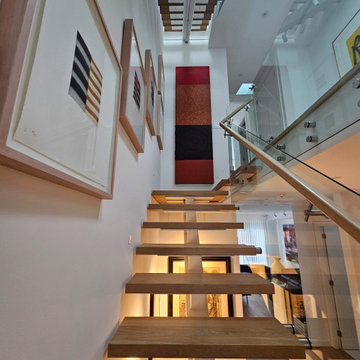
The ground floor is organized around a single corridor that runs from the kitchen island through to the living room, with the staircase serving as the spine of the whole sequence. Rather than treating the stair as purely functional, we kept the glass balustrade open and lit the treads from below, so it reads as a light source as much as a passage. The console beneath it became a natural landing for ceramics and found objects — not styled, just placed.
In the living room, the brief was simple: make room for a very large painting without the room feeling like a gallery. The answer was to keep everything else quiet — a white built-in that does its job, sheer linen curtains that diffuse the light, black leather chairs that anchor the space without competing. The painting does the rest.
Upstairs, the landing is lit by a skylight that washes the hallway in natural light through most of the day. We lined one side with a burl wood console and let the ceramics and framed works speak for themselves. The mix of abstract prints, a bold red canvas, and handmade vessels gives the corridor a rhythm that feels accumulated over time rather than installed all at once — because it was.
Throughout, the material palette is deliberately restrained: white oak floors, white walls, white millwork. The restraint isn't minimalism for its own sake — it's a backdrop. The owners bring the color, texture, and personality. Our job was to give them the right walls to hang things on.
 Rocky Tops Granite & Marble LLC
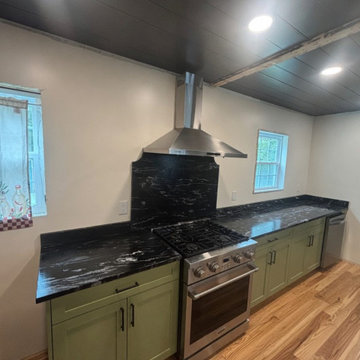
We fabricated and installed Black Forest Leather granite in a kitchen out in St. Matthews, and this is one of those stones that changes the whole feel of a room the second it goes in. It's a granite, but with a leathered finish instead of polished, so the surface has texture you can actually feel under your hand. That leathering knocks the shine down and brings out the depth of the stone, the blacks and dark grays shifting as the light moves across the counters through the day.
Black Forest works in a kitchen because it's granite through and through, hard, dense, and about as tough a countertop material as you're going to find. Heat off a pan straight from the stove isn't going to bother it. Knives, hot pots, everyday kitchen abuse, it shrugs all that off. The leathered texture actually helps hide the small stuff too, fingerprints and water spots don't show up the way they would on a polished slab, which matters in a kitchen that's getting used every single day.
Getting a leathered finish right takes some care in the shop. You can't rush the process or you end up with a surface that feels inconsistent from one section to the next. We templated the kitchen carefully, cut it to fit tight against the cabinets, and set the seams where they'd be least noticeable, matching the movement in the stone across the joints so it reads like one continuous surface instead of pieced-together slabs. We kept the edge eased, clean and simple, which is the right call on a stone with this much character. You don't need a fussy edge competing with what the granite's already doing.
Day to day, this countertop is going to hold up. Granite like this doesn't scratch easily, and with a leathered finish there's less concern about micro-scratching showing over time compared to a high polish. A sealer keeps it easy to wipe down and keeps stains from setting in, and beyond that it's low maintenance, just regular cleaning and it'll look the way it does now for years.
It's good to see stone like this going into a kitchen in St. Matthews. We do a lot of work across the Midlands, and every job's a little different, but a granite with this much texture and depth always makes an impression walking into the room.
 George Ocampo
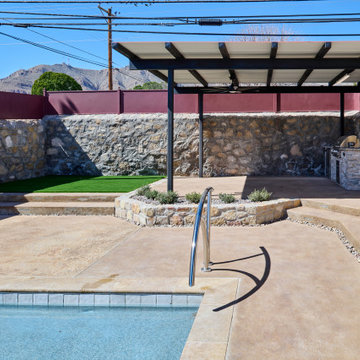
Central El Paso Backyard Renovation:
Fifteen years is a long time for a backyard to quietly wait.
At first, it was full of intention—a pool that promised summers, laughter, and long evenings. But time has a way of settling in. The water turned still, then green. Edges cracked. The space became less of a destination and more of something you looked past. Life moved forward, but the backyard stayed behind.
Then came the decision: it was time.
Not a patch job. Not a quick fix. A complete reset.
The transformation didn’t begin beautifully—it began with demolition. The old pool was drained, exposing years of neglect etched into its surface. Crews stepped in, breaking, clearing, reshaping. What once held stagnant water became an open cavity of possibility. Steel rebar formed a new skeleton, precise and intentional. Every line measured. Every elevation reconsidered.
This wasn’t just construction—it was rethinking how the space should live.
The shell was rebuilt. Surfaces were refined. Plumbing, structure, and flow were corrected at their core. What had once been outdated and failing was now engineered to last.
Then the shift happened.
Hardscape came in—clean, warm-toned concrete replacing worn decking. Stone walls, once just boundaries, were elevated into features. Subtle textures, intentional lines. A visual language that matched the architecture of the home instead of competing with it.
The pool returned—but not as it was.
Now it was sharp, modern, and inviting. A long, clean body of water with a shallow tanning ledge that catches the sun just right. Stainless steel scuppers arc water into the pool—movement, sound, life. Steps are crisp, geometry is balanced, and the water reflects clarity instead of neglect.
Around it, the yard found purpose.
Artificial turf introduced contrast—green, controlled, low-maintenance. A pergola structure rose in the corner, creating a destination within the destination. Beneath it, a built-in outdoor kitchen turned the backyard into a place to gather, not just pass through. Lighting stitched everything together, making the space just as alive at dusk as it is under the midday sun.
By the end, nothing felt accidental.
What was once forgotten is now deliberate. What was once avoided is now the center of attention.
Fifteen years later, the backyard didn’t just come back—it finally became what it was always supposed to be.
 OxanaKovalchukDesign.Inc
This interior was created for a renowned Kazakh mountaineer who has conquered all 14 of the world’s eight-thousanders — the highest peaks on Earth. His extraordinary journey became the inspiration for the name of the project: “On The Way to EVEREST.”
Located on the top floor of the Everest residential complex in Almaty, Kazakhstan, the 69-square-meter apartment was designed as a minimalist, budget-conscious home that reflects the spirit of its owner and his profound connection to the mountains.
The concept began with one extraordinary photograph.
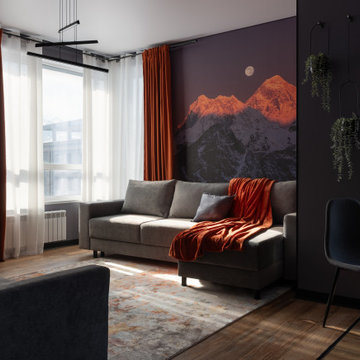
The focal point of the entire interior is a unique photograph of Everest at sunrise, capturing the precise moment when the first rays of sunlight illuminate the summit. The photographer spent two weeks waiting for this particular moment of light. Its dramatic atmosphere, colors, and sense of scale became the starting point for the entire design.
From there, the interior evolved into a dialogue between two mountain worlds: Everest captured in the photograph, and the real mountains of Almaty visible through the apartment’s windows.
The design is deliberately restrained and minimalist. A palette of gray, deep blue-violet, and muted orange creates a quiet, atmospheric backdrop, while concrete, walnut wood, and matte black metal establish a sense of strength, warmth, and simplicity. Rather than competing with the mountain imagery, the materials and furnishings create a calm architectural frame around it.
One of the most distinctive elements is the bedroom.
There is no conventional bed. Instead, I designed a raised wooden platform inspired by the simple timber platforms used by mountaineers as a base for their tents. This architectural gesture transforms an everyday piece of furniture into a subtle reference to the owner’s life in the mountains.
In the morning, the first thing he sees is not a wall or a piece of furniture, but the mountains of Almaty. Wherever you stand within the apartment, the mountains remain part of the visual experience.
The most magical connection happens at sunset.
Standing in the living room and looking toward the photograph of Everest, you can see through the kitchen window a sunset painted in almost exactly the same colors as the sunlight illuminating the summit in the photograph. For a brief moment, it feels as though the Almaty sun itself has reached across the distance and illuminated Everest.
It is a moment that photography can hardly capture.
The apartment therefore becomes more than a place to live. It becomes a continuous journey between adventure and home, memory and reality, Everest and Almaty.
For a man who has stood on the highest peaks in the world, home becomes another kind of summit — a place where the mountains he has conquered remain close, and where the mountains he loves most are always within sight.
 Rocky Tops Granite & Marble LLC
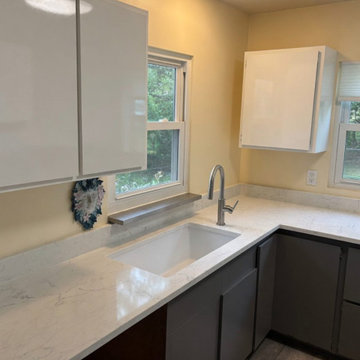
We put MSI Calacatta Aidana quartz into a kitchen out in Hopkins, and it's the kind of stone that changes how a room feels the day it goes in. Aidana's got that bright white background with soft veining moving through it, the kind of pattern that reads clean and calm from across the room but still has movement when you get up close to it. For a kitchen that gets used every day, that's exactly what you want. It doesn't compete with cabinets or fight the light coming through the windows, it just sits there looking good year after year.
Quartz like this is engineered, so the slabs come off the line consistent. That matters more than people think when you're templating a kitchen with a lot of linear footage, corners, and a sink cutout to deal with. We're not chasing a wild vein across a seam or hoping two slabs happen to match. The veining in Aidana is soft enough that seams disappear into the field instead of announcing themselves, and that's a craftsmanship thing as much as a material thing. Getting a seam tight and a pattern lined up right takes patience at the saw and patience setting it, not just a good slab to start with.
The kitchen itself got the full treatment, counters and an eased edge, which is the right call for a stone with this kind of quiet pattern. An eased edge keeps the eye on the surface and the veining instead of on the edge detail, and it's a practical choice too, it holds up well and doesn't chip the way a sharper profile can over time.
Day to day, this is a stone that just works. Quartz doesn't need sealing, it resists staining better than natural stone, and it shrugs off the usual kitchen abuse, knives set down too hard, hot pans set too close, kids leaning on the counter doing homework. It's a surface built for a family that actually cooks and lives in the space rather than one that's roped off for company.
Hopkins has been getting more of these kitchen jobs lately, and it's easy to see why homeowners out that way keep landing on Calacatta Aidana. It's a stone that photographs well and lives even better, bright and clean without being cold, and it gives a kitchen that finished, put-together look the moment you walk in.
 George Ocampo
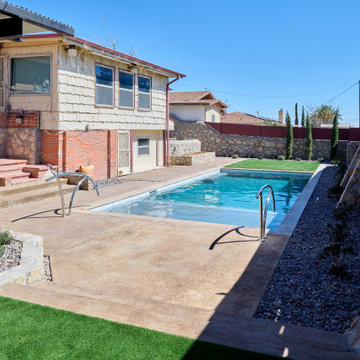
Central El Paso Backyard Renovation:
Fifteen years is a long time for a backyard to quietly wait.
At first, it was full of intention—a pool that promised summers, laughter, and long evenings. But time has a way of settling in. The water turned still, then green. Edges cracked. The space became less of a destination and more of something you looked past. Life moved forward, but the backyard stayed behind.
Then came the decision: it was time.
Not a patch job. Not a quick fix. A complete reset.
The transformation didn’t begin beautifully—it began with demolition. The old pool was drained, exposing years of neglect etched into its surface. Crews stepped in, breaking, clearing, reshaping. What once held stagnant water became an open cavity of possibility. Steel rebar formed a new skeleton, precise and intentional. Every line measured. Every elevation reconsidered.
This wasn’t just construction—it was rethinking how the space should live.
The shell was rebuilt. Surfaces were refined. Plumbing, structure, and flow were corrected at their core. What had once been outdated and failing was now engineered to last.
Then the shift happened.
Hardscape came in—clean, warm-toned concrete replacing worn decking. Stone walls, once just boundaries, were elevated into features. Subtle textures, intentional lines. A visual language that matched the architecture of the home instead of competing with it.
The pool returned—but not as it was.
Now it was sharp, modern, and inviting. A long, clean body of water with a shallow tanning ledge that catches the sun just right. Stainless steel scuppers arc water into the pool—movement, sound, life. Steps are crisp, geometry is balanced, and the water reflects clarity instead of neglect.
Around it, the yard found purpose.
Artificial turf introduced contrast—green, controlled, low-maintenance. A pergola structure rose in the corner, creating a destination within the destination. Beneath it, a built-in outdoor kitchen turned the backyard into a place to gather, not just pass through. Lighting stitched everything together, making the space just as alive at dusk as it is under the midday sun.
By the end, nothing felt accidental.
What was once forgotten is now deliberate. What was once avoided is now the center of attention.
Fifteen years later, the backyard didn’t just come back—it finally became what it was always supposed to be.
 Staging Beautifully
Kim Roberts, owner of Staging Beautifully, has a passion for creating beautiful spaces. From home staging to redecorating, Kim’s relaxed and friendly approach make even the most challenging project fun and enjoyable.
For those interested in refreshing their space, Staging Beautifully can assist a homeowner in decorating their home with the items they already own and love. Like staging, redesign may include color selection, rearranging furniture, hanging art and placing accessories. It is a cost effective design alternative which will give your home a facelift without the cost of an Interior Designer. Utilizing your furnishings and treasures, we will shop your home to find new and creative ways to display your family’s possessions. This will result in a complete interior transformation which will reflect your personality, style, comfort and functionality to your living space without having to buy anything.
Looking to sell your home, consider home staging to target a higher selling price. Home Staging aims to de-personalize your home and make it appealing to virtually all prospective buyers. The way you live in your home and the way you market your home are two very different things. Your home is competing with every other home on the market. A home that looks like it needs work or isn't move-in ready prompts buyers to low-ball their offers, or eliminate your home from consideration all together. Those homes that are staged to reflect current trends attract and appeal to more buyers, resulting in more offers, faster sales, and higher sale prices. Sometimes, an agent may even recommend your price be increased once your home is staged! A well-staged home can even start a bidding war with multiple offers!
 Rocky Tops Granite & Marble LLC
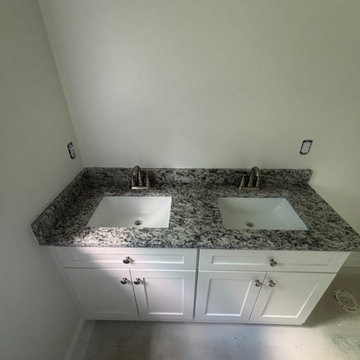
This kitchen in Bamberg came together in Dallas White granite, a stone that reads clean and bright without going stark. The background carries soft grays with subtle movement through it, enough character to keep the eye interested but calm enough to work with just about any cabinet color a builder picks for a spec house like this one. That's part of why it gets used so often in kitchens meant to show well and live well at the same time.
Granite's still one of the best choices you can make for a kitchen countertop, and Dallas White in particular holds up the way granite's supposed to. It's dense, it resists heat, and you can set a hot pan on it without worrying about scorching. Scratches aren't a concern with normal use, and the surface takes a polish that lasts for years. We seal it going in and that's about all the maintenance it ever needs.
Getting a granite slab like this into a kitchen right takes more than just cutting to size. We template the space first to make sure the seams land where they won't draw attention, usually tucked near the sink or stove, and any countertop longer than about 8 to 9 feet is going to need one. Matching the pattern across a seam so it reads as one continuous piece is where the work actually happens. The edge here is eased, a clean, simple line that lets the stone itself do the talking instead of competing with it.
Day to day, this is the kind of countertop that just works. Wipe it down, don't worry about it, and it'll look the same ten years from now as it does today. That durability is exactly what a spec house kitchen needs, something that shows well to a buyer walking through and keeps performing long after they've moved in.
We do a lot of work through the Midlands, and Bamberg jobs like this one are a good example of what granite still does better than almost anything else on the market. It's a straightforward material that never stops earning its keep in a kitchen, and this one turned out exactly the way it should.
 Rocky Tops Granite & Marble LLC
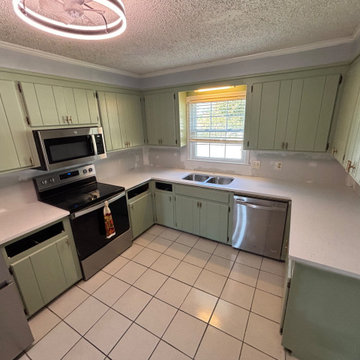
We put GK Carrara Gold quartz into a kitchen in West Columbia, and it's the kind of stone that gives a bright, classic look without asking the homeowner to babysit it. White background, soft gray veining moving through it, a clean bright field that works with just about any cabinet color. Engineered quartz gives us that light, veined look with a material that's built for how a kitchen actually gets used, day in and day out, with hot pans and spills and everything else that happens on a counter.
The templating on a job like this is where the work really happens before it ever shows up on a truck. We measure the cabinets and openings on site, build a template that accounts for every corner and cutout, and send it to the shop so the slab gets cut once, correctly. With a veining pattern like Carrara Gold's, we're paying close attention to how it flows across seams, especially anywhere two pieces meet on an island or a run of countertop that turns a corner. You want the eye to read it as one continuous piece, not two slabs bolted together.
Quartz like this is engineered to be non-porous, so there's no sealing required and no worrying about wine or oil soaking into the surface the way you'd have to watch with some natural stones. It resists scratching and staining well under normal kitchen use, though we still tell people to use a cutting board and a trivet for anything straight off the stove, since sustained high heat can still cause trouble at a seam or in the material itself. Day to day, it wipes clean with soap and water and holds its color and shine for years without a lot of fuss.
We finished the edge simple and eased, which keeps the whole thing looking clean and doesn't compete with the veining for attention. That's a small decision, but it's the right one on a stone with this much movement in the pattern already.
West Columbia's seen a good bit of kitchen work like this lately, and it's easy to see why a bright, veined quartz keeps coming up. It gives a kitchen that clean, timeless feel homeowners are after, backed by a material that's built to actually live in a working kitchen for the long haul.
 Rocky Tops Granite & Marble LLC
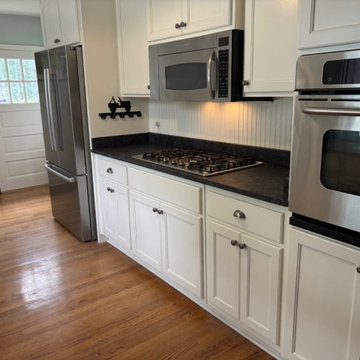
This kitchen in Forest Acres came together around a solid granite countertop, and it's the kind of stone that does the quiet work of holding a whole room together. Granite's been the go-to for kitchen counters for decades because it earns it. It's igneous rock, formed under heat and pressure, and that history is why it laughs off the stuff a real kitchen throws at it. Hot pans, knife work, everyday spills, granite takes it and keeps looking good.
We went with an eased edge on this one, which is the clean, simple line that a lot of Midlands homeowners want. It's not flashy, but that's the point. An eased edge softens the sharp corner just enough to be comfortable to lean against and easy to wipe down, and it lets the granite itself, the movement, the flecks, the depth in the stone, do the talking instead of a fussy edge profile competing for attention.
Getting a countertop like this right starts before the stone ever gets cut. We template the kitchen precisely, accounting for the cabinets, the appliances, and any out-of-square walls that always show up in real houses. Then it's cut, the edges are worked by hand to get that eased profile even and consistent around every corner, and the seams, if there are any, get lined up so the pattern reads as close to continuous as we can get it. Granite doesn't forgive sloppy fabrication. Every joint and cutout has to be tight because the stone's not going anywhere once it's set.
Day to day, this is a countertop that's built for actual cooking and actual life, not just for photos. Granite resists scratching, it handles heat better than almost anything else you'd put in a kitchen, and with a good sealer it shrugs off staining from wine, oil, or lemon juice. It's low maintenance once it's in, just a wipe down and, depending on the specific granite, a reseal every year or two to keep it performing at its best.
Forest Acres has a good mix of older homes getting updated and newer builds going in, and granite fits both. It's a material that's stood the test of time in kitchens across the Midlands, and this one's a solid, honest example of why. Clean lines, real stone, and a countertop that's going to outlast most everything else in that kitchen.
 Rocky Tops Granite & Marble LLC
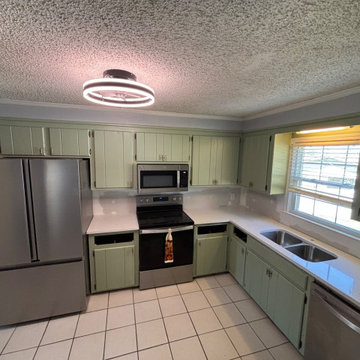
We put GK Carrara Gold quartz into a kitchen in West Columbia, and it's the kind of stone that gives a bright, classic look without asking the homeowner to babysit it. White background, soft gray veining moving through it, a clean bright field that works with just about any cabinet color. Engineered quartz gives us that light, veined look with a material that's built for how a kitchen actually gets used, day in and day out, with hot pans and spills and everything else that happens on a counter.
The templating on a job like this is where the work really happens before it ever shows up on a truck. We measure the cabinets and openings on site, build a template that accounts for every corner and cutout, and send it to the shop so the slab gets cut once, correctly. With a veining pattern like Carrara Gold's, we're paying close attention to how it flows across seams, especially anywhere two pieces meet on an island or a run of countertop that turns a corner. You want the eye to read it as one continuous piece, not two slabs bolted together.
Quartz like this is engineered to be non-porous, so there's no sealing required and no worrying about wine or oil soaking into the surface the way you'd have to watch with some natural stones. It resists scratching and staining well under normal kitchen use, though we still tell people to use a cutting board and a trivet for anything straight off the stove, since sustained high heat can still cause trouble at a seam or in the material itself. Day to day, it wipes clean with soap and water and holds its color and shine for years without a lot of fuss.
We finished the edge simple and eased, which keeps the whole thing looking clean and doesn't compete with the veining for attention. That's a small decision, but it's the right one on a stone with this much movement in the pattern already.
West Columbia's seen a good bit of kitchen work like this lately, and it's easy to see why a bright, veined quartz keeps coming up. It gives a kitchen that clean, timeless feel homeowners are after, backed by a material that's built to actually live in a working kitchen for the long haul.
 Staging Beautifully
Kim Roberts, owner of Staging Beautifully, has a passion for creating beautiful spaces. From home staging to redecorating, Kim’s relaxed and friendly approach make even the most challenging project fun and enjoyable.
For those interested in refreshing their space, Staging Beautifully can assist a homeowner in decorating their home with the items they already own and love. Like staging, redesign may include color selection, rearranging furniture, hanging art and placing accessories. It is a cost effective design alternative which will give your home a facelift without the cost of an Interior Designer. Utilizing your furnishings and treasures, we will shop your home to find new and creative ways to display your family’s possessions. This will result in a complete interior transformation which will reflect your personality, style, comfort and functionality to your living space without having to buy anything.
Looking to sell your home, consider home staging to target a higher selling price. Home Staging aims to de-personalize your home and make it appealing to virtually all prospective buyers. The way you live in your home and the way you market your home are two very different things. Your home is competing with every other home on the market. A home that looks like it needs work or isn't move-in ready prompts buyers to low-ball their offers, or eliminate your home from consideration all together. Those homes that are staged to reflect current trends attract and appeal to more buyers, resulting in more offers, faster sales, and higher sale prices. Sometimes, an agent may even recommend your price be increased once your home is staged! A well-staged home can even start a bidding war with multiple offers!
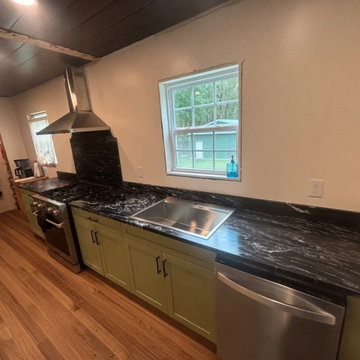 Rocky Tops Granite & Marble LLC
We fabricated and installed Black Forest Leather granite in a kitchen out in St. Matthews, and this is one of those stones that changes the whole feel of a room the second it goes in. It's a granite, but with a leathered finish instead of polished, so the surface has texture you can actually feel under your hand. That leathering knocks the shine down and brings out the depth of the stone, the blacks and dark grays shifting as the light moves across the counters through the day.
Black Forest works in a kitchen because it's granite through and through, hard, dense, and about as tough a countertop material as you're going to find. Heat off a pan straight from the stove isn't going to bother it. Knives, hot pots, everyday kitchen abuse, it shrugs all that off. The leathered texture actually helps hide the small stuff too, fingerprints and water spots don't show up the way they would on a polished slab, which matters in a kitchen that's getting used every single day.
Getting a leathered finish right takes some care in the shop. You can't rush the process or you end up with a surface that feels inconsistent from one section to the next. We templated the kitchen carefully, cut it to fit tight against the cabinets, and set the seams where they'd be least noticeable, matching the movement in the stone across the joints so it reads like one continuous surface instead of pieced-together slabs. We kept the edge eased, clean and simple, which is the right call on a stone with this much character. You don't need a fussy edge competing with what the granite's already doing.
Day to day, this countertop is going to hold up. Granite like this doesn't scratch easily, and with a leathered finish there's less concern about micro-scratching showing over time compared to a high polish. A sealer keeps it easy to wipe down and keeps stains from setting in, and beyond that it's low maintenance, just regular cleaning and it'll look the way it does now for years.
It's good to see stone like this going into a kitchen in St. Matthews. We do a lot of work across the Midlands, and every job's a little different, but a granite with this much texture and depth always makes an impression walking into the room.
 Staging Beautifully
Kim Roberts, owner of Staging Beautifully, has a passion for creating beautiful spaces. From home staging to redecorating, Kim’s relaxed and friendly approach make even the most challenging project fun and enjoyable.
For those interested in refreshing their space, Staging Beautifully can assist a homeowner in decorating their home with the items they already own and love. Like staging, redesign may include color selection, rearranging furniture, hanging art and placing accessories. It is a cost effective design alternative which will give your home a facelift without the cost of an Interior Designer. Utilizing your furnishings and treasures, we will shop your home to find new and creative ways to display your family’s possessions. This will result in a complete interior transformation which will reflect your personality, style, comfort and functionality to your living space without having to buy anything.
Looking to sell your home, consider home staging to target a higher selling price. Home Staging aims to de-personalize your home and make it appealing to virtually all prospective buyers. The way you live in your home and the way you market your home are two very different things. Your home is competing with every other home on the market. A home that looks like it needs work or isn't move-in ready prompts buyers to low-ball their offers, or eliminate your home from consideration all together. Those homes that are staged to reflect current trends attract and appeal to more buyers, resulting in more offers, faster sales, and higher sale prices. Sometimes, an agent may even recommend your price be increased once your home is staged! A well-staged home can even start a bidding war with multiple offers!
166