
Search results for "Constant cycle" in Home Design Ideas

 Pineapple House Interior Design
Several styles and cuts of Calcatta marble create rhythm in this master shower. In the shower, the Kohler Chrome Watertile Rain Shower System includes five body spray units and two Soundtile speakers. The system has programmed settings for temperature, flow, steam, music, massage, etc.
Daniel Newcomb Photography
 Horn & Co. (Previously JHLA)
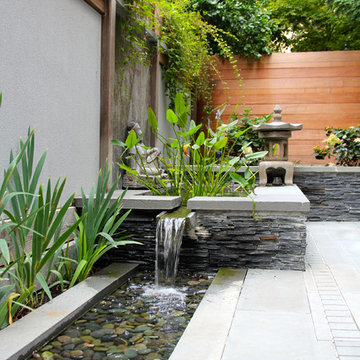
Our clients on this project were inspired by their travels to Asia and wanted to mimic this aesthetic at their DC property. We designed a water feature that effectively masks adjacent traffic noise and maintains a small footprint.
 Divine Custom Homes
SpaceCrafting
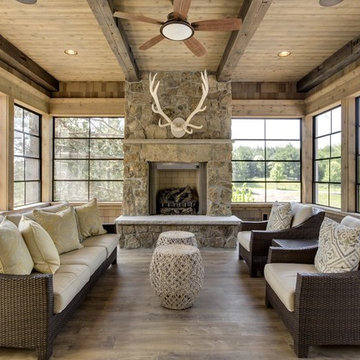
Mid-sized mountain style screened-in, medium tone wood floor and gray floor sunroom photo in Minneapolis with a standard fireplace, a standard ceiling and a stone fireplace
Mid-sized mountain style screened-in, medium tone wood floor and gray floor sunroom photo in Minneapolis with a standard fireplace, a standard ceiling and a stone fireplace
Find the right local pro for your project

 Harvest Timber Specialty Products
Inspiration for a large contemporary full sun and brown rooftop and one-story wood flat roof remodel in San Francisco
 Kitchen Design Concepts
Cabinetry: Elmwood Full Access cabinetry, Chamberlain Rail Providence door style, with a Dove White Matte paint.
Countertops: 3cm Red Shimmer from Caesarstone

 David Sharff Architect, P.C.
Michael J. Lee Photography
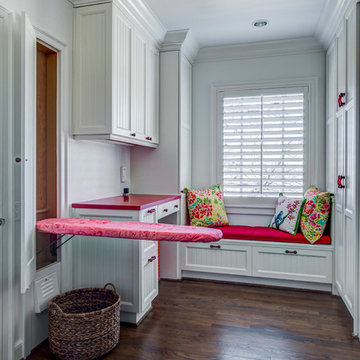
Example of a classic medium tone wood floor dedicated laundry room design in Boston with a side-by-side washer/dryer, a drop-in sink, open cabinets and multicolored walls
Example of a classic medium tone wood floor dedicated laundry room design in Boston with a side-by-side washer/dryer, a drop-in sink, open cabinets and multicolored walls



 Sallie Hill Design, Landscape Architect
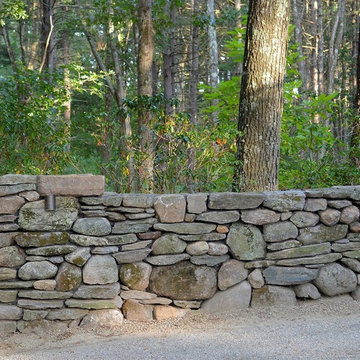
New England fieldstone wall with battered pier and low voltage light. Stone wall edges driveway entrance to Concord, MA country estate. - ©2015 Brian Hill

 Albert, Righter & Tittmann Architects, Inc.
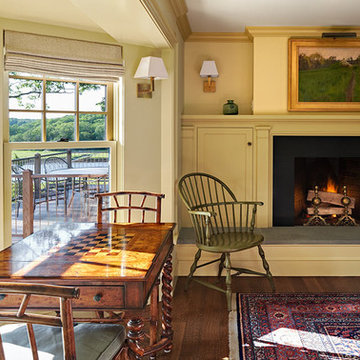
This house wraps around two levels of courtyards on one side and looks out over salt marshes to the sound on the other. Its deeply insulated 12” thick walls and roof conserve energy, and heat recovery ventilation ensures a constant cycle of fresh air.
 Albert, Righter & Tittmann Architects, Inc.
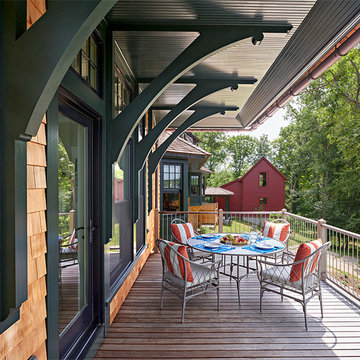
This house wraps around two levels of courtyards on one side and looks out over salt marshes to the sound on the other. Its deeply insulated 12” thick walls and roof conserve energy, and heat recovery ventilation ensures a constant cycle of fresh air.
 Albert, Righter & Tittmann Architects, Inc.
This house wraps around two levels of courtyards on one side and looks out over salt marshes to the sound on the other. Its deeply insulated 12” thick walls and roof conserve energy, and heat recovery ventilation ensures a constant cycle of fresh air.
 Albert, Righter & Tittmann Architects, Inc.
This house wraps around two levels of courtyards on one side and looks out over salt marshes to the sound on the other. Its deeply insulated 12” thick walls and roof conserve energy, and heat recovery ventilation ensures a constant cycle of fresh air.
 Deborah Kirk Interiors, Inc.
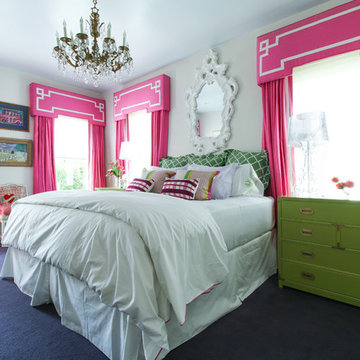
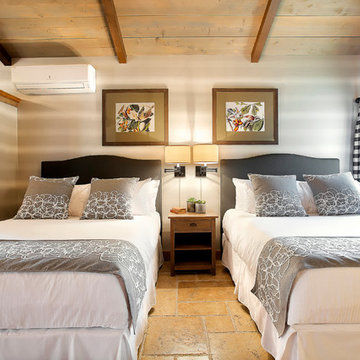
Mid-sized mountain style guest bedroom photo in Austin with gray walls and no fireplace
 Albert, Righter & Tittmann Architects, Inc.
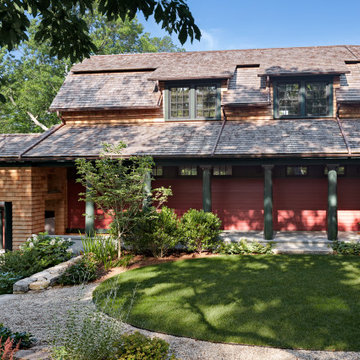
Quarry House, a shingled two story house with dark green trim, is pinned to the solid ledge on the sea coast of Connecticut. The narrow house sits under a spine of a roof, running south to north, with the primary living in a ‘head’, at the north end, where the best views are. The circulation of the site and house follows this massing, through two courts, the lower more public, and the upper more private.
The lower court is defined by the garage building, and by the south face of the house. From this first court, a well-defined portal leads to an arcade, which, flanking the main wing of the house, pulls one along the second and higher court. The L of the main house and the tool shed define the garden court. Both courts withhold the view.
The actual front door is nearly half-way into the house. From there, a short passage brings one to the primary living space where the view unfolds across a syncopated rhythm of windows, first overlooking an intimate tidal inlet and, then, turning west, to the longer view of the Long Island Sound, where a cantilevered deck seems to float over the rock. A clerestory window, hidden in a dormer, brings south light into this room.
A final point: the 3400 square foot house, with its deeply insulated 12” thick walls and roofing, runs on a low energy load. An HRV ensures a constant cycle of fresh air even in heating season.

 SUPERIOR CHIMNEY SERVICES CORPORATION
Winter is always tough on your home. This past winter was no picnic with the snow and cold. By the time spring (really) arrives, your chimney has put up with months of freezing temperatures, snow, ice, and the constant freeze-thaw cycle that quietly does damage you can't always see from the outside. That's why a spring chimney inspection isn't just a good idea, it’s essential to have your chimney checked before storm season begins. Here’s why:
Water Is Your Chimney's Worst Enemy
Here's something that most homeowners don’t know: chimney leaks cause more damage to masonry chimneys than fire does. Think about that a moment. While everyone worries about creosote and chimney fires — and rightfully so — water is silently doing just as much, if not more, damage.
Unlike the rest of your home, which is sheltered by your roof and eaves, your chimney stands fully exposed above the roofline. It takes on rain, wind, snow, and every freeze-thaw cycle winter throws at it, all while absorbing moisture into its porous masonry materials. That water expands and contracts, causing cracks, structural stress, and integrity loss that accumulates over time. The worst part? Chimney leaks are often subtle and slow-moving. By the time you notice water damage inside your home, the problem has usually become more serious, and expensive.
What a Spring Inspection Actually Catches
A professional spring chimney inspection, such as Superior Chimney’s, goes well beyond a quick visual check. A CSIA Certified Chimney Sweep technician will evaluate your entire system — inside and out — looking for the most common sources of chimney leaks and damage, including cracked chimney crowns, deteriorated brick and mortar joints, damaged or missing chimney caps, faulty chimney flashing and roof leaks, chimney slab gaps, and flue gas condensation from improperly sized chimney liners.
Any one of these issues left without a proper inspection, heads into spring storm season is an open invitation for water damage. And as Superior Chimney has discussed, masonry water damage is a progressive problem — the longer it goes unrepaired, the costlier the fix becomes.
What You Can Do Right Now
The good news is that most chimney water damage is preventable. The key steps are:
• have a professional-grade chimney cap installed if you don't already have one
• repair or replace a damaged chimney crown
• address any deteriorated brick and mortar
• fix leaky flashing and
• consider having your chimney professionally waterproofed. Waterproofing alone can save you significantly on future repair costs.
What’s Next?
Superior Chimney always includes a free 14-Point Certified Written Inspection with photo documentation via email with every chimney sweep. This helps you to know exactly what condition your chimney is in and what, if anything, needs attention.
Don't wait, have your chimney checked before storm season begins to reveal a problem that's been building all winter.
Schedule your inspection today at 877-244-6349.

 TN Nursery
Witch Hazel: A Shrub That Teaches Patience in the Garden
Witch hazel is a reminder that some of the most rewarding garden plants operate on a different timetable. Unlike shrubs that demand attention with bold flowers or fast growth, witch hazel reveals its value slowly and intentionally. Its most striking feature often appears when gardeners least expect it, with delicate, ribbon-like blooms emerging in late winter while much of the landscape still rests.
This timing alone sets witch hazel apart. Winter-blooming shrubs change the way gardeners experience their landscapes, encouraging observation during a season that is often overlooked. Planted near windows, paths, or entryways, witch hazel offers moments of surprise and quiet beauty when color is scarce. Its subtle fragrance and fine-textured flowers add depth without overwhelming the surrounding environment.
Beyond bloom, witch hazel contributes structure and balance to the garden year-round. Its branching form develops naturally into an open, graceful shape that rarely requires pruning. During the growing season, its foliage blends effortlessly with perennials, groundcovers, and woodland plants, creating cohesion rather than competition. In autumn, the leaves shift to soft golden tones, easing the transition into dormancy.
Witch hazel also supports a slower, more sustainable approach to gardening. Once established, it asks very little in return, adapting well to its surroundings and thriving without constant inputs. Its fallen leaves enrich the soil, reinforcing natural cycles that benefit neighboring plants.
In a garden culture often driven by instant results, witch hazel stands as a counterpoint. It rewards patience, invites reflection, and becomes more meaningful with time. For gardeners willing to embrace its rhythm, witch hazel offers not just seasonal interest, but a deeper connection to the quiet moments that make gardening truly fulfilling.
https://www.onlineplantnursery.com/products/witch-hazel
https://treenurseryco.com/witch-hazel-shrub
https://www.wholesalenurseryco.com/products/witch-hazel
https://www.tennesseewholesalenursery.com/products/witch-hazel
https://www.tnnursery.net/products/witch-hazel
 Locati Architects
Roger Wade Studio
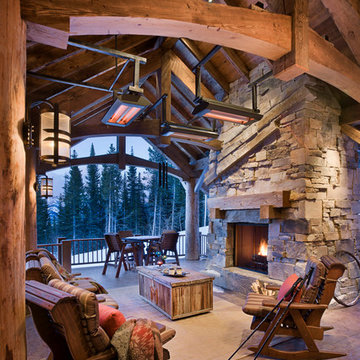
Example of a mountain style patio design with a fire pit and a roof extension
Example of a mountain style patio design with a fire pit and a roof extension
 Windy City Painters
Metal Porch Stairs Painting in Lakeview, Chicago | Windy City Painters
Lakeview is one of Chicago's most architecturally diverse neighborhoods — vintage courtyard buildings, rooftop-deck condos, newly converted three-flats, and classic brick two-flats all line the same block. What they share is this: exposed metal. Back porch stairs, handrails, balconies, and exterior landings define the rear streetscape of nearly every building in the neighborhood. And in Chicago, exposed metal without proper protective coatings doesn't last.
Windy City Painters recently completed a full metal porch stairs painting project in Lakeview that illustrates exactly what professional metal refinishing looks like — and why preparation is everything.
The Problem: Years of Chicago Weather Had Done Their Damage
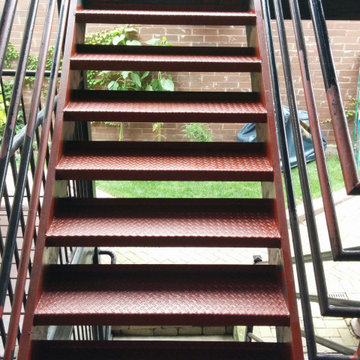
The client's back porch stairs were structurally sound — the diamond-plate steel treads were solid underfoot and the handrails were stable. However, the original paint system had long since failed. Surface rust had spread across the treads and risers. The old coating was peeling at every seam, edge, and weld point. Meanwhile, the black handrails were chalky and beginning to show rust at the bases.
Notably, this is a pattern Windy City Painters sees constantly in Lakeview. The neighborhood's diverse housing stock — ranging from pre-war courtyard buildings to 1990s condo conversions — often features original metal porch work that has never received a proper professional refinish. Homeowners and property managers patch-paint over rust for years, which ultimately accelerates the problem rather than solving it.
The solution isn't more paint. It's a complete system: mechanical rust removal, chemical treatment, primer, and a durable topcoat engineered for exterior metal.
The Windy City Painters Process for Metal Porch Stairs Painting
Windy City Painters approaches every metal porch stairs painting project with the same disciplined sequence. Consequently, our finishes outlast the competition by years.
Step 1 — Mechanical Preparation Our crew wire-brushes all loose rust, flaking paint, and surface contamination from every tread, riser, stringer, and handrail section. For heavier rust accumulation, we use grinding discs to cut down to clean, bare metal. This step is non-negotiable. Additionally, we pay particular attention to weld seams, bolt plates, and edge returns — the spots where moisture consistently hides and rust reliably starts.
Step 2 — Chemical Rust Treatment After mechanical prep, we apply a rust-converting primer to any remaining rust residue. This chemically neutralizes active rust and converts it into a stable, paintable surface. Moreover, the converter bonds to the metal and creates an additional barrier against future oxidation.
Step 3 — Rust-Inhibiting Primer Windy City Painters then applies a full coat of oil-based, rust-inhibiting primer to all prepared metal surfaces. This primer penetrates bare metal and creates the critical bond layer that everything else depends on. Skipping this step — or substituting a latex primer — is the single biggest reason DIY metal paint jobs fail within one season.
Step 4 — Two Topcoats of Industrial Enamel We apply two full coats of oil-based industrial enamel in the client's chosen color. For this Lakeview project, the stairs received a deep red finish and the handrails received gloss black — a classic combination that reads beautifully against the surrounding brick. Each coat is allowed to cure fully before the next is applied. Furthermore, we back-roll every surface to eliminate lap marks and ensure consistent film build.
Step 5 — Final Inspection and Cleanup Windy City Painters inspects every inch of the completed work before calling a project done. We remove all masking, clean up the work area completely, and walk the client through the finished result. In addition, we advise on a maintenance schedule to maximize the life of the coating system.
Why Metal Porch Stairs Painting Matters for Lakeview Properties
Metal porch stairs are among the most visible exterior features of Chicago residential buildings. Therefore, their condition directly affects curb appeal, property value, and — most importantly — structural safety. Rust that penetrates deeply enough will compromise the structural integrity of stairs and railings. Meanwhile, peeling paint signals to buyers, renters, and neighbors that a property is deferred.
In contrast, freshly refinished metal porch stairs signal exactly the opposite. They say the property is maintained, the owner takes pride in the building, and the structure is safe. For Lakeview landlords and homeowners alike, metal porch stair refinishing delivers an exceptional return on investment.
Professional Advice for Lakeview Homeowners
Before starting a metal porch stairs painting project, Windy City Painters recommends the following:
Don't paint over rust. Any rust left beneath a topcoat will continue to spread and will lift the new paint within months. Mechanical removal is essential.
Choose oil-based products for exterior metal. Latex paints don't adhere to metal as reliably and lack the film hardness needed to withstand foot traffic and freeze-thaw cycles.
Time your project right. Ideal conditions for metal painting are 50°F–90°F with low humidity. Chicago's spring and early fall are perfect windows.
Don't skip the primer. A properly applied rust-inhibiting primer is what separates a seven-year finish from a one-year failure.
Budget for full prep. Preparation typically represents 60–70% of the labor on a metal refinishing project. That's where the money is well spent.
Windy City Painters: Lakeview's Trusted Metal Refinishing Contractor
Windy City Painters has refined the process of exterior metal painting and refinishing across Chicago's North Side and Near West Side. We work in Lakeview regularly — on courtyard buildings, two-flats, coach houses, and commercial properties — and we understand the unique demands that Chicago's climate places on exterior metal. As a result, our coating systems are selected and applied for maximum longevity in this specific environment.
See more of our work and request a free estimate at www.windypainters.com.
Ready to transform your Lakeview home? Contact Windy City Painters for a free estimate — visit www.windypainters.com today. Proudly serving Wicker Park, West Town, Lincoln Park, Roscoe Village, Lakeview, Ukrainian Village, River North, and all of Chicago.

 Gevorg Tadevosyan, sculptor
Endless Movement presents a vertical column of intertwined red human forms compressed between two tall white structures. The rigid white sides create a narrow channel, framing the figures as they twist, climb, and fold into one another. Individual bodies are visible, yet they merge into a continuous flow, forming a single upward motion.
The vivid red color contrasts sharply with the calm, architectural white surfaces, emphasizing the energy and tension within the confined space. The figures appear caught in an ongoing cycle—struggling, rising, and transforming—without a clear beginning or end.
This vertical movement suggests persistence and the constant effort of human existence. Despite limitation and pressure from the surrounding structure, the bodies continue to shift and ascend. The sculpture reflects the idea that life is a continuous process of movement, adaptation, and endurance, where individual actions blend into an unending collective rhythm.
Bronze, Steel
75 cm x 25 cm x 10 cm
1