
Search results for "Differs" in Home Design Ideas
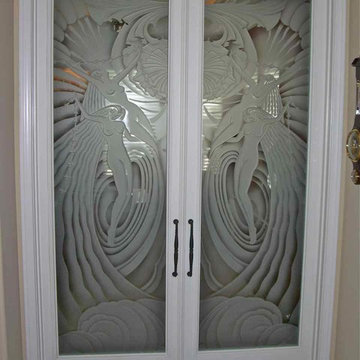
 Sans Soucie Art Glass
Glass Front Entry Doors that Make a Statement! Your front entry door is your home's initial focal point and glass front doors by Sans Soucie with frosted, etched glass designs create a unique, custom effect while providing privacy AND light thru exquisite, quality designs! Available any size, all glass front doors are custom made to order and ship worldwide at reasonable prices. Exterior entry door glass will be tempered, dual pane (an equally efficient single 1/2" thick pane is used in our fiberglass doors). Selling both the glass inserts for front doors as well as entry doors with glass, Sans Soucie art glass doors are available in 8 woods and Plastpro fiberglass in both smooth surface or a grain texture, as a slab door or prehung in the jamb - any size. From simple frosted glass effects to our more extravagant 3D sculpture carved, painted and stained glass .. and everything in between, Sans Soucie designs are sandblasted different ways creating not only different effects, but different price levels. The "same design, done different" - with no limit to design, there's something for every decor, any style. The privacy you need is created without sacrificing sunlight! Price will vary by design complexity and type of effect: Specialty Glass and Frosted Glass. Inside our fun, easy to use online Glass and Entry Door Designer, you'll get instant pricing on everything as YOU customize your door and glass! When you're all finished designing, you can place your order online! We're here to answer any questions you have so please call (877) 331-339 to speak to a knowledgeable representative! Doors ship worldwide at reasonable prices from Palm Desert, California with delivery time ranges between 3-8 weeks depending on door material and glass effect selected. (Doug Fir or Fiberglass in Frosted Effects allow 3 weeks, Specialty Woods and Glass [2D, 3D, Leaded] will require approx. 8 weeks).
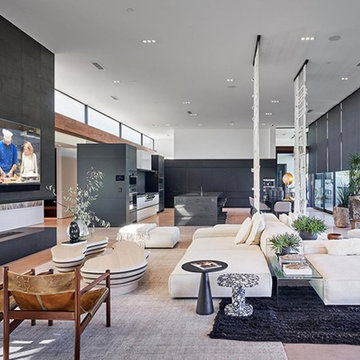
 Electronic Design & Consulting, Inc.
This article is posted here with the consent of the author. The views and opinions expressed in this article are those of the author and do not necessarily reflect the official policy, position, view, or opinion of Crestron Electronics, Inc., or of any of its employees. Crestron Electronics is not responsible for, and does not verify the accuracy of, any of the information contained in this article.
By Jeff Singer
The “smart” revolution began several years ago with smartphones (a.k.a phones) and has extended in recent years to thermostats, doorbells, alarm systems, and kitchen appliances. Smart devices are so ubiquitous that the term “smart” is overused to the point that it is almost meaningless. Companies are eager to jump on the bandwagon and claim their products are “smart,” and consumers proudly claim they have a smart home because they have lighting control. Misconceptions about smart homes are prevalent and create confusion in the marketplace. This can have deleterious effects on businesses and underserve consumers. Here are seven of the most popular misconceptions about smart homes:
1. Apps are smart
Apps are convenient and easy to use. Yes, it seems there’s an app for everything. People expect to be able to download an app and do just about anything. App developers and many companies do not disavow consumers of this myth. On the contrary, they promote this idea with carefully worded descriptions. The promise of having the world at your fingertips for $1.99 is very enticing. Although it sounds too good to be true, it is also too good to pass up for many people. This leads to undervaluing home control and disappointment when the apps don’t work, which undermines confidence in our industry. The fact is that apps are not smart. They do not control anything. They must connect to and communicate with a control system or cloud service that processes, prioritizes, and executes commands. That’s the real magic and what most people do not understand.
2. Smart devices work together
With so many smart appliances and devices on the market today, it’s understandable that the average consumer might think that they actually communicate and work together. This is simply not the case. Smart devices are not that smart. They are designed and manufactured by different, often competing, companies. There are no national or industry standards governing these products. Even if they all operate using Wi-Fi® communications, that doesn’t mean they work together. Some companies promote a home control platform, which unites different devices from different companies – in theory. The platform is yet another third-party software totally dependent on other companies developing APIs and writing control modules for their hardware to run on that piece of software. The devices are not independently compatible. Also, when updates are made to either the hardware or the software, functionality may be affected for some period. That’s a nice way of saying the device or system won’t work and there’s no way of knowing for how long.
3. It’s a DIY project
Which brings us to the next myth, which is that the average person can do it themselves. Unless you are a skilled professional, I would not advise taking on a smart home project. You want to make a light turn on and off with your Alexa® or Google Assistant™ virtual assistant software, go for it. A smart home takes much more planning and expertise. I have no problem changing a light bulb or hanging a light fixture in my dining room; however, I am not going to rewire my house. I may change the flush valve in my toilet, but I’m not going to replace the pipes in my house. You get it. Integrating devices and systems, establishing different zones, creating scenes, designing the UI with a balance between control, feedback, and simplicity – all takes experience and skill.
4. Need a programmer to make changes
Early adopters may have experienced the pain of trying to make a simple change or update to their home control system. Years ago, if the cable provider changed the channel line-up, the homeowner would have to call the dealer or programmer to make an appointment for them to come out to the house to reprogram the system. The system wouldn’t work as expected until it was updated, which often took several days and beaucoup bucks. Not anymore. Technology has evolved so now it’s easy for system owners to change favorite channels, create scenes, rename buttons, update images, and more. While a professional is needed for the initial installation and setup, the system is easy to manage once it’s up and running. This makes life so much easier for both dealer and customer.
5. Tech becomes obsolete quickly
Similar to updating the UI, updating firmware or hardware used to be a stressful process. A smart home should be intelligent enough to update itself. Apps don’t become obsolete. Updates are constantly pushed out from the cloud, making them better all the time. The same is true for a good smart home system. New features, functions, and device support gets added in the background consistently, so the system you installed (or purchased) yesterday gets better over time. Swapping out decorative elements, such as keypads, dimmers, and touch screens is also seamless. When a new device is added, all the settings are pulled down from the cloud and it just works. No system interruptions. No sunk costs. No imposing house calls. No surprise bills.
6. Lighting control saves energy and money
Lighting control is one of the most popular smart systems, but it takes more than just one system to make a home smart. On the surface, it makes sense that if you dim the lights ten percent, then you save ten percent of energy costs. If the shades are raised during the day to take advantage of sunlight so the lights don’t need to be on (or at least not 100%), but that causes the room temperature to rise a few degrees, which triggers the air conditioner to run longer and more often, was energy usage (or cost) reduced? A smart home integrates all the various systems and technology to optimize comfort, convenience, safety, and sometimes energy.
7. Home technology is easy to hack
Security is at the forefront of people’s minds these days. Personal identities are stolen; email accounts hacked; private photos publicized; and more. A smart home must outsmart those who don’t respect privacy. Crestron control systems adhere to the strictest security standards. The same Crestron control system that goes into a home is also installed in secure government and military facilities, global banking institutions, hospitals, and other mission critical applications. When installed correctly by a trained professional, a Crestron smart home is the gold standard for security, comfort, and convenience.
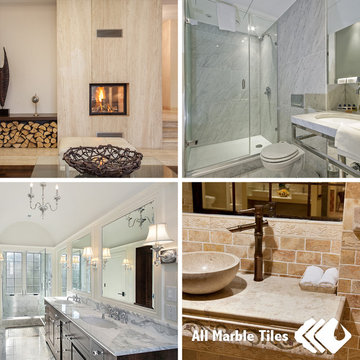
 All Marble Tiles
Marble tiles vs. Travertine tiles
It is a daunting task in renovating an existing or building a new home. All the right choices have to be made as you are going to live with your decisions for a while, unless you are a billionaire whom can afford renovations every six months. Most of us can’t. Part of that decision making process, is to decide what type, color and quality tile to use. Do you want to go with marble, porcelain or travertine tiles? What does your budget allow you to spend? There are so many things to decide. A good idea is to try and understand the differences between all the types of tiles.
In this article, the difference between marble and travertine tiles are going to be explained. Many tiles look like marble, but there are distinct differences:
1) Marble tiles:
Known throughout the centuries for its beauty and proper use in the building of homes for the rich or immaculate sculptures of great minds or the ancient gods; marble has a strong historical background and as such is the first choice for most people, that is, if they can afford it.
• Marble is a saltwater rock, usually mined close to the sea. It is a far more durable than travertine.
• Marble tiles come in various colors from mineral deviations in the marble;
• Marble is more suitable for internal use; though it can be used externally as long as its guarded from the forces of nature;
• The finish options with marble is restricted due to its nature to break;
• Marble tiles are more expensive;
2) Travertine tiles:
This tile is often wrongly referred to as “travertine-marble”. Travertine is closely associated with marble, yet there are important differences.
• Both are natural stone, but travertine tiles are limestone and thus sedimentary and marble tiles, while also a type of limestone, is metamorphic, i.e. marble is formed in tremendous heat;
• Travertine is quarried near fresh water rivers and natural dams;
• The color spectrum of Travertine tiles are far less than marble due to its natural colors;
• Travertine tiles are porous and marble denser;
• Travertine tiles are far more suited for outdoor use because of its durability;
• Travertine tiles has more finish options than marble;
• Travertine tiles are cheaper than marble because it’s widely available.
So, in effect, they are both made from natural stone; Travertine tiles just being more widely found than marble. Decide which atmosphere you want to create at which cost; then decide on the proper tile choice. http://AllMarbleTiles.com
Find the right local pro for your project
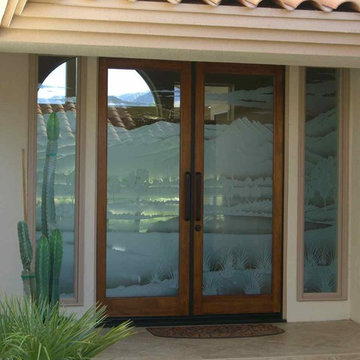 Sans Soucie Art Glass
Glass Front Entry Doors that Make a Statement! Your front entry door is your home's initial focal point and glass front doors by Sans Soucie with frosted, etched glass designs create a unique, custom effect while providing privacy AND light thru exquisite, quality designs! Available any size, all glass front doors are custom made to order and ship worldwide at reasonable prices. Exterior entry door glass will be tempered, dual pane (an equally efficient single 1/2" thick pane is used in our fiberglass doors). Selling both the glass inserts for front doors as well as entry doors with glass, Sans Soucie art glass doors are available in 8 woods and Plastpro fiberglass in both smooth surface or a grain texture, as a slab door or prehung in the jamb - any size. From simple frosted glass effects to our more extravagant 3D sculpture carved, painted and stained glass .. and everything in between, Sans Soucie designs are sandblasted different ways creating not only different effects, but different price levels. The "same design, done different" - with no limit to design, there's something for every decor, any style. The privacy you need is created without sacrificing sunlight! Price will vary by design complexity and type of effect: Specialty Glass and Frosted Glass. Inside our fun, easy to use online Glass and Entry Door Designer, you'll get instant pricing on everything as YOU customize your door and glass! When you're all finished designing, you can place your order online! We're here to answer any questions you have so please call (877) 331-339 to speak to a knowledgeable representative! Doors ship worldwide at reasonable prices from Palm Desert, California with delivery time ranges between 3-8 weeks depending on door material and glass effect selected. (Doug Fir or Fiberglass in Frosted Effects allow 3 weeks, Specialty Woods and Glass [2D, 3D, Leaded] will require approx. 8 weeks).
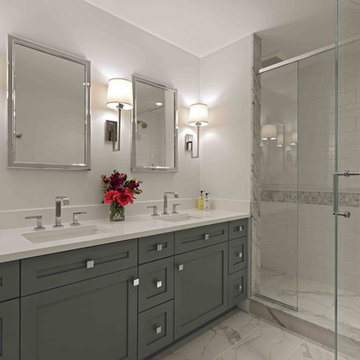
Mid-sized trendy master white tile and porcelain tile porcelain tile alcove shower photo in New York with an undermount sink, shaker cabinets, gray cabinets, solid surface countertops, a one-piece toilet and white walls
 Paper Moon Painting
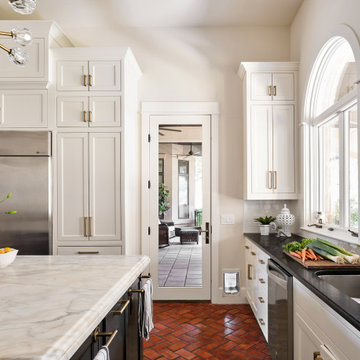
Updated traditional kitchen on Lake Austin, with cabinets in Sherwin Williams "Greek Villa", island in "Iron Ore", and walls in "Neutral Ground".
Huge elegant u-shaped brick floor kitchen photo in Austin with an undermount sink, shaker cabinets, white cabinets, marble countertops, white backsplash, subway tile backsplash, stainless steel appliances and an island
Huge elegant u-shaped brick floor kitchen photo in Austin with an undermount sink, shaker cabinets, white cabinets, marble countertops, white backsplash, subway tile backsplash, stainless steel appliances and an island


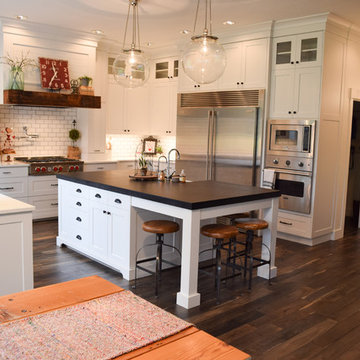
 Brian Kashas
Compare this photo to the before in order to get a sense of how much the space was enlarged. When you're actually in the space, the difference is very dramatic.
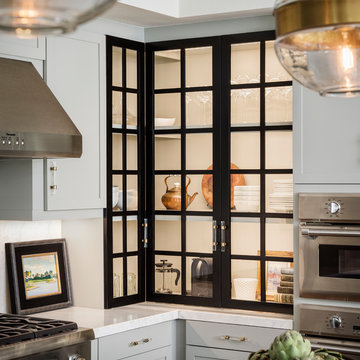
 Corine Maggio Design
Photo courtesy of Chipper Hatter
Example of a mid-sized urban kitchen design in San Francisco
Example of a mid-sized urban kitchen design in San Francisco
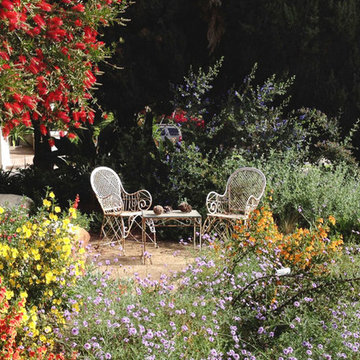
 Theodore Payne Foundation
Garden 6 in Oxford Square
This is an example of a craftsman landscaping in Los Angeles.
This is an example of a craftsman landscaping in Los Angeles.
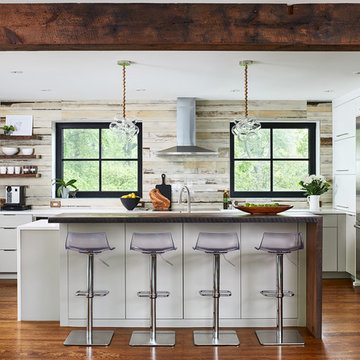
 Gizem Ozkaya - Case Design/Remodeling, Inc.
Example of a trendy medium tone wood floor kitchen design in DC Metro with flat-panel cabinets, white cabinets, multicolored backsplash, stainless steel appliances, an island and white countertops
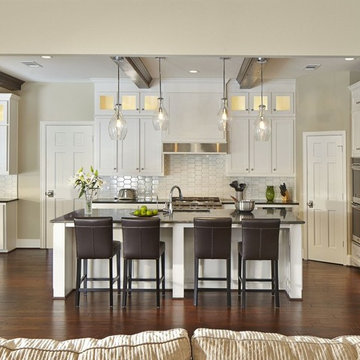
 The Lighting Warehouse
Modern white kitchen with simple clear glass pendants hanging at different heights for a sleek clean look
Example of a mid-sized trendy l-shaped dark wood floor and brown floor open concept kitchen design in Vancouver with an undermount sink, shaker cabinets, white cabinets, white backsplash, porcelain backsplash, stainless steel appliances and an island
Example of a mid-sized trendy l-shaped dark wood floor and brown floor open concept kitchen design in Vancouver with an undermount sink, shaker cabinets, white cabinets, white backsplash, porcelain backsplash, stainless steel appliances and an island
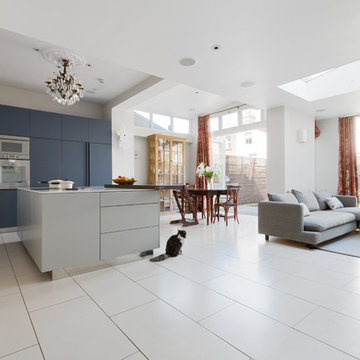
 Granit Architects + Interiors
Photo Credit: Andy Beasley
Eat-in kitchen - contemporary l-shaped porcelain tile eat-in kitchen idea in London with a drop-in sink, flat-panel cabinets, blue cabinets, glass countertops, paneled appliances and an island
Eat-in kitchen - contemporary l-shaped porcelain tile eat-in kitchen idea in London with a drop-in sink, flat-panel cabinets, blue cabinets, glass countertops, paneled appliances and an island
Sponsored
Sunbury, OH

J.Holderby - Renovations
Franklin County's Leading General Contractors - 2X Best of Houzz!

 The Fish Gallery
The aquarium can be seen from several different areas of the home.
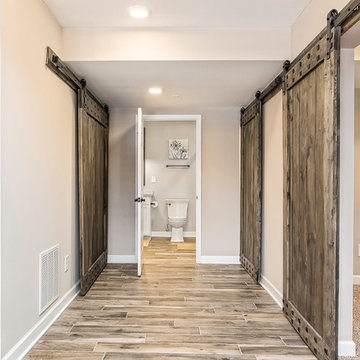
Inspiration for a large transitional medium tone wood floor and brown floor hallway remodel in Houston with yellow walls
Inspiration for a large transitional medium tone wood floor and brown floor hallway remodel in Houston with yellow walls
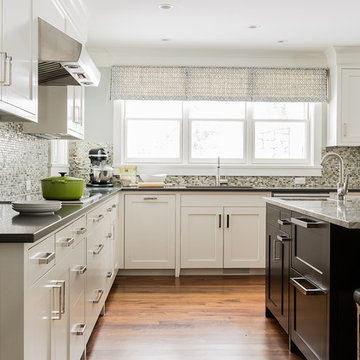
 Jill Litner Kaplan Interiors
Open concept kitchen - large transitional u-shaped medium tone wood floor and brown floor open concept kitchen idea in Boston with an undermount sink, shaker cabinets, white cabinets, granite countertops, metallic backsplash, mosaic tile backsplash, stainless steel appliances and an island
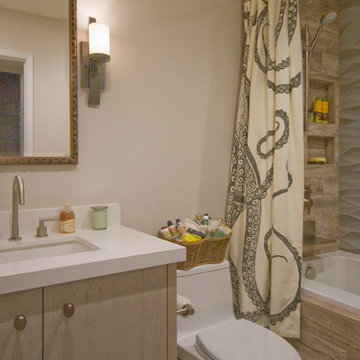
 User
Wood-Mode, Vanguard, Shoreline on European oak; Kohler sink; Watermark faucets; Toto toilet; Americh Madison tub; Caesarstone 'Organic White' counter; Artistic Tile 'Bianco Carrara' Marble Pebbles in Clear Resin Polished Field Tile on floor;
Artistic Tile 'Ambra Gris' on long shower wall; Bedrosian's wood style porcelain tile on remaining shower walls; Kelly Moore 'Frost' paint; Quoizel 'Kyle' sconces in Imperial Bronze
Photo by: Theresa M Sterbis

 JAV Remodeling
Kids' room - mid-sized eclectic girl carpeted and beige floor kids' room idea in DC Metro with green walls
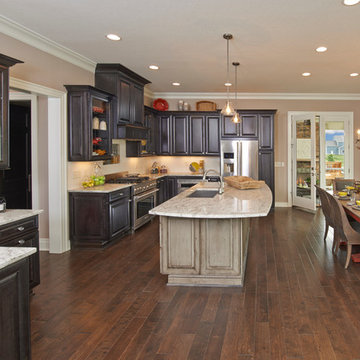

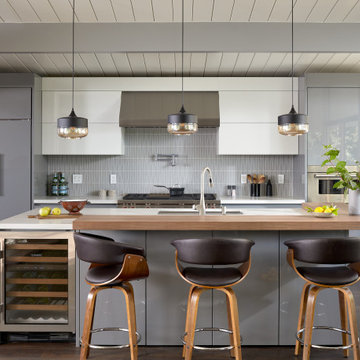
 Baron Construction and Remodeling
Baron Construction & Remodeling Co
Home Remodel & Design
Eichler Home in San Mato Refreshed and Remodeled
2 Bathroom Remodel
Hallway Remodel
Kitchen Backsplash Upgrade



132