
Search results for "Dry acid" in Home Design Ideas
 Tile Doctor Ltd
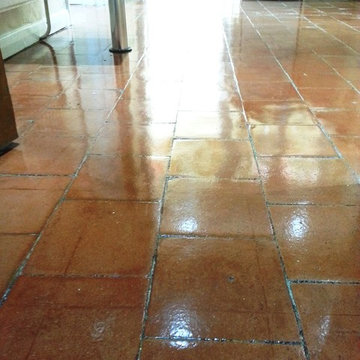
This was an unusual request in that this customer, in the small Bedfordshire village of Cople, had her Kitchen Quarry tiled floor cleaned and sealed six months earlier by another company. The sealer had come off and it soon became evident that after the work had been carried out the client was ill advised as to the correct maintenance of her floor. The cleaning product left by the previous company was totally unsuitable and over the course of six months she had managed in fact to slowly strip the sealer off of the tiles.
I soon realised the problem and advised that the only solution would be to strip any remaining sealer off the floor and re-seal, it’s generally not good practice to apply a different sealer on top of an existing sealer as there can be compatibility issues and the floor may look different in places where there are more layers of seal.
I used a strong dilution of Tile Doctor Pro-Clean to strip any remaining sealer off the tiles and clean them in the process, this involves spreading the solution over the tiles, allow it to dwell and soak in and then scrubbing the solution into the floor using a rotary machine fitted with a black scrubbing pad. The floor was then rinsed with water applied with a mop and bucket and the soiled water extracted using a wet vacuum. One the floor was clean I noticed there was evidence of concrete dust and grout haze on the surface of the tiles from when they were installed so I applied a another Tile Doctor product called Grout Clean-up to remove it, again the floor was thoroughly rinsed with water which was extracted the floor dried using air movers.
Tiled floors need to be dry before sealing and so I left this floor for four days to allow enough time for it to thoroughly dry out before returning to seal it. Choice of sealer for this floor was four coats of Tile Doctor Seal and Go which is a water based sealer so it doesn’t leave a smell and additionally adds a nice subtle shine to the floor. The difference was transformational as the sealer really does bring out the best in the quarry tiles.
Before leaving we have provided the customer a bottle of Tile Doctor Neutral Tile Cleaner which is the correct cleaning agent to maintain a sealed floor. It has a neutral PH formula so it won’t erode the sealer like many of the acidic floor cleaning products you find in the supermarket which are really only meant for use on Vinyl or Ceramic tiles.
Andrew Evans
Bedfordshire Tile Doctor
 Tile Doctor Ltd
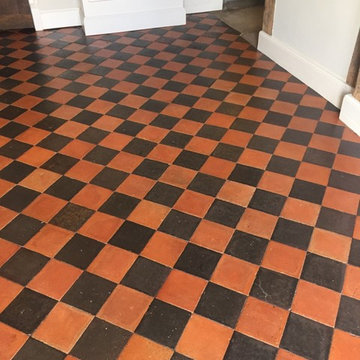
Sometimes it isn’t until you’ve deep cleaned your tiles that you realise just how dirty they were to begin with. This was the case with my customer in Thame, in the south of Oxfordshire where I worked on a classic red and black Quarry tiled floor which was far from being in its best condition.
My starting point in the cleaning process was to mix a strong solution of Tile Doctor Pro Clean, which is the reliable, multi-purpose alkaline cleaner that is safe to use on tile, stone and grout. The solution was left to soak into the tiles for ten minutes before being scrubbed into the floor with a rotary floor machine fitted with a stiff brush.
Following this, I rinsed the floor with clean water and then proceeded to wash it with Tile Doctor Grout Clean Up. This is a concentrated phosphoric acid cleaner designed to remove efflorescence and other mineral deposits such as grout smears.
Finally, I rinsed the tiles again with water and Tile Doctor Neutral Tile Cleaner, which is a pH neutral solution, to neutralise the chemicals and leave the floor fresh and clean, ready to be sealed. The floor was left to dry overnight.
The next day I returned to seal the floor after checking the tiles were dry. I opted to use two different sealers. The first was Tile Doctor Colour Grow, which is an impregnating sealer with the added effect of enhancing the natural colour in the stone. The second was Tile Doctor Seal & Go, a topical sealer that adds the high quality, durable sheen finish to the floor that the customer had requested.
I took the photograph below after sealing half the floor, it really shows the difference a sealer can make to a tiled floor.
Here’s the photo of theQuarry tiled floorafter sealing the whole floor. As you can see, they now have a new lease of life, and they’ll be much easier for the customer to keep looking great in the future.
Barry Woodward
Oxfordshire Tile Doctor
 Tile Doctor Ltd
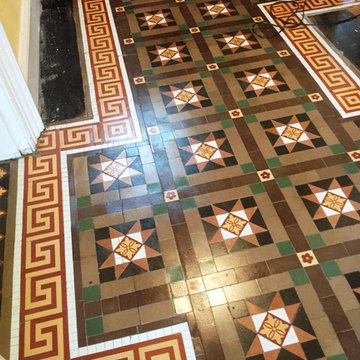
As you can see from the photographs below this Victorian tiled hallway was in quite a state and not only needed a thorough clean and fresh seal but needed to be rebuilt in parts.
Leamington Spa or Royal Leamington Spa to give its full name is one of the original UK Spa towns where people would visit to bathe the waters which are supposed to have medicinal properties, the town has many regency period properties and so Victorian floors
A good 30% of the floor tiles were lose and it took three days to rebuild the screed levelling compound before refitting loose tiles and new ones had to be cut to size, fixed in place and then re-grouted.
On day 4 a 400 grit coarse burnishing pad was applied to clean up the whole floor.
This was followed by scrubbing the tile and grout with Tile Doctor Pro-clean mixed 50/50 with NanoTech HBU remover followed by Remove and Go and finally treated with Acid Gel to remove the grout haze. After that the White tiles were steam cleaned to get them as clean and white as possible.
The floor was thoroughly rinsed after each treatment and the slurry extracted using a wet vacuum.
I left the floor for 5 days so it could thoroughly dry out and settle following the numerous treatments and then came back to seal the tiles, I used a damp test meter first to verify the floor was dry and ready for sealing. Once happy I proceed to apply a couple of coats of Tile Doctor Colour Grow which is a colour enhancing sealer that soaks into the tile protecting it from within and leaves a matt finish.
A lot of work went into restoring this floor but I’m really pleased with the way it came out and as you can imagine the owner was really happy with the transformation that had taken place in their house.
Mick Gayton
Warwickshire Tile Doctor
Find the right local pro for your project
 Tile Doctor Ltd
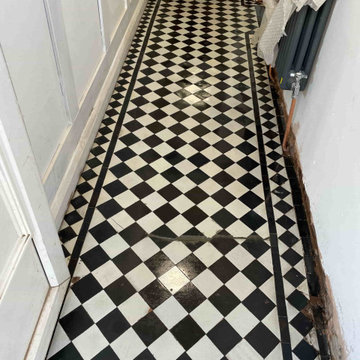
This 1920s single bay house in Earlsdon had been restored by the builder from top to bottom. The hallway floor had been covered in laminate flooring which had been removed, revealing an Edwardian tiled floor beneath. Unfortunately, the plasterer had not covered the floor when working on the walls, so the tiles were now covered in plaster!
The client was keen to keep as many original features as possible and called me in to see if the original 100-year-old floor could be renovated in keeping with the rest of the house. I visited the property to survey the tiles and explained that it certainly could be and having worked on hundreds of these renovations before I was confident of getting a good result. They were happy to go with my quotation and we arranged a time to carry out the work.
The floor tiles themselves were in good condition, but I had to hand carefully scrape the plaster off the tiles before starting on the deep clean. With the plaster removed from the floor I applied Tile Doctor Acid Gel and worked it into the tiles with a coarse 100-grit pad. The floor was then rinsed, and the waste extracted from the floor using a wet vacuum. The process was then repeated with a 200-Grit and then a 400-grit pad until I was happy.
The floor was then speed dried with fans whilst I worked on a repair around the threshold of one of the doors. The repair was relatively straight forward, and I managed to restore the tiling, so the repair was unnoticeable.
The floor was then left overnight to completely dry out. Floors of this age don’t have a damp proof membrane so moisture can build up if they have been covered as in this case. The next stage in the restoration would be to apply a sealer and the floor needs to be dry before you do this otherwise the result can be patchy.
Returning the following day, I first tested the floor with a damp meter to check the moisture levels in different parts of the floor to ensure it was dry enough to seal. The fans had done a good job and I was pleased to find that the floor was dry.
To seal this floor, I used Tile Doctor Seal and Go Extra, it’s a breathable acrylic based sealer that allows for moisture vapour to rise through the tile and evaporate at the surface. This makes it ideal for situations where no damp proof membrane has been installed and there is a low risk of mineral salt deposits being formed (efflorescence).
Once completed the transformation was huge and he Victorian tiles looked well suited to the hallway. Feedback from my client was they were over the moon with the newly restored floor!
For regular cleaning, I recommended Tile Doctor Neutral Tile Cleaner, this is a gentle pH neutral cleaner that will ensure the newly applied seal is retained and not eroded prematurely. This can be the problem with most household cleaning products which contain strong chemicals like bleach which can break down the sealer over time. Without a sealer dirt gets back into the pores of the tile which will mean the homeowner will need to get the floor cleaned and sealed again – a vicious circle!
Mick Gayton
Warwickshire Tile Doctor
 Szén Molnár Tamás
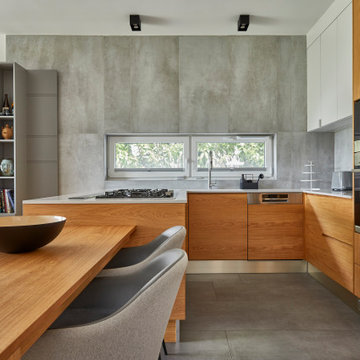
The design task was to create a 160 m2 family house, an elegant, light,
cheerful home for a young couple. We could already start work from the
architectural plans, so they could even initiate some minor
modifications to those.
Cooking plays an important role in the lives of the customers, so the
detailed kitchen utensil requirements were part of the brief. They would
also like to have kids in the future, so the goal was to make the
kitchen, dining room and living room function as one space, and the
dining room extendable. However, a relatively small space was available
for this, so the kitchen was given an unusual formal design. With every
detail in mind, the most current mechanical and intelligent systems have
been integrated into the house: from the unique drying system in the
laundry room to the chamber.
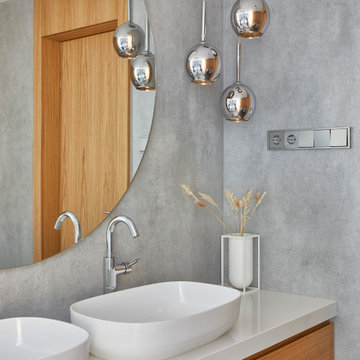
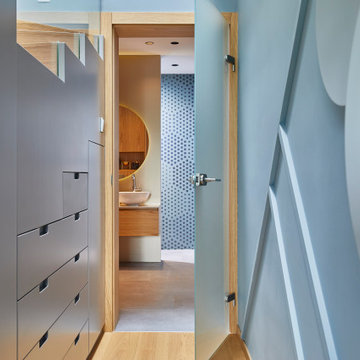
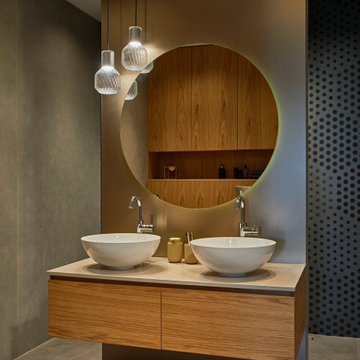
An interesting solution is the placement of the sinks in one of the
bathrooms, their back wall functions as a screen for the shower. In
addition, one half of the building is underground, so those solutions
have been preferred, which allow more natural light into the interiors
(e.g., acid-coated glass and glass bathroom doors have been used in the
common wall of the illuminated staircase and bathroom).
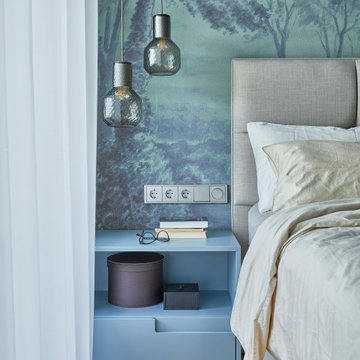
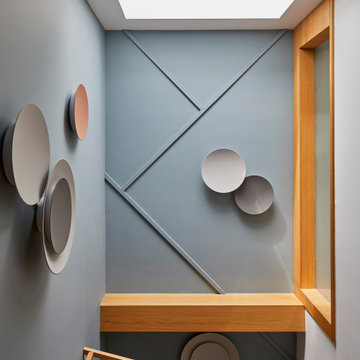
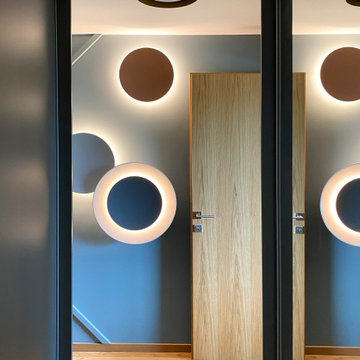
We were free to walk between styles. So geometric, playful shapes,
customer-preferred blue and oak veneered wood surfaces create harmony in
the spaces. The walls feature contemporary posters, custom prints and
contemporary artwork.
 Szén Molnár Tamás
The design task was to create a 160 m2 family house, an elegant, light,
cheerful home for a young couple. We could already start work from the
architectural plans, so they could even initiate some minor
modifications to those.
Cooking plays an important role in the lives of the customers, so the
detailed kitchen utensil requirements were part of the brief. They would
also like to have kids in the future, so the goal was to make the
kitchen, dining room and living room function as one space, and the
dining room extendable. However, a relatively small space was available
for this, so the kitchen was given an unusual formal design. With every
detail in mind, the most current mechanical and intelligent systems have
been integrated into the house: from the unique drying system in the
laundry room to the chamber.
An interesting solution is the placement of the sinks in one of the
bathrooms, their back wall functions as a screen for the shower. In
addition, one half of the building is underground, so those solutions
have been preferred, which allow more natural light into the interiors
(e.g., acid-coated glass and glass bathroom doors have been used in the
common wall of the illuminated staircase and bathroom).
We were free to walk between styles. So geometric, playful shapes,
customer-preferred blue and oak veneered wood surfaces create harmony in
the spaces. The walls feature contemporary posters, custom prints and
contemporary artwork.
 Szén Molnár Tamás
The design task was to create a 160 m2 family house, an elegant, light,
cheerful home for a young couple. We could already start work from the
architectural plans, so they could even initiate some minor
modifications to those.
Cooking plays an important role in the lives of the customers, so the
detailed kitchen utensil requirements were part of the brief. They would
also like to have kids in the future, so the goal was to make the
kitchen, dining room and living room function as one space, and the
dining room extendable. However, a relatively small space was available
for this, so the kitchen was given an unusual formal design. With every
detail in mind, the most current mechanical and intelligent systems have
been integrated into the house: from the unique drying system in the
laundry room to the chamber.
An interesting solution is the placement of the sinks in one of the
bathrooms, their back wall functions as a screen for the shower. In
addition, one half of the building is underground, so those solutions
have been preferred, which allow more natural light into the interiors
(e.g., acid-coated glass and glass bathroom doors have been used in the
common wall of the illuminated staircase and bathroom).
We were free to walk between styles. So geometric, playful shapes,
customer-preferred blue and oak veneered wood surfaces create harmony in
the spaces. The walls feature contemporary posters, custom prints and
contemporary artwork.


 Szén Molnár Tamás
The design task was to create a 160 m2 family house, an elegant, light,
cheerful home for a young couple. We could already start work from the
architectural plans, so they could even initiate some minor
modifications to those.
Cooking plays an important role in the lives of the customers, so the
detailed kitchen utensil requirements were part of the brief. They would
also like to have kids in the future, so the goal was to make the
kitchen, dining room and living room function as one space, and the
dining room extendable. However, a relatively small space was available
for this, so the kitchen was given an unusual formal design. With every
detail in mind, the most current mechanical and intelligent systems have
been integrated into the house: from the unique drying system in the
laundry room to the chamber.
An interesting solution is the placement of the sinks in one of the
bathrooms, their back wall functions as a screen for the shower. In
addition, one half of the building is underground, so those solutions
have been preferred, which allow more natural light into the interiors
(e.g., acid-coated glass and glass bathroom doors have been used in the
common wall of the illuminated staircase and bathroom).
We were free to walk between styles. So geometric, playful shapes,
customer-preferred blue and oak veneered wood surfaces create harmony in
the spaces. The walls feature contemporary posters, custom prints and
contemporary artwork.
 Szén Molnár Tamás
The design task was to create a 160 m2 family house, an elegant, light,
cheerful home for a young couple. We could already start work from the
architectural plans, so they could even initiate some minor
modifications to those.
Cooking plays an important role in the lives of the customers, so the
detailed kitchen utensil requirements were part of the brief. They would
also like to have kids in the future, so the goal was to make the
kitchen, dining room and living room function as one space, and the
dining room extendable. However, a relatively small space was available
for this, so the kitchen was given an unusual formal design. With every
detail in mind, the most current mechanical and intelligent systems have
been integrated into the house: from the unique drying system in the
laundry room to the chamber.
An interesting solution is the placement of the sinks in one of the
bathrooms, their back wall functions as a screen for the shower. In
addition, one half of the building is underground, so those solutions
have been preferred, which allow more natural light into the interiors
(e.g., acid-coated glass and glass bathroom doors have been used in the
common wall of the illuminated staircase and bathroom).
We were free to walk between styles. So geometric, playful shapes,
customer-preferred blue and oak veneered wood surfaces create harmony in
the spaces. The walls feature contemporary posters, custom prints and
contemporary artwork.
 Szén Molnár Tamás
The design task was to create a 160 m2 family house, an elegant, light,
cheerful home for a young couple. We could already start work from the
architectural plans, so they could even initiate some minor
modifications to those.
Cooking plays an important role in the lives of the customers, so the
detailed kitchen utensil requirements were part of the brief. They would
also like to have kids in the future, so the goal was to make the
kitchen, dining room and living room function as one space, and the
dining room extendable. However, a relatively small space was available
for this, so the kitchen was given an unusual formal design. With every
detail in mind, the most current mechanical and intelligent systems have
been integrated into the house: from the unique drying system in the
laundry room to the chamber.
An interesting solution is the placement of the sinks in one of the
bathrooms, their back wall functions as a screen for the shower. In
addition, one half of the building is underground, so those solutions
have been preferred, which allow more natural light into the interiors
(e.g., acid-coated glass and glass bathroom doors have been used in the
common wall of the illuminated staircase and bathroom).
We were free to walk between styles. So geometric, playful shapes,
customer-preferred blue and oak veneered wood surfaces create harmony in
the spaces. The walls feature contemporary posters, custom prints and
contemporary artwork.
 Szén Molnár Tamás
The design task was to create a 160 m2 family house, an elegant, light,
cheerful home for a young couple. We could already start work from the
architectural plans, so they could even initiate some minor
modifications to those.
Cooking plays an important role in the lives of the customers, so the
detailed kitchen utensil requirements were part of the brief. They would
also like to have kids in the future, so the goal was to make the
kitchen, dining room and living room function as one space, and the
dining room extendable. However, a relatively small space was available
for this, so the kitchen was given an unusual formal design. With every
detail in mind, the most current mechanical and intelligent systems have
been integrated into the house: from the unique drying system in the
laundry room to the chamber.
An interesting solution is the placement of the sinks in one of the
bathrooms, their back wall functions as a screen for the shower. In
addition, one half of the building is underground, so those solutions
have been preferred, which allow more natural light into the interiors
(e.g., acid-coated glass and glass bathroom doors have been used in the
common wall of the illuminated staircase and bathroom).
We were free to walk between styles. So geometric, playful shapes,
customer-preferred blue and oak veneered wood surfaces create harmony in
the spaces. The walls feature contemporary posters, custom prints and
contemporary artwork.
 Tile Doctor Ltd
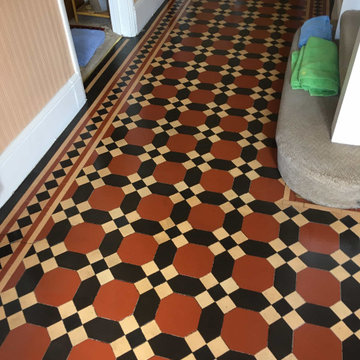
This Victorian floor in Twickenham, Middlesex was in good physical condition for its age but needed a good deep clean. Our customer had informed us that they had never cleaned or sealed the floor in the sixteen years that they had lived there so it was well overdue.
I went over to survey the floor and completed a test clean on a small section of tiling to see which products/techniques would work best. I like to do this as it demonstrates to the client what can be done, and it allows me to come up with an accurate price for doing the work.
As you can see from the pictures, there was quite a difference in the test patch compared to the rest of the floor. Years of foot traffic from the street had taken its’ toll and the floor was very dirty. Luckily, the floor was in very good condition and had not worn too badly.
Once they had seen the test patch, they were confident that it would be worth go ahead with my quote. It would ensure that the period feature was retained for many years to come. The colours on the floor were quite faded so it would be nice to get it restored.
I started the cleaning process by first taping up the surrounding skirting boards and doors to ensure they were protected from potential splashing. Cleaning involved spraying the Victorian tiles with a strong dilution of Tile Doctor Pro-Clean which is a dedicated Tile and Grout cleaning product. This was left to soak in for about ten minutes and then scrubbed in using a black pad fitted to a heavy-duty rotary scrubber.
This gives the floor a good mechanical scrub and works wonders releasing the ground-in dirt and soil from the tiles. The strong dilution of Pro-Clean will also remove any remaining sealers from the tile, however after sixteen years I doubted there would much trace of sealer left. Once done the floor was rinsed with water and all the soils removed with a wet vacuum.
Following the initial clean the colours were already much stronger. Next step however was to improve on that by giving the floor an acid rinse using Tile Doctor Grout Clean-Up. This removes mineral deposits and generally brightens up the appearance of the tile. After another round of scrubbing the floor was rinsed with our high-pressure washer and then vacuumed, extracting all of the dirty water and dirt away in one go. The floor was looking a lot better and was left to dry overnight.
After allowing the floor to dry overnight, we returned the next day to seal the floor. First, checking the floor was dry using the damp meter. Floors of this age can take a little longer to dry as there is no damp-proof membrane so it’s always worth checking as applying a sealer to damp tiles is not a good idea.
Once I was satisfied it was dry eight coats of Tile Doctor Seal and Go sheen finish sealer were applied. This takes a while to do as each coat needs to dry before applying the next. The sealer will protect the Victorian tiles for dirt and stains, it also enhanced the colours in the tile and will make it easier to keep the floor clean going forward.
My client was very pleased with the floor and mentioned that they should have called me in sooner! For aftercare cleaning I recommended Tile Doctor Neutral Clean which is an effective cleaner with a neutral pH, its designed for cleaning tiles without degrading the sealer.
Jonathan Oldham
South Middlesex Tile Doctor
 Szén Molnár Tamás
The design task was to create a 160 m2 family house, an elegant, light,
cheerful home for a young couple. We could already start work from the
architectural plans, so they could even initiate some minor
modifications to those.
Cooking plays an important role in the lives of the customers, so the
detailed kitchen utensil requirements were part of the brief. They would
also like to have kids in the future, so the goal was to make the
kitchen, dining room and living room function as one space, and the
dining room extendable. However, a relatively small space was available
for this, so the kitchen was given an unusual formal design. With every
detail in mind, the most current mechanical and intelligent systems have
been integrated into the house: from the unique drying system in the
laundry room to the chamber.
An interesting solution is the placement of the sinks in one of the
bathrooms, their back wall functions as a screen for the shower. In
addition, one half of the building is underground, so those solutions
have been preferred, which allow more natural light into the interiors
(e.g., acid-coated glass and glass bathroom doors have been used in the
common wall of the illuminated staircase and bathroom).
We were free to walk between styles. So geometric, playful shapes,
customer-preferred blue and oak veneered wood surfaces create harmony in
the spaces. The walls feature contemporary posters, custom prints and
contemporary artwork.
 Tile Doctor Ltd
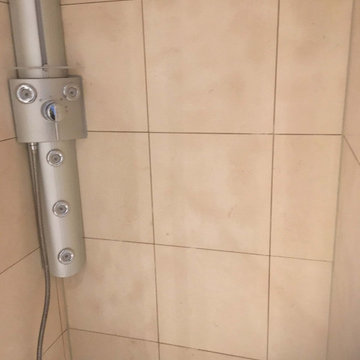
I was asked to look at renovating a shower cubicle at a property in in Manchester city centre that had been clad in White Limestone tiles. I understood the bathroom had been installed 12 years prior, but now the tiles were looking grubby, mouldy and dirty.
The client had lived at the property for the last two years and in an attempt to resolve the problems had used a few different household products such as flash and bleach, they had tried everything, and nothing had helped. I suspected that these strong acidic cleaners had actually made the problem worse by stripping off what was left of the sealer that was protecting the Limestone, allowing dirt to become ingrained in the stone.
I visited the property and ran a few cleaning tests in the shower cubicle with Tile Doctor products. This allows me to see which product will have the best results and gives the customer confidence that we can resolve their issues. The results were immediate, they could see the difference and they were happy to accept my quote and agree a date for my return to complete the work.
I arrived several weeks later and made a start. The tiles were scrubbed by hand with a strong dilution of Tile Doctor Remove and Go with excellent results. This product is designed to remove coatings and sealers, and in this case, it did a great job of drawing out the ingrained stains and dirt build-up. This removed what was left of the sealer and took off most of the dirt and mould. The Limestone tiles and grout were then rinsed with water to remove the soil.
Next I needed to restore the smooth surface of the limestone which had been etched by the use of strong acidic cleaning products. To do this I used a set of six-inch diamond burnishing pads attached to a hand buffer to hone and restore the stone.
I then dried the shower tiles and grout with a heat gun checking the moisture levels with damp meter until I was satisfied it was completely dry.
The last step was to re-seal the Limestone and Grout using a couple of coats of Tile Doctor Colour Grow. This is natural coloured intensifying sealer which provides durable protection to the surface allowing it to breathe and enhancing the colours.
The Customer was amazed with the difference and left the following feedback!
“Kamila was friendly, professional and kept me informed about what to expect before she took on the job and during the tile cleaning. The tiles look absolutely amazing after her work – I feel as though I have a brand new bathroom! Kamila also gave me helpful tips on looking after limestone tiles. I can’t recommend her highly enough.”
For future cleaning I recommended the use of Tile Doctor Aqua-Pro which is a pH neutral shower tile cleaner designed for use on sealed surfaces. Most cleaning products you find in supermarkets are overly strong and will erode the sealer prematurely, so when choosing a cleaning product always read the label and make sure it’s safe to use on Sealed Stone tiles.
Alex Logonzy
Greater Manchester Tile Doctor
 Tile Doctor Ltd
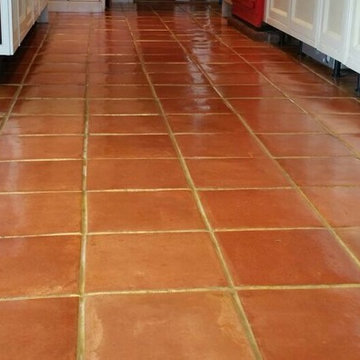
Here’s an interesting job I completed recently in the town of Lymington which is a lovely costal town within the New Forest and on the west side of the Solent. This Terracotta tiled floor was installed in the kitchen and was suffering from an efflorescence issue due to an ongoing leak which resulted in the salts in the water becoming deposited on the surface of the tiles as the water evaporated leaving a white bloom on the surface.
This process is more commonly known as efflorescence and is particularly common in old properties which have no damp proof membrane under the floor and white staining by the cupboards is especially visible in the below photograph.
My client was eager to have the problem fixed, and so enlisted Tile Doctor to get the job done.
To remove the efflorescence, the Terracotta tiled floor was acid washed using a mild dilution of Tile Doctor Grout Clean-Up which is primarily sold to remove grout smears but is equally effective at removing mineral deposits such as the white salts left behind by efflorescence.
The solution was scrubbed into the tiles using a stiff scrubbing brush and was successful at removing the white staining. Naturally it’s not advised to leave acid too long on any surface so the floor was treated in sections and then rinsed off with water and the residue removed using a wet-vacuum.
Following this, the floor was power-scrubbed in combination with a diluted solution of Tile Doctor Pro-Clean. Pro-Clean is a versatile cleaner that also contains stripping properties, allowing it to break down and remove old sealers, it also does a nice job getting the grout clean.
With the efflorescence treated and the floor now clean I was now happy with the condition of the tiles and give them a final rinse under pressure to ensure the floor was neutralised and any trace of products removed.
The Terracotta tiled floor was then left to dry overnight and I came back to seal the floor the next day. To seal the tiles I used three coats of Tile Doctor Seal & Go Extra, which provides a robust surface seal, and is recommended for internal floors with the damp issues.
Hopefully this quick report has offered some useful advice on how to treat efflorescence which is quite a common problem; naturally if you have further questions Tile Doctor does offer a free advice service so do get in touch.
Charles Okwechime
Hampshire Tile Doctor
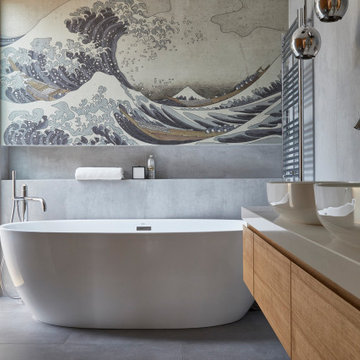 Szén Molnár Tamás
The design task was to create a 160 m2 family house, an elegant, light,
cheerful home for a young couple. We could already start work from the
architectural plans, so they could even initiate some minor
modifications to those.
Cooking plays an important role in the lives of the customers, so the
detailed kitchen utensil requirements were part of the brief. They would
also like to have kids in the future, so the goal was to make the
kitchen, dining room and living room function as one space, and the
dining room extendable. However, a relatively small space was available
for this, so the kitchen was given an unusual formal design. With every
detail in mind, the most current mechanical and intelligent systems have
been integrated into the house: from the unique drying system in the
laundry room to the chamber.
An interesting solution is the placement of the sinks in one of the
bathrooms, their back wall functions as a screen for the shower. In
addition, one half of the building is underground, so those solutions
have been preferred, which allow more natural light into the interiors
(e.g., acid-coated glass and glass bathroom doors have been used in the
common wall of the illuminated staircase and bathroom).
We were free to walk between styles. So geometric, playful shapes,
customer-preferred blue and oak veneered wood surfaces create harmony in
the spaces. The walls feature contemporary posters, custom prints and
contemporary artwork.
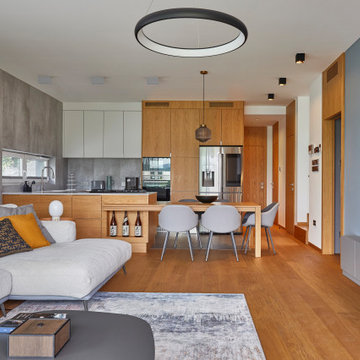 Szén Molnár Tamás
The design task was to create a 160 m2 family house, an elegant, light,
cheerful home for a young couple. We could already start work from the
architectural plans, so they could even initiate some minor
modifications to those.
Cooking plays an important role in the lives of the customers, so the
detailed kitchen utensil requirements were part of the brief. They would
also like to have kids in the future, so the goal was to make the
kitchen, dining room and living room function as one space, and the
dining room extendable. However, a relatively small space was available
for this, so the kitchen was given an unusual formal design. With every
detail in mind, the most current mechanical and intelligent systems have
been integrated into the house: from the unique drying system in the
laundry room to the chamber.
An interesting solution is the placement of the sinks in one of the
bathrooms, their back wall functions as a screen for the shower. In
addition, one half of the building is underground, so those solutions
have been preferred, which allow more natural light into the interiors
(e.g., acid-coated glass and glass bathroom doors have been used in the
common wall of the illuminated staircase and bathroom).
We were free to walk between styles. So geometric, playful shapes,
customer-preferred blue and oak veneered wood surfaces create harmony in
the spaces. The walls feature contemporary posters, custom prints and
contemporary artwork.
 Tile Doctor Ltd
This property was situated in the tiny, yet picturesque village of Grafton Underwood in Kettering, Northamptonshire. The village has only a population numbering a few hundred and, interestingly enough, is the childhood home of the famous ‘Bridget Jones’ character. I have previously worked on a number of floors in Grafton Underwood, and on this particular occasion I was called to complete the job through a recommendation – which is always welcome!
This particular customer had two floors that needed re-finishing; the first was a polished Limestone tiled conservatory (which I will cover in a separate post as the process was different) and the second a Flagstone tiled living room; so on a rather dull day in November, I began my work.
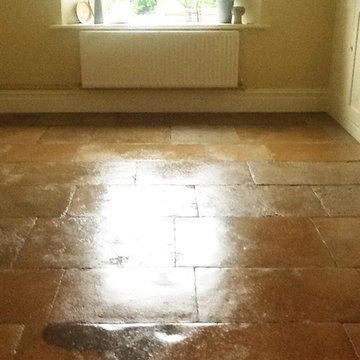
The sealer on the Flagstone tiled living room had failed in certain places, resulting in the floor becoming difficult to clean due to dirt becoming ingrained in the stone. The decline in the sealer is not uncommon, as they do wear down over time – especially in an area of high traffic like a living room. To resolve this issue, the old surface seal needed to be stripped back and re-sealed.
To remove what was left of the old sealer, I applied a dilution of Tile Doctor Remove and Go and scrubbed it into the floor using a rotary machine fitted with black stripping pads. I then gave the floor an initial rinse, before paying special attention to scrubbing the stubborn spots, making sure all of the sealer was removed.
I then gave the floor an acid wash using Tile Doctor Grout Clean-Up in order to remove grout haze and other mineral deposits which were evident. Due to its acidic properties, you have to be very careful with this product on any type of stone, so I didn’t let it dwell for too long and made sure the floor was thoroughly rinsed down afterwards, with all solutions extracted using a wet-vac machine.
The floor was left to dry for more than 24 hours, before I returned to re-seal it using Tile Doctor Seal & Go. This product provides both a stain resistant surface seal and the durable low-sheen finish requested by my client. Seal & Go is suitable for use on internal unsealed, porous surfaces.
I guess the photographs don’t really do the transformation justice however the freshly re-sealed Flagstone living room certainly brightened up what was a very dreary autumn day!
Phil Vissian
Northamptonshire Tile Doctor
 Tile Doctor Ltd
Earlier this month I was in the town of Northampton, to see a client who had reported a problem with her Travertine kitchen tiles. Basically the grout between the tiles was badly stained, to the point of appearing almost black.
The Travertine tiles were also in need of some maintenance, and so I was commissioned to provide a clean, polish and a fresh seal. Travertine is a popular choice for kitchen flooring due to its relatively high durability and distinct features. My task was to get this floor back to looking its best.
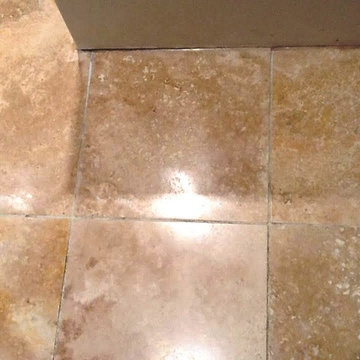
My priority was to address the badly stained grout so I cleaned the grout lines by hand using a combination of hand brushes and Tile Doctor Grout Clean-Up. The surface was pre-wet with water, before a solution of Grout-Clean Up and clean water was applied to the surface. The brushes were then used to agitate the solution. Grout Clean-Up contains a mix of concentrated phosphoric acid and cleaner designed to penetrate below the surface of the grout to remove grout stains, smears and mineral deposits.
As you can see from the photos, Grout Clean-Up made an immediate difference to the appearance of the tiles. This product is suitable for use on masonry and acid resistant surfaces. After completing the clean, I gave the floor a thorough rinse to neutralise the floor after cleaning and removed as much of the water as possible using a wet vacuum.
Following this, I paid attention to the tiles themselves, cleaning them to achieve a polished effect by using a system of burnishing pads. Tile Doctor burnishing pads comprise a set of four pads varying in grit type, from Coarse and Medium to Fine and Very Fine. I applied all four pads in turn to the floor, stopping to rinse the floor in between each. The result was a high quality polished finish.
I then left the floor to dry completely overnight, before commencing the seal the next day. My choice of sealing product was Tile Doctor Colour Grow which is a colour intensifying sealer that both enhances the natural appearance of the stone and provides a durable surface seal.
My client was very pleased with the finished product, and left the following comment on the Tile Doctor feedback system: “efficiently done”, yielding “good results”.
Phil Vissian
Northamptonshire Tile Doctor
7