
Search results for "Freeze dried" in Home Design Ideas


 Connecticut Roofcrafters Llc
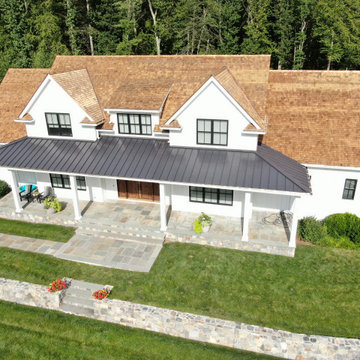
Connecticut Roofcrafters recently completed an expansive roof replacement project in Easton, Connecticut, showcasing our team’s craftsmanship and attention to detail. The homeowners wanted to elevate both the performance and natural beauty of their home, replacing their aging architectural asphalt shingles with a premium Western Red Cedar roof system.
Our crew began by carefully removing the existing asphalt shingles and preparing the structure for a long-lasting cedar installation. We applied CertainTeed WinterGuard Full Ice & Water Shield across the entire roof deck to ensure maximum protection against New England’s freeze–thaw cycles. On top of this, we installed a Benjamin Obdyke Cedar Breather® ventilation layer, which allows cedar shingles to dry properly and significantly extends the roof’s lifespan.
For the finished surface, we installed Watkins Mill Western Red Cedar Perfection Shingles, delivering a warm, natural aesthetic and exceptional durability. To complement the cedar and provide superior weather resistance, we fabricated and installed 16 oz. red copper flashings, including pipe flashings, valley metal, drip edges, and rake edges.
The result is a stunning, high-performance cedar roof that enhances curb appeal, improves ventilation, and offers decades of reliable protection. This Easton home now features a roof that is as structurally sound as it is beautiful—crafted with premium materials and installed with the care Connecticut Roofcrafters is known for.

 Calaisio, Inc
This rectangular serving tray with glass bottom is a unique way to serve cheese, hors d`oeuvres, cold cuts, quiche, pie, cake and many more on your next wine tasting party. Available in 2 sizes. Small 13.25"L x 9.5"W. Medium 17"L x 12"W. "Patent."
Find the right local pro for your project
 The Cultural Landscape Foundation
Saturday June 20, 10:00 to 11:30am | Manhattan
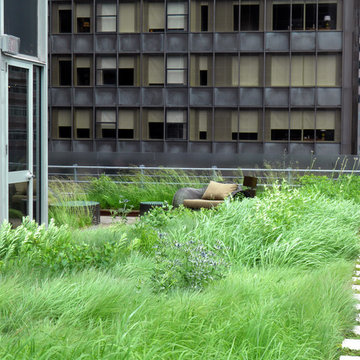
Midtown Sky Garden by Hank White, FASLA, and Aaron Booher of HMWhite
This excursion to a spectacular workplace landscape will take visitors up high above the busy streets of Manhattan. The award-winning, 6,500 square-foot terrace of the Midtown Manhattan Sky Garden takes advantage of panoramic skyline views while providing an intimate garden backdrop to the mid-century-modern building’s newly-renovated interior workspace. Richly textured and seasonally diverse plantings include a dense blanket of drought-tolerant prairie grasses, wildflower perennials, and spring flowering bulbs, punctuated by flowering Crab Apple trees. At twilight, the garden evolves into a subtle stage set of textured plantings, rustling softly against the glow of a frosted glass parapet rail—a soothing space where workers can escape the conference room or the electrifying noise of the dense urban environment. The roof garden’s biophilic design has elevated employees’ well-being, productivity, and morale. Photo copyright Amy Stroud
 Windy City Painters
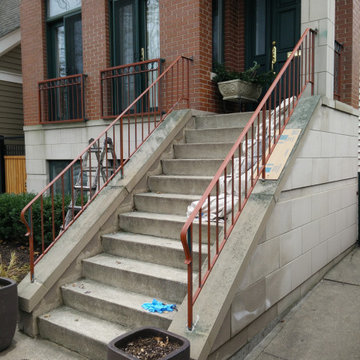
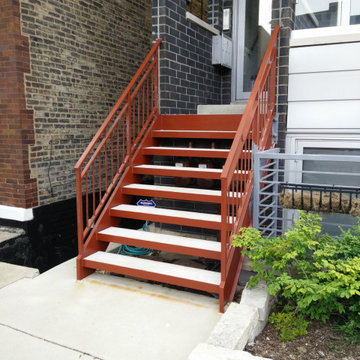
This Gold Coast porch required comprehensive metal refinishing to restore beauty and prevent structural rust damage. The homeowner noticed rust bleeding through existing paint on decorative railings and support posts—a common problem in Chicago after harsh winters. Windy City Painters assessed the damage, stripped everything to bare metal, and applied industrial-grade protection designed for freeze-thaw climates. The result: railings that look new and won't rust again for years.
MATERIALS AND PRODUCTS
Windy City Painters uses only proven products for Chicago's metal challenges. RustDestroyer rust-converting primer chemically bonds to bare steel, converting any remaining rust molecules into a stable base. Sherwin-Williams Corothane Aliphatic Urethane provides superior adhesion and UV resistance compared to standard enamels. Two topcoats ensure maximum durability against road salt spray and freeze-thaw stress. This combination is the North American standard for metal exposed to harsh seasonal climates.
THE PROCESS
Step 1: Wire wheel attachment on a drill removes all loose paint, rust scale, and oxidation down to bare metal. We work methodically to avoid gouging, checking progress frequently. Bare metal is essential—no primer bonds properly over paint or rust. This step typically takes 2-3 hours depending on rail complexity and surface area.
Step 2: Apply RustDestroyer rust-converting primer in a single coat, following manufacturer specs for dry time and coverage. The primer chemically converts any remaining ferrous oxide into a stable compound, then dries to a dark gray or burgundy base. This base is then sealed by the topcoat. Dry time is 24 hours before topcoat application.
Step 3: First coat of Sherwin-Williams Corothane Aliphatic Urethane, applied with a quality brush or roller. Corothane levels beautifully and resists sagging better than traditional polyurethane. We maintain temperature and humidity control during application—critical for proper cure. Tack-free time is 4 hours; full cure requires 7 days.
Step 4: Second topcoat applied after the first coat fully cures. Two coats provide redundant protection against UV fading, moisture penetration, and mechanical wear. The second coat also fills any micro-voids and creates a seamless, glossy finish. Final inspection confirms even color, smooth surface, and no drips or sags.
CHICAGO-SPECIFIC CHALLENGES
North Side and Gold Coast porches face unique stressors. Road salt spray from De-Icing—not ocean salt—deposits chlorides on every metal surface. Winter freeze-thaw cycles force moisture into tiny cracks, expanding and contracting metal, stressing paint adhesion. Spring humidity and Lake Michigan microclimate variations accelerate oxidation. Summer UV radiation fades standard enamels rapidly. Windy City Painters' two-coat Corothane system is engineered for exactly these conditions. The aliphatic urethane resists UV and moisture far better than acrylic-latex or oil-based paints.
WHAT TO EXPECT LONG-TERM
Proper refinishing delivers 5-7 years of reliable protection in Chicago's harsh environment. You'll notice no rust bleeding, no paint lifting, and no color fading within 3-4 years. Minor weathering may appear after year 5-6 if rails face direct salt spray. Routine maintenance—rinsing railings after winter thaw, checking for debris—extends the finish lifespan. Windy City Painters recommends annual inspection of porches facing north or lakeside, where salt and moisture exposure is heaviest.
PRO TIPS
1. Never paint over existing rust. The rust will continue expanding beneath the new paint, lifting and cracking it within months. Windy City Painters always strips to bare metal—it costs more upfront but prevents costly repainting.
2. Time your refinishing for spring or early summer. Corothane requires stable temperatures (50-85°F) and low humidity for optimal cure. Chicago's May through August window is ideal. Fall and winter refinishing risks slow cure and poor adhesion.
3. Inspect end grain, fasteners, and joint areas carefully. These spots collect moisture and corrode first. Windy City Painters applies extra primer attention to crevices and seams.
FAQ
Q: How is Corothane different from Rust-Oleum or other spray paints? A: Corothane is a professional two-part polyurethane with superior hardness, adhesion, and UV resistance. Spray paints are single-stage and fade quickly. Windy City Painters uses Corothane because it's built for architectural metal in harsh climates.
Q: Can you refinish ornamental iron railings on two-flats? A: Yes. Windy City Painters regularly refinishes cast-iron railings on Gold Coast greystones and North Side two-flats. The process is identical—strip, prime with RustDestroyer, topcoat with Corothane.
Q: My railings have been painted many times. Will one wire-wheeling remove all layers? A: We wire wheel aggressively to remove all loose paint and rust. Thin paint layers that are well-adhered can stay if bare metal is exposed beneath. We always reach bare metal in crevices and end grain.
Q: Do I need to prep my porch before Windy City Painters arrives? A: No. We bring all equipment and clean up afterward. Just ensure we have access to electrical outlets and clear floor space around railings.
Q: How long until I can pressure wash my railings after finishing? A: Wait at least 2 weeks. Corothane continues cross-linking and hardening for 7 days. Pressure washing sooner may damage the finish.
Q: What if my railings show rust again within a year? A: Proper application with bare metal prep and two topcoats prevents this. If rust appears, it indicates either prep failure or damage during installation. Contact Windy City Painters immediately for assessment.
Q: Can Corothane be tinted to match my porch trim exactly? A: Sherwin-Williams offers hundreds of colorants. Bring a paint chip or sample, and we'll tint Corothane to your specification.
Q: Is the smell strong during application? A: Corothane has moderate VOC and requires ventilation. Smell dissipates within 24 hours of finishing. Windy City Painters opens windows and positions fans for rapid air exchange.
Q: What if I want a matte finish instead of glossy? A: Corothane comes in gloss, satin, and flat sheens. Matte finishes show dust more readily but suit certain architectural styles. Discuss preference with Windy City Painters during the estimate.
Q: Do you serve Gold Coast and North Side equally? A: Yes. Windy City Painters operates throughout Chicago's north shore. Travel time is built into estimates, but pricing is consistent across neighborhoods.
Contact Windy City Painters at windypainters.com or 773-818-6331 for a free metal refinishing estimate.

 Techo-Bloc
This backyard patio design is inspired by our Travertina Raw patio slab. The Travertina Raw patio slab mimics the texture of natural travertine in a concrete material; making it a more durable option in harsher freeze-thaw climates. Pave luxurious poolsides, patios, walkways and backyards with this travertine stone alternative. This product line has enjoyed huge success and has now been improved with an ultra robust mix design, making it far more durable than the natural travertine stone alternative. Techo-Bloc has now extended the collection to a double-sided, structural retaining wall system, two wall caps and pool coping in order to fulfill customer demand for this luxurious product. https://www.techo-bloc.com/shop/slabs/travertina-raw-slab/



 Techo-Bloc
This backyard patio design is inspired by our Blu 60 Slate patio slab. The best-selling Blu slate patio slab was inspired by natural slate stone. This traditional patio stone comes in multiple sizes for your backyard pool decks, patios & walkways. The same lines and rugged texture as our thicker Blu paver, the same opulent colors and traditional look, Blu 60 Slate slab is the choice for pedestrian areas such as on walkways and patios. Check out our website to shop the look! https://www.techo-bloc.com/shop/slabs/blu-60-slate/
 Techo-Bloc
This backyard patio design is inspired by our Blu 60 patio slab. The Travertina Raw patio slab mimics the texture of natural travertine in a concrete material; making it a more durable option in harsher freeze-thaw climates. Pave luxurious poolsides, patios, walkways and backyards with this travertine stone alternative. This product line has enjoyed huge success and has now been improved with an ultra robust mix design, making it far more durable than the natural travertine stone alternative. Techo-Bloc has now extended the collection to a double-sided, structural retaining wall system, two wall caps and pool coping in order to fulfill customer demand for this luxurious product. https://www.techo-bloc.com/shop/slabs/travertina-raw-slab/



 User
This is an organic Lime Wash done with a true lime wash product as opposed to a brick mortar or concrete that is often seen on new houses. This product can be applied as a solid coating making the surface completely white, or can be applied and "washed off" in many artistic ways, as seen here. If you hate your brick or just want something unique this is a great option!
Photo credit: Jeff Murrey

 Houtje Touwtje
We moved these four Pileas to a bigger pot when they were still young, about three years ago. The bigger the pot, the more space they have to grow and the bigger the plant will become. Credits: instagram.com/houtje.touwtje
 Rocky Tops Granite & Marble LLC
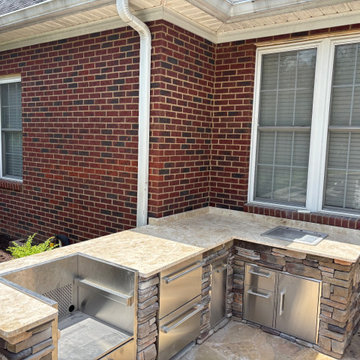
This outdoor kitchen in Lexington is built around 3cm unfilled travertine, and that's a material choice that says a lot about what this space is meant to do. Unfilled travertine keeps its natural pits and texture instead of having them smoothed over with resin, which means the surface reads as raw and organic rather than polished. Out here, under open sky and full sun, that texture works in the stone's favor. It doesn't glare back at you at midday and it doesn't get slick when a hose or a rain shower hits it.
The layout is an L-shaped countertop set over a stacked stone veneer base, with stainless steel drawers and cabinets tucked underneath and a built-in grill anchoring one leg of the L. There's a cutout in the counter for a sink or a cooler, which is the kind of detail that takes real planning at the template stage. You can't cut that opening freehand on site and expect clean lines. We measure twice, dry-fit the appliance or basin, and cut the stone to match before it ever leaves the shop.
Travertine outdoors is a practical call as much as a good-looking one. It handles heat well, which matters right next to a grill, and it won't crack or discolor the way some engineered materials can when they take direct sun for years. Unfilled travertine in particular breathes a little more than the filled version, so it doesn't trap moisture the way a sealed slab might. We finished the edges eased, which keeps the whole thing feeling soft and unfussy, no sharp lines to bang a hip on when you're moving between the grill and the prep space.
Outdoor kitchens take a beating that indoor ones never see: pollen, humidity, the occasional hard freeze here in the Midlands, direct sun for months at a stretch. Travertine's been used outdoors for centuries for exactly that reason, it ages instead of failing. Sealing it now and then keeps water from sitting in the pits, but even bare it holds up. This one in Lexington is set up to be used hard, grilled on, gathered around, and to look better for the wear rather than worse.
 Rocky Tops Granite & Marble LLC
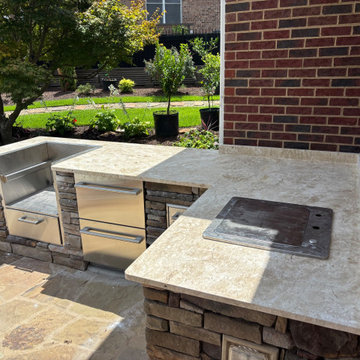
This outdoor kitchen in Lexington is built around 3cm unfilled travertine, and that's a material choice that says a lot about what this space is meant to do. Unfilled travertine keeps its natural pits and texture instead of having them smoothed over with resin, which means the surface reads as raw and organic rather than polished. Out here, under open sky and full sun, that texture works in the stone's favor. It doesn't glare back at you at midday and it doesn't get slick when a hose or a rain shower hits it.
The layout is an L-shaped countertop set over a stacked stone veneer base, with stainless steel drawers and cabinets tucked underneath and a built-in grill anchoring one leg of the L. There's a cutout in the counter for a sink or a cooler, which is the kind of detail that takes real planning at the template stage. You can't cut that opening freehand on site and expect clean lines. We measure twice, dry-fit the appliance or basin, and cut the stone to match before it ever leaves the shop.
Travertine outdoors is a practical call as much as a good-looking one. It handles heat well, which matters right next to a grill, and it won't crack or discolor the way some engineered materials can when they take direct sun for years. Unfilled travertine in particular breathes a little more than the filled version, so it doesn't trap moisture the way a sealed slab might. We finished the edges eased, which keeps the whole thing feeling soft and unfussy, no sharp lines to bang a hip on when you're moving between the grill and the prep space.
Outdoor kitchens take a beating that indoor ones never see: pollen, humidity, the occasional hard freeze here in the Midlands, direct sun for months at a stretch. Travertine's been used outdoors for centuries for exactly that reason, it ages instead of failing. Sealing it now and then keeps water from sitting in the pits, but even bare it holds up. This one in Lexington is set up to be used hard, grilled on, gathered around, and to look better for the wear rather than worse.
 Rocky Tops Granite & Marble LLC
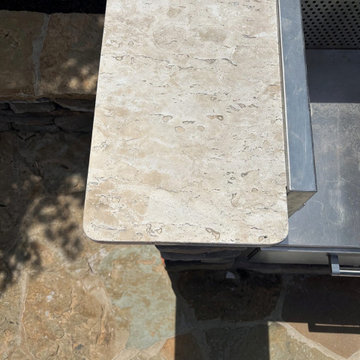
This outdoor kitchen in Lexington is built around 3cm unfilled travertine, and that's a material choice that says a lot about what this space is meant to do. Unfilled travertine keeps its natural pits and texture instead of having them smoothed over with resin, which means the surface reads as raw and organic rather than polished. Out here, under open sky and full sun, that texture works in the stone's favor. It doesn't glare back at you at midday and it doesn't get slick when a hose or a rain shower hits it.
The layout is an L-shaped countertop set over a stacked stone veneer base, with stainless steel drawers and cabinets tucked underneath and a built-in grill anchoring one leg of the L. There's a cutout in the counter for a sink or a cooler, which is the kind of detail that takes real planning at the template stage. You can't cut that opening freehand on site and expect clean lines. We measure twice, dry-fit the appliance or basin, and cut the stone to match before it ever leaves the shop.
Travertine outdoors is a practical call as much as a good-looking one. It handles heat well, which matters right next to a grill, and it won't crack or discolor the way some engineered materials can when they take direct sun for years. Unfilled travertine in particular breathes a little more than the filled version, so it doesn't trap moisture the way a sealed slab might. We finished the edges eased, which keeps the whole thing feeling soft and unfussy, no sharp lines to bang a hip on when you're moving between the grill and the prep space.
Outdoor kitchens take a beating that indoor ones never see: pollen, humidity, the occasional hard freeze here in the Midlands, direct sun for months at a stretch. Travertine's been used outdoors for centuries for exactly that reason, it ages instead of failing. Sealing it now and then keeps water from sitting in the pits, but even bare it holds up. This one in Lexington is set up to be used hard, grilled on, gathered around, and to look better for the wear rather than worse.
 Rocky Tops Granite & Marble LLC
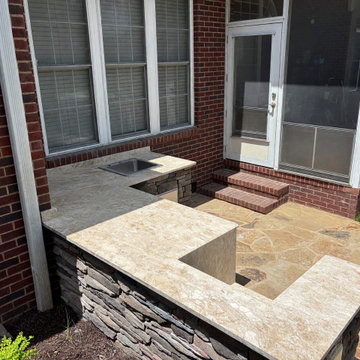
This outdoor kitchen in Lexington is built around 3cm unfilled travertine, and that's a material choice that says a lot about what this space is meant to do. Unfilled travertine keeps its natural pits and texture instead of having them smoothed over with resin, which means the surface reads as raw and organic rather than polished. Out here, under open sky and full sun, that texture works in the stone's favor. It doesn't glare back at you at midday and it doesn't get slick when a hose or a rain shower hits it.
The layout is an L-shaped countertop set over a stacked stone veneer base, with stainless steel drawers and cabinets tucked underneath and a built-in grill anchoring one leg of the L. There's a cutout in the counter for a sink or a cooler, which is the kind of detail that takes real planning at the template stage. You can't cut that opening freehand on site and expect clean lines. We measure twice, dry-fit the appliance or basin, and cut the stone to match before it ever leaves the shop.
Travertine outdoors is a practical call as much as a good-looking one. It handles heat well, which matters right next to a grill, and it won't crack or discolor the way some engineered materials can when they take direct sun for years. Unfilled travertine in particular breathes a little more than the filled version, so it doesn't trap moisture the way a sealed slab might. We finished the edges eased, which keeps the whole thing feeling soft and unfussy, no sharp lines to bang a hip on when you're moving between the grill and the prep space.
Outdoor kitchens take a beating that indoor ones never see: pollen, humidity, the occasional hard freeze here in the Midlands, direct sun for months at a stretch. Travertine's been used outdoors for centuries for exactly that reason, it ages instead of failing. Sealing it now and then keeps water from sitting in the pits, but even bare it holds up. This one in Lexington is set up to be used hard, grilled on, gathered around, and to look better for the wear rather than worse.
 Windy City Painters
Does your iron fence look like Chicago winters have been winning the battle for years? That slow orange spread across pickets and rails is not just an eyesore - it is active corrosion undermining the structural integrity of metalwork that frames some of Chicago's most architecturally significant residential properties. Windy City Painters addresses iron fence rust at the source, using professional-grade rust conversion chemistry and direct-to-metal coatings engineered for the specific abuse Chicago's climate delivers.
PROJECT OVERVIEW
This project involved a heavily rusted ornamental iron fence on a Chicago North Side residential property. Rust had progressed beyond surface oxidation into moderate pitting on lower rails, a pattern Windy City Painters sees frequently on properties within blocks of treated roadways where salt drift accelerates corrosion. The scope included mechanical descaling, chemical rust conversion, DTM priming, and a durable gloss topcoat matched to the original fence color.
MATERIALS AND PRODUCTS
Ospho Rust Converter: A phosphoric acid-based treatment that chemically reacts with iron oxide, converting it to iron phosphate - a stable, paintable compound. Corroseal Water-Based Rust Converter is an alternative for situations requiring lower VOC handling. Rust-Oleum Professional DTM Primer and Sherwin-Williams DTM Acrylic Coating serve as the primary coating system, formulated for direct metal adhesion with built-in rust inhibitors. For structurally compromised sections, welding is coordinated before any chemical or coating work begins.
THE PROCESS
Step 1 - Mechanical Preparation: Wire wheel grinding on an angle grinder removes loose rust scale, mill scale, and flaking paint. For advanced pitting, Windy City Painters deploys a needle gun descaler, which impacts the metal surface thousands of times per minute to drive scale from deep cavities. This step determines whether the fence can be coated or needs welding first.
Step 2 - Chemical Rust Conversion: Ospho or Corroseal is brushed onto all remaining rust surface. These products do not simply seal rust - they react with it. The conversion process takes 24 hours to fully cure before topcoating. Skipping this step is the single most common reason iron fence paint jobs fail prematurely.
Step 3 - DTM Priming: Sherwin-Williams DTM or Rust-Oleum DTM primer is applied by brush to ensure full penetration around decorative elements, picket tips, and weld joints. Spray application is used on open sections for even film build. DTM formulations bond directly to prepared metal without a separate shop primer.
Step 4 - Finish Coating: A DTM topcoat in gloss or semi-gloss provides the final weather barrier. Gloss is preferred for iron fencing because the harder surface sheds water more effectively and resists dirt adhesion between maintenance cycles. Windy City Painters applies two finish coats for maximum film thickness.
CHICAGO-SPECIFIC CHALLENGES
Chicago's freeze-thaw cycle is the primary enemy of iron fence coatings. Water infiltrates micro-cracks in paint film, freezes, expands, and delaminate coating from beneath. Properties on the North Side and Near West Side also contend with lake-effect humidity that keeps metal surfaces damp for extended periods, slowing cure times and promoting under-film corrosion if preparation is inadequate. Greystones and Victorian brownstones typically feature ornate cast iron or wrought iron fencing with complex geometries that trap moisture and demand hand-brush application to fully coat recesses.
WHAT TO EXPECT LONG-TERM
A properly prepared and coated iron fence in Chicago should hold 5-8 years before requiring recoating. Annual inspection of weld joints, picket tips, and base rails closest to grade will identify early rust return. Addressing small spots with touch-up converter and primer extends service life significantly between full recoats.
PRO TIPS
Tip 1: Never pressure wash a rusted iron fence immediately before painting. Water drives moisture into pits and delays the surface drying needed for chemical converter adhesion. Allow 48 hours of dry weather before prep begins.
Tip 2: Picket tips and rail ends are the first failure points. These end-grain equivalent areas on metal concentrate corrosion. Ask your painter to apply an extra brush coat to every tip and terminus.
Tip 3: Black is the traditional and most durable color choice for iron fencing. Dark pigments absorb UV rather than reflecting it, reducing thermal cycling stress on the paint film at color change boundaries.
FAQ
Q: What does iron fence painting cost in Chicago?
A: Most residential iron fence painting in Chicago ranges from $400 to $1,200 depending on linear footage, rust severity, prep method required, and whether structural welding is needed before Windy City Painters can coat the surface.
Q: How do I know if my fence needs a welder before painting?
A: If you can press a screwdriver through a rail or picket, the metal wall has failed. Windy City Painters inspects all fencing before quoting and identifies weld-required sections so repairs happen before any coating investment.
Q: Is Ospho or Corroseal better for my fence?
A: Both convert rust effectively. Ospho is solvent-based and fast-acting, preferred for heavy rust. Corroseal is water-based with lower odor, preferred in enclosed or residential settings where off-gassing is a concern. Windy City Painters selects based on site conditions.
Q: Can iron fence painting be done in winter in Chicago?
A: Application requires temperatures above 50 degrees Fahrenheit for DTM coatings to cure properly. Most iron fence painting in Chicago runs April through October, with scheduling flexibility based on extended warm stretches.
Q: How do I maintain my fence between professional recoats?
A: Inspect annually in spring. Sand any rust spots to bare metal with 80-grit paper, apply Ospho, let cure 24 hours, then spot-prime with DTM primer and touch up with finish coat. Windy City Painters offers maintenance inspections.
Q: Do you paint courtyard building fences and coach house gates?
A: Yes. Multi-unit courtyard buildings and coach houses are common in the North Side neighborhoods Windy City Painters serves. We coordinate with property managers and HOAs for larger perimeter fence projects.
Q: How long after painting can I touch the fence?
A: DTM coatings are typically dry to touch in 2-4 hours and hard dry in 24 hours. Full cure for maximum hardness takes 7 days. Windy City Painters advises against pressure washing or heavy contact during that cure window.
Visit windypainters.com to request your free iron fence assessment and project quote.

 Dianne Davant and Associates
Master Bedroom with Red Bed Frame and custom drapery and bedding.
Bedroom - traditional master light wood floor bedroom idea in Charlotte
Bedroom - traditional master light wood floor bedroom idea in Charlotte


 Secret Gardens
The house on this block is living a second life, a classic 100 yr. old Queenslander that was salvaged and relocated to this spectacular setting in Federal, Byron Bay. The landscaping around the house was simple, with plenty of lawn and low plantings to highlight the renovated building and not impede any views from the house. The swimming pool and surrounds were lowered, again to maintain views from within the house and to work with the lay of the land. The positioning of the pool and the classic layout were to compliment the period and orientation of the house and reinforce the outlook. The stone walling between the house and pool helps create a separation ensuring that when you are poolside you feel that you are part of this great view; part of the landscape as opposed to being an extension to the house.
6