
Search results for "Global accessibility" in Home Design Ideas





Find the right local pro for your project







Sponsored
Columbus, OH
Free consultation for landscape design!

Peabody Landscape Group
Franklin County's Reliable Landscape Design & Contracting






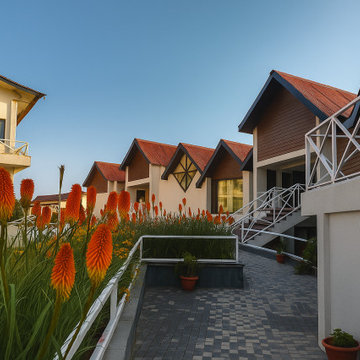
 Metamorphosis Design
Koti Resorts
(Hotel Project)
Constructed commenced 1991
Location : Baldeyan, Himachal Pradesh
GENESIS OF A HOTEL PROJECT - KOTI RESORTS, NALDHERA, SHIMLA
How does a Newbie make an entry into the HOSPITALITY INDUSTRY.......???
Or, to be specific – HOW DOES ONE MAKE A HOTEL...... GET INTO THE HOTEL BUSINESS...???
Agreed, the business of teaching/learning of getting into this mammoth Industry is also BIG BUSINESS. Considering that almost each and every city in the country has several institutes/colleges/ and even University departments have jumped onto the band wagon of this reasonably popular academic course.
So when a long time friend from the neighbourhood wanted to start a new business/career on a family held plot in the hills – it smelled like a good opportunity. As a student of the University, he was also accidentally pushed into the “business” of running the University Cafeteria – which was on contract to some people. The student leaders (he was part of the Association) were dared to take over the Cafeteria and run it themselves if they had a problem with the then management.
Obviously, EGOS got hurt, and one doesn’t DARE a bunch of University leaders of the Student body running the roost.
So initial experience taught them supply chain management, financial acumen, human resource management, and of course – all about food. All components of running a ‘dicey operation’ such as a Student cafeteria in a volatile environment were experienced and the nut and bolts of the business learnt the hard way.
So it was full confidence and a positive gut feeling that this friend took that momentous decision. And the idea germinated.
Remember when we (almost the entire extended family from here in the plains + the rest from the hills) took off to Shimla to case the joint – to put mildly. Would’ve been summertime then – is all that I can remember.
Caught up with the ‘hill party’ at Shimla for further going towards the Naldhera Golf Course, where we were booked for lunch. The site was en route – a few strokes short, as ad people would put it, of the Golf Course...
On a hilltop called Baldeyan.
Anyway, after the family divisions of the land parcel ownership was settled, we (my friend and yours truly) spent some time at the site to figure out the way ahead. Ideas flew back and forth, including some number crunching – and just like that we zeroed in onto making a Resort Hotel. In the middle of a wild nowhere – with great views all around.
Shimla town visible at 7 o’clock (S/SW), and the snow capped peaks of the Upper Himalayas ranging from the North to the ESE (say 4 o’clock) the radio mast tower dead North, and the Craignano peak due South (that’s where Shimla’s water supply tanks are located}.
The location was a gift from heaven.
And the matter was settled – we all agreed that it was so......!!!!
So the next step – what kind of hotel do we plan for??? What kind of target customer, tariff, rooms, program...........and a thousand other questions befuddled us. I suggested going to a Hotel Consultant.
No ego!
So the both of us drove down to Delhi after zeroing in to the offices of Mr. AN Haksar (the recently retd Chairman of the ITC) – who had only recently set up this office. It hurt when we agreed to pay 1/2 a lakh as consultancy fees – in spite of me being the designated Architect for the job. But then.........cie la vie..........!!!!
Such is life!!!
We got into a quick learning curve of hotel industry terms, and practices. Of things like Occupancy rates, the ARR, peak season rates, and various depts. like F&B, Housekeeping, etc. But what the heck – we both were in our thirties.......!!!
And lapped up the learning without any fuss. And joyfully agreed when they said they’d do the hand holding for a while after the hotel started business.
Of course we’d agree – after all AN Haksar was the Chairman Emeritus of the ITC group – that super successful upstart in the Hotel Industry. With the Hotel Mughal Agra, the ITC Chola, the ITC Maurya, and the ITC Grand Kakatiya, amongst other successful Iconic properties under their belt.
I had already made up my mind on NOT DESTROYING THE ENVIRONMENT with a multi-floor frame structure that was standard pattern in the desecration of the hills. So a low rise low floor concept was a given. And that’s what we did – to achieve what we’d like to think of as the pioneer of hill resort hotel design character.........
We were already in competition with another resort being planned some distance away near Chail – another great resort hotel, and the game was on.
After getting sanctions and a starter loan from the HP SIDC, we borrowed money from family and friends, and – in a small Maruti 800 – took off for the site one summer morning. Also in the car back seat was my old mistri (now appointed thekedar) and his ‘brother mistri’......from their village in UP.
Stopped for a quick lunch immediately after crossing the Dhalli Tunnel, and the on to the site.
Now after throwing all tenets of site planning and architecture down the hill, one walked around to locate the point where we would start CONSTRUCTION OF THE RESORT HOTEL.
Took a few minutes (remember we were freshers in our thirties) and within the hour had laid out the foundation plan for the 1 st Block. Another added advantage – there were no site boundaries and no benchmarks to go by – excepting an old stone water tank used by the village below. And a few pipes going down from there.
Meanwhile left the contractor there in the wilderness for him to locate his construction huts, approach roads, material dump spaces, etc. No idea how he managed.
Within a month we were well into the making of the first ‘residential hut’ that one had envisaged. A block of four rooms – with outer rooms a bit larger with a separate dining space. And a vestibule as one entered. The toilets were located between the dining & bedroom spaces – and well ventilated. There was also an open lobby between the four rooms – giving safe access to all. And interesting approaches planned as per site conditions. With built in housekeeping stores, etc under the staircase landings. And space for 2-3 kilo-liters of water tanks
for the 8 rooms/suites per block.
One also planned for a central heating system – with insulated pipes servicing each block. A/C s were not even in our minds – but we were forced to install them later because of global warming and climate change. Neither were the ubiquitous ceiling fans - which are nowadays a must have in the towns of Shimla and Solan. Among other hill stations.....!!!
In fact one got insulated cavity walls made under duress...........a fact appreciated much later in life.
Incidentally, I think the cost of petrol was around Re. 8/50 or something those days, and it was easier on the pocket to drive up to the site beyond Shimla than stay over night in a hotel. And the Mandal Commission agitation had made us night birds on the highways to Shimla.
VP Singh was the PM, and globalisation of the economy had yet to take birth...........!!!!
The hotel had a soft opening in 1991, I think.
And the first customer stayed for a week. And then came back after a sort while to stay for a month. We felt vindicated.
And the Hotel has never looked back ever since.
designed by www.MetamorphosisDesign.org
Struggling to bring clarity to your vision before starting your dream project?
Let us help you refine your ideas and align them seamlessly with your budget.
Schedule your design consultation today - call - 9316511166

 SS
Top Real Estate App Development Companies Delivering Smart PropTech Solutions
The real estate industry is experiencing a revolution in technology as there have been developments in the form of mobile applications, which have now become essential tools and prove to be an integral part for buyers and sellers as well as agents and developers in this industry. The application of technology in the form of virtual tours and property recommendations through artificial intelligence and other such technology has brought about a new way of doing real estate business. It has been found out through statistics that the PropTech industry will experience considerable growth in the next decade due to the increased use of smartphones, cloud computing, and artificial intelligence.
Why Real Estate Apps Are Transforming the PropTech Industry
The introduction of digital platforms has revolutionized the way people search for, assess, and buy properties. Modern real estate software ensures easy access to property listings, neighborhood information, mortgage calculators, virtual tours, and direct contact with real estate agents, thus cutting out many of the obstacles that were part of the purchasing process. Real Estate App Development allows companies to manage properties efficiently, automatically generate leads, effectively handle customers, and make informed decisions. The inclusion of artificial intelligence and digital transactions makes the experience of using these apps even more efficient.
List of Top Real Estate App Development Companies in the Global Market
1. Suffescom Solutions
Suffescom Solutions is a mobile app development company specializing in Real Estate App Development for startups, real estate agencies, property management firms, and enterprises. The company develops scalable, feature-rich applications that simplify property discovery, virtual tours, lead management, and secure digital transactions. By integrating advanced technologies such as AI, AR/VR, cloud computing, and location intelligence, Suffescom Solutions helps businesses build intuitive PropTech platforms that enhance customer engagement and operational efficiency. The company also focuses on customization, security, and post-launch support to ensure long-term business success.
Key Features
Custom real estate application development
AI-powered property recommendations
Property listing management
Interactive map integration
Virtual property tours
CRM integration
Secure payment gateway
Multi-platform development
Cloud-native architecture
Maintenance and support
2. RisingMax
RisingMax develops innovative digital solutions for businesses seeking advanced PropTech platforms. Its expertise in Real Estate App Development enables companies to launch scalable property applications equipped with intelligent search capabilities, real-time property updates, and secure communication tools. RisingMax combines modern UI/UX practices with cloud technologies to deliver applications that improve customer engagement and simplify property management.
Key Features
Cross-platform app development
AI-enabled property search
Property management dashboard
Cloud deployment
Push notifications
Digital payment integration
Analytics and reporting
API integration
Secure authentication
Ongoing technical support
3. Ascendix Technologies
Ascendix Technologies is known for developing enterprise-grade PropTech software for commercial and residential real estate businesses. The company focuses on building customized applications that streamline property management, brokerage operations, customer engagement, and business workflows. Its expertise includes CRM development, cloud solutions, and data analytics, enabling businesses to manage property portfolios more efficiently.
Key Features
Enterprise real estate solutions
CRM integration
Commercial property management
Cloud infrastructure
Advanced analytics
Workflow automation
Custom software development
Secure data management
API connectivity
Long-term support
4. WillowTree
WillowTree develops premium mobile applications across various industries, including real estate and digital commerce. The company creates user-centric property applications that emphasize intuitive navigation, personalized property recommendations, and engaging digital experiences. Its development approach combines robust engineering with modern design principles to build scalable PropTech platforms for growing businesses.
Key Features
Mobile-first development
Personalized user experience
Property search optimization
Cloud-native architecture
Interactive UI/UX
Analytics integration
Secure user authentication
Multi-device compatibility
Third-party integrations
Continuous optimization
5. Unico Connect
Unico Connect specializes in delivering customized digital products for startups and enterprises, including Real Estate App Development solutions. The company builds scalable applications that simplify property listings, communication, lead management, and customer engagement while integrating cloud technologies for improved business performance.
Key Features
Custom property applications
Cloud-based infrastructure
Real-time messaging
Lead management system
Property listing platform
API integration
Digital documentation
Performance analytics
Secure payment integration
Ongoing maintenance
6. Trango Tech
Trango Tech develops intelligent mobile solutions that help real estate businesses digitize property management and customer interactions. Its applications support advanced search functionality, location-based services, secure transactions, and AI-powered recommendations. The company focuses on scalable software architecture that supports long-term business growth and operational efficiency.
Key Features
Property marketplace development
AI-powered recommendations
Interactive map integration
GPS-enabled search
Digital document management
User analytics
Cross-platform applications
Secure backend systems
CRM connectivity
Cloud deployment
7. MindInventory
MindInventory is a software development company delivering digital transformation solutions across multiple industries, including real estate. Its Real Estate App Development services include modern property applications that combine intuitive interfaces with advanced technologies such as AI, IoT, and cloud computing. The company focuses on creating engaging user experiences while ensuring scalability, security, and seamless business operations.
Key Features
AI-enabled property applications
Cloud-native development
Property management tools
Interactive dashboards
IoT integration
User engagement features
Third-party API integration
Business intelligence reporting
Secure infrastructure
Continuous technical support
Essential Features Every Modern Real Estate App Should Include
Successful Real Estate App Development requires more than attractive property listings. Modern applications must provide seamless experiences for buyers, sellers, agents, and property managers while simplifying transactions and communication.
• User Registration and Profile Management
Allow buyers, sellers, agents, and administrators to create personalized accounts with secure authentication and profile customization.
• Advanced Property Search
Provide powerful filters based on location, property type, price range, amenities, size, and availability to improve property discovery.
• Interactive Maps
Integrate GPS-enabled maps that display nearby schools, hospitals, transportation hubs, restaurants, and neighborhood information.
• High-Quality Property Listings
Support multiple images, HD videos, floor plans, property specifications, and detailed descriptions for each listing.
• Virtual Tours
Enable immersive 360-degree property walkthroughs using AR/VR technology to improve buyer confidence before physical visits.
• AI-Powered Property Recommendations
Use artificial intelligence to recommend properties based on user preferences, browsing behavior, and previous searches.
• Real-Time Chat and Messaging
Facilitate instant communication between buyers, sellers, and agents for faster inquiry resolution.
• Mortgage Calculator
Help users estimate monthly payments, loan eligibility, and financing options directly within the application.
• Appointment Scheduling
Allow users to schedule property visits, virtual meetings, or consultations with agents through integrated calendars.
• Secure Digital Payments
Support booking fees, deposits, subscription payments, and service charges through encrypted payment gateways.
• Document Management
Store contracts, agreements, ownership documents, inspection reports, and legal paperwork securely within the application.
• Push Notifications
Notify users about new listings, price changes, scheduled visits, document approvals, and promotional offers.
• Admin Dashboard
Provide centralized control over users, listings, transactions, content moderation, analytics, and platform management.
• Analytics and Reporting
Offer detailed insights into customer behavior, listing performance, lead generation, conversions, and revenue growth.
• Strong Security
Implement encrypted communications, secure authentication, role-based access control, data privacy measures, and regulatory compliance.
Emerging Trends Shaping the Future of Real Estate App Development
The future of Real Estate App Development is being driven by intelligent technologies that improve decision-making, customer experiences, and operational efficiency throughout the property lifecycle.
Artificial intelligence is transforming property discovery by delivering personalized recommendations, predictive pricing models, and automated customer support. Machine learning algorithms analyze user preferences and market trends to recommend relevant properties while helping businesses generate qualified leads more effectively.
Augmented reality (AR) and virtual reality (VR) are becoming essential components of digital property experiences. Virtual property tours allow buyers to explore homes remotely, reducing travel time and accelerating purchasing decisions.
Another significant trend is IoT integration within smart properties. Connected devices enable users to monitor energy consumption, security systems, lighting, and climate control directly through mobile applications, enhancing property value and user convenience.
Finally, sustainability is becoming an important focus. Modern real estate platforms increasingly highlight green-certified buildings, energy-efficient homes, and environmentally friendly construction projects to meet changing buyer preferences.
Conclusion
The rapid evolution of the PropTech sector has made Real Estate App Development an essential investment for businesses aiming to deliver seamless, technology-driven property experiences. From AI-powered property recommendations and immersive virtual tours to secure digital transactions and cloud-based management systems, modern applications are transforming every stage of the real estate journey. Selecting an experienced development company with expertise in emerging technologies, scalable architecture, and user-centric design is crucial for building a competitive digital platform. As customer expectations continue to evolve, organizations that invest in innovative real estate applications will be better positioned to improve operational efficiency, strengthen customer relationships, and achieve long-term growth in the digital property marketplace.
FAQs
1. What is Real Estate App Development?
Real Estate App Development involves building mobile or web applications that help users buy, sell, rent, and manage properties through digital platforms.
2. How much does Real Estate App Development cost?
Development costs vary based on features, platforms, integrations, UI/UX complexity, and technology requirements, ranging from basic to enterprise-grade solutions.
3. Which features are essential in a real estate app?
Core features include property listings, advanced search, virtual tours, GPS maps, messaging, appointment scheduling, payment integration, and analytics dashboards.
4. Why should businesses invest in Real Estate App Development?
It enhances customer engagement, streamlines property management, increases lead generation, supports digital transactions, and helps businesses stay competitive in the evolving PropTech market.

85