
Search results for "Opposing sofas" in Home Design Ideas

 Blulens Design
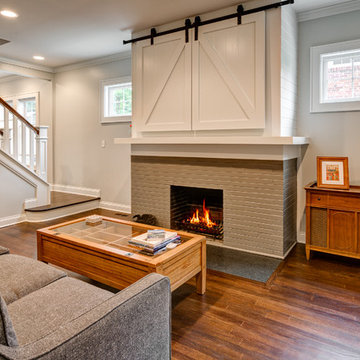
Mid-sized trendy open concept dark wood floor living room library photo in Cleveland with beige walls


Find the right local pro for your project


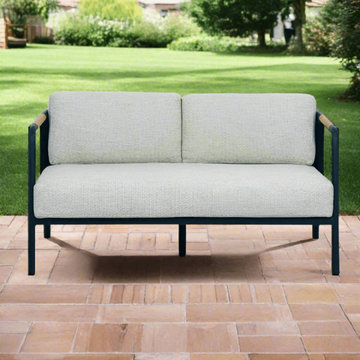
 Modern Wicker & Outdoor Furniture
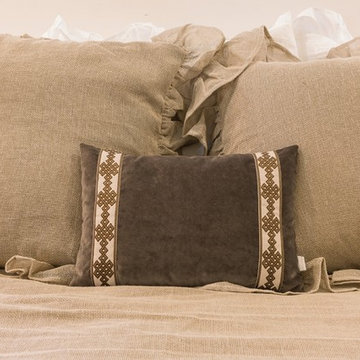
Crafted with meticulous attention to detail, the Alfresco Home Elle Belt Deep Seating Loveseat boasts a generous 54" frame, providing ample space for you and your loved one to unwind in absolute comfort. The teak arm rests add a touch of sophistication while ensuring sturdy support, making it the perfect fusion of style and functionality.

Sponsored
Columbus, OH

Wannemacher Interiors
Customized Award-Winning Interior Design Solutions in Franklin Cnty OH
 Neumann & Rudy Architecture
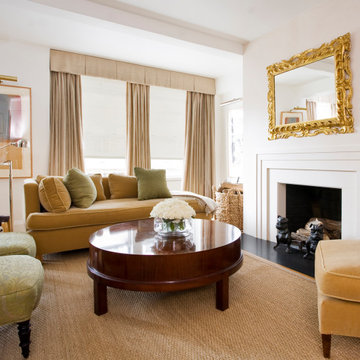
This is a compact, pre-war urban parlor handled with the confidence of a much larger room, and its success rests on a disciplined negotiation between rectilinear architecture and curvilinear furnishings. The volume is defined by two competing datum lines: a substantial dropped beam and soffit bridging the left-hand window wall, and the crisp stepped architrave of the fireplace surround opposite, which projects into the room as the primary architectural event. That mantel—executed in tiered, chamfered planes with a shallow reveal and a honed black stone hearth extending as a cantilevered shelf—reads as a stripped-classical or Art Deco–inflected aedicule, its symmetry anchoring the seating plan. Circulation is organized on a diagonal: the long axis established by the low, tight-back sofa beneath the fenestration is intercepted by the oval mahogany cocktail table, whose ellipse dissolves the room's orthogonal grid and permits comfortable passage on all sides. Sightlines are deliberately layered—the gilt mirror above the mantel captures a reflected register of the opposing wall's cornice, drapery, and framed art, effectively doubling the perceived depth of the plan and admitting borrowed light. The furniture is uniformly low-slung, an intentional strategy that preserves headroom and visually raises the ceiling plane, while the exposed leg profiles (turned casters, tapered mahogany posts, square-section table legs) keep the floor plane continuous and the composition buoyant rather than freighted.
The palette is a masterclass in tonal modulation within a narrow chromatic band—warm ivory plaster walls with a faintly pinkish undertone provide the neutral ground against which a family of golds, ochres, and honeyed camels is arranged in ascending saturation. The sofa's cut velvet in a deep saffron-caramel is the room's chromatic keystone, echoed in the club chair at right and moderated by two temperature-shifting accents: sage and moss velvet cushions that introduce a cool, desaturated counterpoint, and a damask-woven celadon slipper chair with matching ottoman whose subtle jacquard relief supplies pattern without noise. Textiles are stratified by pile depth and light response—the matte, slightly slubbed linen of the box-pleated pelmet and floor-length panels absorbs light, while the velvets refract it, producing that characteristic gilded bloom along the seat rolls and cushion edges. Against these soft goods, the designer sets three hard, contrasting registers: the French-polished mahogany table, whose figured, mirror-like top functions as a horizontal reflector; the water-gilded, deeply carved acanthus mirror frame, its burnished high points offering the room's only true metallic brilliance; and the patinated bronze bulldog andirons and blackened firebox, which supply necessary chromatic weight. Underfoot, a coarse woven sisal or seagrass rug provides the essential textural antithesis—dry, granular, and vernacular—as do the loose-woven rush baskets flanking the window, grounding the room's refinement in something agrarian and unpretentious.
Daylighting is generous but rigorously controlled: the twin windows are filtered through translucent roller blinds that diffuse direct sun into an even, high-key wash, and the pelmet with its softly gathered box pleats crops the aperture to conceal hardware and reinforce the horizontal. The result is a luminous, almost overexposed north-facing quality along the left flank that gradates into softer shadow at the hearth wall—a chiaroscuro that gives the room its sense of depth and repose. Artificial illumination is deliberately architectural and understated rather than decorative: a swing-arm picture light above the abstract framed work at left, a second slim picture light on the return wall, and an articulating chrome task/floor lamp with a polished conical shade positioned to serve the reading corner. Notably, there is no central fixture; the strategy is entirely peripheral and layered, calibrated for evening intimacy at cushion height. Stylistically, the room synthesizes into what one might call Restrained American Traditionalism, or more precisely a Warm Modern Classicism—the vocabulary of a New York or London town-house drawing room, edited of clutter and pattern, retaining the ceremonial gestures (gilt overmantel mirror, tailored drapery, symmetrical hearth) while adopting modernist restraint in silhouette, chromatic economy, and the absence of ornament on the case goods. The reference points span Deco, Regency, and mid-century upholstery forms, yet the assembly feels neither eclectic nor historicist. It is, instead, a quietly authoritative interior—luxurious in material and light, ascetic in gesture, and calibrated for daily habitation rather than display.


102