
Search results for "Proper operation" in Home Design Ideas
 Dallas Builders Association
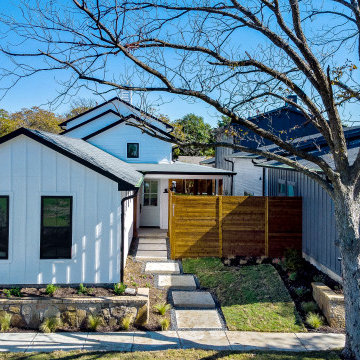
The Dallas Builders Association’s Parade of Homes — presented by Atmos Energy — will hold open six luxury Dallas residences from 10 a.m. to 5 p.m. on May 7. This scattered-site, self-guided tour benefits Operation FINALLY HOME, an organization that provides custom mortgage-free homes to combat-wounded U.S. military veterans and their families. The Association’s eighth project is currently underway in Irving.
Featured homes are situated in several neighborhoods in Dallas, including Briarwood, Midway Hollow, and East Dallas near White Rock Lake, as well as in West Dallas just south of the Trinity River.
Hoffmann Homes builds award-winning innovative green homes using quality materials, sustainable building practices, smart technologies, and reliable and efficient energy sources for maximum comfort.
Pioneering home builder and residential developer Alan Hoffmann was first inspired to pursue alternative construction methods after visiting his ancestral home on the Spanish island of Ibiza. The 400 year old home had three-foot thick perimeter walls comprised of stone excavated from the building site. The mass of these walls allowed the ground’s ambient temperature to conduct up through the walls to keep the house cool in the summer and warmer in the winter. Hoffmann replicates this elegantly simple system today in his distinctive mode of construction with Insulated Concrete Forms (ICFs).
Our Parade of Homes build in the Abode @ White Rock community is 2111 Autumn Sage Place. Old-world features such as thick thermal mass walls, breezeways and whitewashed cement finishes are reimagined in a modern context in Hoffmann Homes’ newest build. Situated in the Abode @ White Rock green community, the home features high-performance windows, proper housing orientation and a storm shelter/pantry. Each home in the community is certified with the Department of Energy’s Net Zero Ready program, Energy Star Program and Green Built Texas.
While every Hoffmann Home starts with a high-performance building envelope (ICF), they also include conditioned attics, seal combustion furnaces, whole house dehumidification, whole house water filtration for indoor air and water quality. The homes are also solar-ready and are pre-wired for rapid electric vehicle charging. Other features include a natural gas tankless water heater, high-efficiency gas furnace, sealed combustion gas fireplace. These natural gas appliances help reduce energy use, lower utility costs and reduce emissions while increasing homeowner comfort.
For more info visit www.hoffmannhomes.com.
Tickets for the Parade of Homes are $25 for ages 12 and older. They are available at ParadeofHomesDallas.com. Tour maps will be emailed to ticket holders a week prior to the event.
 Chicago Roof Deck & Garden
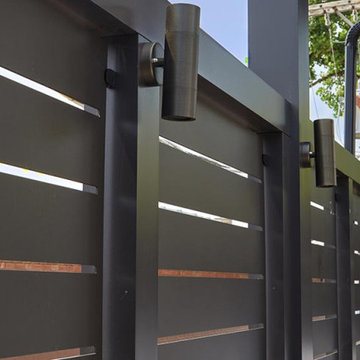
A homeowner with the opportunity to enhance two, side by side garages engaged CRDG to take on this unique project. The garage hosting the new sport court enhancement was properly built for a roof deck and already included decking. A complete upgrade was necessary for the other garage to properly support a new roof deck. Masonry, structural steel and new roofing were essential in order to incorporate all the bells and whistles that create this new outdoor living space. An operable shade system with heating along with the appliance counter and TV provides everything one would need without having to run back into the house. The double garage has something for everyone in the family to enjoy!
 The Masons Co and Dionysian Artificers Landscape
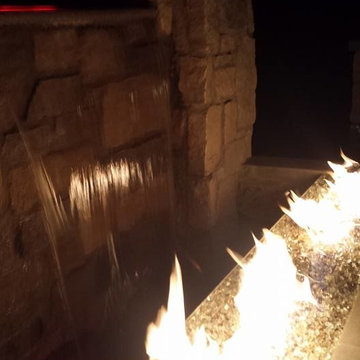
The Masons Co and Dionysian Artificers Who we are? http://www.themasonscompany.com/ has provided historic preservation consulting and contracting services on countless structures throughout entire Midwest region including several dozen on the National Register of Historic Places. We believe that a multi-disciplinary approach to the planning of all aspects of historic preservation projects is necessary to preserve the heritage of our built environment. As active participants in the preservation community we are appreciative of the limited resources available for the preservation and maintenance of the cultural heritage embodied in historic structures. We endeavor to provide historically appropriate, sensitive, creative, and responsible solutions to the stewards of these treasures. Our solutions are applicable to the repair of all structures including, Brick, Stone, Masonry Restoration, Fountain, Water features - buildings, high-rise structures, parking structures, airports, bridges, tanks, plaza decks, and historic structures.
The Masons Co and Dionysian Artificers is an operated business which provides high quality masonry restoration and fountain repair service in the state of Arkansas, Nebraska, Des Moines IA, Memphis TN, Nashville TN, Denver Co, Oklahoma City, Springfield IL, Dallas TX, Florida and entire Midwest region. Our commitment to quality and a standard of excellence on every level is the foundation the company has been built upon. Our skilled and conscientious craftsmen specialize in the historic repair, renovation, replication and restoration of any structure we are contracted to work on. Our nearly 30 years of experience assures efficiency, safety and quality by using the proper materials and installation procedures. This unparalleled experience has earned us a reputation for providing clients with the highest quality repair and installation services available.
Find the right local pro for your project
 User
UserWhen seeking a professional painting contractor in Houston, a thousand things must run through your mind. Let the painting professionals at Duran’s Roofing & Remodeling set your mind at ease. Painting is second nature to us. As you may be good at your job, we’re pretty good at ours. Painting, you might say, is in our blood. Family owned and operated is all we know.
Before our painters put the first brush of paint to your walls, we make sure that your surfaces are clean and free of damage. Preparing a fresh canvas and painting with proper technique makes your old walls look like brand new once again.
Duran’s Roofing & Remodeling works hard to make sure your property looks amazing, inside and out. Our experienced paint crews know how to create beautiful finishes inside your home, while properly protecting your home’s fixtures and non-painted surfaces.
From offices to storefronts, let our experienced commercial paint maintenance specialists make sure your business looks great all year long. Whether it is damage touch-up or whole property repainting, we can do it. We’ll work with your schedule to ensure minimal downtime and inconvenience to your employees and customers.
Our painting services are more than just a few rollers and cans of paint. We take pride in our work and in the relationships we build with our clients. Complete client satisfaction is our goal, and we attain it by keeping the process simple. Our courteous, clean-cut staff will arrive when they say they will, get the job done right, complete all work on time, and finish on job on budget.
 Free Lancing
Effective residential construction project management is crucial in today’s fast-moving building industry. It means overseeing every step of building a home, from planning to finishing, to ensure projects are completed time, within budget, and with high quality. Unlike commercial projects, residential projects require special attention to meet homeowners' unique needs and wishes, requiring a customized approach from the beginning to the end.
In 2025, the construction sector will use advanced technologies like AI and integrated project delivery (IPD) to streamline processes and improve stakeholder collaboration. However, project managers face significant challenges, including managing risks, maintaining quality control, and ensuring effective communication among team members.
A WIP Report (Work-in-Progress Report) is a key tool that helps track a project's budget, progress, and resource use. It provides clear insights, making managing costs easier, avoiding delays, and making informed decisions.
By adopting best practices and using modern construction management tools, project managers can overcome these challenges and deliver successful residential construction projects that meet client expectations and contribute to a sustainable future.
This article provides a brief overview of residential construction project management, highlights its importance, and touches on the challenges faced by project managers while incorporating the latest trends and technologies in the field.
Types of Residential Construction Management
Here are the different types of Residential Construction Management:
Single-Family Homes: These are standalone houses built for individual families. Managing these projects involves overseeing construction from planning to completion, ensuring that the home meets the owner's preferences and budget.
Multi-Family Housing: This includes apartments, condominiums, and townhouses. Projects of this type require managing multiple units, often with shared facilities, and ensuring compliance with local building codes.
Custom Home Building: This involves constructing homes tailored to specific client needs. Close collaboration with architects and designers is required to ensure the house reflects the owner's personality and preferences.
Home Renovation and Remodeling: These projects focus on updating or expanding existing homes. They often involve working with subcontractors for specialized tasks like electrical or plumbing work.
Components of Residential Construction Project Management
Managing a residential construction project requires carefully coordinating people, materials, and timelines. A well-structured approach ensures efficiency, cost control, and high-quality results.
Roles and Responsibilities
A project manager plays a vital role in residential construction. They oversee every step from planning to completion and ensure the project stays on schedule, within budget, and meets quality standards.
Project Manager’s Role in Home Construction
The project manager is responsible for organizing tasks, managing resources, and solving problems that arise during construction. They coordinate between different teams, track progress, and ensure safety regulations are followed.
Collaboration with Contractors, Architects, and Stakeholders
Successful residential construction requires teamwork. Project managers work closely with architects to bring designs to new heights, coordinate with contractors to manage labor and materials, and keep stakeholders (such as homeowners and investors) informed about project updates.
Client Communication and Expectations Management
Clear communication with clients is essential. The project manager keeps homeowners updated on timelines, changes, and challenges. Setting realistic expectations and providing regular updates, they help avoid misunderstandings and keep the project running smoothly.
Project Scope & Planning
Practical project planning sets the foundation for a successful residential construction project. It ensures clear goals, minimizes risks, and keeps the project on track.
Defining Project Objectives and Deliverables:
Clearly outlining what needs to be done and what the final result should look like is essential. This involves setting specific, measurable goals that align with the homeowner's vision and budget.
Managing Homeowner Expectations and Scope Creep:
Homeowners often have changing needs or ideas. Effective project managers must manage these expectations to prevent "scope creep," which can delay projects and increase costs. This involves open communication and setting clear boundaries.
Ensuring Compliance with Zoning Laws and Permits:
Before construction begins, it's crucial to ensure that all necessary permits are obtained and that the project complies with local zoning laws. This step avoids costly fines and delays, ensuring the project moves forward smoothly.
Budgeting & Cost Control
Proper budgeting is essential for keeping residential construction projects financially viable. Effective cost management prevents overspending and ensures profitability.
Accurate Cost Estimation for Residential Projects
A precise cost estimate considers labor, materials, permits, and unexpected expenses. Using historical data and Sage 300 CRE for financial management improves accuracy and helps set realistic budgets.
Budget Allocation and Tracking
Allocating funds efficiently ensures that each phase of the project receives the necessary resources. Tracking expenses through Construction & Financial Dashboards allows for real-time monitoring and early detection of budget deviations.
Preventing Budget Overruns
Uncontrolled costs can derail a project. Regular financial reviews, automated alerts for overspending, and contingency planning help keep expenses in check and prevent financial strain.
Scheduling & Timeline Management
Timely project completion is crucial in residential construction. Effective scheduling minimizes delays and ensures a smooth workflow.
Creating Detailed Project Schedules
A structured schedule outlines all tasks, deadlines, and dependencies. Breaking down the project into phases, planning, execution, and finishing, helps maintain order and clarity.
Preventing Delays & Meeting Deadlines
Delays can result from labor shortages, weather conditions, or supply chain issues. To avoid problems, it’s good to check for risks ahead of time, add extra time to schedules, and keep everyone on the same page.
Using Gantt Charts and Critical Path Methods
CPM for Construction helps identify critical activities that directly impact project completion, while Gantt charts provide a visual timeline of tasks. Both tools optimize scheduling and improve efficiency.
Residential Construction Project Management Phases
Managing a residential construction project effectively requires a structured approach through various phases. Each phase plays a critical role in ensuring the project's success, from initial planning to completion.
Pre-Construction Phase
The pre-construction phase sets the foundation for a smooth and efficient building process. Proper planning at this stage helps prevent costly changes and delays later.
Site Analysis & Approvals: A thorough site analysis assesses soil conditions, topography, and environmental factors. Feasibility studies evaluate project viability, including costs and regulatory compliance. Obtaining zoning approvals, permits, and other legal clearances is crucial before breaking ground.
Selecting Materials and Procurement Strategies: Choosing the right materials impacts durability, sustainability, and cost efficiency. A well-planned procurement strategy, including bulk purchasing and reliable supplier partnerships, ensures timely delivery and cost savings. Using Sage 300 CRE for procurement management helps streamline material sourcing and financial planning.
Construction Phase
The construction phase transforms plans into reality. Effective coordination and strict quality control ensure a successful build.
Resource Allocation and Workflow Coordination: Efficiently managing labor, equipment, and materials is key to maintaining progress. Using CPM for Construction, project managers can allocate resources strategically, prevent bottlenecks, and optimize workflows for timely completion.
Quality Control and Ensuring Compliance with Safety Regulations: Strict adherence to building codes and safety standards is non-negotiable. Regular inspections, worker training, and real-time quality monitoring ensure a structurally sound and legally compliant project. Proactive safety measures prevent accidents and project disruptions.
Project Closeout & Handover
The final phase of residential construction project management is crucial for ensuring a smooth transition from construction to occupancy. Proper closeout procedures guarantee quality, client satisfaction, and long-term project success.
Final Inspections and Quality Assurance: Before finishing the project, a final inspection checks that everything meets safety rules and quality standards. Any problems need to be fixed quickly. Using Procore helps make inspections and tracking issues easier, ensuring a high-quality final product.
Client Walkthrough and Support: A final check helps homeowners see the finished work, ask questions, and make sure it meets their expectations. This is also a chance to explain important home features and maintenance tips. Good communication here builds trust and strengthens relationships.
Warranty Management and Feedback: Efficient warranty management ensures clients get quick help for any issues after construction. A clear process for tracking requests and keeping in touch with homeowners boosts satisfaction. Collecting feedback helps improve future projects. Using S-Curve Forecasting tracks performance trends and refines management strategies.
Software for Residential Construction Project Management
The integration of technology in residential construction project management has revolutionized the way projects are planned, executed, and monitored. Digital tools streamline operations, reduce costs, and improve communication, making them essential for modern construction firms.
Importance of Digital Tools
Investing in digital tools is crucial for construction firms as it transforms the industry by enhancing efficiency, accuracy, and collaboration across the entire project lifecycle. They also improve project management by streamlining processes, automating tasks, and facilitating real-time stakeholder communication.
Top Construction Management Software for Residential Projects
Several software solutions are available for managing residential construction projects:
Procore: Known for its comprehensive project management features, including document management and collaboration tools.
Sage 300 CRE: Offers robust accounting and financial management capabilities, ideal for large-scale construction projects.
Buildertrend: Specializes in residential construction, providing tools for project scheduling, budgeting, and client communication.
CoConstruct: Focuses on custom home building and remodeling, offering features for estimating, scheduling, and project management.
WIP Reports: Useful for tracking work-in-progress and managing project finances effectively.
Features Comparison and Best Use Cases:
Procore: Best for large projects requiring extensive collaboration and document management.
Sage 300 CRE: Ideal for firms needing robust financial management.
Buildertrend: Suitable for residential builders focusing on client communication and project scheduling.
CoConstruct: Perfect for custom home builders who need detailed estimating and scheduling tools.
WIP Reports: Useful for firms needing to track project finances closely.
How Software Improves Project Efficiency
Construction management software significantly enhances project efficiency in several ways:
Automating Accounting and Job Costing: Software like Sage 300 CRE automates financial tasks, reducing manual errors and improving budget tracking.
Streamlining Document Management and Communication: Tools like Procore centralize documents and facilitate real-time communication among team members, reducing misunderstandings and delays.
Mobile-Friendly Solutions for Real-Time Tracking: Mobile apps from platforms like Buildertrend allow for on-site access to project data, enabling real-time tracking and decision-making.
These digital tools and software solutions are essential for modern residential construction project management, offering benefits such as improved efficiency, enhanced collaboration, and better financial control.
Challenges in Residential Construction Project Management
Residential construction projects face a variety of challenges that can impact their success. Here are some of the key issues project managers encounter:
Managing Subcontractors and Labor Shortages
One of the biggest challenges in residential construction is managing subcontractors and dealing with labor shortages. Subcontractors often have their own schedules and priorities, which can lead to delays if not coordinated properly. Additionally, labor shortages can slow down projects and increase costs due to the need for overtime or hiring temporary workers.
Budget Overruns and Unexpected Costs
Budget overruns are common in residential construction due to factors like material price fluctuations, unexpected site conditions, or changes in project scope. Effective budget management involves regularly monitoring expenses and having contingency plans for unexpected costs.
Changing Construction and Eco Rules
Construction and Eco Rules are always changing, so project managers need to keep up with the latest regulations. This involves following guidelines for saving energy, protecting the environment, and ensuring safety. Ignoring these rules can lead to fines, delays, or even stopping the project.
Best Practices
To ensure your residential construction projects run smoothly and successfully, follow these essential best practices:
Setting Clear Project Goals and Milestones
Clearly defining what you want to achieve is the first step to success. Set specific, measurable, achievable, relevant, and time-bound (SMART) goals. This helps everyone involved understand what needs to be done and by when. For example, instead of saying "build a house," say "build a house with three bedrooms and two bathrooms within the next nine months."
Stakeholder Collaboration
Good communication is key to keeping everyone on the same page. Regular meetings with contractors, suppliers, and homeowners help prevent misunderstandings and ensure that everyone knows what's happening and what's next. This open dialogue also helps resolve issues quickly, preventing small problems from becoming big delays.
Using Data-Driven Insights for Decision-Making
Making decisions based on facts rather than guesses is crucial. Use data and analytics to understand project progress, identify potential issues early, and make informed decisions. For instance, if data shows that a particular material is consistently causing delays, you can plan ahead to avoid those delays in the future.
Proactive Risk Management Strategies
Things don't always go as planned, so being prepared is essential. Identify potential risks early and have a plan to manage them. This might include having backup suppliers, planning for weather conditions, or setting aside extra funds for unexpected expenses. Being proactive can prevent small issues from turning into major problems.
Conclusion
Effective residential construction project management requires careful planning, clear communication, and the right digital tools. From single-family homes to multi-family housing and custom projects, managing timelines, budgets, and quality is essential for success.
By following best practices, using project management software, and staying ahead of industry trends, project managers can ensure smooth execution and client satisfaction despite challenges like labor shortages, budget overruns, and regulatory compliance; modern technology and strategic planning help mitigate risks.
Construction firms can improve efficiency, enhance collaboration, and maintain financial control by adopting advanced tools like Procore, Sage 300 CRE, and Buildertrend. A well-managed project delivers a quality home and builds trust and long-term success in the industry.
FAQs
What is residential construction project management?
It involves overseeing all aspects of building residential properties, from initial planning and design to construction and completion, ensuring projects are completed on time, within budget, and to the desired quality standards.
How can I prevent budget overruns in my construction project?
Accurate cost estimation, continuous budget tracking, and having contingency plans for unexpected expenses are key strategies to prevent budget overruns.
What are the main stages of a residential construction project?
The primary stages include design, pre-construction, procurement, and construction.
How does construction management software improve project efficiency?
It streamlines processes like scheduling, budgeting, and communication, providing real-time data access and collaboration among stakeholders, which enhances overall project efficiency.
How can I ensure my project complies with local building codes and regulations?
Engage professionals familiar with local laws, obtain all necessary permits before starting, and conduct regular inspections to ensure adherence to building codes and regulations.
 E-Commerce
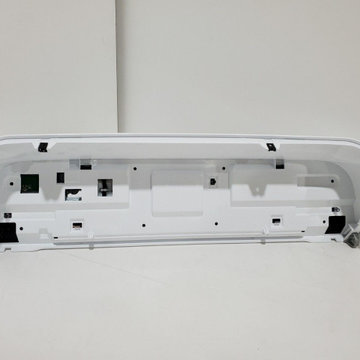
The Whirlpool W11569437 Washer Console is your washing machine's control center, containing the user interface and display. This electronic panel allows you to select wash cycles, change settings such as water temperature and spin speed, and track the status of your laundry. You can control the washer by pressing buttons, turning knobs, or using a touch screen (depending on the console design). A clear display shows the selected cycle, the estimated time remaining, and any error codes that may appear. A functional console is essential for operating your washer efficiently and ensuring your clothes receive proper care.
 Care Free Homes, Inc.
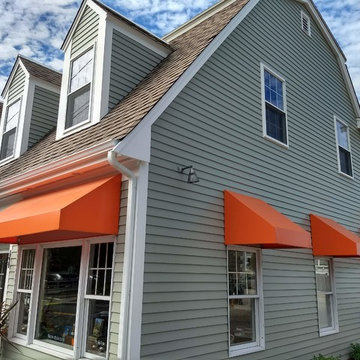
This South Dartmouth office and apartment building looks gorgeous with new cedar shingle siding, Harvey replacement windows and more! Located in scenic Padanaram village, the owner chose premium white cedar shingles. Wood siding is a New England favorite for many reasons:
-Wood siding such as cedar is naturally resistant to rot, decay and insect attacks when installed properly by an experienced siding contractor.
-It is much easier to repair wood siding than any other home siding option.
-A variety of styles, textures & thicknesses are available such as clapboards, shakes, shingles, and board & batten to match any homeowner’s style.
-Wood siding is versatile and available in a variety of paint or stain options. You can even get the boards pre-stained which provides protection from U.V. rays, water & mildew.
-Wood that is harvested from sustainably managed forests are extremely environmentally friendly. It also produces the least greenhouse gas, air pollution, water pollution and solid waste.
Along with cedar shingle siding, we installed ten of our top selling Harvey Classic double hung replacement windows. These beautiful, energy efficient windows feature easy, finger-tip operation and tilt in for easy cleaning. Harvey Classics come in a variety of colors, grid patterns, and hardware finishes. Manufactured right here in the New England, every window is customized to your specifications!
To finish this project up we also installed PVC trim, gutters and downspouts and a Therma-tru door! For over 40 years, homeowners throughout Southeastern Massachusetts, Cape Cod, and Eastern Rhode Island have trusted Care Free Homes to provide professional grade home improvement products, quality workmanship, and outstanding customer service. In addition to fantastic product warranties we also provide our very own 10 year workmanship guarantee! Our customers do not pay a single penny for home improvement projects until their project is complete and they are 100% satisfied. Qualified homeowners can even take advantage our financing options! When it comes time for your exterior home improvements call us for a free quote!
 AD Garage Doors and Locks LLC
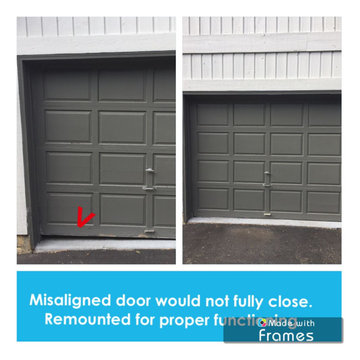
Misaligned door was removed and reinstalled for a proper remount. Door now opens and closes properly and operates smoothly.

 Bru’s House of Color
Bru’s House of Color was established in April 1961 by Charles “Bru” Baker, hence the name. The store is currently owned and operated by Ray & Darlene Wiemer who purchased the business in 2000. We have been serving the community in the same location since 1963.
Each of our professionally trained staff members have been part of our family for a minimum of 10 years. We are a true professional paint store, not a paint department. Bru’s is your one-stop paint store for the professional or the “do it yourselfer”. We are here to assist you in any way we can: answering questions, determining proper products for each project, custom color matching as well as color consultations.
“Big Box Store selection and prices.”
In addition to all things paint, we are also able to provide custom window coverings– measuring and installation are part of our service. We can also bring our showroom to your home for a true professional consultation at no charge.
“Our most important product is service, and our most important customer is you.”
 Houston Window Experts
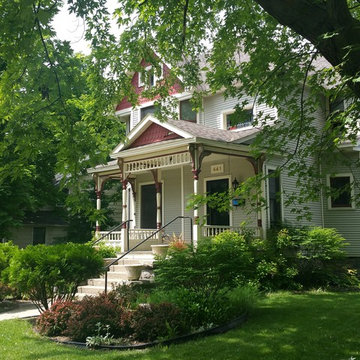
This Victorian Era home needed new windows because the old ones were not operating properly, were sweating, did not meet egress standards and were drafty.
We installed a premium vinyl window from Milgard Windows and Doors. Thsi product offers the same traditional look of the original windows but with the benefits of vinyl. Since vinyl is available in several colors, the homeowner chose the Matte Black option for this project. The interior of the windows is white so that it matches the casing, trim and baseboards.
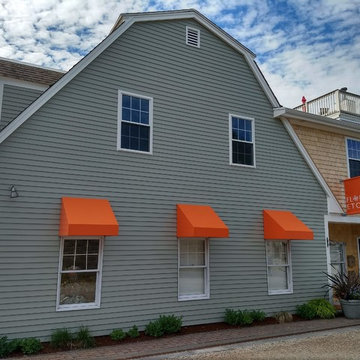 Care Free Homes, Inc.
This South Dartmouth office and apartment building looks gorgeous with new cedar shingle siding, Harvey replacement windows and more! Located in scenic Padanaram village, the owner chose premium white cedar shingles. Wood siding is a New England favorite for many reasons:
-Wood siding such as cedar is naturally resistant to rot, decay and insect attacks when installed properly by an experienced siding contractor.
-It is much easier to repair wood siding than any other home siding option.
-A variety of styles, textures & thicknesses are available such as clapboards, shakes, shingles, and board & batten to match any homeowner’s style.
-Wood siding is versatile and available in a variety of paint or stain options. You can even get the boards pre-stained which provides protection from U.V. rays, water & mildew.
-Wood that is harvested from sustainably managed forests are extremely environmentally friendly. It also produces the least greenhouse gas, air pollution, water pollution and solid waste.
Along with cedar shingle siding, we installed ten of our top selling Harvey Classic double hung replacement windows. These beautiful, energy efficient windows feature easy, finger-tip operation and tilt in for easy cleaning. Harvey Classics come in a variety of colors, grid patterns, and hardware finishes. Manufactured right here in the New England, every window is customized to your specifications!
To finish this project up we also installed PVC trim, gutters and downspouts and a Therma-tru door! For over 40 years, homeowners throughout Southeastern Massachusetts, Cape Cod, and Eastern Rhode Island have trusted Care Free Homes to provide professional grade home improvement products, quality workmanship, and outstanding customer service. In addition to fantastic product warranties we also provide our very own 10 year workmanship guarantee! Our customers do not pay a single penny for home improvement projects until their project is complete and they are 100% satisfied. Qualified homeowners can even take advantage our financing options! When it comes time for your exterior home improvements call us for a free quote!
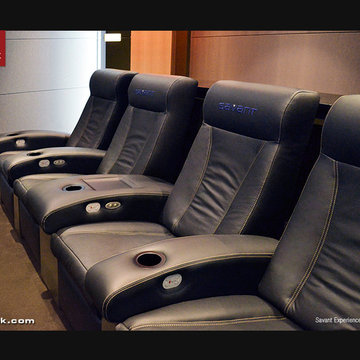
 CINEAK luxury seating
REDEFINING CUSTOM THEATER SEATING
The FORTUNY theater chair was created for the most luxurious home theater. It’s concept is unique in many aspects and the design combines leather upholstery, varying stitching finishes, ergonomic contours, real wood veneer and an independently controlled reclining mechanism. The chair was designed by the Mitra Theaters team
as a seating solution for their exclusive high-end home theater projects.
Careful attention has been paid to the overall comfort of this chair. Ergonomics have been thorougly studied during the design and development process. High quality foam with different densities in combination with zigzag seating support and webbed backrest support are used to create a comfortable and soft feel which maintains a proper balance for ones body.
A steel frame and mechanism ensures a smooth operation now and in the future. The independently controlled reclining mechanism allows the user to adjust the backrest independently from the footrest, giving the user full freedom and the ability to adjust the chair to a position that fits one’s body structure. The articulating headrest is a feature which ensures ultimate comfort while viewing a movie in the reclined position. It gives the proper neck support needed and guarantees the perfect viewing in relation to the film screen.
The Fortuny is also available as a fixed chair and in a manually operated reclining version.
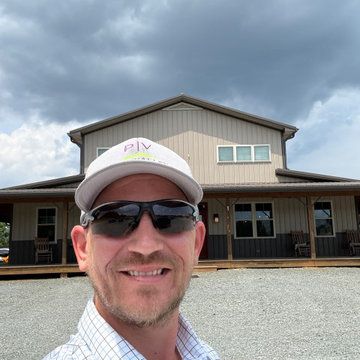
 Pine Valley Turf Management
To support large-scale commercial site development, land clearing, and earthmoving projects, our team utilizes heavy-duty equipment including track bulldozers with rake attachments and articulated off-road dump trucks. Having this level of heavy machinery in-house allows us to perform extensive excavation, rough grading, brush clearing, and bulk dirt hauling efficiently. Whether prepping a raw lot for development or reshaping challenging terrain, we have the horsepower to tackle demanding land management jobs from start to finish.
By operating our own heavy equipment fleet, Pine Valley Turf Management eliminates reliance on third-party subcontractors and rental delays, keeping project timelines tight and costs competitive. From clearing heavy vegetation and rock to hauling hundreds of tons of soil and aggregate, our heavy machinery operations ensure every site is properly excavated, leveled, and stabilized for subsequent construction or landscaping.
 TrueMark Repair
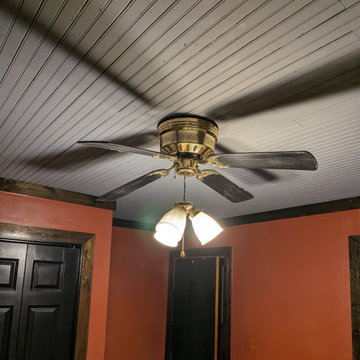
TrueMark provides specialized home solutions that enhance everyday living. In this project, we replaced an outdated or non-functional fixture with a high-efficiency ceiling fan.
Beyond the physical mounting, we ensured the unit was properly balanced for silent operation and securely anchored to the ceiling box for safety. This installation not only improves the room's air circulation but also adds a refreshed aesthetic to the space. Whether it's a precision door retrofit or an essential fixture upgrade, Jake ensures every detail is handled with professional care.
 The Masons Co and Dionysian Artificers Landscape
The Masons Co and Dionysian Artificers http://www.themasonscompany.com/ has provided historic preservation consulting and contracting services on countless structures throughout entire Midwest region including several dozen on the National Register of Historic Places. We believe that a multi-disciplinary approach to the planning of all aspects of historic preservation projects is necessary to preserve the heritage of our built environment. As active participants in the preservation community we are appreciative of the limited resources available for the preservation and maintenance of the cultural heritage embodied in historic structures. We endeavor to provide historically appropriate, sensitive, creative, and responsible solutions to the stewards of these treasures. Our solutions are applicable to the repair of all structures including, Brick, Stone, Masonry Restoration, Fountain, Water features - buildings, high-rise structures, parking structures, airports, bridges, tanks, plaza decks, and historic structures.
The Masons Co and Dionysian Artificers is an operated business which provides high quality masonry restoration and fountain repair service in the state of Arkansas, Nebraska, Des Moines IA, Memphis TN, Nashville TN, Denver Co, Oklahoma City, Springfield IL, Dallas TX, Florida and entire Midwest region. Our commitment to quality and a standard of excellence on every level is the foundation the company has been built upon. Our skilled and conscientious craftsmen specialize in the historic repair, renovation, replication and restoration of any structure we are contracted to work on. Our nearly 30 years of experience assures efficiency, safety and quality by using the proper materials and installation procedures. This unparalleled experience has earned us a reputation for providing clients with the highest quality repair and installation services available.
 Evanston Garage Door
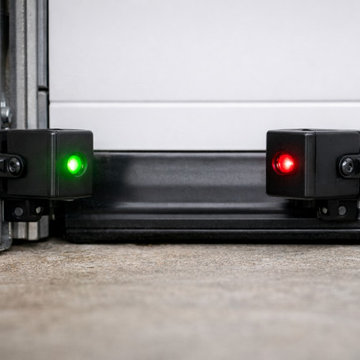
This project focused on realigning and calibrating garage door safety sensors for a homeowner in Evanston, IL. The door was failing to close properly because the infrared sensors were misaligned, causing the system to stop midway. Our technicians inspected the wiring, cleaned the lenses, and adjusted the sensor angles to ensure accurate detection and smooth operation.
After the alignment, the door closed safely and consistently without interruptions. We also tested the opener system and verified that the safety reverse function worked perfectly. The homeowner appreciated the quick fix and the improved reliability of their garage door.
Proper sensor alignment is essential for safety and prevents unnecessary wear on the opener system.
 safe ZOnea
Every year, the same thing happens. The first real snowfall arrives, demand for de-icing materials spikes overnight, and the businesses that waited too long find themselves scrambling for supply at the worst possible moment. Facility managers, property owners, contractors, and municipalities all depend on a steady supply of salt and ice melt to keep their properties safe and operational through winter. The ones who plan ahead sail through. The ones who don't pay more, wait longer, and take on real risk.
Sourcing de-icing materials well is not complicated, but it does require thinking ahead and understanding the options. The choices you make about what to buy, how to buy it, and who to buy it from have a direct effect on your costs, your reliability, and your ability to keep people safe when conditions turn dangerous. This article lays out what matters.
Why Your Choice of Supplier Matters More Than You Think
It is easy to treat de-icing material as a commodity, something you grab whenever you need it without much thought about where it comes from. That works fine until the moment it doesn't, usually in the middle of a storm when everyone needs supply at once and the casual sources have run dry. At that point, the relationships you built before the season become the difference between staying stocked and being stuck.
Reliable supply is the whole game in winter operations. A property that runs out of ice melt during a storm faces safety hazards, liability exposure, and disruption, none of which can wait for a back-ordered shipment. This is why establishing relationships with dependable rock salt suppliers before the season starts is one of the smartest moves a facility manager or contractor can make. It locks in supply, often locks in better pricing, and removes a major source of mid-winter stress.
The lesson here is to treat sourcing as a planning decision rather than a last-minute errand. The businesses that come through winter smoothly are almost always the ones that secured their supply chain early, chose suppliers who could actually deliver when it counted, and never had to gamble on finding material during a shortage. Reliability bought in advance is far cheaper than scarcity paid for in a crisis.
Bagged or Bulk: Matching the Material to the Job
One of the first practical decisions is whether to buy de-icing material in bags or in bulk, and the right answer depends entirely on the operation. Each format has clear advantages, and many operations end up using both for different purposes.
Bagged material offers convenience, control, and easy storage. It is simple to handle, easy to distribute to different locations or crews, straightforward to store without special equipment, and convenient for spot application by hand. It suits smaller properties, businesses without bulk storage, and situations where portion control and tidiness matter. Bulk material, on the other hand, tends to make sense for large operations that go through high volumes, where buying in quantity lowers the per-unit cost and the operation has the equipment and space to store and handle it. The tradeoff is between the convenience and flexibility of bags and the volume economics of bulk.
For many operations, the right approach is a mix: bulk for the high-volume core of the work and bags for flexibility, spot treatment, and locations where bulk handling is impractical. The key is to match the format to how the material will actually be stored, moved, and applied, rather than defaulting to one or the other out of habit. Thinking this through in advance avoids both the waste of over-buying bulk you can't handle and the expense of relying entirely on bags for a large operation.
Rock Salt Is Not Your Only Option
Rock salt, or sodium chloride, is the workhorse of winter de-icing for good reason. It is effective, widely available, and cost-efficient, which makes it the default choice for most operations most of the time. But it has limits, and understanding the alternatives helps you choose the right material for the conditions you actually face.
The most important limitation is temperature. Rock salt becomes less effective as temperatures drop, and in genuinely cold conditions it can struggle to do the job at all. This is where alternatives come in. Calcium chloride, for instance, works at much lower temperatures than rock salt and acts quickly, which makes it valuable when conditions are severe or when fast melting matters. Operations that face hard freezes or need dependable performance in extreme cold often keep calcium chloride for sale on hand for exactly those situations, using it alongside rock salt rather than instead of it.
The practical approach is to understand the conditions your property faces and stock accordingly. For many operations, rock salt handles the bulk of the work while a faster, colder-rated material like calcium chloride covers the extreme days when ordinary salt falls short. Matching the material to the temperature and the urgency of the situation is what separates an operation that stays ahead of winter from one that is constantly reacting to it.
Securing Your Supply Before the Season
Knowing what to buy is only half the equation. The other half is making sure you can actually get it when you need it, which means securing your supply before winter arrives rather than after it has already started. Timing is one of the most underrated factors in winter operations.
The logic is simple. Demand for de-icing materials is highly seasonal and spikes sharply during storms, when everyone needs supply simultaneously. Prices and availability both move against the buyer at exactly those moments. By contrast, planning ahead, estimating your needs and arranging supply before the season, puts you in a far stronger position. Working with established rock salt suppliers ahead of time means your material is accounted for before the rush, often at better pricing and with the confidence that it will be there when the first storm hits.
This kind of planning also lets you think clearly rather than react under pressure. You can estimate your seasonal needs based on your property and past winters, decide on the right mix of materials and formats, and arrange storage in advance. Operations that do this consistently spend less, worry less, and never find themselves making frantic calls during a storm. The effort of planning ahead is modest, and the payoff in reliability and cost savings is substantial.
Storing and Handling What You Buy
Securing supply is not much use if the material degrades before you can use it, which makes proper storage and handling an important and often overlooked part of the equation. De-icing materials are sensitive to moisture, and poor storage can turn a good supply into a clumped, hardened mess that is difficult to apply.
The fundamentals are straightforward. Keep material dry and protected from moisture, since salt and ice melt readily absorb water and can harden if exposed. Store it in a way that suits the format, whether that means a proper bulk storage area or a dry space for stacked bags. Keep it accessible, so crews can get to it quickly when a storm hits and time is short. And handle it with the right equipment for the format and volume, which protects both the material and the people working with it. None of this is complicated, but neglecting it can undermine even a well-planned supply.
Good storage practices protect the investment you made in securing supply early. There is little point in arranging your materials ahead of the season only to have them degrade before use. Treating storage and handling as part of the overall plan, rather than an afterthought, ensures that the material you secured is actually usable when the moment comes. It is the final link in a supply chain built to perform under winter conditions.
Estimating How Much You Actually Need
One question trips up operations of every size: how much de-icing material to buy. Order too little and you risk running short during a storm. Order too much and you tie up money and storage space in material you may not use. Getting the estimate reasonably right is a meaningful part of sourcing well.
Several factors shape the answer. The size and type of the areas you treat, sidewalks, lots, entrances, and drive lanes, set the baseline for how much material each application consumes. The local climate matters too, since colder regions and those with frequent snowfall go through far more material than milder ones. Application frequency depends on how often storms hit and how quickly surfaces need to be cleared, which varies with the kind of property and the expectations of the people who use it. And the type of material plays a role, since different products are applied at different rates.
Past experience is often the best guide. Operations that track what they used in previous winters, adjusted for the size of the property and the severity of the season, can estimate their needs with reasonable confidence. For newer operations without that history, it helps to plan conservatively and to work with a supplier who can replenish stock reliably, so that a low estimate does not turn into a mid-storm shortage.
The goal is not perfect precision but a sound, slightly cautious estimate paired with a dependable supply relationship. That combination lets an operation keep enough material on hand to handle the season without over-committing to volume it cannot store or use. Thinking this through before winter, rather than guessing during it, is one more way that planning ahead pays off when the snow starts to fall.
The Bottom Line
Sourcing de-icing materials well comes down to a few straightforward principles: plan ahead, choose reliable suppliers before the season, match your materials and formats to your actual needs and conditions, and store what you buy properly. The operations that follow these principles move through winter with confidence, while those that improvise pay more and take on needless risk.
Winter is predictable in one respect: it arrives every year, and demand for de-icing material spikes the moment it does. The businesses that prepare for that reality, rather than being surprised by it, are the ones that keep their properties safe, their costs controlled, and their operations running no matter what the season throws at them. A little foresight before the first snowfall pays off through every storm that follows.

 Total System Service
As a manager of a building or property, you quickly learn the art of mediation. One minute you may be working with a vendor to keep the building’s operating system running efficient and smooth; the next moment you may be calming a tenant down after finding the change in the system disrupted his office’s workflow. Give and take; it’s the only way to make sure every day runs perfectly.
Overall, you have two goals to strive for in everything you do.
1. Keep the building running properly, upgrading systems as appropriate, and striving to do all you can on a pre-established budget.
2. Keep the building occupants happy, with as little disruption as possible.
While some changes are minor, barely registering on a building occupant’s mind, with HVAC challenges, that’s rarely the case. If a HVAC contractor is replacing an air handler, for instance, and disconnects one and moves to the next unit, it may cause major disruptions to sensitive areas of a building. And if the occupant wasn’t prepared for the disruption, you can have a mighty unhappy customer on your hand.
Anytime you are working on HVAC projects throughout your building, there are strategies you can put into place to keep things running smooth.
Communicate with occupants
Communication is key to any good relationship, and as a property manager, this rule is a great place to start. If you will be working with the HVAC equipment, block out the timeframe for work to be done, and understand the potential consequences of the process. Then communicate this process with every point of contact you have throughout the building. The more detail you can provide, the less surprises you’ll have throughout the process. You can also work with your building’s occupants before the process begins, finding out if there are better timeframes than others.
Establish a realistic schedule
As a property manager, its easy to provide your expectations for the HVAC project at hand, and request that the proposal be written in such a way that work is completed on your timeframe. Unfortunately, many contractors want your business and will agree to anything upfront in order to win the bid, knowing full well the work will take longer than specified. Instead of projecting your timeframes into the proposal process, ask for HVAC project bids to establish realistic schedules of how long the process will take, and what areas of your property will be most effected throughout the schedule. This will help you avoid crises between you and the contractor, and you and your tenants.
Plan for the whole system
If one small piece of your HVAC system is weak, its easy to fix that one small piece. But how will that impact your overall system? Will it cause weak spots in different parts of the building – maybe a corner office will have reduced air flow, and therefore be colder in the winter and warmer in the summer? When retrofitting new pieces with older existing systems, its easy to reduce the efficiency of your entire system. Before agreeing to certain repairs, make sure you understand how it will impact your entire system overall. An easy way of handling this problem is by working with the same HVAC contractor again and again, He will understand your system’s potential, and know when to make repairs, and when to replace.
Have points of contact available for immediate assistance
In many cases, problems arise because connections can’t be made. Can the HVAC contractor get a hold or you or another person that can make decisions at a moments notice if a problem arises? Do you have access to decision makers throughout the building that may be impacted by this change? Many projects have been put on hold simply because a person in authority can’t be found to give the go-ahead to move forward. If you have access to these people during the time of the project, you’ll be able to complete the project in record time.
Test
Finally, if you can test things in stages, or test when the potential for problems is the smallest, you reduce the chances of bigger emergency issues falling into your lap. If you’ll be installing a new terminal unit, can you make the switch on a Saturday morning when the building is largely unoccupied? If you’re replacing a large system, can you replace and test in phases so the entire project isn’t released at once?
Most issues can be avoided with just a little strategy from the beginning. If you’ve never had a HVAC maintenance team to help you stay on track with your building’s heating and cooling, now may be the time to find out how easy a team approach makes the process.
 The Masons Co and Dionysian Artificers Landscape
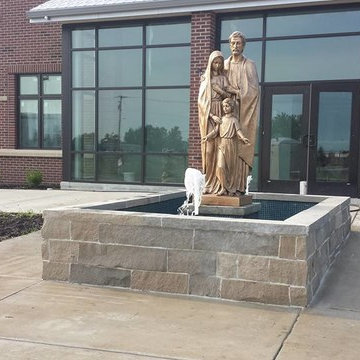
The Masons Co and Dionysian Artificers has provided historic preservation consulting and contracting services on countless structures throughout entire Midwest region including several dozen on the National Register of Historic Places. We believe that a multi-disciplinary approach to the planning of all aspects of historic preservation projects is necessary to preserve the heritage of our built environment. As active participants in the preservation community we are appreciative of the limited resources available for the preservation and maintenance of the cultural heritage embodied in historic structures. We endeavor to provide historically appropriate, sensitive, creative, and responsible solutions to the stewards of these treasures. Our solutions are applicable to the repair of all structures including, Brick, Stone, Masonry Restoration, Fountain, Water features - buildings, high-rise structures, parking structures, airports, bridges, tanks, plaza decks, and historic structures.
The Masons Co and Dionysian Artificers is an operated business which provides high quality masonry restoration and fountain repair service in the state of Arkansas, Nebraska, Des Moines IA, Memphis TN, Nashville TN, Denver Co, Oklahoma City, Springfield IL, Dallas TX, Florida and entire Midwest region. Our commitment to quality and a standard of excellence on every level is the foundation the company has been built upon. Our skilled and conscientious craftsmen specialize in the historic repair, renovation, replication and restoration of any structure we are contracted to work on. Our nearly 30 years of experience assures efficiency, safety and quality by using the proper materials and installation procedures. This unparalleled experience has earned us a reputation for providing clients with the highest quality repair and installation services available.


6