
Search results for "Reduce river" in Home Design Ideas
 Great American Landscapes
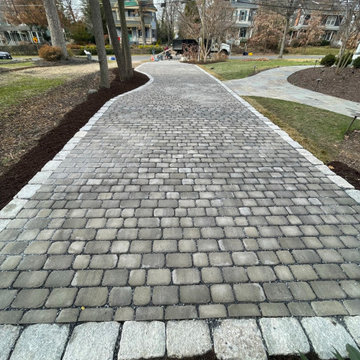
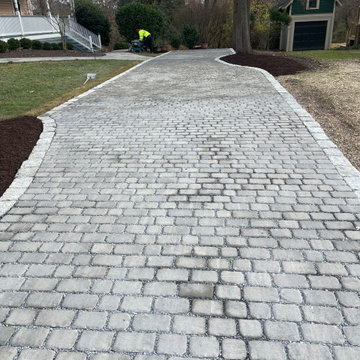
Over a span of two years we completed several projects at this Tokoma Park, Maryland property. We cleaned up the backyard, renovated an existing swale, and installed water loving plants. The following year, we replaced the old pea gravel driveway with a permeable paver driveway. While doing the driveway we encountered spongey clay that was saturated from a leaking water line. We had to install concrete piers down to virgin soil to bear the weight of the walkway. The driveway excavation had to take into account the root zones of large trees. To avoid the surface roots we used a minimal excavation design.
Our ultimate goal with this project was to ensure that the new walkways provided a safe and comfortable path for the homeowners and guest to get from their cars to porch whether parked along the street or in the driveway. To provide an extra layer of security, we added low-voltage lighting to accent trees and light the walkway, which were programmed to come on at dusk and turn off automatically at dawn.
The new plantings are native species including River Birch, Swamp Hibiscus, Blue Flag Iris, and Common Rush, that are adapted to growing in wet soils. The permeable paver driveway will reduce runoff by storing rain in gravel base while allowing it to be absorbed into the soil below. The paver surface eliminates the tracking of pea gravel into the house while allowing heels to walk on it without sinking in. The swale handles runoff from all the uphill properties and the gravel keeps it from becoming a soggy mess.
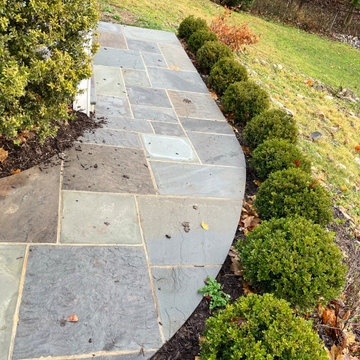
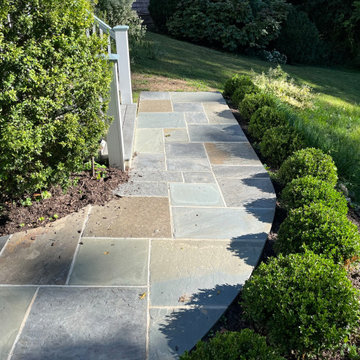
During seasonal months, snow and leaf removal are greatly eased by having a hard surface to shovel or rake. The permeable pavers used are Techo-Bloc Villagio in Shale Grey and we installed a granite Belgian block border. We replaced existing broken concrete walkway with new curving flagstone walkway and connected the front steps to the driveway and side steps. All projects were consulted with the City of Takoma Park’s Urban Forest Manager, and the Montgomery County Historical Preservation Commission.

 Good Earth Water Gardens
Granite stream with driftwood waterfall.
This is an example of a mid-sized tropical partial sun backyard gravel water fountain landscape in Kansas City for summer.
This is an example of a mid-sized tropical partial sun backyard gravel water fountain landscape in Kansas City for summer.
 Great American Landscapes
Over a span of two years we completed several projects at this Tokoma Park, Maryland property. We cleaned up the backyard, renovated an existing swale, and installed water loving plants. The following year, we replaced the old pea gravel driveway with a permeable paver driveway. While doing the driveway we encountered spongey clay that was saturated from a leaking water line. We had to install concrete piers down to virgin soil to bear the weight of the walkway. The driveway excavation had to take into account the root zones of large trees. To avoid the surface roots we used a minimal excavation design.
Our ultimate goal with this project was to ensure that the new walkways provided a safe and comfortable path for the homeowners and guest to get from their cars to porch whether parked along the street or in the driveway. To provide an extra layer of security, we added low-voltage lighting to accent trees and light the walkway, which were programmed to come on at dusk and turn off automatically at dawn.
The new plantings are native species including River Birch, Swamp Hibiscus, Blue Flag Iris, and Common Rush, that are adapted to growing in wet soils. The permeable paver driveway will reduce runoff by storing rain in gravel base while allowing it to be absorbed into the soil below. The paver surface eliminates the tracking of pea gravel into the house while allowing heels to walk on it without sinking in. The swale handles runoff from all the uphill properties and the gravel keeps it from becoming a soggy mess.
During seasonal months, snow and leaf removal are greatly eased by having a hard surface to shovel or rake. The permeable pavers used are Techo-Bloc Villagio in Shale Grey and we installed a granite Belgian block border. We replaced existing broken concrete walkway with new curving flagstone walkway and connected the front steps to the driveway and side steps. All projects were consulted with the City of Takoma Park’s Urban Forest Manager, and the Montgomery County Historical Preservation Commission.
Find the right local pro for your project

 Studio 804
The 722 Ash Street residence consists of a 1500 sf primary house with a contiguous 500 sf accessory dwelling. The project is set in the rich culture of North Lawrence, its rear property line abuts the Lawrence levee trail which runs for nine miles along the north bank of the Kansas River.
North Lawrence is known for its quality soil, large trees, curbless streets and random size parcels before it breaks into larger farms further from the urban center. It is built on the typical orthogonal grid of American development, but it represents the older growth of the city prior to urban planners and zoning regulations. The rumble of freight trains and farm trucks in the shadows of the towering grain elevators are only blocks away. It is home to many who enjoy being only a bridge crossing away from Lawrence’s vibrant downtown but are far enough away to maintain their independence from many of the restrictions on living near the historic district. They can work in their large gardens and toiling in their garages and shops in a manner more rural than urban.
The house on 722 Ash St. is imbued with the character of North Lawrence and the Levee Trail area. The design was inspired by the Midwestern farmstead vernacular of the region. These timeless vernacular qualities house all the accommodations necessary for modern, sustainable living. A unique feature of this house is the Accessory Dwelling Unit permitted in the zoning district. It is a small separate residence on the same lot that can be used for income property or for extended family members. It also supports the city of Lawrence’s goals of increased density close to downtown rather than continued sprawl into the countryside.
The buildings use technology and common-sense design to reduce the building’s footprint and assure the owners low energy use and costs. A 4.9 Kw solar collection system is located on the only south facing gable and the super insulated envelopes (r-62 roof and r-35 walls) of all three forms easily exceeds the standards. Studio 804 continues their long standing pattern of maintaining the highest level of sustainable design while remaining contextually sensitive to the surrounding community. This house, like every Studio 804 project since 2008, is USGBC LEED Platinum Certified.
 Great American Landscapes
Over a span of two years we completed several projects at this Tokoma Park, Maryland property. We cleaned up the backyard, renovated an existing swale, and installed water loving plants. The following year, we replaced the old pea gravel driveway with a permeable paver driveway. While doing the driveway we encountered spongey clay that was saturated from a leaking water line. We had to install concrete piers down to virgin soil to bear the weight of the walkway. The driveway excavation had to take into account the root zones of large trees. To avoid the surface roots we used a minimal excavation design.
Our ultimate goal with this project was to ensure that the new walkways provided a safe and comfortable path for the homeowners and guest to get from their cars to porch whether parked along the street or in the driveway. To provide an extra layer of security, we added low-voltage lighting to accent trees and light the walkway, which were programmed to come on at dusk and turn off automatically at dawn.
The new plantings are native species including River Birch, Swamp Hibiscus, Blue Flag Iris, and Common Rush, that are adapted to growing in wet soils. The permeable paver driveway will reduce runoff by storing rain in gravel base while allowing it to be absorbed into the soil below. The paver surface eliminates the tracking of pea gravel into the house while allowing heels to walk on it without sinking in. The swale handles runoff from all the uphill properties and the gravel keeps it from becoming a soggy mess.
During seasonal months, snow and leaf removal are greatly eased by having a hard surface to shovel or rake. The permeable pavers used are Techo-Bloc Villagio in Shale Grey and we installed a granite Belgian block border. We replaced existing broken concrete walkway with new curving flagstone walkway and connected the front steps to the driveway and side steps. All projects were consulted with the City of Takoma Park’s Urban Forest Manager, and the Montgomery County Historical Preservation Commission.
 Great American Landscapes
Over a span of two years we completed several projects at this Tokoma Park, Maryland property. We cleaned up the backyard, renovated an existing swale, and installed water loving plants. The following year, we replaced the old pea gravel driveway with a permeable paver driveway. While doing the driveway we encountered spongey clay that was saturated from a leaking water line. We had to install concrete piers down to virgin soil to bear the weight of the walkway. The driveway excavation had to take into account the root zones of large trees. To avoid the surface roots we used a minimal excavation design.
Our ultimate goal with this project was to ensure that the new walkways provided a safe and comfortable path for the homeowners and guest to get from their cars to porch whether parked along the street or in the driveway. To provide an extra layer of security, we added low-voltage lighting to accent trees and light the walkway, which were programmed to come on at dusk and turn off automatically at dawn.
The new plantings are native species including River Birch, Swamp Hibiscus, Blue Flag Iris, and Common Rush, that are adapted to growing in wet soils. The permeable paver driveway will reduce runoff by storing rain in gravel base while allowing it to be absorbed into the soil below. The paver surface eliminates the tracking of pea gravel into the house while allowing heels to walk on it without sinking in. The swale handles runoff from all the uphill properties and the gravel keeps it from becoming a soggy mess.
During seasonal months, snow and leaf removal are greatly eased by having a hard surface to shovel or rake. The permeable pavers used are Techo-Bloc Villagio in Shale Grey and we installed a granite Belgian block border. We replaced existing broken concrete walkway with new curving flagstone walkway and connected the front steps to the driveway and side steps. All projects were consulted with the City of Takoma Park’s Urban Forest Manager, and the Montgomery County Historical Preservation Commission.
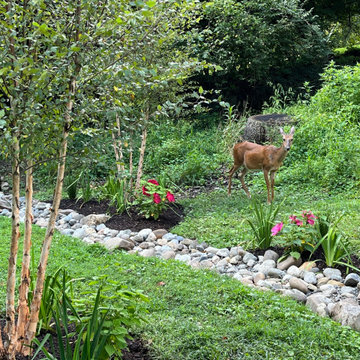 Great American Landscapes
Over a span of two years we completed several projects at this Tokoma Park, Maryland property. We cleaned up the backyard, renovated an existing swale, and installed water loving plants. The following year, we replaced the old pea gravel driveway with a permeable paver driveway. While doing the driveway we encountered spongey clay that was saturated from a leaking water line. We had to install concrete piers down to virgin soil to bear the weight of the walkway. The driveway excavation had to take into account the root zones of large trees. To avoid the surface roots we used a minimal excavation design.
Our ultimate goal with this project was to ensure that the new walkways provided a safe and comfortable path for the homeowners and guest to get from their cars to porch whether parked along the street or in the driveway. To provide an extra layer of security, we added low-voltage lighting to accent trees and light the walkway, which were programmed to come on at dusk and turn off automatically at dawn.
The new plantings are native species including River Birch, Swamp Hibiscus, Blue Flag Iris, and Common Rush, that are adapted to growing in wet soils. The permeable paver driveway will reduce runoff by storing rain in gravel base while allowing it to be absorbed into the soil below. The paver surface eliminates the tracking of pea gravel into the house while allowing heels to walk on it without sinking in. The swale handles runoff from all the uphill properties and the gravel keeps it from becoming a soggy mess.
During seasonal months, snow and leaf removal are greatly eased by having a hard surface to shovel or rake. The permeable pavers used are Techo-Bloc Villagio in Shale Grey and we installed a granite Belgian block border. We replaced existing broken concrete walkway with new curving flagstone walkway and connected the front steps to the driveway and side steps. All projects were consulted with the City of Takoma Park’s Urban Forest Manager, and the Montgomery County Historical Preservation Commission.
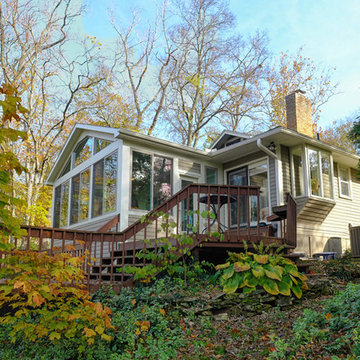
Sponsored
Westerville, OH

Custom Home Works
Franklin County's Award-Winning Design, Build and Remodeling Expert

 Kane Brothers, Inc.
Chemical-Free Natural Swim Pool Design
Example of a classic pool design in Chicago
Example of a classic pool design in Chicago
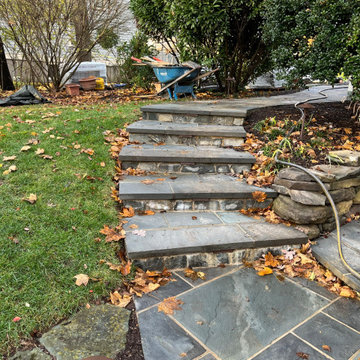 Great American Landscapes
Over a span of two years we completed several projects at this Tokoma Park, Maryland property. We cleaned up the backyard, renovated an existing swale, and installed water loving plants. The following year, we replaced the old pea gravel driveway with a permeable paver driveway. While doing the driveway we encountered spongey clay that was saturated from a leaking water line. We had to install concrete piers down to virgin soil to bear the weight of the walkway. The driveway excavation had to take into account the root zones of large trees. To avoid the surface roots we used a minimal excavation design.
Our ultimate goal with this project was to ensure that the new walkways provided a safe and comfortable path for the homeowners and guest to get from their cars to porch whether parked along the street or in the driveway. To provide an extra layer of security, we added low-voltage lighting to accent trees and light the walkway, which were programmed to come on at dusk and turn off automatically at dawn.
The new plantings are native species including River Birch, Swamp Hibiscus, Blue Flag Iris, and Common Rush, that are adapted to growing in wet soils. The permeable paver driveway will reduce runoff by storing rain in gravel base while allowing it to be absorbed into the soil below. The paver surface eliminates the tracking of pea gravel into the house while allowing heels to walk on it without sinking in. The swale handles runoff from all the uphill properties and the gravel keeps it from becoming a soggy mess.
During seasonal months, snow and leaf removal are greatly eased by having a hard surface to shovel or rake. The permeable pavers used are Techo-Bloc Villagio in Shale Grey and we installed a granite Belgian block border. We replaced existing broken concrete walkway with new curving flagstone walkway and connected the front steps to the driveway and side steps. All projects were consulted with the City of Takoma Park’s Urban Forest Manager, and the Montgomery County Historical Preservation Commission.
 Studio 804
The 722 Ash Street residence consists of a 1500 sf primary house with a contiguous 500 sf accessory dwelling. The project is set in the rich culture of North Lawrence, its rear property line abuts the Lawrence levee trail which runs for nine miles along the north bank of the Kansas River.
North Lawrence is known for its quality soil, large trees, curbless streets and random size parcels before it breaks into larger farms further from the urban center. It is built on the typical orthogonal grid of American development, but it represents the older growth of the city prior to urban planners and zoning regulations. The rumble of freight trains and farm trucks in the shadows of the towering grain elevators are only blocks away. It is home to many who enjoy being only a bridge crossing away from Lawrence’s vibrant downtown but are far enough away to maintain their independence from many of the restrictions on living near the historic district. They can work in their large gardens and toiling in their garages and shops in a manner more rural than urban.
The house on 722 Ash St. is imbued with the character of North Lawrence and the Levee Trail area. The design was inspired by the Midwestern farmstead vernacular of the region. These timeless vernacular qualities house all the accommodations necessary for modern, sustainable living. A unique feature of this house is the Accessory Dwelling Unit permitted in the zoning district. It is a small separate residence on the same lot that can be used for income property or for extended family members. It also supports the city of Lawrence’s goals of increased density close to downtown rather than continued sprawl into the countryside.
The buildings use technology and common-sense design to reduce the building’s footprint and assure the owners low energy use and costs. A 4.9 Kw solar collection system is located on the only south facing gable and the super insulated envelopes (r-62 roof and r-35 walls) of all three forms easily exceeds the standards. Studio 804 continues their long standing pattern of maintaining the highest level of sustainable design while remaining contextually sensitive to the surrounding community. This house, like every Studio 804 project since 2008, is USGBC LEED Platinum Certified.


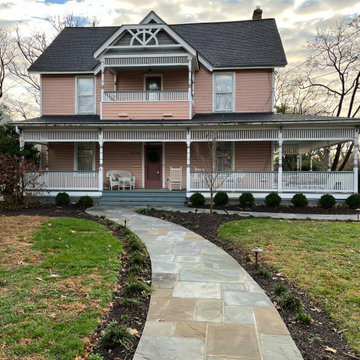 Great American Landscapes
Over a span of two years we completed several projects at this Tokoma Park, Maryland property. We cleaned up the backyard, renovated an existing swale, and installed water loving plants. The following year, we replaced the old pea gravel driveway with a permeable paver driveway. While doing the driveway we encountered spongey clay that was saturated from a leaking water line. We had to install concrete piers down to virgin soil to bear the weight of the walkway. The driveway excavation had to take into account the root zones of large trees. To avoid the surface roots we used a minimal excavation design.
Our ultimate goal with this project was to ensure that the new walkways provided a safe and comfortable path for the homeowners and guest to get from their cars to porch whether parked along the street or in the driveway. To provide an extra layer of security, we added low-voltage lighting to accent trees and light the walkway, which were programmed to come on at dusk and turn off automatically at dawn.
The new plantings are native species including River Birch, Swamp Hibiscus, Blue Flag Iris, and Common Rush, that are adapted to growing in wet soils. The permeable paver driveway will reduce runoff by storing rain in gravel base while allowing it to be absorbed into the soil below. The paver surface eliminates the tracking of pea gravel into the house while allowing heels to walk on it without sinking in. The swale handles runoff from all the uphill properties and the gravel keeps it from becoming a soggy mess.
During seasonal months, snow and leaf removal are greatly eased by having a hard surface to shovel or rake. The permeable pavers used are Techo-Bloc Villagio in Shale Grey and we installed a granite Belgian block border. We replaced existing broken concrete walkway with new curving flagstone walkway and connected the front steps to the driveway and side steps. All projects were consulted with the City of Takoma Park’s Urban Forest Manager, and the Montgomery County Historical Preservation Commission.
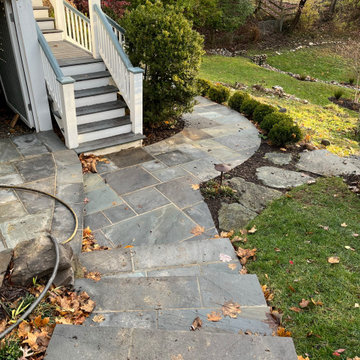 Great American Landscapes
Over a span of two years we completed several projects at this Tokoma Park, Maryland property. We cleaned up the backyard, renovated an existing swale, and installed water loving plants. The following year, we replaced the old pea gravel driveway with a permeable paver driveway. While doing the driveway we encountered spongey clay that was saturated from a leaking water line. We had to install concrete piers down to virgin soil to bear the weight of the walkway. The driveway excavation had to take into account the root zones of large trees. To avoid the surface roots we used a minimal excavation design.
Our ultimate goal with this project was to ensure that the new walkways provided a safe and comfortable path for the homeowners and guest to get from their cars to porch whether parked along the street or in the driveway. To provide an extra layer of security, we added low-voltage lighting to accent trees and light the walkway, which were programmed to come on at dusk and turn off automatically at dawn.
The new plantings are native species including River Birch, Swamp Hibiscus, Blue Flag Iris, and Common Rush, that are adapted to growing in wet soils. The permeable paver driveway will reduce runoff by storing rain in gravel base while allowing it to be absorbed into the soil below. The paver surface eliminates the tracking of pea gravel into the house while allowing heels to walk on it without sinking in. The swale handles runoff from all the uphill properties and the gravel keeps it from becoming a soggy mess.
During seasonal months, snow and leaf removal are greatly eased by having a hard surface to shovel or rake. The permeable pavers used are Techo-Bloc Villagio in Shale Grey and we installed a granite Belgian block border. We replaced existing broken concrete walkway with new curving flagstone walkway and connected the front steps to the driveway and side steps. All projects were consulted with the City of Takoma Park’s Urban Forest Manager, and the Montgomery County Historical Preservation Commission.
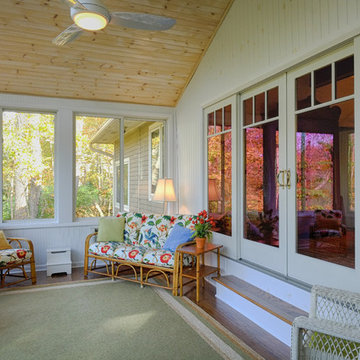
Sponsored
Westerville, OH
Custom Home Works
Franklin County's Award-Winning Design, Build and Remodeling Expert
 Studio 804
The 722 Ash Street residence consists of a 1500 sf primary house with a contiguous 500 sf accessory dwelling. The project is set in the rich culture of North Lawrence, its rear property line abuts the Lawrence levee trail which runs for nine miles along the north bank of the Kansas River.
North Lawrence is known for its quality soil, large trees, curbless streets and random size parcels before it breaks into larger farms further from the urban center. It is built on the typical orthogonal grid of American development, but it represents the older growth of the city prior to urban planners and zoning regulations. The rumble of freight trains and farm trucks in the shadows of the towering grain elevators are only blocks away. It is home to many who enjoy being only a bridge crossing away from Lawrence’s vibrant downtown but are far enough away to maintain their independence from many of the restrictions on living near the historic district. They can work in their large gardens and toiling in their garages and shops in a manner more rural than urban.
The house on 722 Ash St. is imbued with the character of North Lawrence and the Levee Trail area. The design was inspired by the Midwestern farmstead vernacular of the region. These timeless vernacular qualities house all the accommodations necessary for modern, sustainable living. A unique feature of this house is the Accessory Dwelling Unit permitted in the zoning district. It is a small separate residence on the same lot that can be used for income property or for extended family members. It also supports the city of Lawrence’s goals of increased density close to downtown rather than continued sprawl into the countryside.
The buildings use technology and common-sense design to reduce the building’s footprint and assure the owners low energy use and costs. A 4.9 Kw solar collection system is located on the only south facing gable and the super insulated envelopes (r-62 roof and r-35 walls) of all three forms easily exceeds the standards. Studio 804 continues their long standing pattern of maintaining the highest level of sustainable design while remaining contextually sensitive to the surrounding community. This house, like every Studio 804 project since 2008, is USGBC LEED Platinum Certified.
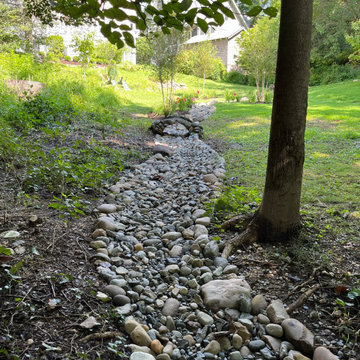 Great American Landscapes
Over a span of two years we completed several projects at this Tokoma Park, Maryland property. We cleaned up the backyard, renovated an existing swale, and installed water loving plants. The following year, we replaced the old pea gravel driveway with a permeable paver driveway. While doing the driveway we encountered spongey clay that was saturated from a leaking water line. We had to install concrete piers down to virgin soil to bear the weight of the walkway. The driveway excavation had to take into account the root zones of large trees. To avoid the surface roots we used a minimal excavation design.
Our ultimate goal with this project was to ensure that the new walkways provided a safe and comfortable path for the homeowners and guest to get from their cars to porch whether parked along the street or in the driveway. To provide an extra layer of security, we added low-voltage lighting to accent trees and light the walkway, which were programmed to come on at dusk and turn off automatically at dawn.
The new plantings are native species including River Birch, Swamp Hibiscus, Blue Flag Iris, and Common Rush, that are adapted to growing in wet soils. The permeable paver driveway will reduce runoff by storing rain in gravel base while allowing it to be absorbed into the soil below. The paver surface eliminates the tracking of pea gravel into the house while allowing heels to walk on it without sinking in. The swale handles runoff from all the uphill properties and the gravel keeps it from becoming a soggy mess.
During seasonal months, snow and leaf removal are greatly eased by having a hard surface to shovel or rake. The permeable pavers used are Techo-Bloc Villagio in Shale Grey and we installed a granite Belgian block border. We replaced existing broken concrete walkway with new curving flagstone walkway and connected the front steps to the driveway and side steps. All projects were consulted with the City of Takoma Park’s Urban Forest Manager, and the Montgomery County Historical Preservation Commission.
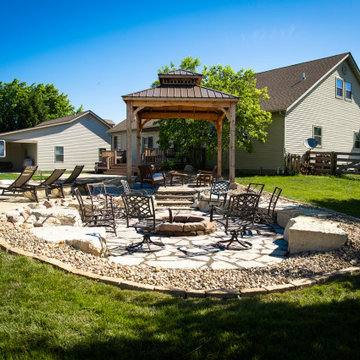

 Great American Landscapes
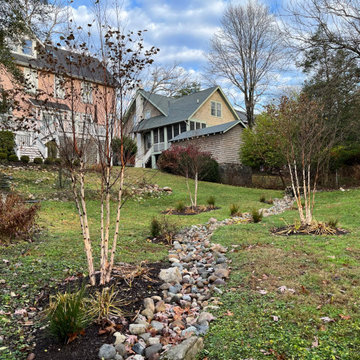
Over a span of two years we completed several projects at this Tokoma Park, Maryland property. We cleaned up the backyard, renovated an existing swale, and installed water loving plants. The following year, we replaced the old pea gravel driveway with a permeable paver driveway. While doing the driveway we encountered spongey clay that was saturated from a leaking water line. We had to install concrete piers down to virgin soil to bear the weight of the walkway. The driveway excavation had to take into account the root zones of large trees. To avoid the surface roots we used a minimal excavation design.
Our ultimate goal with this project was to ensure that the new walkways provided a safe and comfortable path for the homeowners and guest to get from their cars to porch whether parked along the street or in the driveway. To provide an extra layer of security, we added low-voltage lighting to accent trees and light the walkway, which were programmed to come on at dusk and turn off automatically at dawn.
The new plantings are native species including River Birch, Swamp Hibiscus, Blue Flag Iris, and Common Rush, that are adapted to growing in wet soils. The permeable paver driveway will reduce runoff by storing rain in gravel base while allowing it to be absorbed into the soil below. The paver surface eliminates the tracking of pea gravel into the house while allowing heels to walk on it without sinking in. The swale handles runoff from all the uphill properties and the gravel keeps it from becoming a soggy mess.
During seasonal months, snow and leaf removal are greatly eased by having a hard surface to shovel or rake. The permeable pavers used are Techo-Bloc Villagio in Shale Grey and we installed a granite Belgian block border. We replaced existing broken concrete walkway with new curving flagstone walkway and connected the front steps to the driveway and side steps. All projects were consulted with the City of Takoma Park’s Urban Forest Manager, and the Montgomery County Historical Preservation Commission.
 Great American Landscapes
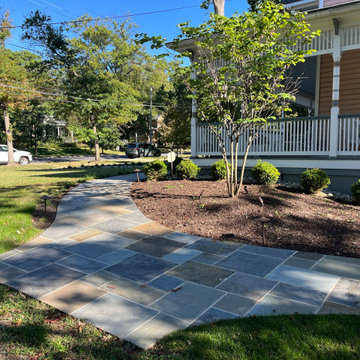
Over a span of two years we completed several projects at this Tokoma Park, Maryland property. We cleaned up the backyard, renovated an existing swale, and installed water loving plants. The following year, we replaced the old pea gravel driveway with a permeable paver driveway. While doing the driveway we encountered spongey clay that was saturated from a leaking water line. We had to install concrete piers down to virgin soil to bear the weight of the walkway. The driveway excavation had to take into account the root zones of large trees. To avoid the surface roots we used a minimal excavation design.
Our ultimate goal with this project was to ensure that the new walkways provided a safe and comfortable path for the homeowners and guest to get from their cars to porch whether parked along the street or in the driveway. To provide an extra layer of security, we added low-voltage lighting to accent trees and light the walkway, which were programmed to come on at dusk and turn off automatically at dawn.
The new plantings are native species including River Birch, Swamp Hibiscus, Blue Flag Iris, and Common Rush, that are adapted to growing in wet soils. The permeable paver driveway will reduce runoff by storing rain in gravel base while allowing it to be absorbed into the soil below. The paver surface eliminates the tracking of pea gravel into the house while allowing heels to walk on it without sinking in. The swale handles runoff from all the uphill properties and the gravel keeps it from becoming a soggy mess.
During seasonal months, snow and leaf removal are greatly eased by having a hard surface to shovel or rake. The permeable pavers used are Techo-Bloc Villagio in Shale Grey and we installed a granite Belgian block border. We replaced existing broken concrete walkway with new curving flagstone walkway and connected the front steps to the driveway and side steps. All projects were consulted with the City of Takoma Park’s Urban Forest Manager, and the Montgomery County Historical Preservation Commission.

 Aerate 1 Landscaping & Ponds, Inc
Photo of a mid-sized traditional full sun backyard stone pond in Chicago for spring.
18