
Search results for "Smart home technology" in Home Design Ideas


 Glenn Layton Homes
HGTV Smart Home 2013 by Glenn Layton Homes, Jacksonville Beach, Florida.
Large island style master dark wood floor and brown floor bedroom photo in Jacksonville with white walls and no fireplace
Large island style master dark wood floor and brown floor bedroom photo in Jacksonville with white walls and no fireplace

 Fran Kerzner- DESIGN SYNTHESIS
Inspiration for a mid-sized contemporary l-shaped porcelain tile open concept kitchen remodel in Los Angeles with a drop-in sink, flat-panel cabinets, medium tone wood cabinets, solid surface countertops, white backsplash, stainless steel appliances and an island
Find the right local pro for your project


 Systems Design & Integration, Inc.
In this house, we prewired and installed for whole house audio, home automation, outdoor audio, network, and surveillance. We worked in collaboration with International Builders on this project.
Photo credit to: Dan Cutrona
 N Sabella Inc
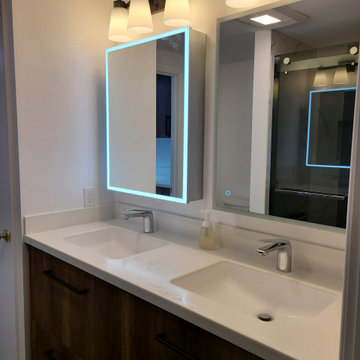
Smart technology was incorporated into this Needham bathroom remodel as part of a whole house overhaul. The client was looking for a clean, modern look while maximizing space. Lighting was critical as there are no windows in this pass-through bathroom. The mirror uses an environmentally-friendly LED light strip which reduces energy waste. Also, the backlit design is a natural and soft light, your eyes can easily adapt and is more suitable for makeup. There is a USB port and two additional outlets inside. An organizer on the first shelf keeps clutter off the counter.

 Integrated Smart Technologies, Inc.
Inspiration for a large timeless enclosed home theater remodel in Grand Rapids with beige walls and a projector screen
Sponsored
Plain City, OH

The Creative Kitchen Company
Columbus Area Kitchen Remodeling and Refacing Professional

 Cloud9 Smart
Jordan Wills
Mid-sized country home bar photo in New York with open cabinets, wood countertops and glass sheet backsplash
Mid-sized country home bar photo in New York with open cabinets, wood countertops and glass sheet backsplash

 Vitrea Smart Home Technologies
This ultra-modern Tel Aviv loft is fully equipped with Vitrea's VTouch Plus smart home system. The homeowner decided to add extra contrast with splashes of yellow. The black bookshelves add an eye-catching element and customized black glass switches from Vitrea mounted on the white walls compliments the design further.

 Xtend Technologies
Inspiration for a mid-sized craftsman enclosed carpeted family room library remodel in Cleveland with gray walls, a standard fireplace, a stone fireplace and a wall-mounted tv
 Integrated Smart Technologies, Inc.
Home theater - mid-sized traditional enclosed carpeted home theater idea in Grand Rapids with beige walls and a projector screen
 Electronic Design & Consulting, Inc.
This article is posted here with the consent of the author. The views and opinions expressed in this article are those of the author and do not necessarily reflect the official policy, position, view, or opinion of Crestron Electronics, Inc., or of any of its employees. Crestron Electronics is not responsible for, and does not verify the accuracy of, any of the information contained in this article.
By Jeff Singer
The “smart” revolution began several years ago with smartphones (a.k.a phones) and has extended in recent years to thermostats, doorbells, alarm systems, and kitchen appliances. Smart devices are so ubiquitous that the term “smart” is overused to the point that it is almost meaningless. Companies are eager to jump on the bandwagon and claim their products are “smart,” and consumers proudly claim they have a smart home because they have lighting control. Misconceptions about smart homes are prevalent and create confusion in the marketplace. This can have deleterious effects on businesses and underserve consumers. Here are seven of the most popular misconceptions about smart homes:
1. Apps are smart
Apps are convenient and easy to use. Yes, it seems there’s an app for everything. People expect to be able to download an app and do just about anything. App developers and many companies do not disavow consumers of this myth. On the contrary, they promote this idea with carefully worded descriptions. The promise of having the world at your fingertips for $1.99 is very enticing. Although it sounds too good to be true, it is also too good to pass up for many people. This leads to undervaluing home control and disappointment when the apps don’t work, which undermines confidence in our industry. The fact is that apps are not smart. They do not control anything. They must connect to and communicate with a control system or cloud service that processes, prioritizes, and executes commands. That’s the real magic and what most people do not understand.
2. Smart devices work together
With so many smart appliances and devices on the market today, it’s understandable that the average consumer might think that they actually communicate and work together. This is simply not the case. Smart devices are not that smart. They are designed and manufactured by different, often competing, companies. There are no national or industry standards governing these products. Even if they all operate using Wi-Fi® communications, that doesn’t mean they work together. Some companies promote a home control platform, which unites different devices from different companies – in theory. The platform is yet another third-party software totally dependent on other companies developing APIs and writing control modules for their hardware to run on that piece of software. The devices are not independently compatible. Also, when updates are made to either the hardware or the software, functionality may be affected for some period. That’s a nice way of saying the device or system won’t work and there’s no way of knowing for how long.
3. It’s a DIY project
Which brings us to the next myth, which is that the average person can do it themselves. Unless you are a skilled professional, I would not advise taking on a smart home project. You want to make a light turn on and off with your Alexa® or Google Assistant™ virtual assistant software, go for it. A smart home takes much more planning and expertise. I have no problem changing a light bulb or hanging a light fixture in my dining room; however, I am not going to rewire my house. I may change the flush valve in my toilet, but I’m not going to replace the pipes in my house. You get it. Integrating devices and systems, establishing different zones, creating scenes, designing the UI with a balance between control, feedback, and simplicity – all takes experience and skill.
4. Need a programmer to make changes
Early adopters may have experienced the pain of trying to make a simple change or update to their home control system. Years ago, if the cable provider changed the channel line-up, the homeowner would have to call the dealer or programmer to make an appointment for them to come out to the house to reprogram the system. The system wouldn’t work as expected until it was updated, which often took several days and beaucoup bucks. Not anymore. Technology has evolved so now it’s easy for system owners to change favorite channels, create scenes, rename buttons, update images, and more. While a professional is needed for the initial installation and setup, the system is easy to manage once it’s up and running. This makes life so much easier for both dealer and customer.
5. Tech becomes obsolete quickly
Similar to updating the UI, updating firmware or hardware used to be a stressful process. A smart home should be intelligent enough to update itself. Apps don’t become obsolete. Updates are constantly pushed out from the cloud, making them better all the time. The same is true for a good smart home system. New features, functions, and device support gets added in the background consistently, so the system you installed (or purchased) yesterday gets better over time. Swapping out decorative elements, such as keypads, dimmers, and touch screens is also seamless. When a new device is added, all the settings are pulled down from the cloud and it just works. No system interruptions. No sunk costs. No imposing house calls. No surprise bills.
6. Lighting control saves energy and money
Lighting control is one of the most popular smart systems, but it takes more than just one system to make a home smart. On the surface, it makes sense that if you dim the lights ten percent, then you save ten percent of energy costs. If the shades are raised during the day to take advantage of sunlight so the lights don’t need to be on (or at least not 100%), but that causes the room temperature to rise a few degrees, which triggers the air conditioner to run longer and more often, was energy usage (or cost) reduced? A smart home integrates all the various systems and technology to optimize comfort, convenience, safety, and sometimes energy.
7. Home technology is easy to hack
Security is at the forefront of people’s minds these days. Personal identities are stolen; email accounts hacked; private photos publicized; and more. A smart home must outsmart those who don’t respect privacy. Crestron control systems adhere to the strictest security standards. The same Crestron control system that goes into a home is also installed in secure government and military facilities, global banking institutions, hospitals, and other mission critical applications. When installed correctly by a trained professional, a Crestron smart home is the gold standard for security, comfort, and convenience.

 iQuarters
Of course, all of these slick features are made all the better with powerful and user-friendly controls. The Savant mobile app is the master control over everything. From it this customer can easily control:
Audio
Video
Lighting
Climate control
Imagine sitting on your couch with a drink, and from your smartphone or tablet dimming the lights, adjusting the temperature, playing some music, and then switching on the TV.
For this particular setup, we created a number of Savant scenes, including “Welcome Home” and “Goodbye”. The Welcome Home preset, for example, turns on lights, adjusts the temperature (cooler in summer, warmer in winter), and plays some relaxing tunes throughout the house.
iPad control of home through Savant Automation
Sponsored
Sunbury, OH

J.Holderby - Renovations
Franklin County's Leading General Contractors - 2X Best of Houzz!

 Integrated Smart Technologies, Inc.
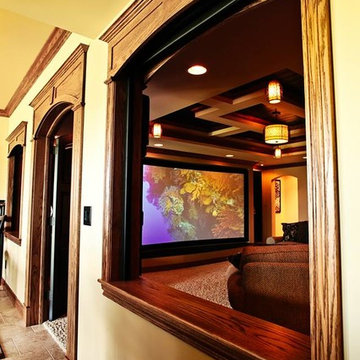
Home design - large traditional enclosed home design idea in Grand Rapids with beige walls and a projector screen


 Barrett's Technology Solutions
With comfortable seating, surround sound by Bowers and Wilkins, projection by Sony and a recessed TV by Seura, this hard to resist theater is sure to delight all.
Sponsored
Columbus, OH

EverHome Improvement & Design
Top Choice for Reliable Tile & Stone | Franklin County, Ohio
 Systems Design & Integration, Inc.
In this house, we prewired and installed for whole house audio, home automation, outdoor audio, network, and surveillance. We worked in collaboration with International Builders on this project.
Photo credit to: Dan Cutrona
 Barrett's Technology Solutions
Bowers and Wilkens
Inspiration for a modern home theater remodel in Chicago
Inspiration for a modern home theater remodel in Chicago

23