
Search results for "Water lee" in Home Design Ideas
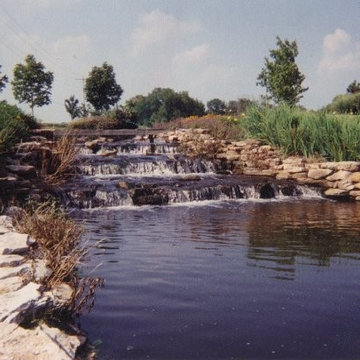
 The Masons Co and Dionysian Artificers Landscape
We are an elite KANSAS CITY landscaping design, waterfeture,/ fountains landscape paver installation company with over 20 years of experience. The Landscape Company Kansas City is engaged in the landscape design KANSAS CITY, planning, landscape installation Kansas City area and development of residential, commercial and industrial establishments, bounded by a belief in hardwork, expertise, and professionalism in the specialized field of landscaping. LANDSCAPE WATERFEATURS , BRICK MASONRY REPAIR
We are known for our exceptional, outstanding landscape design in KANSAS CITY area and quality workmanship. We are a Certified Landscape installations kansas City. We are specializing in Landscape design, Landscape patio, Landscape stone/brick kansas city, Fountian, LANDSCAPE Water Garden, LANDSCAPE Stone Retaining walls in Kansas city
Kansas City Landscape & Design offers landscape design and install landscaping, landscape retaining walls, outdoor firepits, outdoor fireplaces, built in bbq grills, bbq grills, outdoor patios, low voltage lighting, driveways, retaining walls, landscape lighting, brick pavers, concrete pavers, outside fireplaces, outdoor water features, ponds, Landscape outdoor kitchens, outdoor lighting, water features, flagstone patios, Landscape patio pavers, pools and spas in Kansas City, Shawnee, Overland Park, Bonner Springs, Leawood, Olathe, Mission Hills, Lenexa, Prairie Village, Lee’s Summit, Blue Springs, Liberty, Raymore, Raytown, Independence, Belton, Gladstone, Lansing, Wichita, North Kansas City, Kansas City Masonry / Kansas City Fountain,landscape water feature fountain
Landscape Design & Installation Service
Exterior Landscaping (Hardscape & Softscape)
Interior Landscaping
Waterfalls / Water Features / Fountains / Pond / Pool Installation
New Residential Landscaping ( large or small )
Commercial Landscaping
Garden Renovation / Improvement / Restoration
Landscape Design & Development
Landscape Irrigation Installation
Landscape Maintenance
Landscape / Garden Outdoor Lighting Installation
Outdoor Construction, Masonry & Concrete Work
Pavers / Paver Patio
Drainage Solutions
Outdoor Kitchens
Outdoor Fireplace / Firepit
Porous Pave
Landscape Retaining Walls
Patio Stone & Pavers
Seeding & Sodding
Retail Plant Center / Plantings
Wetland Mitigation
Woodland restoration
Erosion Control
Landscape Lighting

 Elms Interior Design
Photography by Michael J. Lee Photography
Large beach style l-shaped open concept kitchen photo in Boston with shaker cabinets, white cabinets, marble countertops, white backsplash, marble backsplash, two islands and white countertops
Large beach style l-shaped open concept kitchen photo in Boston with shaker cabinets, white cabinets, marble countertops, white backsplash, marble backsplash, two islands and white countertops

 LeichtUSA
Floor-to-ceiling windows and striking pillars dominate the
lounge area on the ground floor which generously opens
up to the outside. The architect was inspired by the work
of Le Corbusier and thus created a flowing, intermingling
room arrangement. The numerous comfortable seating
possibilities are inviting and communicative: this is where
several people come together or where more discreet
meetings take place. The water landscape outside is refreshing and is part of the ingenious climate concept the
building is based on. Photo: Kuo-Min Lee
Find the right local pro for your project

 Sally Scott Interior Designer
This exquisite and luxurious master bedroom provides the perfect escape after a sun drenched day. Opulent bedding, cozy swivel chairs and an unexpected funky tiled fireplace are just a few of the interesting elements to this room. Need a late night TV fix??? Jut open the doors above the fireplace! The Lee Jofa floral linen drapery draws your view to the water beyond the comfortable deck. Sweet dreams!
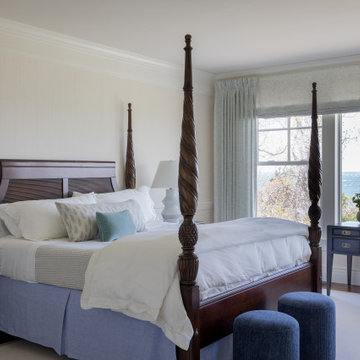 Elms Interior Design
Photography by Michael J. Lee Photography
Example of a mid-sized beach style guest dark wood floor bedroom design in Boston with beige walls
Example of a mid-sized beach style guest dark wood floor bedroom design in Boston with beige walls
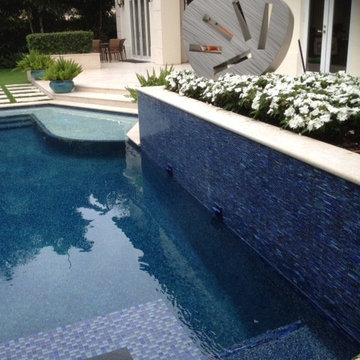
 Kendall Marcelle Design Assoc. Inc.
lee industries
John Stillman
Inspiration for a transitional pool remodel in Miami
Inspiration for a transitional pool remodel in Miami
 LeichtUSA
The amoebic shape as well as the façade with its significant projections make it virtually impossible for
the onlooker to take in the whole building on first sight. But this fluid type of construction makes you
want to see the inside: it is meant to make inhabitants want to leave their own apartments to get in touch
with their neighbours. It was correspondingly important for the architect to create plenty of space for
regeneration with expansive areas of water and lots of green. The second level is home to spa areas
and a pool. Photo: Kuo-Min Lee

 Elms Interior Design
Photography by Michael J. Lee Photography
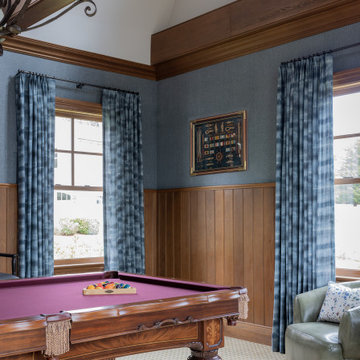
Inspiration for a large coastal enclosed carpeted, exposed beam and wallpaper living room remodel in Boston with a music area, gray walls and no tv
Inspiration for a large coastal enclosed carpeted, exposed beam and wallpaper living room remodel in Boston with a music area, gray walls and no tv

 Lee Anne Cowart Interiors
Large cottage chic backyard brick and rectangular lap pool fountain photo in Atlanta


 Elms Interior Design
Photography by Michael J. Lee Photography
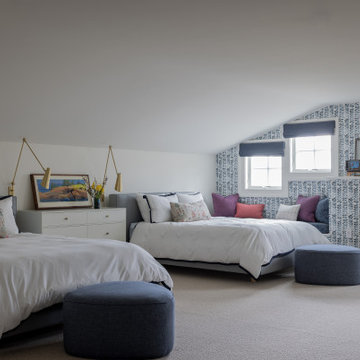
Inspiration for a large coastal guest carpeted, gray floor, vaulted ceiling and wallpaper bedroom remodel in Boston with blue walls
Inspiration for a large coastal guest carpeted, gray floor, vaulted ceiling and wallpaper bedroom remodel in Boston with blue walls
 Elms Interior Design
Photography by Michael J. Lee Photography
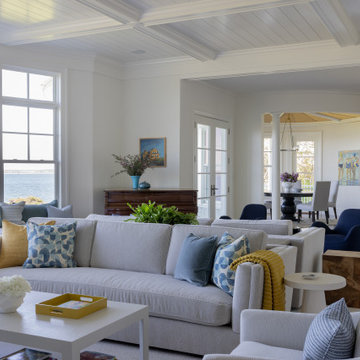
Living room - large coastal enclosed dark wood floor and coffered ceiling living room idea in Boston with white walls, a standard fireplace and a stone fireplace
Living room - large coastal enclosed dark wood floor and coffered ceiling living room idea in Boston with white walls, a standard fireplace and a stone fireplace

 Thomas Lee Fisher Landscaping
Example of a large trendy backyard stone patio design in Philadelphia with a gazebo
Sponsored
Sunbury, OH

J.Holderby - Renovations
Franklin County's Leading General Contractors - 2X Best of Houzz!

 Envision Web
Stuart Wade, Envision Virtual Tours
The second-largest and most developed of Georgia's barrier islands, St. Simons is approximately twelve miles long and nearly three miles wide at its widest stretch (roughly the size of Manhattan Island in New York). The island is located in Glynn County on Georgia's coast and lies east of Brunswick (the seat of Glynn County), south of Little St. Simons Island and the Hampton River, and north of Jekyll Island. The resort community of Sea Island is separated from St. Simons on the east by the Black Banks River. Known for its oak tree canopies and historic landmarks, St. Simons is both a tourist destination and, according to the 2010 U.S. census, home to 12,743 residents.
Early History
The earliest
St. Simons Island Village
record of human habitation on the island dates to the Late Archaic Period, about 5,000 to 3,000 years ago. Remnants of shell rings left behind by Native Americans from this era survive on many of the barrier islands, including St. Simons. Centuries later, during the period known by historians as the chiefdom era, the Guale Indians established a chiefdom centered on St. Catherines Island and used St. Simons as their hunting and fishing grounds. By 1500 the Guale had established a permanent village of about 200 people on St. Simons, which they called Guadalquini.
Beginning in 1568, the Spanish attempted to create missions along the Georgia coast. Catholic missions were the primary means by which Georgia's indigenous Native American chiefdoms were assimilated into the Spanish colonial system along the northern frontier of greater Spanish Florida. In the 1600s St. Simons became home to two Spanish missions: San Buenaventura de Guadalquini, on the southern tip of the island, and Santo Domingo de Asao (or Asajo), on the northern tip. Located on the inland side of the island were the pagan refugee villages of San Simón, the island's namesake, and Ocotonico. In 1684 pirate raids left the missions and villages largely abandoned.
Colonial History
As
Fort Frederica
early as 1670, with Great Britain's establishment of the colony of Carolina and its expansion into Georgia territory, Spanish rule was threatened by the English. The Georgia coast was considered "debatable land" by England and Spain, even though Spain had fully retreated from St. Simons by 1702. Thirty-one years later General James Edward Oglethorpe founded the English settlement of Savannah. In 1736 he established Fort Frederica, named after the heir to the British throne, Frederick Louis, prince of Wales, on the west side of St. Simons Island to protect Savannah and the Carolinas from the Spanish threat.
Between 1736 and 1749 Fort Frederica was the hub of British military operations along the Georgia frontier. A town of the same name grew up around the fort and was of great importance to the new colony. By 1740 Frederica's population was 1,000. In 1736 the congregation of what would become Christ Church was organized within Fort Frederica as a mission of the Church of England. Charles Wesley led the first services. In 1742 Britain's decisive victory over Spain in the Battle of Bloody Marsh, during the War of Jenkins' Ear, ended the Spanish threat to the Georgia coast. When the British regimen disbanded in 1749, most of the townspeople relocated to the mainland. Fort Frederica went into decline and, except for a short time of prosperity during the 1760s and 1770s under the leadership of merchant James Spalding, never fully recovered. Today the historic citadel's tabby ruins are maintained by the National Park Service.
Plantation Era
By the start of the American Revolution (1775-83), Fort Frederica was obsolete, and St. Simons was left largely uninhabited as most of its residents joined the patriot army. Besides hosting a small Georgia naval victory on the Fort Frederica River, providing guns from its famous fort for use at Fort Morris in Sunbury, and serving as an arena for pillaging by privateers and British soldiers, the island played almost no role in the war.
Following the war, many of the townspeople, their businesses destroyed, turned to agriculture. The island was transformed into fourteen cotton plantations after acres of live oak trees were cleared for farm land and used for building American warships, including the famous USS Constitution, or "Old Ironsides." Although rice was the predominant crop along the neighboring Altamaha River, St. Simons was known for its production of long-staple cotton, which soon came to be known as Sea Island cotton.
Between
Ebos Landing
the 1780s and the outbreak of the Civil War (1861-65), St. Simons's plantation culture flourished. The saline atmosphere and the availability of cheap slave labor proved an ideal combination for the cultivation of Sea Island cotton. In 1803 a group of Ebo slaves who survived the Middle Passage and arrived on the west side of St. Simons staged a rebellion and drowned themselves. The sacred site is known today as Ebos Landing.
One of the largest owners of land and slaves on St. Simons was Pierce Butler, master of Hampton Point Plantation, located on the northern end of the island. By 1793 Butler owned more than 500 slaves, who cultivated 800 acres of cotton on St. Simons and 300 acres of rice on Butler's Island in the Altamaha River delta. Butler's grandson, Pierce Mease Butler, who at the age of sixteen inherited a share of his grandfather's estate in 1826, was responsible for the largest sale of human beings in the history of the United States: in 1859, to restore his squandered fortune, he sold 429 slaves in Savannah for more than $300,000. The British actress and writer Fanny Kemble, whose tumultuous marriage to Pierce ended in divorce in 1849, published an eyewitness account of the evils of slavery on St. Simons in her book Journal of a Residence on a Georgian Plantation in 1838-1839 (1863).
Another
Retreat Plantation
large owner of land and slaves on St. Simons was Major William Page, a friend and employee of Pierce Butler Sr. Before purchasing Retreat Plantation on the southwestern tip of the island in 1804, Page managed the Hampton plantation and Butler's Island. Upon Page's death in 1827, Thomas Butler King inherited the land together with his wife, Page's daughter, Anna Matilda Page King. King expanded his father-in-law's planting empire on St. Simons as well as on the mainland, and by 1835 Retreat Plantation alone was home to as many as 355 slaves.
The center of life during the island's plantation era was Christ Church, Frederica. Organized in 1807 by a group of island planters, the Episcopal church is the second oldest in the Diocese of Georgia. Embargoes imposed by the War of 1812 (1812-15) prevented the parishioners from building a church structure, so they worshiped in the home of John Beck, which stood on the site of Oglethorpe's only St. Simons residence, Orange Hall.
The first Christ Church building, finished on the present site in 1820, was ruined by occupying Union troops during the Civil War. In 1884 the Reverend Anson Dodge Jr. rebuilt the church as a memorial to his first wife, Ellen. The cruciform building with a trussed gothic roof and stained-glass windows remains active today as Christ Church.
Civil War and Beyond
The
St. Simons Island Lighthouse
outbreak of the Civil War in 1861 put a sudden end to St. Simons's lucrative plantation era. In January of that year, Confederate troops were stationed at the south end of the island to guard the entrance to Brunswick Harbor. Slaves from Retreat Plantation, owned by Thomas Butler King, built earthworks and batteries. Plantation residents were scattered—the men joined the Confederate army and their families moved to the mainland. Cannon fire was heard on the island in December 1861, and Confederate troops retreated in February 1862, after dynamiting the lighthouse to keep its beacon from aiding Union troops. Soon thereafter, Union troops occupied the island, which was used as a camp for freed slaves. By August 1862 more than 500 former slaves lived on St. Simons, including Susie King Taylor, who organized a school for freed slave children. But in November the ex-slaves were taken to Hilton Head, South Carolina, and Fernandina, Florida, leaving the island abandoned.
After the Civil War the island never returned to its status as an agricultural community. The plantations lay dormant because there were no slaves to work the fields. After Union general William T. Sherman's January 1865 Special Field Order No. 15 —a demand that former plantations be divided and distributed to former slaves—was overturned by U.S. president Andrew Johnson less than a year later, freedmen and women were forced to work as sharecroppers on the small farms that dotted the land previously occupied by the sprawling plantations.
By
St. Simons Lumber Mills
1870 real economic recovery began with the reestablishment of the timber industry. Norman Dodge and Titus G. Meigs of New York set up lumber mill operations at Gascoigne Bluff, formerly Hamilton Plantation. The lumber mills provided welcome employment for both blacks and whites and also provided mail and passenger boats to the mainland. Such water traffic, together with the construction of a new lighthouse in 1872, designed by architect Charles B. Cluskey, marked the beginning of St. Simons's tourism industry. The keeper of the lighthouse created a small amusement park, which drew many visitors, as did the seemingly miraculous light that traveled from the top of the lighthouse tower to the bottom. The island became a summer retreat for families from the mainland, particularly from Baxley, Brunswick, and Waycross.
The island's resort industry was thriving by the 1880s. Beachfront structures, such as a new pier and grand hotel, were built on the southeastern end of the island and could be accessed by ferry. Around this time wealthy northerners began vacationing on the island.
Twentieth Century
The
St. Simons Island Pier and Village
opening in 1924 of the Brunswick–St. Simons Highway, today known as the Torras Causeway, was a milestone in the development of resorts in the area. St. Simons's beaches were now easily accessible to locals and tourists alike. More than 5,000 automobiles took the short drive from Brunswick to St. Simons via the causeway on its opening day, paving the way for convenient residential and resort development.
In 1926 automotive pioneer Howard Coffin of Detroit, Michigan, bought large tracts of land on St. Simons, including the former Retreat Plantation, and constructed a golf course, yacht club, paved roads, and a residential subdivision. Although the causeway had brought large numbers of summer people to the island, St. Simons remained a small community with only a few hundred permanent residents until the 1940s.
The
St. Simons Island
outbreak of World War II (1941-45) brought more visitors and residents to St. Simons. Troops stationed at Jacksonville, Florida; Savannah; and nearby Camp Stewart took weekend vacations on the island, and a new naval air base and radar school became home to even more officers and soldiers. The increased wartime population brought the island its first public school. With a major shipyard for the production of Liberty ships in nearby Brunswick, the waters of St. Simons became active with German U-boats. In April 1942, just off the coast, the Texas Company oil tanker S. S. Oklahoma and the S. S. Esso Baton Rouge were torpedoed by the Germans, bringing the war very close to home for island residents.
Due in large part to the military's improvement of the island's infrastructure during the war, development on the island boomed in the 1950s and 1960s. More permanent homes and subdivisions were built, and the island was no longer just a summer resort but also a thriving community. In 1950 the Methodist conference and retreat center Epworth by the Sea opened on Gascoigne Bluff. In 1961 novelist Eugenia Price visited St. Simons and began work on her first works of fiction, known as the St. Simons Trilogy. Inspired by real events on the island, Price's trilogy renewed interest in the history of Georgia's coast, and the novelist herself relocated to the island in 1965 and lived there for thirty-one years. St. Simons is also home to contemporary Georgia writer Tina McElroy Ansa.
Since
Epworth by the Sea
1980 St. Simons's population has doubled. The island's continued status as a vacation destination and its ongoing development boom have put historic landmarks and natural areas at risk. While such landmarks as the Fort Frederica ruins and the Battle of Bloody Marsh site are preserved and maintained by the National Park Service, and while the historic lighthouse is maintained by the Coastal Georgia Historical Society, historic Ebos Landing has been taken over by a sewage treatment plant.
Several coastal organizations have formed in recent years to save natural areas on the island. The St. Simons Land Trust, for example, has received donations of large tracts of land and plans to protect property in the island's three traditional African American neighborhoods. Despite its rapid growth and development, St. Simons remains one of the most beautiful and important islands on the Georgia coast.
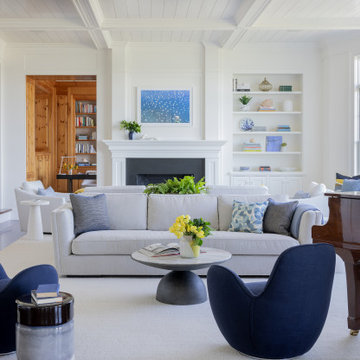 Elms Interior Design
Photography by Michael J. Lee Photography
Inspiration for a huge coastal formal and open concept dark wood floor and coffered ceiling living room remodel in Boston with white walls, a standard fireplace, a stone fireplace and no tv
Inspiration for a huge coastal formal and open concept dark wood floor and coffered ceiling living room remodel in Boston with white walls, a standard fireplace, a stone fireplace and no tv

 Broadway Botanicals
Custom wood slab bench designed by Dorie Swanson and created by: Lee J. Braun woodwork and Moe the metal guy. Updated lighting fixtures finish off the new entry way.
 LeichtUSA
The amoebic shape as well as the façade with its significant projections make it virtually impossible for
the onlooker to take in the whole building on first sight. But this fluid type of construction makes you
want to see the inside: it is meant to make inhabitants want to leave their own apartments to get in touch
with their neighbours. It was correspondingly important for the architect to create plenty of space for
regeneration with expansive areas of water and lots of green. The second level is home to spa areas
and a pool. Photo: Kuo-Min Lee

 LeichtUSA
Enjoying in an elegant atmosphere
Everything flows in the Community Clubhouse of architect Keng Fu Lo. The kitchen by LEICHT is the focus and enjoys a seamless transition into the lounge.
The Community Clubhouse, located in a residential building in Tainan, offers its residents spacious
rooms for relaxation and joint activities on three floors; spa areas are just as important as yoga rooms
and a shared kitchen by LEICHT. Embedded in a complex ecosystem, the Clubhouse is operated
energy-efficiently and is surrounded by a water landscape and lush trees. The architect‘s main concern
was to create a building in which nature and inhabited space merge.
Photo: Kuo-Min Lee

 Pamela Copeman Design Group
, Interior Design
Photography, Jean Donohue
Bedroom - traditional bedroom idea in Boston
Bedroom - traditional bedroom idea in Boston
 Sally Scott Interior Designer
This exquisite and luxurious master bedroom provides the perfect escape after a sun drenched day. Opulent bedding, cozy swivel chairs and an unexpected funky tiled fireplace are just a few of the interesting elements to this room. Need a late night TV fix??? Jut open the doors above the fireplace! The Lee Jofa floral linen drapery draws your view to the water beyond the comfortable deck. Sweet dreams!
30