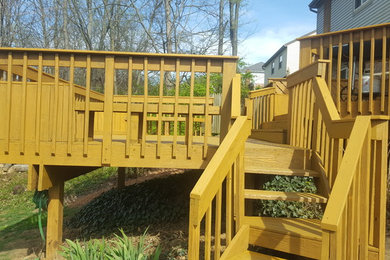
We used Brian and his crew in August. We had been referred to them by a pesticide company. We had called the pesticide company because we were having a problem with carpenter bees. We had inherited them. They had been swarming our house -- specifically, along one side of the house -- since we bought it in 2000. Over the years we had tried a variety of remedies -- hiring exterminators (they spent two years making half-hearted attempts to eliminate the bees), applying pesticides on our own, etc. -- all to no avail. Ultimately, I decided to try again. I contacted ANOTHER pesticide company. When they heard what we had done in the past to eliminate the bees, they suggested I contact Brian. Their belief was: Unless caught in the beginning, carpenter bees are nearly impossible to eliminate. The bees burrow into your wood, sometimes boring tunnels 20' long, to deposit their eggs/larva (not sure of the correct scientific term) which then "hatch" the following season -- an endless, ever-expanding problem. And if, as in our case, the opening of those tunnels are inaccessible, well...you've got a problem -- you can't fill the tunnels with poison and plug them, which is often cited as the best solution to the problem. The pesticide company said Brian was the only remodeler they referred clients to, and that he might have a "technological solution." Yep, that's what I thought too -- a "technological solution?" No matter, I wanted the bees removed. I called Brian. I had no problem reaching him. We spoke briefly, and then he asked me to text him photos of the area in question. He immediately called back. He said, "I now understand why the exterminator suggested you call me. He's correct. The best way to eliminate the bees is to remove the wood they have infested and replace it with a composite wood, made of plastic, that looks and takes paint just like wood." Think Trex, which is used in decking, only it was a different brand, sold by Lowe's. That made sense. Bees don't drill through plastic. And if you remove the old wood, you've removed their "nests." I asked for a quote to include installation, painting, caulking, a one-year warranty, and hauling away the debris (about $2,000) and we were set to go. They came out a few weeks later, again when mutually convenient, and did the work. Brian sent out two nice, polite guys in their 20s who knew what they were doing and who wanted to do it well. It took them two days to complete the job. As Brian had said, the "plastic" wood looked exactly like the old wood. More importantly, when the crew had finished, we noticed an immediately reduction in bees; those that remained kept looking around, trying to find their old homes, or, barring that, to find ways or locations to drill new ones. But because all the accessible wood had been replaced by "plastic" wood there was no place to drill. Ultimately, the stragglers took off, hoping, I'm assuming, to find other homes. Since then, things have continued to improve. After a couple of weeks, we'd see the occasional bee, but no signs of new drilling: just a buzzing nuisance out for an afternoon stroll. A part of the improvement could be the season -- carpenter bees historically slow down late summer, early fall -- but we suspect that much of it has to do with the "technological solution": plastic wood. We'll know for certain next spring, when carpenter bees come back into season, but we're optimistic. Time will tell. And we have a one-year warranty if Brian's approach fails to fix the problem along the side of the house. Sure, the bees could come back and start drilling on the front or the back of the house, but that's a different problem -- there will always be bees. But we're hopeful that we removed their desire to return to the side of our house. My 4 star rating reflects the quality of Brian's work, his thoroughness, his innovative solution to fixing the problem, and the ease we had with contacting and communicating with him. We won't know for certain whether his solution actually worked until we get through another spring season, but we're optimistic. If we do get through next spring with no bees, I'll bump the review up to 5 stars.